The S-Corp Advantage: Understanding the Fundamentals
Running a successful business is challenging, and navigating taxes can feel like a maze. For over five million small businesses operating as S corporations, there’s a powerful tool for financial optimization: tax planning for S corps. It’s about leveraging the unique structure of your S corp to keep more of your hard-earned money.
The primary benefits of tax planning for S corps include:
- Avoiding Double Taxation: Unlike C corporations, S corps pass profits and losses directly to owners, avoiding corporate-level tax.
- Self-Employment Tax Savings: Owners can pay themselves a reasonable salary (subject to payroll taxes) and take remaining profits as distributions, which are not subject to self-employment tax.
- Qualified Business Income (QBI) Deduction: Many S corp owners can deduct up to 20% of their qualified business income.
- Deductible Business Expenses: S corps can deduct legitimate business costs, further reducing taxable income.
- Retirement Plan Contributions: Owners can contribute significantly to tax-advantaged retirement plans through the S corp.
Open uping these benefits requires a smart approach. The tax landscape is complex, with many rules and opportunities. Proactive planning isn’t just about compliance; it’s about finding every legal way to reduce your tax burden and build financial stability.
I’m David Fritch, and I’ve spent over 40 years helping small business owners like you master their finances through strategic tax planning for S corps. My goal is to help you manage and grow your profits while working less.
Similar topics to tax planning for S corps:
- business tax planning strategies
- high income self employed tax strategies
- advanced tax planning strategies
An S corporation is a business entity that has elected a special tax status with the IRS. It’s not a business structure like an LLC, but a tax classification that allows the business to pass its income, losses, deductions, and credits through to its shareholders.
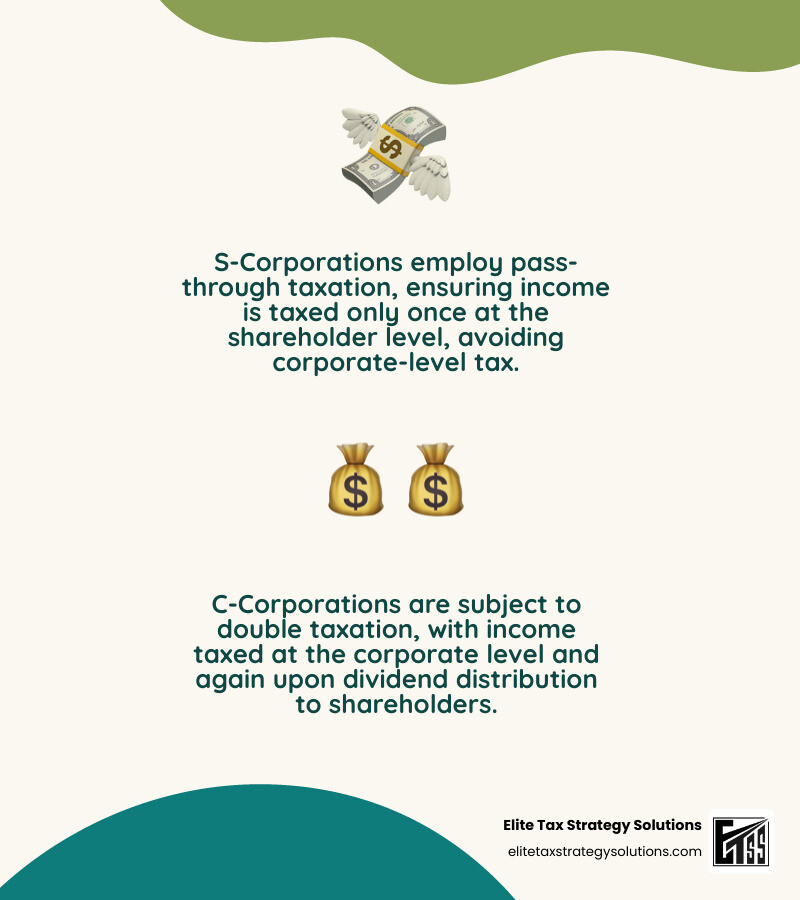
This “pass-through” taxation model is the cornerstone of the S corp advantage. Unlike a C corporation, which is taxed on its profits and then shareholders are taxed again on dividends (double taxation), an S corp avoids this. Profits and losses are reported directly on the shareholders’ personal tax returns and taxed at their individual income tax rates, meaning the income is taxed only once.
To qualify for S corp status, a business must meet several key requirements:
- Domestic Corporation: The business must be a domestic corporation, formed in the United States.
- Allowable Shareholders: Shareholders must generally be individuals, certain trusts, or estates. Partnerships, corporations, and non-resident aliens typically cannot be shareholders.
- Shareholder Limit: An S corp can have no more than 100 shareholders.
- One Class of Stock: The corporation can only have one class of stock, which simplifies profit and loss allocation.
- Not an Ineligible Corporation: Certain financial institutions, insurance companies, and Domestic International Sales Corporations (DISCs) are not eligible.
S corporations must file their annual tax return by the 15th day of the 3rd month after their tax year ends (March 15th for most). It’s crucial to meet these deadlines to avoid penalties. Owners also need to make estimated tax payments throughout the year to cover their personal tax liability from the S corp’s pass-through income.
Core Tax Forms and Filings
Navigating IRS forms is a key part of effective tax planning for S corps. Here are the essentials:
- Form 1120-S, U.S. Income Tax Return for an S Corporation: The S corp’s main informational tax return, reporting income, deductions, and losses. It calculates the total profit or loss passed through to shareholders.
- Schedule K-1 (Form 1120-S), Shareholder’s Share of Income, Deductions, Credits, etc.: Issued to each shareholder, this form details their individual share of the company’s income, deductions, and credits for their personal tax return.
- Form 1040, U.S. Individual Income Tax Return: Shareholders use the information from their Schedule K-1 to report S corp income on their personal Form 1040, where it is ultimately taxed.
- Schedule E (Form 1040), Supplemental Income and Loss: S corp income and losses from Schedule K-1 are typically reported on Schedule E of your Form 1040.
- Form 2553, Election by a Small Business Corporation: This one-time form is filed with the IRS to elect S corp status, requiring the consent of all shareholders.
- Form 7004, Application for Automatic Extension of Time To File Certain Business Income Tax, Information, and Other Returns: File this form for an automatic six-month extension to file your Form 1120-S. Note: this is an extension to file, not to pay!
Strategic Tax Planning for S Corps
Effective tax planning for S corps involves using your business as a sophisticated financial tool. The key is understanding how to strategically split your income and maximize every available deduction.
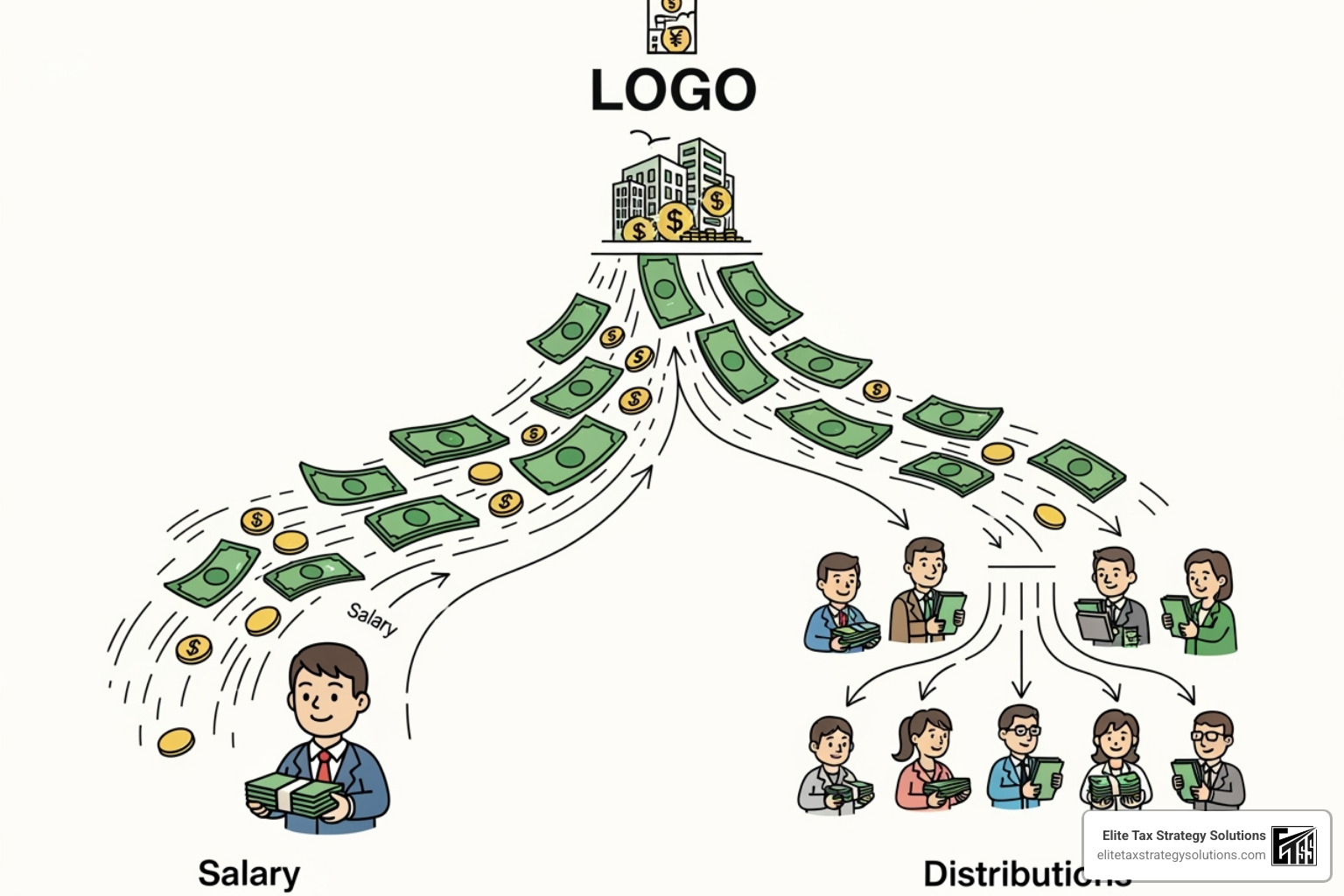
The beauty of S corp taxation lies in its flexibility. Unlike sole proprietors who pay self-employment taxes on all profits, S corp owners can divide their income into two streams: a salary (subject to payroll taxes) and distributions (which escape self-employment taxes). This distinction can save you thousands in taxes annually.
However, the IRS requires you to pay yourself “reasonable compensation,” and getting this balance right is crucial for successful tax planning for S corps. Beyond the salary-distribution strategy, every legitimate business expense you deduct reduces your S corp’s taxable income, which means less profit flows through to your personal tax return, lowering your overall taxes.
The Cornerstone: Reasonable Salary vs. Distributions
This is the heart of S corp tax strategy. The IRS guidance on reasonable compensation is clear: if you actively work in your S corp, you must pay yourself a salary that reflects what you’d pay someone else to do your job.
Only your salary portion is subject to FICA taxes (Social Security and Medicare, totaling 15.3%). The remaining profits taken as distributions are free from these taxes, providing significant self-employment tax relief.
Determining a fair salary requires research. Look at industry standards for similar roles using resources like the Bureau of Labor Statistics to justify your salary. While some use a 60/40 rule of thumb (60% salary, 40% distributions), this is only a starting point. Your reasonable salary must reflect your actual role and market value.
Setting your salary too low is dangerous. The IRS can reclassify distributions as wages, leading to back payroll taxes, penalties, and interest. It’s better to be slightly conservative with your salary than to be too aggressive and risk an audit.
Maximizing Your Business Deductions

Every dollar you legitimately deduct is a dollar that isn’t taxed. Smart tax planning for S corps means leaving no stone unturned when it comes to business deductions.
The home office deduction requires the space to meet the exclusive use rule. If you qualify, you can deduct a percentage of home expenses or use the simplified method of $5 per square foot (up to 300 sq. ft.).
Vehicle expenses can be deducted using either the actual expense method or the standard mileage rate. Keep detailed records. Heavy vehicles (over 6,000 lbs GVWR) may qualify for large Section 179 deductions.
For health insurance premiums, S corp owners with over 2% ownership have an opportunity. The S corp can pay your premiums, include them as wages on your W-2, and you can then deduct them on your personal return via the self-employed health insurance deduction.
Hiring family members is a smart tax move, provided they do legitimate work for reasonable pay. Your children can earn up to the standard deduction amount federally tax-free.
Retirement plan contributions (e.g., SEP IRA, Solo 401(k)) are deductible business expenses. S corp owners can contribute significant amounts toward retirement, reducing their current tax burden.
Don’t overlook professional fees. The cost of hiring accountants, lawyers, and consultants for tax planning is fully deductible.
Leveraging Depreciation and Asset-Based Deductions
When your S corp invests in assets like equipment or software, depreciation rules can create immediate tax benefits.
Section 179 expensing allows you to deduct the full purchase price of qualifying assets in the year of purchase, which can dramatically reduce your current year’s taxable income.
Bonus depreciation adds another layer of savings, allowing you to deduct 60% of eligible property costs in 2024. This benefit is phasing out annually and is set to disappear in 2027, so timing major purchases is important.
These strategies slash your S corp’s taxable income, directly reducing the profits that flow to your personal return.
Open uping Tax Credits and State-Level Savings
Tax credits are even better than deductions, as they reduce your tax bill dollar-for-dollar.
The Qualified Business Income (QBI) deduction under Section 199A allows many S corp owners to deduct up to 20% of their qualified business income on their personal returns. Income limitations and special rules apply.
R&D tax credits are available if your business develops new products, processes, or technology, directly reducing your tax liability.
The State and Local Tax (SALT) cap can be mitigated with Pass-Through Entity Taxes (PTETs). Many states now allow S corps to pay state taxes at the entity level, making them deductible for federal purposes and bypassing the individual SALT limitation.
State-specific credits vary widely but can include incentives for job creation, equipment purchases, or other activities. It’s worth exploring what your state offers.
Advanced Strategies and Common Pitfalls

As your business grows, you may be ready for more advanced tax planning for S corps. These strategies offer greater savings but require more precision. Meticulous record-keeping is essential, as it provides the necessary documentation to support your tax positions under potential IRS scrutiny.
Key Considerations in Tax Planning for S Corps
As your S corp thrives, you might encounter situations that call for specialized tax planning:
- Mergers & Acquisitions (M&A): The tax implications of an M&A deal are complex. Whether it’s a stock sale or an asset sale, the tax treatment for the seller and buyer varies significantly regarding capital gains, ordinary income, and basis. Careful planning before the deal closes is essential.
- Qualified Subchapter S Subsidiary (QSub): An S corp can own another company that also gets pass-through tax benefits. If your S corp owns 100% of a domestic corporation, you can elect to treat it as a QSub. For federal tax purposes, the QSub is not a separate entity; its assets, liabilities, income, and deductions are treated as belonging to the parent S corp, simplifying tax reporting.
- Accountable Plans for Reimbursements: To ensure expense reimbursements for items like travel or home office costs are tax-free to the recipient and deductible for the S corp, they must be made through an “accountable plan.” This requires showing a clear business purpose, providing proper documentation (receipts), and returning any excess reimbursement.
- Renting Your Home to the S-Corp (Augusta Rule): Under the “Augusta Rule,” you can rent your personal residence to your S corp for business purposes (e.g., board meetings) for up to 14 days per year. The S corp can deduct the reasonable rent it pays you, and you do not have to report that rental income on your personal tax return.
Avoiding Common Mistakes
S corp owners can stumble into common pitfalls that are costly or lead to IRS issues. Here’s how to avoid them:
- Inadequate record-keeping: This is a major mistake. Best Practice: Maintain meticulous documentation for all income, expenses, and deductions. A clear paper or digital trail is necessary.
- Misclassifying salary vs. distributions: The IRS requires a “reasonable salary.” Paying too little can lead to reclassification of distributions as wages, triggering payroll taxes and penalties. Best Practice: Pay a reasonable salary that aligns with industry standards and your role, and document your reasoning.
- Missing filing deadlines: S corps must generally file Form 1120-S by March 15th. Missing this deadline leads to penalties. Best Practice: File Form 1120-S by the 15th day of the 3rd month after the tax year ends.
- Failing to meet S-corp requirements: Violating eligibility rules (e.g., the 100-shareholder limit) can terminate your S corp status and trigger C corp taxation. Best Practice: Continuously monitor and ensure compliance with all S corp eligibility rules.
- Overlooking state tax nexus: Your business activities might create a tax presence (nexus) in other states. Best Practice: Understand and comply with state-specific S corp tax laws and filing rules wherever your business operates.
Frequently Asked Questions about S-Corp Tax Strategies
Let’s address some of the most common questions about tax planning for S corps. Getting these areas right can make a significant difference in your tax savings.
How do I determine a ‘reasonable salary’ for myself as an S-corp owner?
Determining a reasonable salary is a crucial part of tax planning for S corps that the IRS scrutinizes. There is no single magic number.
The IRS expects you to be paid what someone else would earn for the same job in a similar business. They consider IRS factors like your duties, time and effort, and what comparable businesses pay for similar services.
To determine this, research industry benchmarks using resources like the Bureau of Labor Statistics. Your role and responsibilities are key—your salary should reflect the value you provide. It is vital to document your decision and keep clear records of how you arrived at your salary figure.
This process can be complex, which is why consulting a tax professional is a smart move. A professional can offer personalized guidance based on your earnings, profits, job responsibilities, and industry averages to ensure compliance and optimization.
What are the main requirements for deducting home office expenses?
The home office deduction is a valuable tax break, but the IRS has strict rules.
First, your home office must be used exclusively and regularly for business. “Exclusively” means it is used for nothing else, and “regularly” means it is used on an ongoing basis.
Second, the space must be your principal place of business, a place where you meet clients, or a separate structure not attached to your home.
For calculating the deduction, you have two options. The simplified method is $5 per square foot (up to 300 sq. ft.). The actual expense method involves deducting a percentage of your actual home expenses (rent, mortgage interest, utilities) based on the office’s square footage. Meticulous record-keeping is essential.
How does the Qualified Business Income (QBI) deduction work for an S-corp?
The Qualified Business Income (QBI) deduction, or Section 199A deduction, is a major tax benefit from the Tax Cuts and Jobs Act that is central to tax planning for S corps.
It allows eligible S corp owners to take a 20% deduction on their qualified business income. This deduction is not taken at the corporate level but on your personal tax return (Form 1040).
However, the deduction is subject to income limitations. If your taxable income exceeds certain thresholds, the deduction may be limited based on the amount of W-2 wages paid by the business or the unadjusted basis of its qualified property.
High earners also face W-2 wage limitations, which can cap the QBI deduction at 50% of the W-2 wages paid by the S corp. This is why paying a slightly higher reasonable salary can sometimes help maximize the QBI deduction.
Finally, be aware of the Specified Service Trade or Business (SSTB) rules. If your S corp is in a field like health, law, accounting, or consulting, the QBI deduction may be phased out or disallowed once your taxable income hits certain levels. Navigating these rules requires careful planning.
Conclusion
The big takeaway is simple: tax planning for S corps is a powerful opportunity, not just a chore. It’s about being proactive and making strategic choices to direct more money back into your business and your pocket. S corporations offer incredible savings opportunities through reduced payroll taxes, maximized business deductions, and valuable tax credits.
Key strategies include setting a reasonable salary, maximizing deductions for home office and vehicle use, and leveraging tools like depreciation and the QBI deduction. It is also critical to avoid common pitfalls like poor record-keeping and missed deadlines.
The tax world is constantly shifting, and keeping up with new rules can feel like a full-time job. This is why professional guidance is invaluable. Here at Elite Tax Strategy Solutions, we live and breathe tax planning for S corps. Our specialty is crafting personalized strategies for high earners and closely held businesses, ensuring you’re not just compliant, but truly optimizing your financial future. We take a proactive approach to tax optimization and compliance, making sure you never leave a single dollar on the table.
Don’t let tax season bring a wave of stress. Let us help you build a comprehensive tax playbook for your S corp to achieve financial stability and maximize your savings.