Securing Your Legacy Amidst the Great Wealth Transfer
Family business tax planning is essential for protecting the wealth you’ve built and ensuring your enterprise thrives across generations. With an estimated $84 trillion in assets set to change hands, the stakes have never been higher. Family businesses are the backbone of the U.S. economy, but without a solid plan, most won’t survive the transition to the next generation.
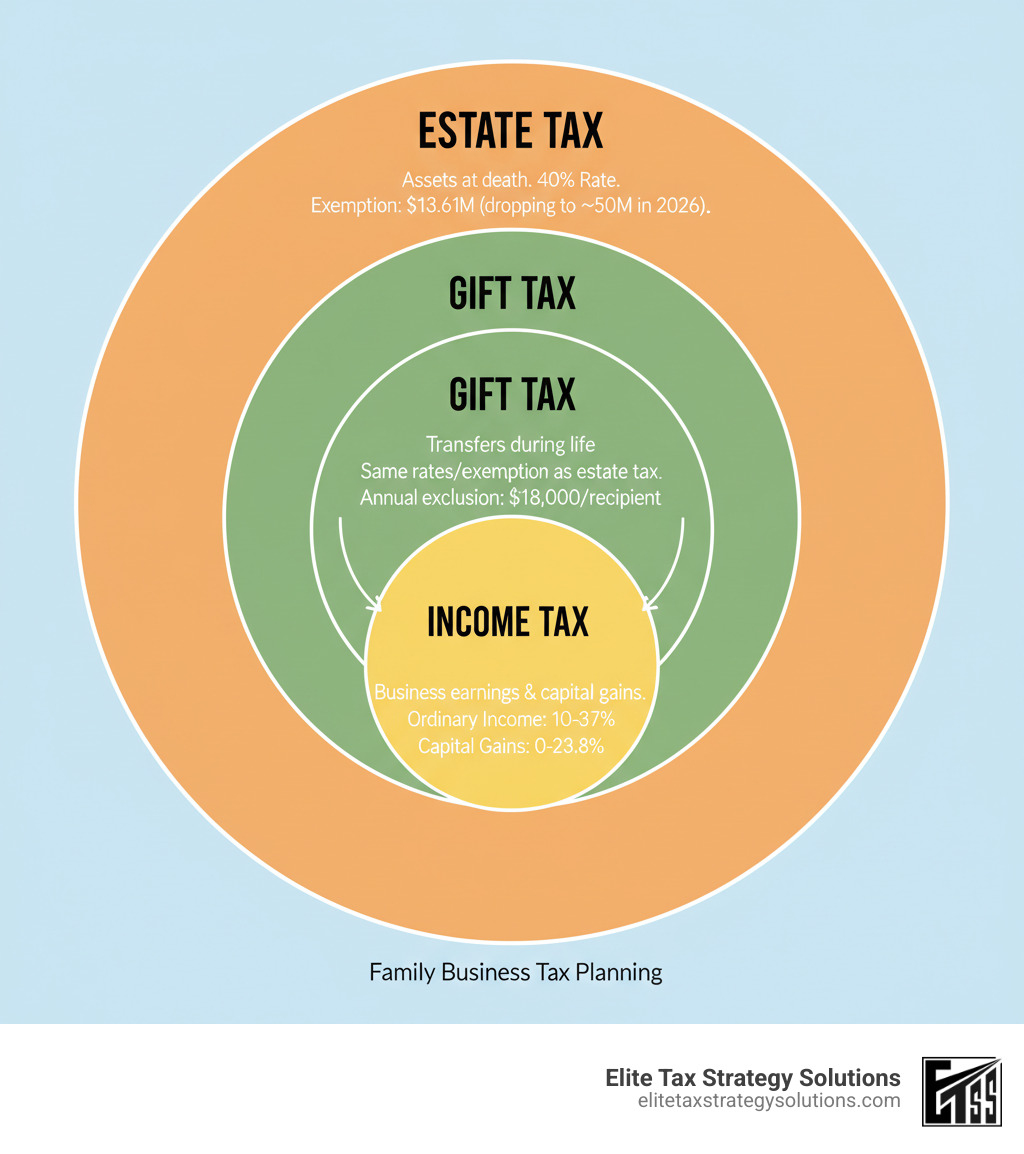
The challenge is often tax. With estate tax exemptions set to drop dramatically after 2025, the window for proactive planning is closing fast. Key priorities include:
- Income Tax: Minimizing current tax through smart structural and operational choices.
- Gift Tax: Transferring ownership during your lifetime using annual exclusions and lifetime exemptions.
- Estate Tax: Reducing taxes on assets transferred at death before exemptions fall in 2026.
- Capital Gains Tax: Planning sales or transfers to minimize taxes on appreciation.
- Succession Planning: Starting early to beat the odds, as only 30% of family businesses survive to the second generation.
I’m David Fritch, and as a CPA and attorney with 40 years of experience, I’ve guided hundreds of families through successful transitions. At Elite Tax Strategy Solutions, we specialize in the complexities of family business tax planning to preserve wealth and legacy.
Family business tax planning glossary:
The Core of Family Business Tax Planning: Structures and Succession
After four decades in this field, I’ve learned a critical lesson: your business structure today dictates the success or failure of your succession tomorrow. Family business tax planning isn’t just about this year’s tax bill; it’s about building a foundation to pass your life’s work to your children without the IRS taking a massive cut.
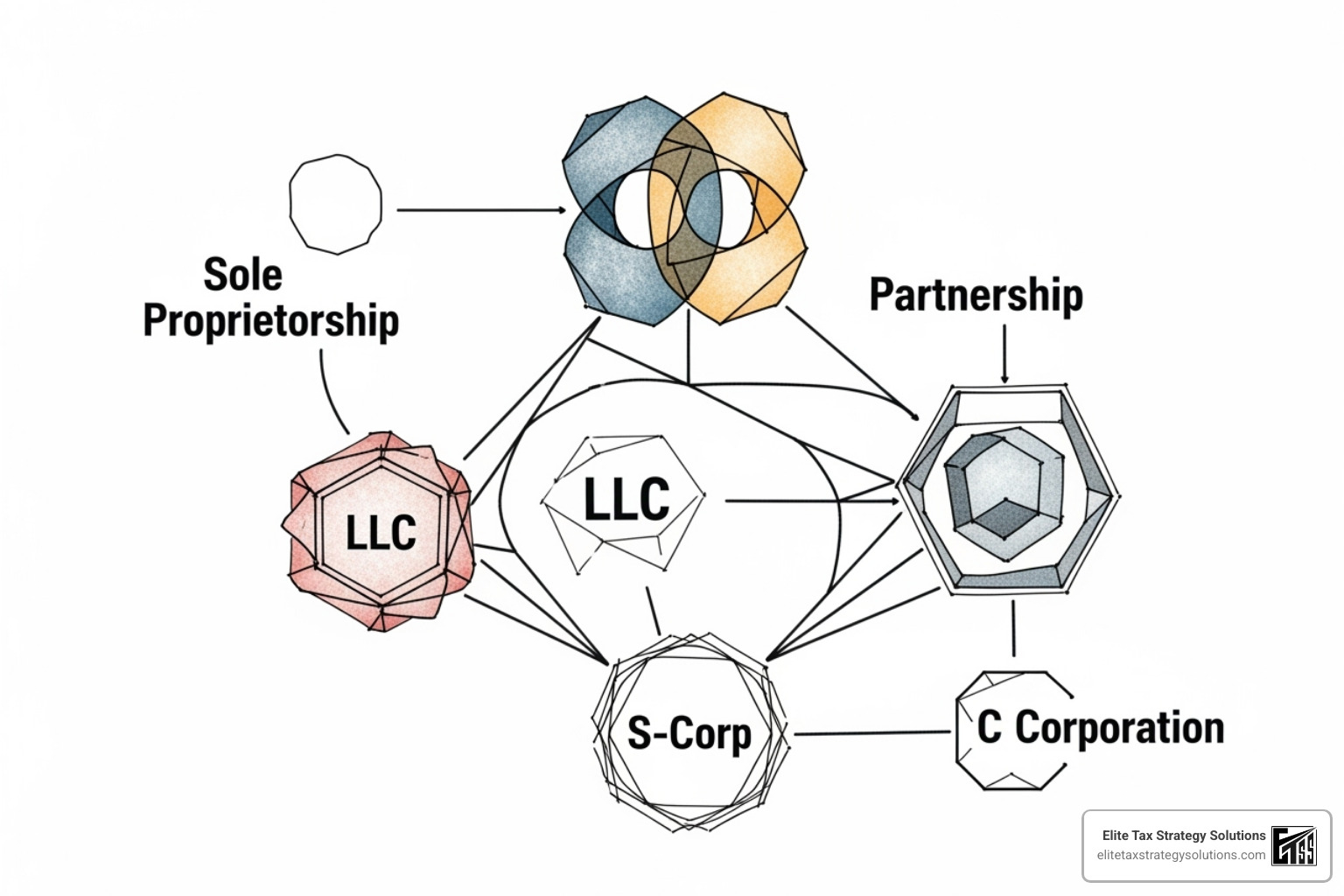
The legal entity you choose—sole proprietorship, partnership, LLC, S-Corp, or C-Corp—interconnects your income, gift, and estate taxes. Many families wait until retirement to address this, but by then, options are limited and expensive. Starting early provides the flexibility to create a tax-efficient transfer that preserves your legacy.
How Your Business Structure Affects Tax Liability
Your business structure is the foundation for your tax strategy. Here’s a brief overview:
- A Sole Proprietorship is simple, with income reported on your personal return. However, it offers no liability protection and can complicate succession, often forcing an asset sale that triggers immediate capital gains.
- Partnerships are pass-through entities ideal for multiple family owners, avoiding double taxation. The downside is that partners typically face unlimited liability.
- The Limited Liability Company (LLC) is a flexible tool for family business tax planning. It provides liability protection and allows owners to choose how they are taxed (as a sole proprietorship, partnership, S-Corp, or C-Corp), enabling strategies to evolve with the business.
- An S-Corporation offers pass-through taxation and liability protection, often reducing self-employment taxes. However, ownership is limited to 100 U.S. citizen or resident shareholders, which can be a constraint for large, multi-generational families.
- C-Corporations provide the strongest liability protection but face double taxation (at the corporate level and on shareholder dividends). While often avoided, they can be advantageous in specific scenarios involving retained earnings or complex estate plans.
Your choice of structure directly impacts how easily and affordably you can transfer business interests to the next generation.
Key considerations for family business tax planning
Beyond the entity, understanding capital gains is crucial. Capital gains tax applies when you sell an asset for more than its original cost. Long-term gains (assets held over a year) are taxed at preferential rates (0% to 23.8%), while short-term gains are taxed as ordinary income.
When transferring a business, the choice between an asset sale versus a stock sale has major tax implications. Buyers prefer asset sales for the “stepped-up basis,” which allows for greater depreciation deductions. Sellers often face higher taxes in an asset sale due to depreciation recapture, where past depreciation deductions are taxed at ordinary income rates. Sellers typically prefer a stock (or interest) sale, as the entire gain usually qualifies for lower long-term capital gains rates.
The step-up in basis is a powerful estate planning tool. When an heir inherits a business, its tax basis is “stepped up” to the fair market value at the time of death. This erases the built-in capital gain, allowing heirs to sell the business with little to no capital gains tax. This creates a fundamental trade-off: gifting during life removes future growth from your estate but passes on your low basis, while transferring at death provides a step-up but includes the business in your taxable estate. Effective family business tax planning involves balancing these trade-offs to find the optimal path.
Strategic Transfers: Gifting vs. Selling Your Business
One of the most critical decisions in family business tax planning is whether to gift your business to the next generation or sell it to them. The choice is deeply personal and has dramatically different tax consequences. Gifting uses your lifetime tax exemption but may pass on a large future tax bill to your heirs. Selling triggers capital gains tax for you now but gives your children a higher cost basis.

Understanding the Gift Tax and Lifetime Exemption
The gift tax is a tax on transfers of property for less than full value, but the IRS provides powerful tools to transfer wealth tax-free.
First is the annual gift exclusion. In 2024, you can give up to $18,000 per person ($36,000 for a married couple) each year without tax implications or filing requirements. Over time, this allows for significant wealth transfer.
Second is the lifetime gift tax exemption. In 2024, each person can gift up to $13.61 million tax-free over their lifetime ($27.22 million for a married couple). This is the same exemption used for your estate, so gifts made during life reduce the amount available at death.
The catch with gifting is that the recipient inherits your cost basis. If your business has appreciated significantly, your children will be responsible for the capital gains tax when they eventually sell. However, using your exemption now—before it potentially drops in 2026—removes the asset and all its future growth from your taxable estate. Gifts exceeding the annual exclusion must be reported on Form 709 to track your lifetime exemption usage. For more details, see the IRS guidance on gift tax.
Comparing Transfer Methods: Sales, Installment Notes, and Annuities
If selling to the next generation is the better option, several methods can manage the tax impact.
- An outright sale provides you with immediate cash but also an immediate capital gains tax bill on the entire gain.
- An installment sale is often more attractive. The buyer pays you over time, and you pay capital gains tax only as you receive the payments. This spreads out the tax liability and makes the purchase more affordable for the next generation, who can use business cash flow to fund the payments.
- A Self-Cancelling Installment Note (SCIN) is an installment sale with a twist: if you die before the note is paid off, the remaining balance is cancelled and is not part of your taxable estate. In exchange for this benefit, the IRS requires a higher sale price or interest rate.
- A private annuity involves the buyer agreeing to pay you a set amount for the rest of your life. This removes the asset from your estate immediately. Payments continue as long as you live, making it a calculated bet on life expectancy.
Choosing the right method depends on your need for cash, estate planning goals, and what the next generation can afford. This is where strategic family business tax planning aligns your family’s financial needs with tax-efficient strategies.
Advanced Tax-Saving Structures and Strategies
For complex family enterprises, basic planning may not be enough. Sophisticated tools are where family business tax planning becomes truly transformative, preserving wealth across generations.
Using Trusts to Preserve Wealth and Minimize Taxes
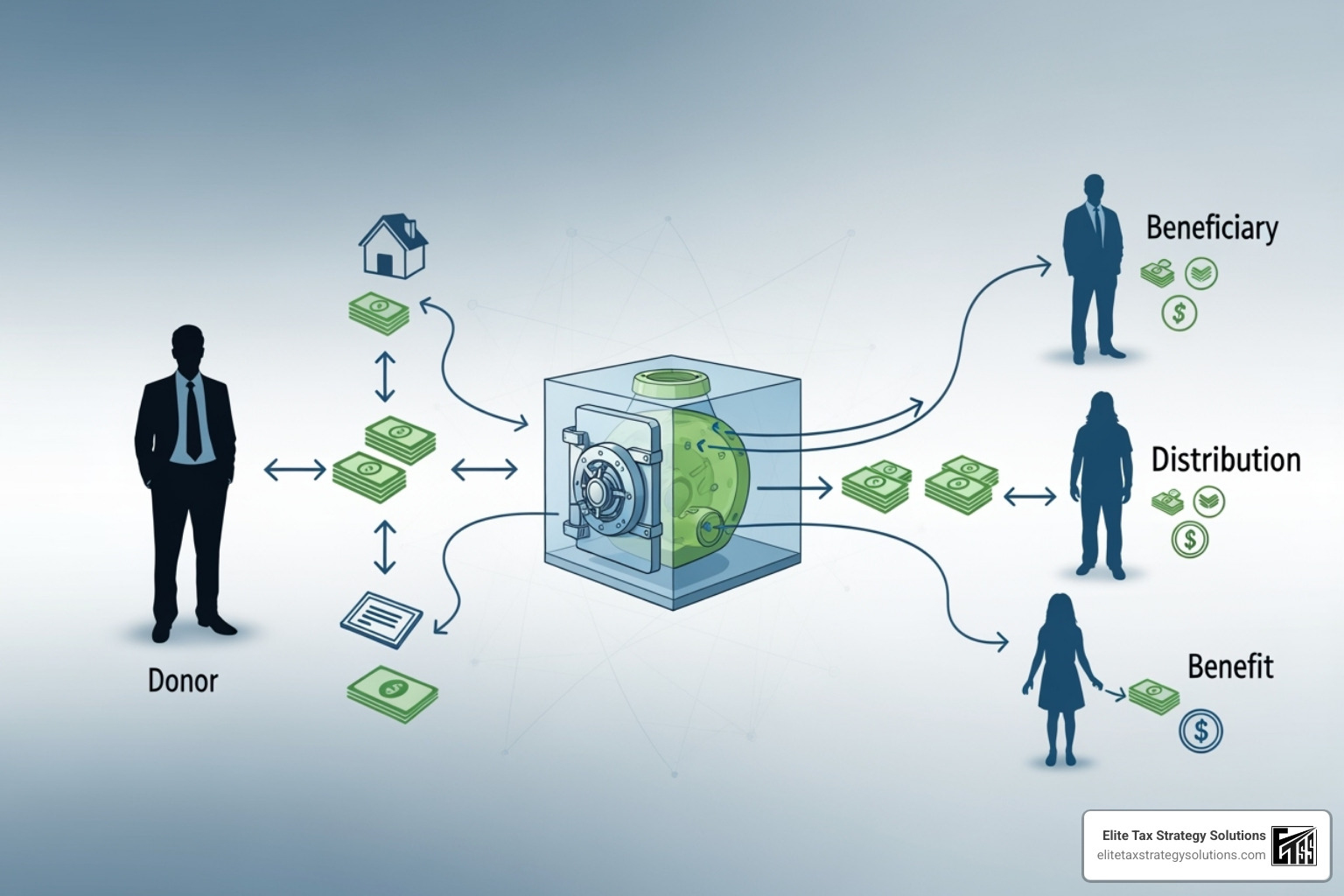
Trusts are versatile containers for wealth that can save millions in taxes. Key types include:
- Grantor Retained Annuity Trust (GRAT): You transfer assets to a trust and receive an annuity for a set term. Any asset growth above an IRS-set rate passes to beneficiaries tax-free. This is ideal for high-growth business interests.
- Intentionally Defective Grantor Trust (IDGT): You sell assets to a trust for a promissory note. For estate tax purposes, the asset is out of your estate, but for income tax purposes, you are still the owner, so the sale does not trigger capital gains. This allows assets to grow outside your taxable estate.
- Spousal Lifetime Access Trust (SLAT): One spouse makes a gift into a trust for the other spouse, removing the assets from both of their estates. The beneficiary spouse can still access the funds if needed, providing a safety net while achieving significant estate tax savings.
- Dynasty Trust: This long-term trust shields assets from estate taxes, creditors, and divorce settlements for multiple generations, ensuring your family’s legacy endures.
The Role of Buy-Sell Agreements and Estate Freezes
Two other powerful tools are essential for succession planning.
Buy-sell agreements are contracts that dictate what happens to ownership shares upon events like death, disability, or retirement. They prevent family conflicts, ensure business continuity, and can establish a defensible business value for estate tax purposes. Often, these agreements are funded with life insurance to provide liquidity for a buyout.
An estate freeze is a technique to lock in your estate’s value. You recapitalize the business, exchanging your appreciating common stock for fixed-value preferred stock. New common stock is issued to the next generation at a low value. All future growth accrues to the next generation’s shares, passing outside of your taxable estate, while you receive income from the preferred shares.
The Hybrid Core-Satellite Business Structure
To balance wealth protection with entrepreneurial freedom for the next generation, a hybrid structure can be effective. The core model places the primary business assets in a trust for protection, unified governance, and tax benefits. The satellite model gives individual family members direct ownership of certain assets, providing autonomy.
The hybrid approach combines both. The main family enterprise is protected in a core trust, while other assets or business interests are held as satellite holdings. This structure protects the core legacy while empowering younger generations, optimizing tax liabilities, and adapting to complex family dynamics.
The 2025 Tax Cliff: Why Proactive Planning is Urgent
We are approaching a critical deadline in family business tax planning: the end of 2025. Key provisions of the Tax Cuts and Jobs Act (TCJA) are set to expire, creating a “tax cliff” that demands immediate attention.

What Happens When the TCJA Expires?
The most significant change is the reduction of the lifetime estate and gift tax exemption. In 2024, the exemption is $13.61 million per person. On January 1, 2026, it is scheduled to drop to an inflation-adjusted ~$5 million. For a married couple, the combined exemption will shrink from over $27 million to roughly $10 million.
Many family businesses that are safe today will suddenly face a large estate tax bill. This pre-2026 period is a “use-it-or-lose-it” window. The IRS has confirmed there will be no “clawback,” meaning large gifts made now under the high exemption will not be retroactively taxed. Acting now to use the current exemption through strategic gifting or trust funding is critical. Waiting until 2026 could cost your family millions in transfer taxes.
Operational Tax Planning: Hiring Family and Day-to-Day Savings
Smart family business tax planning also involves day-to-day operations.
Hiring your children can offer tax advantages. For sole proprietorships or partnerships, wages paid to your child under 18 are generally exempt from Social Security, Medicare, and FUTA taxes. Furthermore, your child can earn up to the standard deduction ($14,600 in 2024) tax-free, while you get a business deduction for their reasonable salary. For specific rules, consult the IRS on family employees.
Other strategies like the home office deduction, bonus depreciation, and Section 179 expensing can reduce current taxable income. Year-end planning is key to maximizing these benefits.
Proactive family business tax planning to avoid audits
To reduce audit risk, focus on meticulous documentation and compliance.
- Maintain thorough records for all financial transactions, valuations, and legal agreements.
- Properly classify workers as employees or contractors to avoid a major IRS red flag.
- Substantiate all deductions with receipts and logs. Avoid using round numbers on tax returns.
- Be aware of audit triggers, such as reporting large losses year after year, claiming unusually large deductions, or having a lifestyle that doesn’t match your reported income.
Organizing key documents like valuation reports, trust agreements, gift tax returns (Form 709), and buy-sell agreements is your best defense and a cornerstone of successful succession planning.
Assembling Your Succession Dream Team
Successful family business tax planning is not a solo endeavor. It requires a coordinated team of professionals, each playing a critical role.

-
Your tax professional (CPA) quarterbacks the team, analyzing the tax implications of every decision. We model different structures and transfer methods to minimize income, gift, and estate taxes, ensuring your plan is both tax-efficient and audit-proof.
-
Your estate planning attorney is the legal architect. They draft the legally binding documents—trusts, wills, and buy-sell agreements—that turn your plan into a reality and prevent future family disputes.
-
Your financial advisor focuses on the big picture of your family’s wealth. They ensure the succession plan aligns with your retirement needs and the long-term financial security of both the senior and next generations.
The magic happens when these professionals collaborate. At Elite Tax Strategy Solutions, we champion this unified approach. When your team works together, you get a strategy that is tax-efficient, legally sound, and financially sensible—the hallmark of a successful transition.
Conclusion: Take Control of Your Family’s Financial Future
You now understand that family business tax planning is about securing your legacy. We’ve covered business structures, gifting versus selling, and advanced trusts. We’ve also highlighted the urgency of the 2025 tax cliff and the importance of smart operational planning.
The reality is stark: few family businesses survive to the third generation. With estate tax exemptions set to plummet, the families who act now will be the ones who preserve their wealth.
I’ve spent four decades helping families steer these challenges, and the key to success is always timing. The most powerful, tax-saving strategies require years to implement. Waiting until retirement is often too late.
You don’t have to figure this out alone. At Elite Tax Strategy Solutions, we work with high earners and closely held businesses in Jasper, Indiana, and suburban areas who demand more than basic tax compliance. We believe proactive planning is an investment that pays for itself many times over.
The great wealth transfer is happening, and the 2025 tax cliff is approaching. Your family’s financial future deserves a plan, not just hope.
Develop your innovative tax plan with us today, and let’s build the legacy you’ve worked so hard to create.