Why Trust and Estate Taxes Can Make or Break Your Legacy
Trust and estate taxes are a complex area of the tax code affecting high-income earners and business owners who want to preserve wealth for future generations. Here’s a brief overview:
Key Types of Trust and Estate Taxes:
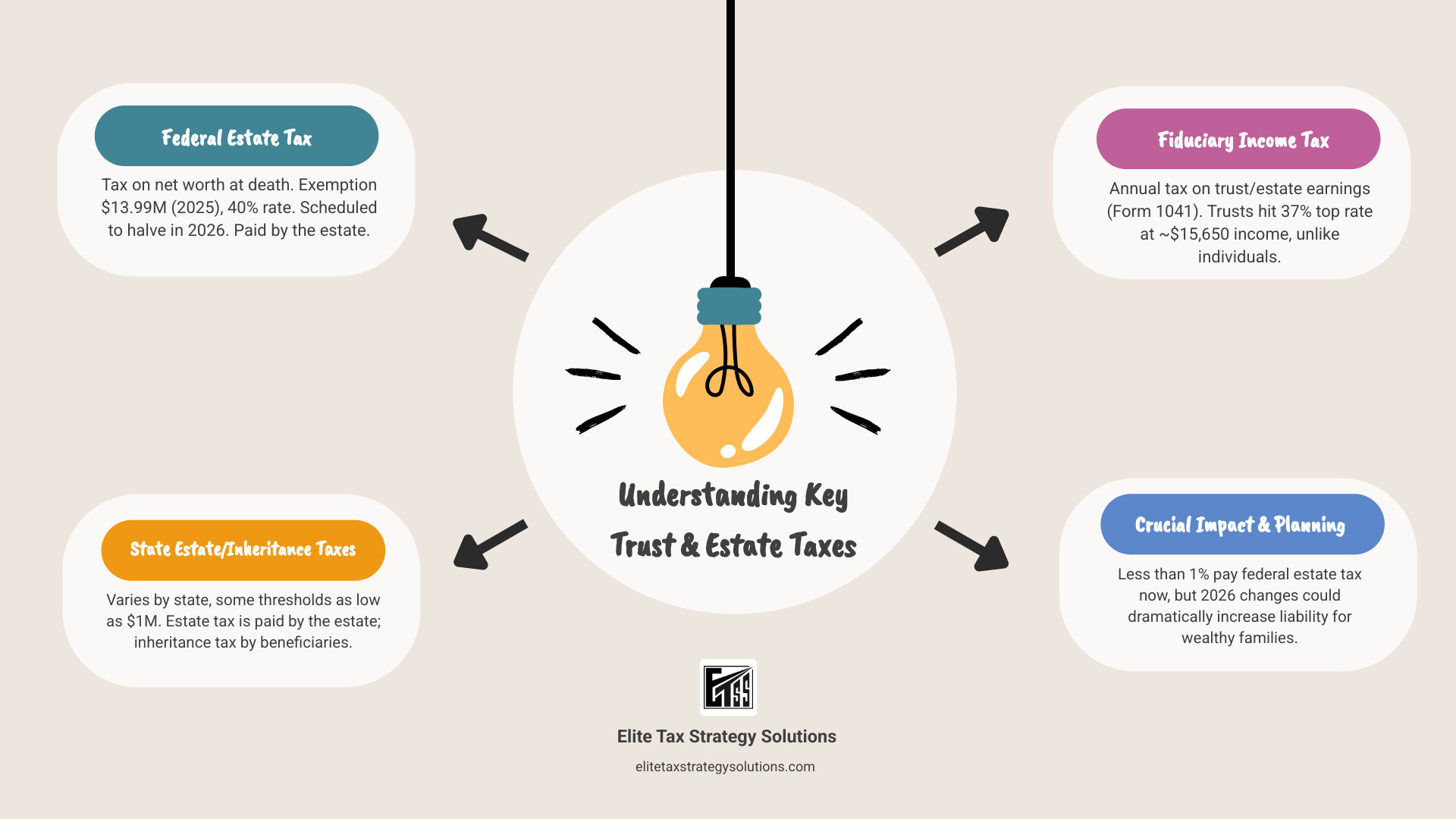
- Federal Estate Tax – 40% tax on estates over $13.99 million (2025)
- State Estate/Inheritance Taxes – Varies by state, some with thresholds as low as $1 million
- Fiduciary Income Tax – Annual tax on income earned by trusts and estates (Form 1041)
Who Pays What:
- Estate tax is paid by the estate before assets are distributed.
- Inheritance tax is paid by beneficiaries receiving assets.
- Income tax on trust earnings can be paid by the trust or beneficiaries.
The stakes are high. While less than 1% of Americans currently face federal estate tax, that could change in 2026 when the exemption amount is scheduled to be cut in half. This means potentially millions more in taxes for wealthy families without proper planning.
A further challenge is that trusts reach the top 37% income tax rate with just $15,650 of income, while individuals don’t hit that rate until $609,350. This compressed tax structure means poor planning can be costly.
I’m David Fritch, and with 40 years of experience as a CPA and attorney, I’ve helped countless clients steer trust and estate taxes. My firm, Elite Tax Strategy Solutions, specializes in innovative tax strategies that can save substantial amounts when implemented correctly.
Trust and estate taxes vocab to learn:
Understanding the Two Main Types of Trust and Estate Taxes
Understanding the basic structure of trust and estate taxes is the first step to effective planning. There is a one-time tax on the value of an estate at death (estate tax) and an annual tax on the earnings the estate or trust generates (fiduciary income tax). This section clarifies which taxes might apply to your situation.
The Federal Estate Tax: A Tax on Your Net Worth at Death
The federal estate tax is a tax on your right to transfer wealth at death. It’s levied on your estate’s total value before assets are distributed. The IRS calculates your estate’s value by adding up everything you own: your house, investments, business interests, and life insurance proceeds. If that total exceeds $13.99 million for individuals (or $27.98 million for married couples) in 2025, the excess is taxed at rates up to 40%.
Your estate files Form 706 and pays this tax before heirs receive their inheritance. For example, if your estate is worth $15 million, only $1.01 million would be subject to the tax.
A critical point for planning: these generous exemption amounts are scheduled to be cut in half after 2025 due to a sunset provision in the Tax Cuts and Jobs Act. The exemption could drop to around $7 million per person, subjecting many more families to this tax. This makes High Net Worth Tax Planning absolutely critical right now.

State-Level Estate and Inheritance Taxes
State taxes can be tricky because they vary widely. State estate taxes work like the federal version but have much lower exemption thresholds. Currently, 12 states plus Washington D.C. impose estate taxes, some with exemptions as low as $1 million. You can check the List of states with estate taxes for details.
An inheritance tax is different: the person receiving the inheritance pays the tax. Only five states currently have inheritance taxes, and rates often depend on the beneficiary’s relationship to the deceased. A spouse might pay nothing, while a friend could face a higher rate. Maryland is unique as it has both an estate tax and an inheritance tax. See which States that levy an inheritance tax to learn more.
Fiduciary Income Tax: Annual Taxes on Estate and Trust Earnings
Fiduciary income tax is the annual tax that estates and trusts pay on income they generate. If an estate or trust has over $600 in gross income, it must file Form 1041. This income can come from dividends, interest, rent, or capital gains.
The critical detail is that trusts have compressed tax brackets. While an individual doesn’t reach the top 37% tax rate until their income exceeds $626,350, a trust hits that same rate at just $15,650 of income.
The 2025 tax brackets show this dramatic difference:
| Income Level | Trust Tax Rate | Single Individual Tax Rate |
|---|---|---|
| $0 – $3,150 | 10% | 10% |
| $3,151 – $11,450 | 24% | 12% |
| $11,451 – $15,650 | 35% | 22% |
| Over $15,650 | 37% | 24% (up to $100,525) |
This compression makes strategic Tax Liability Reduction crucial. Smart planning can save thousands of dollars each year.
The Role of Trusts in Managing Your Tax Burden
Trusts are a cornerstone of estate planning, but trust and estate taxes affect different types of trusts in dramatically different ways. Choosing the right trust is key. Some trusts are excellent for avoiding probate but offer no estate tax savings, while others can significantly reduce your tax bill but require you to give up control of your assets.
How Revocable vs. Irrevocable Trusts Affect Your Estate Tax
A common misconception is that a revocable trust (or “living trust”) saves on estate taxes. While you maintain complete control over the assets—changing terms or beneficiaries as you wish—this flexibility makes them excellent for probate avoidance. Assets can transfer directly to beneficiaries without going through the public court process.
However, because you retain control, the IRS considers the assets part of your taxable estate. A revocable trust will not reduce your estate tax liability.
An irrevocable trust is different. Once you transfer assets into it, you generally lose control, and the trust becomes a separate legal entity. This loss of control is what makes irrevocable trusts powerful for asset removal from your estate. Since you no longer own the assets, the IRS cannot include them in your taxable estate. For a $20 million estate, moving $5 million into an irrevocable trust could save $2 million in estate taxes (at a 40% rate). This is a significant step, which is why professional guidance for Tax Efficient Estate Planning is so important.

Understanding Simple, Complex, and Grantor Trusts for Income Tax
The type of trust also determines who pays the annual income tax on its earnings.
Simple trusts must distribute all their income to beneficiaries each year. Under the conduit principle, this income “flows through” to the beneficiaries, who report it on their personal tax returns. The trust itself pays no income tax, as it gets a deduction for the distributed income.
Complex trusts offer more flexibility. The trustee has discretion to either distribute income or retain it within the trust. They can also distribute principal. If income is distributed, it’s taxed to the beneficiaries. If it’s retained, the trust pays tax at the high, compressed rates.
Grantor trusts are a clever strategic tool. The grantor retains certain powers over the trust, so for income tax purposes, the IRS treats the trust as non-existent. The grantor reports all the trust’s income and deductions on their personal Form 1040. This might seem counterintuitive, but it’s a powerful estate planning move. The trust assets grow outside of your taxable estate, while you pay the income tax from your other assets, effectively making a tax-free gift to the trust beneficiaries each year. This strategy is a cornerstone of Advanced Tax Planning for high-net-worth clients.

Understanding these classifications is the difference between paying unnecessary taxes and implementing a strategy that preserves wealth.
Navigating the Filing and Distribution Process
Understanding the administrative side of trust and estate taxes is crucial for fiduciaries—the executors and trustees responsible for managing the estate or trust—and beneficiaries.
Filing Essentials: Form 1041 and the Role of the EIN
The primary tax form is Form 1041, the U.S. Income Tax Return for Estates and Trusts. It reports all income, deductions, gains, and losses of the entity, plus any income distributed to beneficiaries. An estate or trust must file Form 1041 if it has any taxable income or gross income of $600 or more for the tax year.
For entities using a calendar year, the Form 1041 deadline is April 15th. A 5-month extension can be requested with Form 7004.
Before filing or opening financial accounts, the fiduciary must obtain an Employer Identification Number (EIN) for the trust or estate. An EIN functions like a Social Security Number for the entity and is a critical first step for any executor or trustee. Without it, you cannot open bank accounts for estates or file taxes.
How Beneficiary Distributions Are Taxed
When a trust or estate distributes income, it generally gets a tax deduction, and the income “flows through” to the beneficiary. This is often advantageous, as beneficiaries are typically in lower tax brackets than the trust.
The trust or estate issues a Schedule K-1 to each beneficiary, detailing their share of income, deductions, and credits. Beneficiaries use this information to report the income on Form 1040, their personal tax return. While an inheritance itself is usually not taxable income, any income the inherited property generates after death and is distributed to you is taxable. For more details, see the IRS’s Information on beneficiary tax forms.
A complex calculation called Distributable Net Income (DNI) limits how much taxable income can be passed to beneficiaries. Understanding DNI is key for fiduciaries to plan distributions and for beneficiaries to anticipate their tax liability. This type of strategic planning is a core part of Personal Tax Planning.
Proactive Strategies to Minimize Trust and Estate Taxes
With the right strategies, you can significantly reduce the tax burden on your estate. This is about smart, legal planning to ensure your legacy reaches your heirs efficiently.
Advanced Gifting and Trust Strategies
One of the most powerful tools is gifting assets during your lifetime. The IRS allows an annual gift tax exclusion, which for 2025 is $19,000 per recipient. A married couple can give $38,000 per recipient per year. This allows you to move significant assets out of your estate annually without tax consequences.
Beyond simple gifts, several sophisticated trust strategies can improve your planning:
- An Irrevocable Life Insurance Trust (ILIT) owns your life insurance policy. This ensures the death benefit is paid to your beneficiaries free from income tax and is excluded from your taxable estate.
- A Charitable Remainder Trust (CRT) is ideal for the charitably inclined with highly appreciated assets. You transfer an asset to the CRT, which sells it tax-free. The trust then pays you an income stream for life, and the remainder goes to charity upon your death. You get an immediate tax deduction, avoid capital gains tax, and remove the asset from your estate.
- A Spousal Lifetime Access Trust (SLAT) is a strategy for married couples where one spouse creates an irrevocable trust for the other. Assets are removed from the first spouse’s estate, but the family retains access through the beneficiary spouse. This is particularly valuable before the 2026 exemption reduction.
These are core components of Advanced Tax Planning Strategies that can dramatically reduce your trust and estate taxes.
Strategic Income Distribution and Timing
The compressed tax brackets for trusts create opportunities for savings through smart distribution strategies. The goal is to move income from the highly-taxed trust to beneficiaries in lower tax brackets.
Two timing rules provide fiduciaries with flexibility:
The 65-Day Rule allows trustees to make distributions within 65 days after year-end (by March 6, or March 5 in leap years) and treat them as if they were made in the prior tax year. This allows for retroactive tax planning after the trust’s annual income is known.

Fiscal year elections for estates are another powerful tool. While trusts must use a calendar year, estates can elect a fiscal year-end. This can defer the taxability of income distributions to beneficiaries into the next calendar year, providing planning opportunities.
These timing strategies are essential elements of Tax Optimization Strategies that can save thousands annually.
Frequently Asked Questions about Trust and Estate Taxes
Here are answers to common questions about trust and estate taxes.
What’s the difference between an estate tax and an inheritance tax?
An estate tax is paid by the deceased’s estate from its total assets before distribution. The tax is based on the estate’s total value. The federal government imposes an estate tax, as do some states.
An inheritance tax is paid by the beneficiary who receives the assets. The tax rate often depends on the beneficiary’s relationship to the deceased. Only a few states levy an inheritance tax.
Do I have to pay income tax on money I inherit?
Generally, no. The money or property you inherit is not considered taxable income. However, if the inherited assets generate new income after you receive them (e.g., interest, dividends, or rent), that new income is taxable to you.
Additionally, if an estate or trust earns income and distributes it to you, that distributed income is taxable. You will receive a Schedule K-1 detailing the amount to report on your personal tax return.
Will my living trust help me avoid estate taxes?
No, a standard revocable living trust does not reduce your federal estate tax liability. While these trusts are excellent for avoiding probate and keeping your affairs private, you retain control over the assets. Therefore, the IRS still considers them part of your taxable estate.
To remove assets from your estate for tax purposes, an irrevocable trust is required. This involves giving up control over the assets, which is a significant decision. For families facing potential estate tax, especially with the 2026 exemption decrease, it’s a critical strategy to consider.
Conclusion: Secure Your Legacy with Proactive Planning
Planning for trust and estate taxes is about protecting the legacy you’ve worked a lifetime to build. We’ve covered federal and state taxes, the impact of compressed trust tax brackets, and how the right trust structure can preserve your wealth.
The clock is ticking. The federal estate tax exemption is set to drop dramatically after 2025, from $13.99 million to around $7 million per person. This change could expose many more families to a 40% tax bill.
The good news is that proactive planning works. By using the right trusts, gifting strategies, and smart income distribution rules, you can significantly reduce your family’s tax burden. Proper administration, including filing Form 1041 and issuing Schedule K-1s, is the foundation that makes these strategies successful.
At Elite Tax Strategy Solutions, our 40 years of experience as both a CPA and attorney have shown us that the right plan can save families millions in taxes. We take a personalized approach to every client’s unique trust and estate taxes challenges.
Don’t let tax law changes catch your family unprepared. The strategies discussed, from ILITs to strategic income distribution, are most effective when implemented with time to spare. Learn more about our innovative tax planning services and let’s work together to secure your legacy.