
Maximizing Retirement Savings for High-Income Earners
When it comes to retirement planning, traditional IRAs are a cornerstone for many. But traditional IRA for high income earners can be particularly strategic. Here’s a quick answer if you’re pressed for time:
Quick takeaway:
– Traditional IRAs offer tax-deferred growth and no contribution income limits.
– Contributions remain tax-deductible if you meet IRS guidelines.
– Even high earners can benefit from IRAs through non-deductible contributions and conversions.
For high-income earners, managing substantial income while planning for retirement can be challenging. The goal? Maximize tax savings while ensuring long-term financial security. This delicate balance underscores the importance of tax planning and savvy retirement strategies.
I’m David Fritch, CEO of Elite Tax Strategy Solutions, with 40 years’ experience in tax planning and financial optimization for high-income earners. Let’s dig into the details of how traditional IRAs can be a powerful tool in your retirement planning.
Traditional ira for high income earners terms explained:
– financial planning for high income earners
– retirement tax strategies for high income earners
– tax advice for high earners
What is a Traditional IRA?
A Traditional IRA (Individual Retirement Account) is a tax-advantaged retirement savings account. You can contribute pre-tax dollars, which means your contributions may be tax-deductible, depending on your income and whether you have access to a workplace retirement plan.
Tax-Deferred Growth
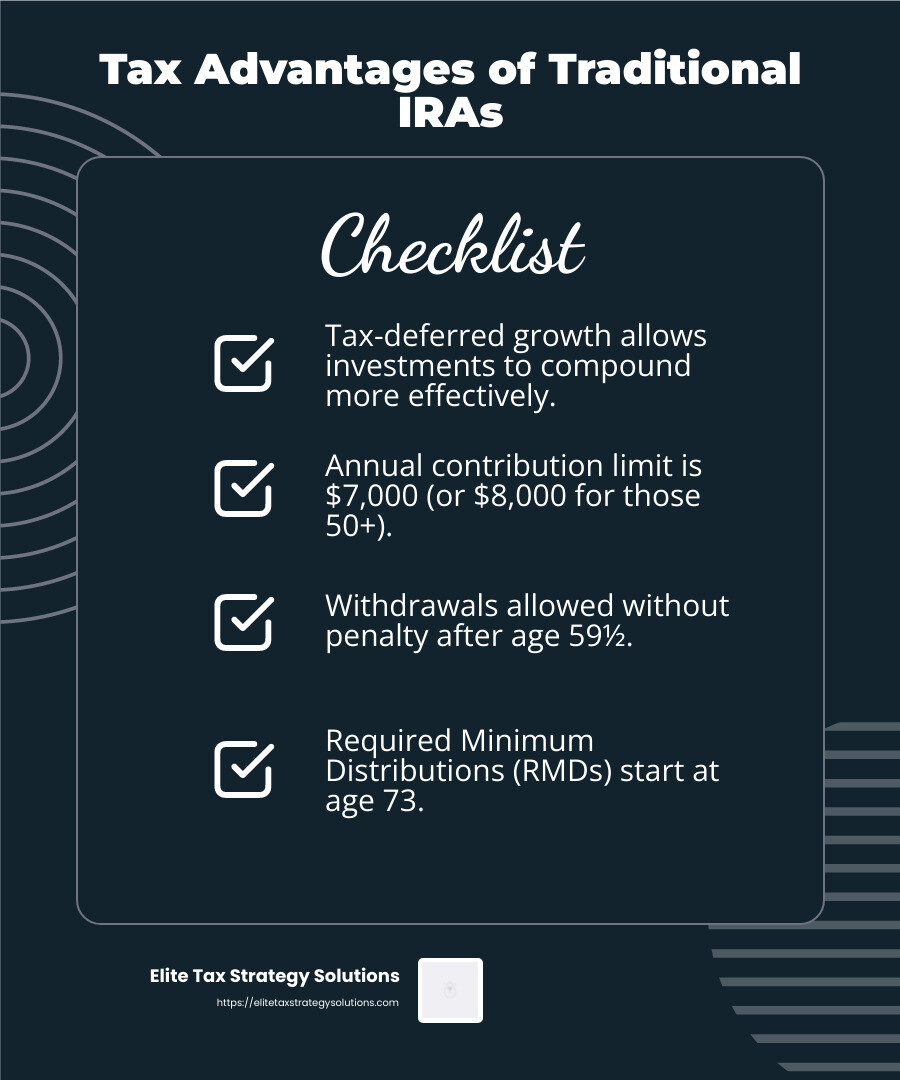
One of the biggest benefits of a Traditional IRA is tax-deferred growth. This means that the money you invest can grow without being taxed until you withdraw it during retirement. This allows your investments to compound more effectively over time.
For example, if you contribute $7,000 annually and your investments grow at an average rate of 7%, your account could grow to nearly $1 million over 30 years. This assumes you start at age 35 and retire at 65.
Contribution Limits
The IRS sets annual contribution limits for Traditional IRAs. For 2024, you can contribute up to $7,000 per year. If you are 50 or older, you can make an additional catch-up contribution of $1,000, bringing your total to $8,000.
- Under 50: $7,000
- 50 and older: $8,000
These limits apply to your total contributions across all IRAs you own.
Withdrawal Rules
Withdrawals from a Traditional IRA are subject to specific rules:
-
Age 59½ Rule: You can start taking withdrawals without penalty at age 59½. Before this age, withdrawals are generally subject to a 10% early withdrawal penalty, in addition to regular income tax.
-
Required Minimum Distributions (RMDs): Starting at age 73, you must begin taking RMDs each year. The amount is based on your life expectancy and account balance.
-
Taxable Withdrawals: All withdrawals are taxed as ordinary income. This means they are subject to your current income tax rate at the time of withdrawal.
Non-Deductible Contributions
High-income earners who exceed the income limits for tax-deductible contributions can still make non-deductible contributions. These contributions won’t reduce your taxable income for the year, but they still benefit from tax-deferred growth.
In summary, a Traditional IRA offers a powerful way to save for retirement through tax-deferred growth and flexible contribution options. Understanding the rules and benefits can help high-income earners make the most of this retirement tool.
Next, let’s explore the specific benefits of Traditional IRAs for high-income earners.
Benefits of Traditional IRAs for High Income Earners
Tax-Deferred Growth
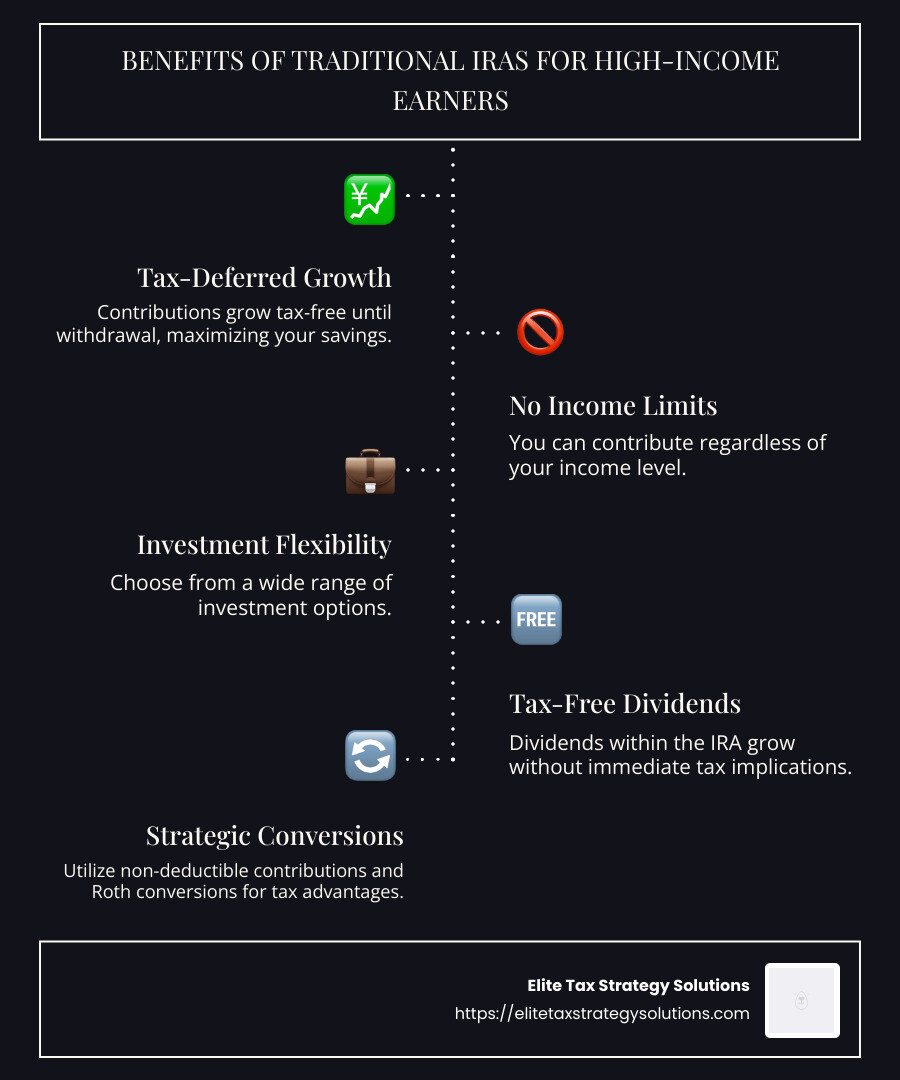
One of the standout benefits of a Traditional IRA for high-income earners is tax-deferred growth. This means your investments can grow without being taxed until you withdraw the money during retirement. This deferral can make a substantial difference over time.
For example, if you contribute $7,000 annually and your investments grow at an average rate of 7%, your account could grow to nearly $1 million over 30 years. This assumes you start at age 35 and retire at 65.
No Income Limits
Unlike Roth IRAs, which have income limits that restrict high earners from contributing, Traditional IRAs have no income limits for contributions. This makes them an accessible option for high-income earners looking to save more for retirement.
Investment Flexibility
Traditional IRAs offer investment flexibility that can be particularly advantageous for high-income earners. You can invest in a wide range of assets, including:
- Individual Stocks and Bonds
- Mutual Funds
- ETFs (Exchange-Traded Funds)
- Real Estate (through a self-directed IRA)
This flexibility allows you to tailor your investment strategy to fit your financial goals and risk tolerance.
Tax-Free Dividends
Another benefit is that dividends earned within a Traditional IRA are not taxed when they are paid. Instead, they contribute to the overall growth of your account, which remains tax-deferred until you make withdrawals in retirement.
Example of Tax Benefits
Consider this: If you invest in a taxable account, dividends and capital gains are taxed annually. However, in a Traditional IRA, these earnings grow tax-free until withdrawal. This can significantly improve the compounding effect on your investments.
Summary
For high-income earners, a Traditional IRA offers several compelling benefits:
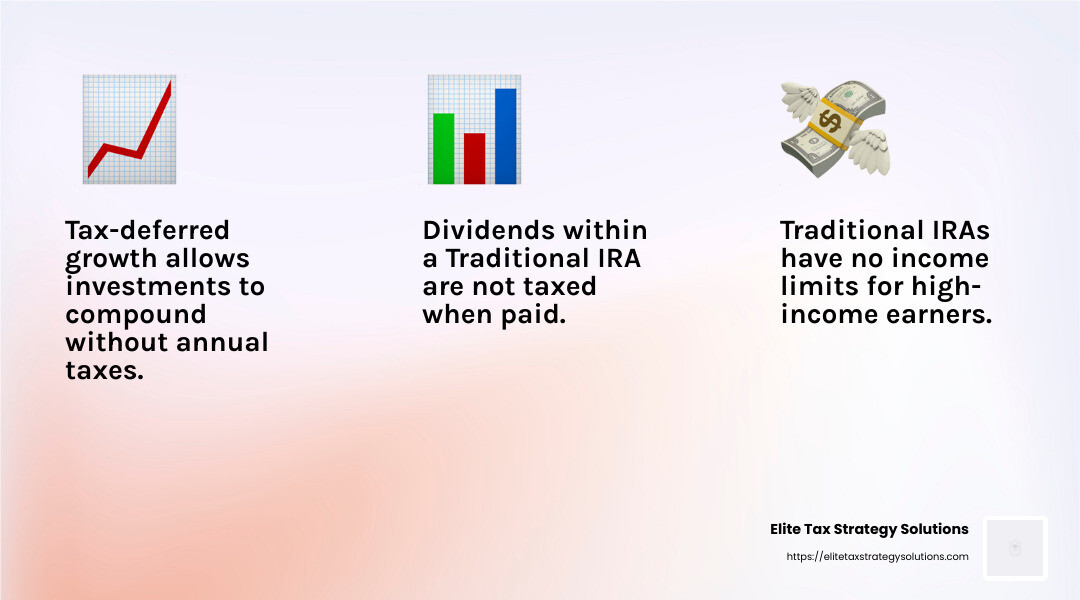
- Tax-deferred growth allows your investments to compound without the drag of annual taxes.
- No income limits mean you can contribute regardless of how much you earn.
- Investment flexibility lets you choose from a wide array of assets.
- Tax-free dividends further improve the growth of your investments.
Next, let’s dive into the contribution limits and rules for Traditional IRAs to understand how much you can invest each year and the guidelines you need to follow.
Contribution Limits and Rules
Annual Limits
For 2024, the annual contribution limit for a Traditional IRA is $7,000. If you are 50 or older, you can contribute an additional $1,000, bringing the total to $8,000. This is a combined limit for all your IRAs, including both Traditional and Roth IRAs.
Age-Based Catch-Up Contributions
If you’re 50 or older, the IRS allows you to make catch-up contributions. These are additional contributions on top of the standard limit, designed to help you save more as you approach retirement. For 2024, the catch-up contribution is $1,000, making your total possible contribution $8,000 if you’re 50 or older.
Non-Deductible Contributions
High-income earners often face restrictions on tax-deductible contributions to Traditional IRAs, especially if they or their spouse are covered by a workplace retirement plan. However, you can still make non-deductible contributions. These contributions do not reduce your taxable income for the year, but they still benefit from tax-deferred growth.
IRS Regulations
The IRS has specific regulations that govern Traditional IRAs:
- Required Minimum Distributions (RMDs): Once you reach age 73, you must start taking RMDs from your Traditional IRA. These withdrawals are subject to income tax.
- Contribution Deadline: You have until the tax filing deadline of the following year to make your contributions. For example, you can contribute to your IRA for 2024 until April 15, 2025.
- Earned Income Requirement: You need to have earned income to contribute to a Traditional IRA. This includes wages, salaries, tips, and self-employment income.
Summary
Understanding the contribution limits and rules for Traditional IRAs is crucial for high-income earners looking to maximize their retirement savings. By adhering to these guidelines, you can make the most of your contributions and enjoy the benefits of tax-deferred growth.
Next, let’s explore the tax implications of Traditional IRAs and how they affect your retirement strategy.
Tax Implications
When it comes to Traditional IRAs for high income earners, understanding the tax implications is key. Here’s what you need to know:
Tax-Deferred Growth
One of the biggest advantages of a Traditional IRA is tax-deferred growth. This means that the money you invest can grow without being taxed each year. You don’t pay taxes on dividends, interest, or capital gains as long as the money stays in the account. This can help your investments grow faster compared to a taxable account.
Taxable Withdrawals
While your investments grow tax-free, withdrawals from a Traditional IRA are a different story. When you start taking money out in retirement, those withdrawals are taxed as ordinary income. The tax rate you’ll pay depends on your income at the time of withdrawal.
Example: If you’re in a higher tax bracket when you retire, you’ll pay more in taxes on your withdrawals. Conversely, if your income is lower, you might pay less.
Capital Gains
In a taxable investment account, you pay capital gains tax on the profit you make when you sell an investment. However, in a Traditional IRA, capital gains are not taxed as long as the money stays in the account. This can be a significant advantage for long-term growth.
Income Tax Rates
Your current and future income tax rates play a huge role in how beneficial a Traditional IRA can be for you. Since withdrawals are taxed as ordinary income, predicting your future tax bracket can help you decide how much to contribute now.
High-income earners should consider:
-
Current Tax Bracket: If you’re in a high tax bracket now, contributing to a Traditional IRA can reduce your taxable income, potentially lowering your tax bill for the year.
-
Future Tax Bracket: If you expect to be in a lower tax bracket in retirement, a Traditional IRA can be more advantageous. You’ll defer taxes now and pay them at a potentially lower rate later.
Note: Tax laws and rates change, so it’s wise to consult with a tax professional to tailor your strategy.
Required Minimum Distributions (RMDs)
Once you reach age 73, you must start taking RMDs from your Traditional IRA. These withdrawals are mandatory and are taxed as ordinary income. Failing to take RMDs can result in hefty penalties, so it’s crucial to plan for them.
By understanding the tax implications of a Traditional IRA, high-income earners can make informed decisions to optimize their retirement savings. Next, let’s dive into strategies that can help you maximize the benefits of your Traditional IRA.
Strategies for High Income Earners
For high-income earners, traditional IRAs offer valuable benefits, but there are additional strategies to consider for maximizing your retirement savings. Here are some key strategies:
Backdoor Roth IRA
A Backdoor Roth IRA is a legal workaround that allows high-income earners to enjoy the benefits of a Roth IRA. Here’s how it works:
- Contribute to a Traditional IRA: You can contribute up to $7,000 in 2024 (or $8,000 if you’re 50 or older).
- Convert to Roth IRA: Convert those funds to a Roth IRA. You’ll pay taxes on any pre-tax contributions and earnings, but future withdrawals will be tax-free.
This strategy lets you bypass the income limits that usually prevent high earners from contributing to a Roth IRA directly.
Roth Conversion
A Roth conversion involves moving funds from a Traditional IRA to a Roth IRA. This can be done in two ways:
- Partial Conversion: Convert a portion of your Traditional IRA funds to a Roth IRA each year. This helps spread out the tax liability.
- Full Conversion: Convert the entire Traditional IRA balance to a Roth IRA in one go.
Pros:
– Future withdrawals are tax-free.
– No required minimum distributions (RMDs) for Roth IRAs.
Cons:
– You’ll owe taxes on the converted amount, so plan for this expense.
Mega-Backdoor Roth IRA
The Mega-Backdoor Roth IRA is another strategy to consider if your employer’s 401(k) plan allows after-tax contributions. Here’s how it works:
- Max Out 401(k) Contributions: Contribute up to the annual limit of $22,500 (or $30,000 if you’re 50 or older) in 2024.
- After-Tax Contributions: Make additional after-tax contributions up to the overall limit of $69,000 (or $76,500 if you’re 50 or older).
- Transfer to Roth IRA: Transfer these after-tax contributions to a Roth IRA.
This allows you to save even more in a tax-advantaged account.
After-Tax Contributions
For those who have maxed out their tax-deferred options, after-tax contributions to a Traditional IRA can still be beneficial. While these contributions don’t reduce your taxable income, they can be converted to a Roth IRA later, taking advantage of tax-free growth.
Key Points:
– Non-Deductible Contributions: These contributions are made with after-tax dollars.
– Conversion to Roth IRA: Convert these funds to a Roth IRA to benefit from tax-free withdrawals in retirement.
By leveraging these strategies, high-income earners can optimize their retirement savings and take full advantage of the tax benefits available. Next, let’s address some frequently asked questions about Traditional IRAs for high income earners.
Frequently Asked Questions about Traditional IRAs for High Income Earners
Can high income contribute to a traditional IRA?
Yes, high-income earners can still contribute to a traditional IRA, but there are important details to understand:
- Income Limitations: If you have access to a 401(k) or another employer-sponsored retirement plan, your ability to deduct traditional IRA contributions on your tax return is limited by your income. For instance, if you’re a high earner, you may not be able to deduct your contributions.
- Non-Deductible Contributions: Even if you can’t deduct your contributions, you can still make non-deductible contributions to a traditional IRA. These contributions grow tax-deferred until withdrawal.
Is a Roth or traditional IRA better for high income earners?
The choice between a Roth IRA and a traditional IRA depends on several factors:
- Tax Bracket Considerations: If you expect to be in a higher tax bracket in retirement, a Roth IRA might be more beneficial since withdrawals are tax-free. Conversely, if you expect a lower tax bracket, a traditional IRA could be advantageous because you defer taxes now.
- Tax-Free Withdrawals: Roth IRAs offer tax-free withdrawals in retirement, which can be a significant benefit. Traditional IRAs, on the other hand, require you to pay taxes on withdrawals.
- Retirement Planning: Consider your long-term financial goals. Roth IRAs have no required minimum distributions (RMDs), allowing your funds to grow tax-free for a longer period.
What are the alternatives if my income is too high for a Roth IRA?
High-income earners have several alternatives to take advantage of the benefits of a Roth IRA:
-
Backdoor Roth IRA: This strategy allows you to contribute to a traditional IRA and then convert those funds to a Roth IRA. It’s a legal workaround that bypasses the income limits for Roth IRA contributions. Learn more about it here.
-
Roth 401(k): Many employers offer a Roth 401(k) option, which doesn’t have income limits. Contributions are made with after-tax dollars, but withdrawals in retirement are tax-free. This can be a straightforward way to gain Roth benefits without the income restrictions.
-
Mega-Backdoor Roth IRA: If your employer’s 401(k) plan allows after-tax contributions, you can contribute up to the overall limit (e.g., $69,000 in 2024) and then transfer these after-tax contributions to a Roth IRA. This is a powerful strategy for high-income earners looking to maximize their tax-advantaged savings.
By understanding these options, high-income earners can make informed decisions about their retirement savings and take full advantage of the tax benefits available.
Conclusion
In summary, while traditional IRAs offer valuable tax-deferred growth and investment flexibility, high-income earners need to steer specific rules and limitations. Understanding the nuances of traditional IRAs for high income earners—like non-deductible contributions and tax implications—can help you make the most of this retirement savings option.
Tax planning is crucial for optimizing your financial future. Strategies such as the backdoor Roth IRA and mega-backdoor Roth IRA can provide additional tax benefits and flexibility.
At Elite Tax Strategy Solutions, we specialize in providing personalized tax planning services custom to your unique financial situation. Our proactive approach ensures that you maximize your tax savings and achieve long-term financial stability.
For expert guidance and to explore custom tax-saving strategies, contact us today and let us help you steer the complexities of tax planning for high-income earners.