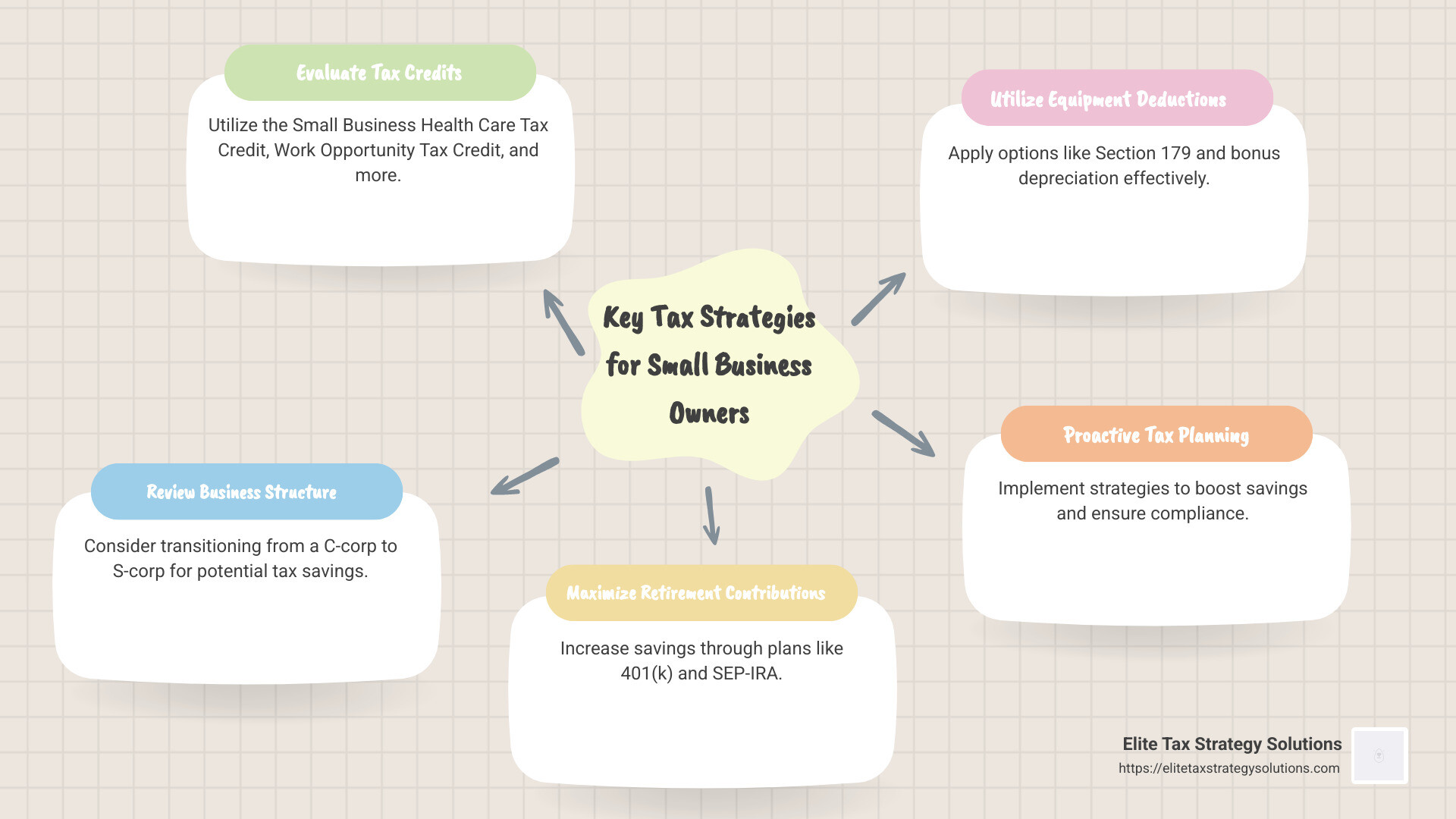
Tax strategies for small business owners are vital tools for enhancing financial health and ensuring long-term success. By employing effective tax planning, you can find ways to boost savings, reduce tax liability, and remain compliant with changing regulations. Here are essential approaches to focus on:
- Evaluate Tax Credits: Leverage the Small Business Health Care Tax Credit, Work Opportunity Tax Credit, and others.
- Review Your Business Structure: Transition from a C-corp to S-corp if beneficial.
- Maximize Retirement Contributions: Optimize savings through 401(k), SEP-IRA, etc.
- Use Equipment Deductions: Apply Section 179 and bonus depreciation effectively.
These strategies are not just about savings; they’re stepping stones to business growth and stability.
I’m David Fritch, with 40 years in tax strategy, focused on navigating complex tax codes to open up savings for small business owners. My expertise lies in maximizing tax savings and ensuring tax compliance, helping businesses like yours achieve financial optimization. Let’s dig deeper into these strategies.
Tax strategies for small business owners basics:
– Business tax management
– Tax management services
– Tax risk management
Employ Family Members
Hiring family members can be a smart move for small business owners looking to reduce taxes while also supporting their loved ones. The IRS allows business owners to employ family members, which can help shelter income from taxes if done correctly.
Benefits of Hiring Family Members
-
Tax Savings: When you hire your spouse or children, you can potentially save on taxes. For instance, children under 18 aren’t subject to FICA taxes, which include Social Security and Medicare. This means you won’t have to pay the employer’s share of these taxes on their wages.
-
Family Income: Hiring family members can provide them with income that can be invested in retirement accounts like a Roth IRA, giving them a head start on savings. This can be particularly beneficial for children, as starting early can help them build a substantial retirement fund over time.
-
Expense Deductions: You can deduct their salaries as a business expense, decreasing the overall taxable income of your business. This is especially useful if your family members perform legitimate work that contributes to your business operations.
Real-Life Example
Consider a small business owner in Jasper, Indiana, who hires their teenage child to help with administrative tasks. By doing so, they not only gain valuable assistance in running their business but also save on taxes. The child’s earnings are below the IRS threshold for FICA taxes, which means the business avoids these additional costs.
Important Considerations
-
Legitimate Work: Ensure that the work your family members do is legitimate and necessary for the business. The IRS expects family members to perform real tasks and be compensated fairly.
-
Proper Documentation: Keep accurate records of the work performed and the wages paid. This documentation is crucial in case of an audit.
-
Consult a Professional: Before employing family members, it’s wise to consult with a tax professional. They can help you steer the specific rules and regulations that apply to your business structure and family situation.
By hiring family, small business owners can effectively reduce taxes while also fostering family involvement in the business. It’s a win-win strategy that combines financial benefits with personal growth opportunities for family members.
Fund Retirement Plans
Setting up a retirement savings plan is a powerful way for small business owners to secure their future and enjoy significant tax deductions. There are several options available, including SIMPLE IRA, SEP IRA, and 401(k) plans, each with its own benefits and requirements.
SIMPLE IRA
A SIMPLE IRA (Savings Incentive Match Plan for Employees) is designed for small businesses with fewer than 100 employees. It’s easy to set up and administer, making it a popular choice for busy entrepreneurs.
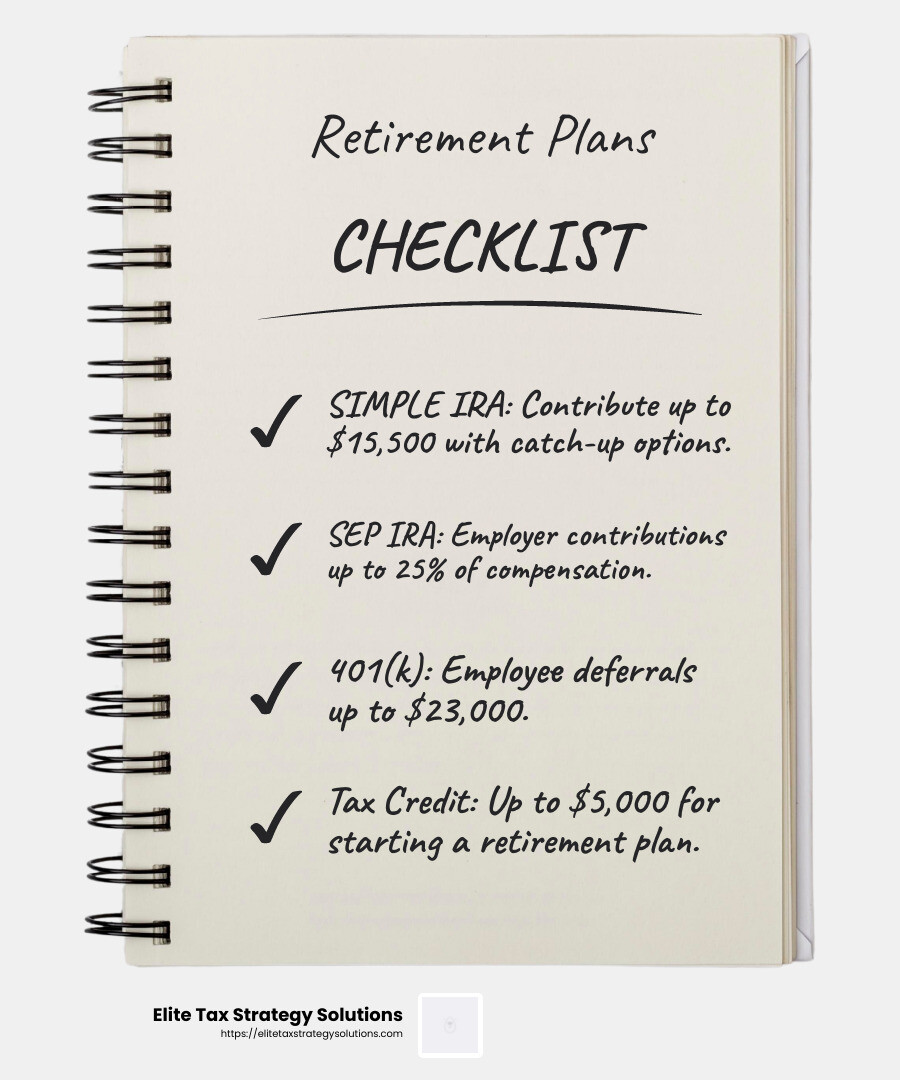
- Contribution Limits: Employees can contribute up to $15,500 in 2024, with an additional catch-up contribution of $3,500 for those aged 50 or older.
- Employer Contributions: Employers must either match employee contributions up to 3% of their salary or make a 2% non-elective contribution for all eligible employees.
SEP IRA
The SEP IRA (Simplified Employee Pension) is another straightforward option, ideal for self-employed individuals or small business owners with few employees.
- Contribution Limits: In 2024, the contribution limit is the lesser of 25% of compensation or $69,000.
- Flexibility: Contributions are made solely by the employer, and the plan allows for flexible annual contributions, which can be adjusted based on the business’s financial situation.
401(k) Plans
A 401(k) plan offers higher contribution limits and more investment options, making it suitable for businesses looking to offer robust retirement benefits.
- Contribution Limits: Employees can defer up to $23,000 in 2024, with a $7,500 catch-up contribution for those 50 and older.
- Employer Matching: Many businesses choose to match a portion of employee contributions, which can be a strong incentive for attracting and retaining talent.
Tax Benefits
Implementing a retirement plan not only helps you and your employees save for the future but also provides immediate tax advantages. Contributions to these plans are typically tax-deductible, reducing your business’s taxable income. Additionally, small businesses may qualify for a tax credit of up to $5,000 to offset the costs of starting a retirement plan.
By considering and implementing the right retirement savings plan, small business owners can bolster their financial security and take advantage of valuable tax deductions. It’s a strategic move that benefits both the employer and employees, fostering a more committed and financially secure workforce.
Optimize Business Structure
Choosing the right business structure can make a big difference in how much tax you pay. For small business owners, understanding the benefits of different structures like LLCs and S Corporations can open up significant savings.
LLCs and S Corporations
Limited Liability Companies (LLCs) and S Corporations are popular choices for small businesses. They offer the benefits of a pass-through entity, meaning the business income is passed directly to the owners and taxed at their personal income tax rates.
Why Choose an LLC?
-
Flexibility: An LLC offers flexibility in management and ownership. You can have one owner or several, and you can choose how to manage the business.
-
Liability Protection: Your personal assets are protected from business debts and liabilities.
-
Taxation: By default, an LLC is a pass-through entity. This means you avoid the double taxation faced by C Corporations, where income is taxed at the corporate level and again at the personal level.
Why Consider an S Corporation?
-
Tax Savings: S Corporations allow owners to pay themselves a salary and receive dividends. This can reduce self-employment taxes since only the salary is subject to payroll taxes.
-
Pass-Through Taxation: Like LLCs, S Corporations benefit from pass-through taxation. The business itself isn’t taxed, only the owners’ income.
-
Raising Capital: While LLCs are flexible, S Corporations can have advantages if you want to issue stock to raise funds.
Transitioning to a Pass-Through Entity
Switching from a C Corporation to an S Corporation or forming an LLC can be a strategic move. It can reduce your tax burden and simplify your tax filings.
- Case Study: A small retail business in Indiana transitioned from a C Corporation to an S Corporation. By doing so, they saved over 20% on their tax bill in the first year alone.
Key Considerations
-
State Taxes: Some states, like Utah, have specific pass-through entity taxes. These can be deducted on your federal tax return, offering more savings.
-
Business Growth: As your business grows, the right structure can help you manage taxes more effectively and protect your assets.
-
Consult a Professional: Before making changes, consult with a tax professional to understand the implications for your specific situation.
By optimizing your business structure, you can take advantage of tax strategies for small business owners that not only reduce your taxes but also support your long-term business goals.
Leverage Equipment Deductions and Green Energy Credits
As a small business owner, you can open up significant tax savings by leveraging equipment deductions and green energy credits. These strategies can help you reduce your taxable income and support sustainable business practices.
Section 179 Deduction
The Section 179 Deduction allows businesses to deduct the full purchase price of qualifying equipment or software purchased or financed during the tax year. This can be a huge benefit if you’ve invested in new or used equipment, as it allows you to write off the entire cost in the year of purchase.
-
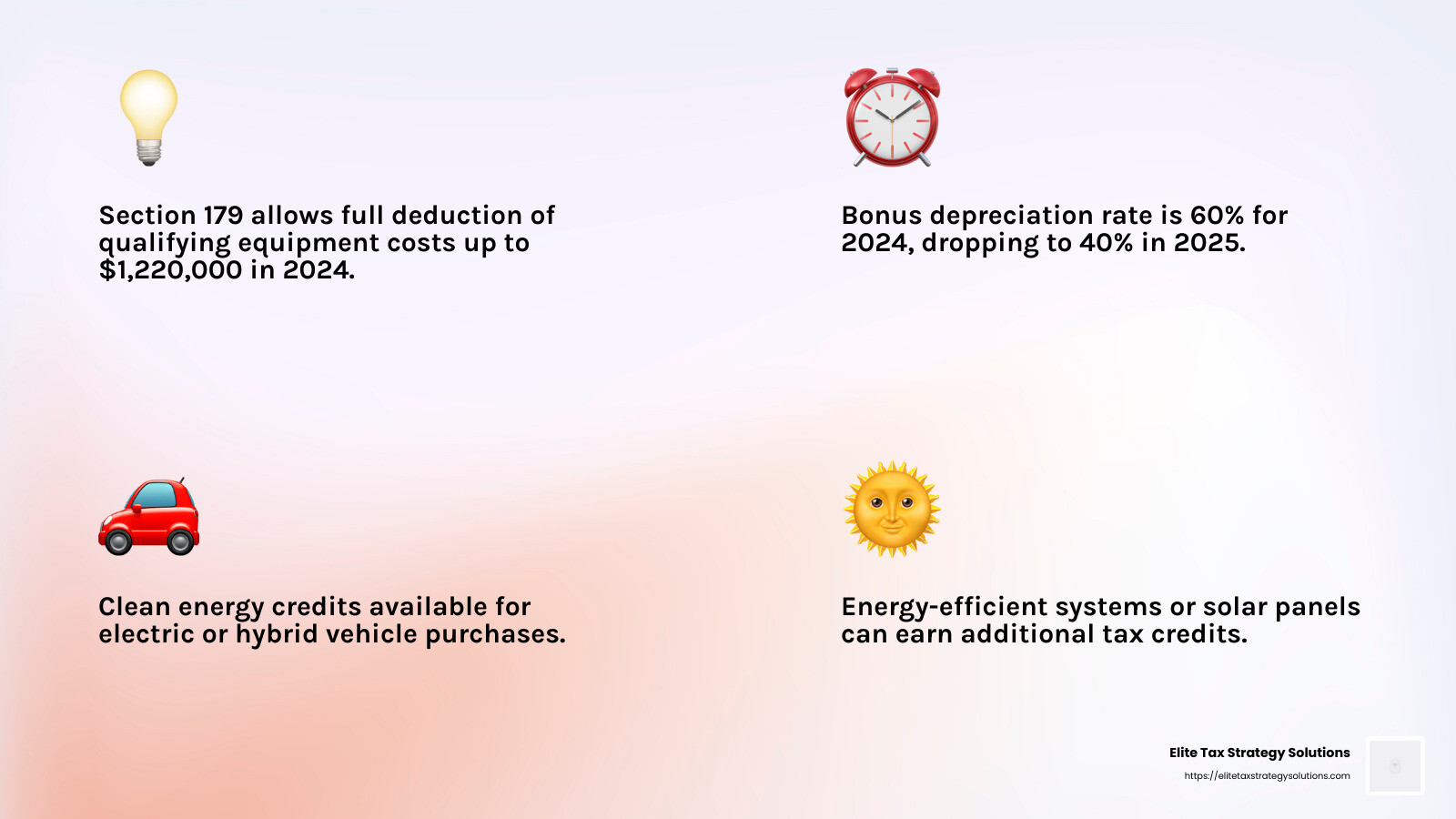
Limit: For 2024, you can deduct up to $1,220,000. However, this deduction starts to phase out if your total equipment purchases exceed $3.05 million.
-
Timing: Consider your financial year. If 2024 looks better financially, purchase equipment before December 31 to maximize your deduction.
Bonus Depreciation
In addition to Section 179, bonus depreciation offers another way to save. This option lets you deduct a percentage of the cost of eligible purchases in the year they are bought.
-
Current Rate: For 2024, the bonus depreciation rate is 60%. This means you can deduct 60% of the cost of qualifying assets placed in service during the year.
-
Future Changes: The bonus depreciation rate is scheduled to decrease to 40% in 2025. Plan your purchases accordingly to maximize savings.
Clean Energy Tax Credits
The Inflation Reduction Act has introduced substantial incentives for businesses investing in clean energy. These clean energy tax credits can offset the costs of adopting greener technologies.
-
Electric Vehicles: Businesses can receive credits for purchasing electric or hybrid vehicles. This not only reduces your tax burden but also supports environmental sustainability.
-
Energy Efficiency: Installing energy-efficient systems or solar panels can qualify you for additional credits.
-
State Incentives: Check if your state offers additional clean energy incentives, as these can compound your savings.
Strategic Planning
To make the most of these deductions and credits, strategic planning is essential. Here are a few tips:
-
Assess Needs: Evaluate your business needs and financial position. If you anticipate higher profits next year, consider deferring purchases to take advantage of future deductions.
-
Consult Experts: Work with a tax professional to steer the complexities of these deductions and credits. They can help ensure compliance and maximize your savings.
Leveraging equipment deductions and green energy credits is a key part of effective tax strategies for small business owners. These tools not only reduce your tax liability but also position your business for sustainable growth.
Tax Strategies for Small Business Owners
When it comes to tax strategies for small business owners, understanding your adjusted gross income (AGI), making smart tax elections, and considering income deferral can make a big difference in your tax burden.
Adjusted Gross Income (AGI)
Your AGI is crucial because it determines your eligibility for various tax credits and deductions. A lower AGI can mean less tax owed. Here are a few ways to manage your AGI:
-
Contribute to Retirement Plans: Contributions to tax-deferred retirement accounts, like a SIMPLE IRA or SEP IRA, can lower your AGI. For example, if you contribute $5,000 to a SEP IRA, your AGI decreases by that amount.
-
Health Savings Account (HSA): If you have a high-deductible health plan, contributing to an HSA can also reduce your AGI. This not only lowers your taxes but also helps save for medical expenses.
-
Charitable Contributions: If you itemize deductions, charitable donations can lower your AGI. Keep track of all donations throughout the year to maximize this benefit.
Tax Elections
Making the right tax elections can significantly impact your tax liability. Here are a few options to consider:
-
Section 179 Deduction: As mentioned earlier, this allows you to deduct the full cost of qualifying equipment. Choosing this election can be beneficial if you need immediate tax relief.
-
Bonus Depreciation: If the Section 179 deduction doesn’t cover all your needs, consider bonus depreciation. This option is phasing down, with 60% available in 2024 and 40% in 2025. Plan your purchases to take advantage of these rates.
-
Home Office Deduction: If you work from home, you can choose between deducting actual expenses or using the simplified rate. The simplified rate is $5 per square foot, up to 300 square feet.
Income Deferral
Deferring income can help manage your tax liability, especially if you expect to be in a lower tax bracket in the future. Here are some ways to defer income:
-
Delay Billing: If possible, delay billing clients until the next tax year. This pushes income into the following year, reducing your current tax burden.
-
Retirement Contributions: Maximize contributions to retirement accounts. This not only lowers your AGI but also defers taxes on the income until withdrawal.
-
Accelerate Expenses: Pay expenses that you can deduct this year, such as office supplies or repairs, before the year ends. This reduces your taxable income for the current year.
Implementing these tax strategies for small business owners requires careful planning and consideration of your financial situation. Always consult with a tax professional to tailor strategies to your specific needs and ensure compliance with tax laws.
Frequently Asked Questions about Small Business Taxes
How to pay the least amount of taxes as a small business owner?
To reduce your tax bill, consider your business structure. Choosing the right structure, like an LLC or S Corporation, can provide tax advantages. For instance, an S Corporation allows income to pass through to personal tax returns, potentially lowering overall taxes.
Family employment is another strategy. Hiring family members can save on taxes. For example, wages paid to your children under 18 aren’t subject to Social Security and Medicare taxes. This can reduce your taxable income while benefiting your family.
What is the 20% tax deduction for small businesses?
The 20% tax deduction comes from the Tax Cuts and Jobs Act (TCJA). It allows eligible small businesses to deduct up to 20% of their qualified business income (QBI). This applies to pass-through entities, like sole proprietorships, partnerships, and S Corporations.
To qualify, your business must meet specific criteria, including income limits. If eligible, this deduction can significantly lower your taxable income, leading to substantial savings.
How to lower your taxable income as a business owner?
Lowering taxable income involves strategic planning. Here are some effective methods:
-
Health Insurance: If you’re self-employed, you can deduct health insurance premiums for yourself, your spouse, and dependents. This deduction reduces your taxable income directly.
-
Retirement Savings: Contributing to retirement plans, such as a SEP IRA or 401(k), can decrease your taxable income. These contributions are tax-deferred, meaning you won’t pay taxes on them until withdrawal, usually during retirement when you might be in a lower tax bracket.
Implementing these strategies can help you manage your tax liability effectively. Always consult with a tax professional to ensure you’re taking full advantage of available deductions and credits.
Conclusion
Navigating taxes can feel overwhelming. But with proactive tax planning, small business owners can achieve significant savings and financial stability. At Elite Tax Strategy Solutions, we specialize in tailoring tax strategies to fit the unique needs of high earners and closely held businesses.
Our approach is simple: we focus on maximizing tax savings while ensuring compliance with ever-changing tax laws. We understand that every business is different, and so are their tax needs. That’s why we offer personalized services to help you open up substantial tax savings and secure your financial future.
Whether you’re looking to optimize your business structure, leverage equipment deductions, or employ family members to reduce taxes, our team of seasoned tax professionals is here to guide you. We work diligently to stay informed about the latest tax regulations and opportunities so you can focus on what you do best—running your business.
Let us help you open up the full potential of your business with our expert tax planning solutions. Visit our Tax Planning for Small Businesses page to learn more about how we can support your journey to financial success.
Effective tax strategies are not just about saving money today. They’re about building a stable financial foundation for tomorrow. Let’s make your taxes work for you.