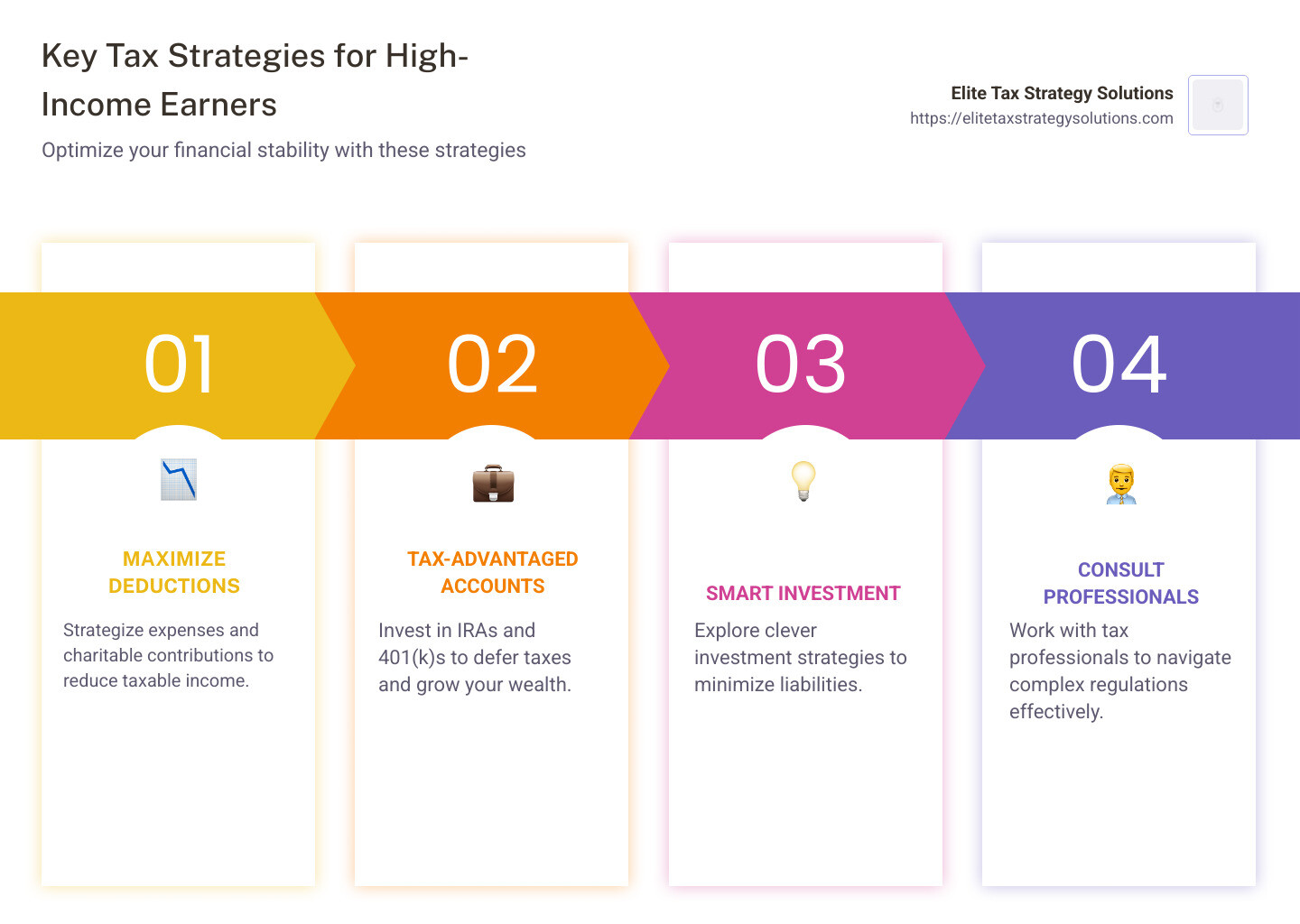
Tax strategies for high-income earners are essential to ensure financial stability and maximize wealth. If you’re earning a substantial income, the right approach can make a significant difference. Here are some key strategies:
- Maximize deductions through strategic expenses and charitable contributions.
- Invest in tax-advantaged accounts like IRAs and 401(k)s.
- Explore clever investment strategies to minimize liabilities.
- Consult with tax professionals to steer complex regulations effectively.
For high-income earners, understanding these tax strategies is crucial to avoid overpaying and to align with financial goals.
As someone deeply involved with these strategies, I am David Fritch. With 40 years of experience in tax law and financial planning, I specialize in helping high-income individuals optimize their tax strategies. Transitioning from complex regulations to strategic planning can significantly impact your financial well-being.
Key terms for tax strategies for high-income earners:
– extra medicare tax for high earners
– retirement tax strategies for high income earners
– traditional ira for high income earners
Understanding Tax Rules for High-Income Earners
When it comes to tax strategies for high-income earners, understanding how tax rules apply to your situation is crucial. Let’s explore some of the basics.
Tax Brackets
The IRS organizes tax rates into brackets. These brackets determine the percentage of tax you owe based on your income. For 2024, if your taxable income as a single filer is above $197,300, you’re in one of the top three tax brackets. This means a significant portion of your income is taxed at higher rates, with the top rate being 37% for those earning over $626,351.
IRS Definition of High-Income Earners
The IRS considers you a high-income earner if you fall into the top three tax brackets. This includes individuals with a taxable income over $197,300. For married couples filing jointly, the threshold is $394,600. Being classified as a high-income earner means you face unique tax challenges and opportunities.
Taxable Income
Taxable income is your adjusted gross income minus deductions and exemptions. It’s the amount used to determine your tax bracket. High-income earners often have multiple income streams, including salary, bonuses, and investment income. Each type of income can be taxed differently, adding complexity to the calculation.
Consider this: if you earn $600,000, your taxable income might be less after deductions. But understanding how each dollar is taxed is key to effective planning.
By grasping these fundamentals, you can better steer the tax landscape and make informed decisions. This knowledge is vital for aligning your tax strategy with your financial goals.
Tax Strategies for High-Income Earners
Navigating taxes can feel overwhelming, especially for high-income earners. But don’t worry, there are strategies that can help you keep more of your money. Let’s explore some key tax strategies for high-income earners.
Retirement Contributions
Maximizing your retirement contributions is a smart move. If you have access to a 401(k), you can contribute up to $22,500 in 2024. If you’re 50 or older, you can add $7,500 more as a catch-up contribution. These contributions reduce your taxable income, which means you pay less in taxes now while saving for the future.
Roth IRA Conversions
A Roth IRA conversion can be a powerful tool. This involves moving money from a traditional IRA to a Roth IRA. While you’ll pay taxes on the converted amount now, your future withdrawals will be tax-free. This can be a great strategy if you expect to be in a higher tax bracket in retirement. Just be sure to consider the tax implications carefully.
Municipal Bonds
Investing in municipal bonds can offer tax advantages. The interest income from these bonds is generally exempt from federal taxes. If you live in the state where the bond is issued, you might avoid state and local taxes too. This makes them a popular choice for high-income earners looking to reduce their taxable income.
Donor-Advised Funds
Charitable giving is not only a way to give back but also a way to save on taxes. A donor-advised fund allows you to make a charitable contribution, receive an immediate tax deduction, and then recommend grants over time. This flexibility can be especially useful for high-income earners looking to manage their tax liabilities while supporting causes they care about.
Health Savings Accounts
If you have a high-deductible health plan, a Health Savings Account (HSA) can be a triple tax advantage. Contributions are tax-deductible, the money grows tax-free, and withdrawals for qualified medical expenses are also tax-free. Plus, after age 65, you can use the funds for any purpose, making it a versatile part of your retirement strategy.
By leveraging these strategies, high-income earners can effectively manage their tax burden while working toward their financial goals. Up next, we’ll explore some advanced techniques to further optimize your tax planning.
Advanced Tax Planning Techniques
For high-income earners, advanced tax planning can be the key to maximizing wealth and minimizing tax liabilities. Let’s explore some sophisticated strategies that can make a significant impact.
Tax Residency Planning
Relocating can be more than just a lifestyle change—it can be a savvy tax move. States like Florida and Texas have no state income tax, which can lead to substantial savings. If you own properties in multiple states, tax residency planning might be worth considering. This involves establishing residency in a state with favorable tax laws to reduce your tax burden. However, it’s crucial to follow state rules carefully to avoid audits. Consulting with an experienced tax accountant can make this transition smoother.
Capital Gains Strategies
Capital gains taxes can take a big bite out of your investment returns. But there are ways to mitigate this. One strategy is the 1031 exchange, which allows you to defer capital gains taxes by reinvesting proceeds from the sale of a property into a similar property within 180 days. Another approach is to invest in qualified dividends, which are taxed at a lower rate than ordinary income. By holding investments for over a year, you can also benefit from long-term capital gains rates, which are generally lower than short-term rates.
Charitable Remainder Trusts
For those with philanthropic goals, a charitable remainder trust (CRT) can offer both tax benefits and the satisfaction of giving back. By placing assets in a CRT, you receive a tax deduction based on the trust’s value, and the trust can sell assets without immediate capital gains taxes. You or your beneficiaries receive income from the trust for a set period, after which the remaining assets go to a designated charity. This strategy not only supports your favorite causes but also provides potential income and estate tax benefits.
Business Structure Optimization
Choosing the right business structure can have significant tax implications. S corporations allow for pass-through taxation, meaning income is taxed at the shareholder level, avoiding double taxation. Limited Liability Companies (LLCs) offer flexibility in taxation, as they can be taxed as sole proprietorships, partnerships, or corporations. By optimizing your business structure, you can minimize taxes while maximizing profits. It’s essential to evaluate your business needs and consult with a tax advisor to determine the most beneficial structure for your situation.
By applying these advanced techniques, high-income earners can not only reduce their tax liabilities but also align their financial strategies with long-term wealth-building goals. Let’s address some frequently asked questions about tax strategies for high-income earners next.
Frequently Asked Questions about Tax Strategies for High-Income Earners
How can a high-income earner pay less taxes?
High-income earners often face hefty tax bills, but there are effective strategies to reduce those payments. One of the simplest methods is to maximize contributions to tax-advantaged accounts. This includes accounts like 401(k)s, IRAs, and Health Savings Accounts (HSAs). By contributing the maximum allowable amounts, you can lower your taxable income significantly.
Charitable donations also offer a way to decrease your taxable income. You can deduct donations to qualifying organizations, which reduces your tax liability. Consider setting up a donor-advised fund for more strategic giving.
Asset allocation is another key strategy. By investing in tax-exempt municipal bonds or tax-efficient mutual funds, you can minimize the taxes on your investment income. This approach ensures your portfolio is aligned with both your financial goals and tax strategy.
What are the biggest tax loopholes?
Some tax strategies might seem like loopholes, but they are perfectly legal when used correctly. One popular method is the backdoor IRA, which allows high-income earners to contribute to a Roth IRA even if their income exceeds the usual limits. This involves making a non-deductible contribution to a traditional IRA and then converting it to a Roth IRA.
Carried interest is another often-discussed strategy, particularly in the investment world. It allows fund managers to pay taxes on a portion of their income at the lower capital gains rate rather than the higher ordinary income tax rate.
Life insurance can also be a tool for tax planning. Permanent life insurance policies, such as whole or universal life, offer tax-deferred growth of cash value, and the death benefit is generally tax-free to beneficiaries.
How to save tax on a 200k salary?
For those earning around $200,000, 401(k) contributions are a straightforward way to reduce taxable income. In 2024, individuals can contribute up to $23,000, or $30,500 if they’re over 50. This not only lowers taxable income but also secures retirement savings.
Another effective method is contributing to Health Savings Accounts (HSAs), provided you have a high-deductible health plan. HSAs offer triple tax benefits: contributions are tax-deductible, growth is tax-free, and withdrawals for qualified medical expenses are tax-free.
Participating in stock purchasing programs offered by your employer can also be beneficial. These programs often allow you to buy company stock at a discount, and holding the stock for a period can lead to favorable tax treatment on any gains.
By leveraging these strategies, high-income earners can effectively manage their tax liabilities while working towards their financial goals.
Conclusion
Navigating the complex world of taxes can be daunting, especially for high-income earners. That’s where Elite Tax Strategy Solutions comes in. We specialize in personalized tax planning that aligns with your financial goals, ensuring you maximize your wealth while minimizing tax liabilities.
Our proactive approach is designed to keep you ahead of the ever-changing tax laws. We don’t just react to changes; we anticipate them and adjust your strategies accordingly. This means you benefit from the latest tax-saving opportunities without having to keep up with every legislative update yourself.
At Elite Tax Strategy Solutions, we understand that every client is unique. That’s why we tailor our strategies to fit your specific situation, whether it’s optimizing your retirement contributions, taking advantage of Roth IRA conversions, or leveraging tax-efficient investments. Our team is dedicated to helping you steer the complexities of tax planning with ease and confidence.
Ready to take control of your tax strategy? Explore our innovative tax planning solutions and see how we can help you achieve financial stability and peace of mind.