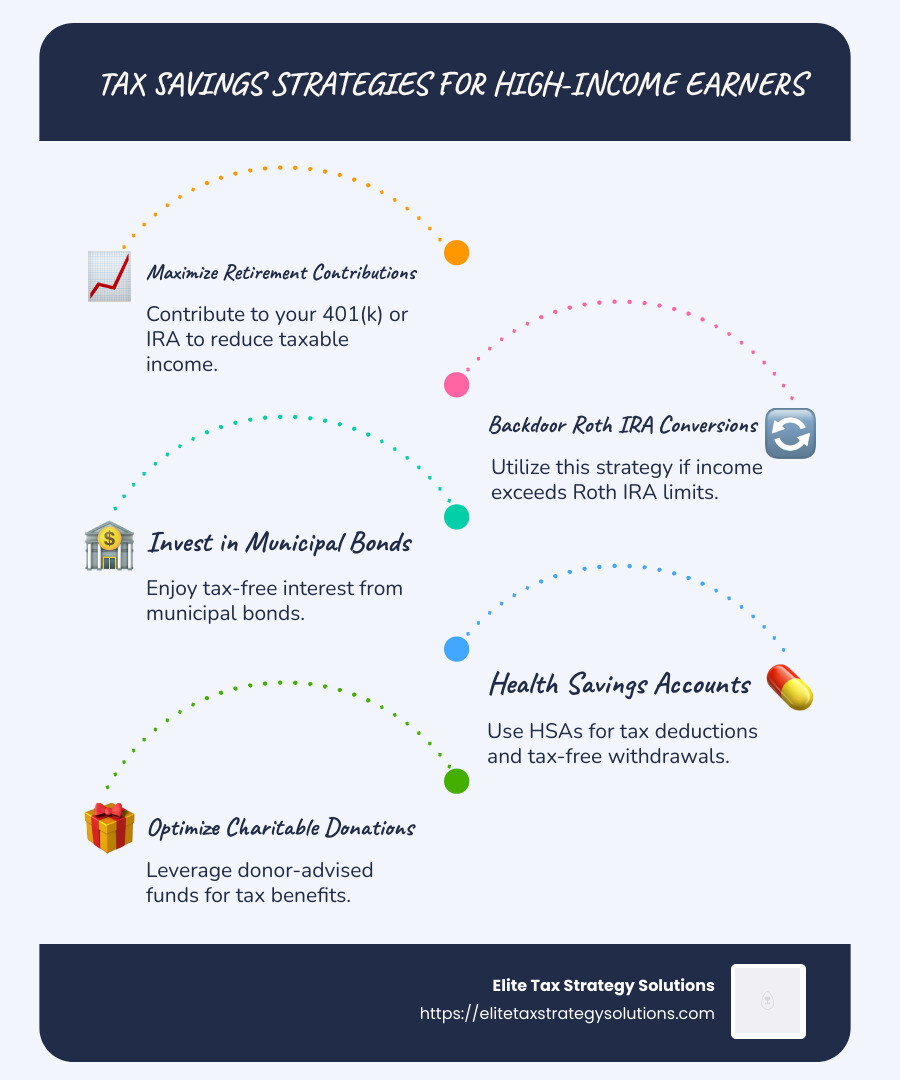
Tax savings strategies for high income earners can feel overwhelming, but there are ways to manage this complexity effectively. At its core, tax planning involves making informed decisions to minimize your tax burden while staying compliant with ever-changing regulations. Here’s a quick overview of strategies to consider:
- Maximize Retirement Contributions: Contribute the maximum allowable amounts to your 401(k) or IRA.
- Backdoor Roth IRA Conversions: Consider this if your income exceeds regular Roth IRA limits.
- Invest in Municipal Bonds: Enjoy tax-free interest from these government-backed securities.
- Capitalize on Health Savings Accounts (HSAs): If you’re enrolled in a high-deductible health plan, HSAs offer both tax deductions and tax-free withdrawals for qualified expenses.
- Optimize Charitable Donations: Use donor-advised funds for potential tax benefits.
Navigating the tax landscape is crucial, especially for high earners, who face unique challenges. High-income earners—typically defined as those making over $200,000 annually—often pay a higher percentage of taxes compared to average earners. Understanding tax rules and leveraging tax-saving strategies can make a significant difference in your financial outcome.
I’m David Fritch. With over 40 years of experience in tax planning, I specialize in providing tax savings strategies for high income earners. Having worked with both large firms and individual clients, I understand the intricacies of tax law and offer personalized advice to help optimize your financial standing.
Explore more about tax savings strategies for high income earners:
– high income tax reduction strategies
– strategies to reduce taxes for high income earners
– advanced tax planning strategies
Tax Savings Strategies for High-Income Earners
When it comes to tax savings strategies for high income earners, there are several key moves you can make to keep more of your hard-earned money.
Maximize Retirement Contributions
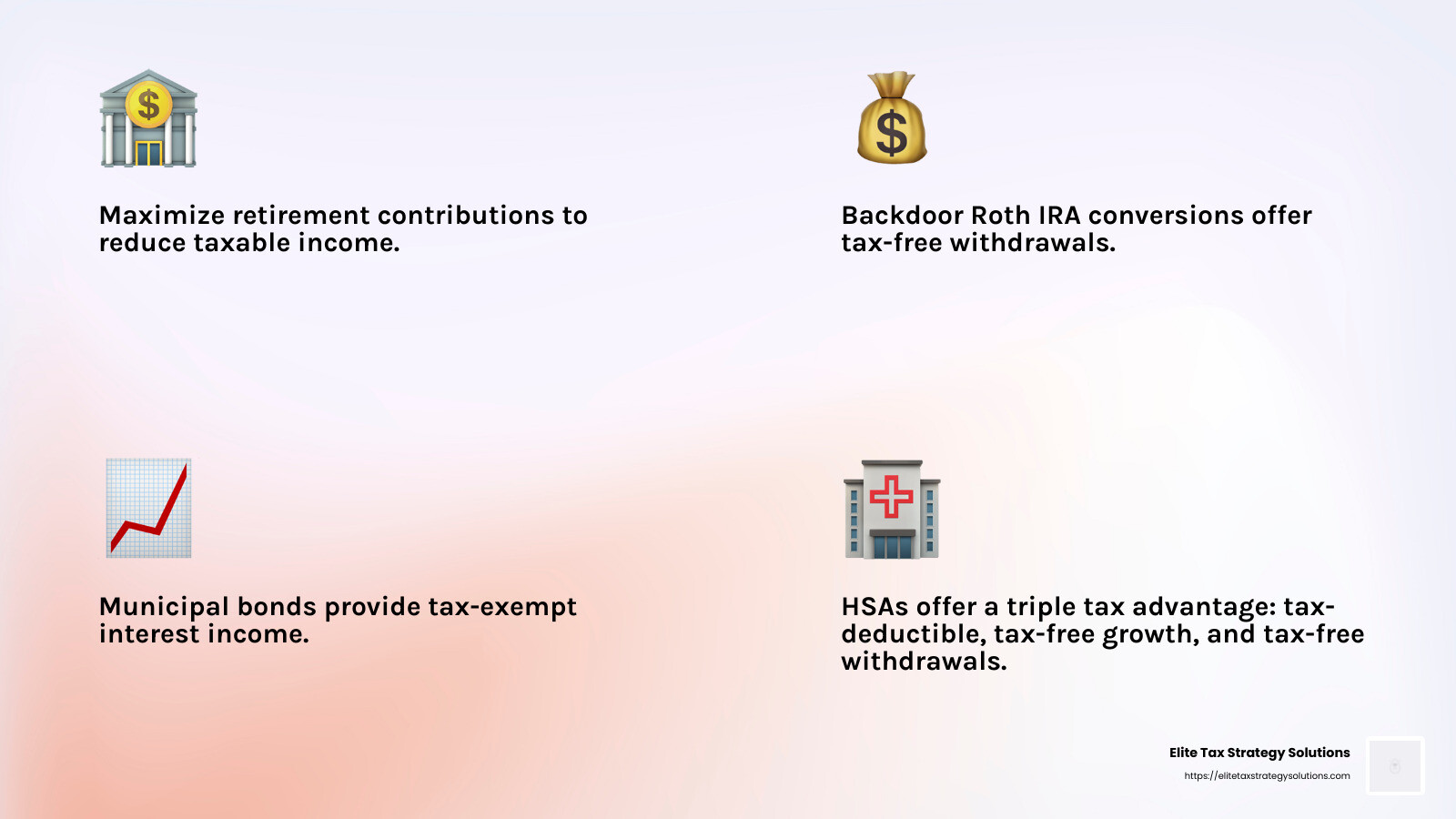
Start by contributing the maximum allowable amounts to your retirement accounts. For 2024, you can contribute up to $23,000 to a Traditional 401(k) as an employee, or $30,500 if you’re over 50. This not only helps you save for retirement but also reduces your taxable income right now.
Roth IRA Conversions
If your income is too high for regular Roth IRA contributions, consider a Backdoor Roth IRA conversion. This involves contributing to a traditional IRA and then converting it to a Roth IRA. While you may pay taxes on the conversion, future withdrawals are tax-free, which can be a big advantage in retirement.
Invest in Municipal Bonds
Municipal bonds are another smart choice. The interest income from these bonds is typically exempt from federal tax. If you buy bonds issued in your state, you might also avoid state and local taxes. This makes them an attractive option for reducing your taxable income.
Donor-Advised Funds
For those who are charitably inclined, donor-advised funds (DAFs) are a great way to manage donations. You can contribute to the fund, receive an immediate tax deduction, and decide later which charities to support. This strategy allows you to bunch charitable contributions into a single year, maximizing your tax benefits.
Health Savings Accounts
Lastly, don’t overlook Health Savings Accounts (HSAs). If you have a high-deductible health plan, you can contribute up to $4,150 for individuals or $8,300 for families in 2024, with an extra $1,000 if you’re 55 or older. HSAs offer a triple tax advantage: contributions are tax-deductible, growth is tax-free, and withdrawals for qualified medical expenses are also tax-free.
These strategies are just the tip of the iceberg. By implementing them, you can significantly reduce your tax burden and improve your financial well-being. Up next, we’ll explore how changing the character of your income can further optimize your tax position.
Changing the Character of Your Income
High-income earners have more opportunities to change the character of their income to reduce taxes. Here’s how you can make some smart moves:
Business Structure
Choosing the right business structure can make a big difference in your tax bill. For example, a C-corporation might pay a lower tax rate than an S-corporation or a sole proprietorship. Plus, earnings from a pass-through entity could qualify for a deduction of up to 20% of business income.
Another strategy is to hire your minor children. You can pay them without withholding payroll taxes, and their earnings are taxed at a lower rate. This not only reduces your taxable income but also helps your kids start saving early.
Tax-Exempt Bonds
Investing in tax-exempt bonds is another way to lower your taxable income. Municipal bonds, for instance, offer interest income that’s generally free from federal taxes and often state and local taxes as well. This can be particularly beneficial if the bonds are issued in your state.
Index Mutual Funds
Consider investing in index mutual funds or exchange-traded funds (ETFs). These are more tax-efficient than actively managed funds because they typically have lower turnover rates, which means fewer taxable events. This can help you keep more of your investment income.
Health Savings Accounts
Lastly, an often overlooked tool is the Health Savings Account (HSA). If you qualify, consider investing your HSA contributions rather than spending them immediately. Earnings grow tax-free, and future distributions are tax-free if used for qualified medical expenses. This is a powerful way to build a tax-advantaged healthcare fund for your future.
By strategically changing the character of your income, you can significantly reduce your tax liabilities and keep more of what you earn.
Next, we’ll dive into managing your tax bracket to further optimize your tax situation.
Tax Bracket Management
Tax bracket management is a smart strategy for high-income earners who want to minimize their tax liabilities. By understanding and leveraging your tax bracket, you can make informed decisions about when to realize income and when to defer it. Let’s explore some key tactics.
Lower-Earning Years
In years when your income is lower, it’s a good time to “fill up” your tax bracket. This means taking advantage of the lower tax rate by realizing additional income up to the top of your current bracket. Here are some ways to do that:
-
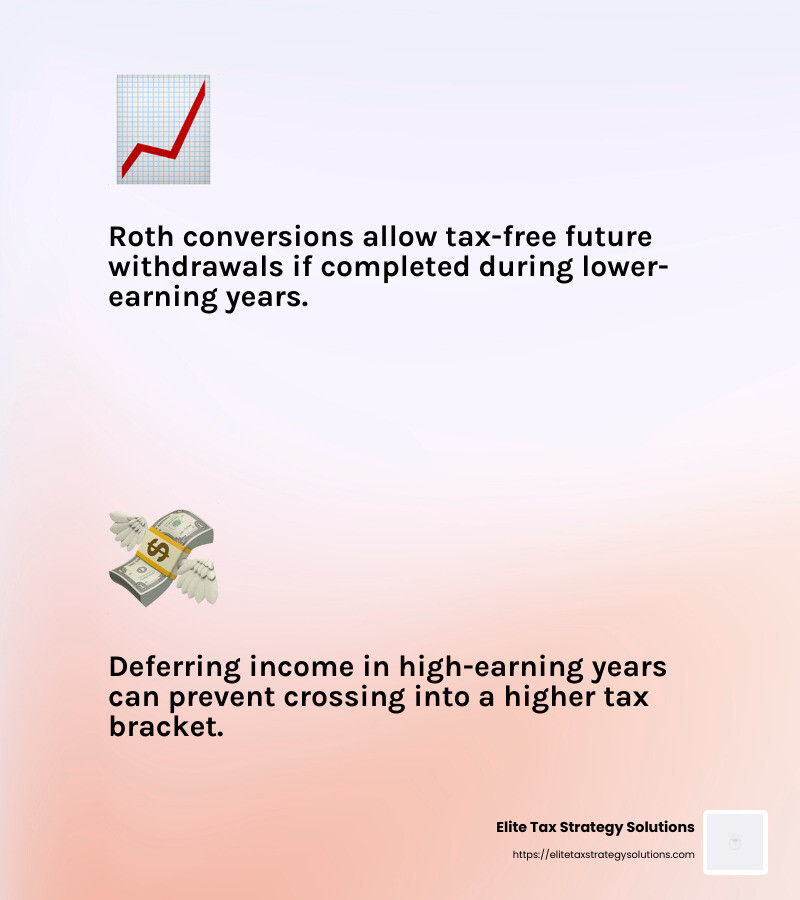
Roth Conversion: If you have a traditional IRA, converting some of it to a Roth IRA can be beneficial. You’ll pay taxes on the converted amount now, but future withdrawals will be tax-free. This is ideal if you expect to be in a higher tax bracket in the future.
-
Investment Gains: Harvesting long-term capital gains during a lower-income year can also save you money. Long-term capital gains are taxed at a lower rate than ordinary income, so selling appreciated assets when you’re in a lower bracket can be advantageous.
Higher-Earning Years
In contrast, during higher-earning years, the goal is to reduce your taxable income to avoid moving into a higher tax bracket. Here’s how:
-
Defer Income: If possible, defer bonuses or other income to the following year. This can help keep you in a lower bracket this year.
-
Maximize Deductions: Contribute the maximum amount to retirement accounts like a 401(k) or Health Savings Account (HSA) to reduce taxable income.
-
Charitable Donations: Consider making charitable donations, which can provide significant deductions and help reduce your taxable income.
By understanding your income flow and strategically timing your financial moves, you can effectively manage your tax bracket and keep more of your hard-earned money.
Next, we’ll explore advanced tax planning techniques to further improve your tax strategy.
Advanced Tax Planning Techniques
For high-income earners, diving into advanced tax planning techniques can open up substantial savings. Let’s explore a few powerful strategies: Opportunity Zones, 1031 exchanges, Charitable Remainder Trusts, and Section 1202 stock.
Opportunity Zones
Opportunity Zones are special areas designated by the government to encourage investment in economically distressed communities. By investing in these zones, you can defer and potentially reduce capital gains taxes. Here’s how it works:
-
Deferral of Capital Gains: When you reinvest gains into an Opportunity Zone Fund, you defer taxes on those gains until the end of 2026 or when you sell your investment, whichever comes first.
-
Reduction of Taxable Gains: If you hold the investment for at least 5 years, your deferred gain is reduced by 10%. Hold it for 7 years, and the reduction increases to 15%.
-
Tax-Free Growth: Investments held for at least 10 years can grow tax-free. This means any appreciation on your Opportunity Zone investment is not taxed.
1031 Exchange
A 1031 exchange allows you to defer capital gains taxes on real estate by rolling proceeds into a new investment property. Here are the essentials:
-
Like-Kind Property: The new property must be similar in nature or character to the one sold.
-
180-Day Rule: You have 180 days to purchase the new property after selling the old one.
-
Tax Deferral: This swap defers the capital gains tax, allowing you to reinvest more capital into your next property.
This strategy is particularly beneficial for real estate investors looking to upgrade or diversify their portfolios without the immediate tax hit.
Charitable Remainder Trust
A Charitable Remainder Trust (CRT) is a win-win for those who are charitably inclined. You can donate appreciated assets to a CRT, receive income for life or a set term, and then have the remainder go to charity. Here’s why it’s smart:
-
Income Tax Deduction: You get an immediate tax deduction based on the present value of the remainder interest going to charity.
-
Deferral of Capital Gains: Transfer appreciated assets without immediate capital gains tax, allowing the full value to grow within the trust.
-
Steady Income Stream: Receive regular payouts from the trust, providing a predictable income stream.
Section 1202 Stock
For those invested in small businesses, Section 1202 stock offers a significant tax advantage. If you hold qualified small business stock (QSBS) for more than 5 years, you can exclude up to $10 million in gains or 10 times your basis, whichever is greater. Here’s why it matters:
-
Massive Exclusion: This can mean huge tax savings, especially for founders or early investors in startups.
-
Long-Term Investment: Encourages long-term investment in small businesses, supporting innovation and growth.
These advanced tax planning techniques require careful consideration and professional guidance. They can significantly reduce your tax burden and increase your wealth over time.
Next, we’ll address frequently asked questions about tax savings strategies for high-income earners.
Frequently Asked Questions about Tax Savings Strategies for High-Income Earners
How can high earners reduce taxable income?
High-income earners can reduce taxable income by taking advantage of tax-advantaged accounts. These include 401(k) plans, where contributions are made with pre-tax dollars, effectively lowering your taxable income. For example, contributing the maximum allowed to a 401(k) can significantly reduce your taxable income, especially if you’re earning $200,000 or more.
Another powerful tool is a Roth conversion. While contributions to a Roth IRA are made with after-tax dollars, the account grows tax-free, and withdrawals in retirement are also tax-free. This can be a smart move if you expect to be in a higher tax bracket during retirement.
Consider 529 accounts for educational savings. Contributions aren’t deductible on federal taxes, but some states offer tax deductions or credits. Plus, the earnings grow tax-free, and withdrawals for qualified education expenses are also tax-free.
Lastly, don’t overlook charitable donations. Donating to qualified charities can provide a deduction, reducing your taxable income. Using donor-advised funds can maximize this benefit, allowing you to bunch several years’ worth of donations into one year to exceed the standard deduction.
What are the biggest tax loopholes?
High-income earners can benefit from several tax loopholes to minimize taxes legally. One popular strategy is the backdoor IRA, which allows those with high incomes to contribute to a Roth IRA indirectly. This involves making a nondeductible contribution to a traditional IRA and then converting it to a Roth IRA.
Another significant loophole is carried interest, which is particularly beneficial for those in private equity or hedge funds. It allows income earned from investments to be taxed at the lower capital gains rate instead of the higher ordinary income rate.
Life insurance can also serve as a tax strategy. Permanent life insurance policies, such as whole life or universal life, offer tax-free growth of cash value and tax-free death benefits. This can be a strategic way to transfer wealth while minimizing estate taxes.
How to save tax on a 200k salary?
For individuals earning around $200,000, saving on taxes can be achieved through several strategies. Maximize contributions to your 401(k). In 2024, you can contribute up to $23,000 (or $30,500 if you’re over 50). This reduces your taxable income directly.
Engage in stock purchasing through employer stock purchase plans, if available. These often offer stock at a discount, and holding onto them for over a year can qualify you for lower long-term capital gains taxes.
A health savings account (HSA) is another effective tool. Contributions are tax-deductible, the account grows tax-free, and withdrawals for qualified medical expenses are also tax-free. For 2024, individuals can contribute up to $4,150, and families up to $8,300, with an additional $1,000 catch-up contribution if you’re 55 or older.
These strategies can help high-income earners reduce their taxable income and take advantage of the tax code to maximize savings. Next, we’ll explore more about changing the character of your income.
Conclusion
At Elite Tax Strategy Solutions, we believe that personalized tax planning is the key to open uping financial stability and maximizing savings for high-income earners. Our approach goes beyond the basics, offering custom strategies that align with your unique financial situation and long-term goals.
Proactive tax planning is not just about saving money today; it’s about ensuring your financial well-being in the future. We focus on staying ahead of tax changes and leveraging opportunities that can significantly impact your bottom line. Our team of seasoned professionals is dedicated to providing innovative solutions that help you steer the complexities of the tax code with ease.
Whether you’re looking to optimize your retirement contributions, explore Roth conversions, or invest in Opportunity Zones, we have the expertise to guide you every step of the way. Our commitment to proactive planning means we’re always on the lookout for new strategies to improve your tax savings.
Ready to take control of your tax planning? Find how our innovative tax planning services can help you achieve your financial aspirations. Let’s work together to build a brighter financial future.