Why Tax Risk Management Has Become Critical for Business Survival
Tax risk management is the structured process of identifying, assessing, and mitigating risks related to tax compliance, reporting, and planning to avoid financial penalties, legal disputes, and reputational damage.
Key Components of Effective Tax Risk Management:
- Risk Identification: Document all potential tax exposures across jurisdictions
- Assessment Framework: Rate risks by probability and financial impact using a 5×5 matrix
- Mitigation Controls: Implement policies, procedures, and monitoring systems
- Governance Structure: Establish board oversight and clear accountability
- Continuous Monitoring: Regular reviews and updates to address changing regulations
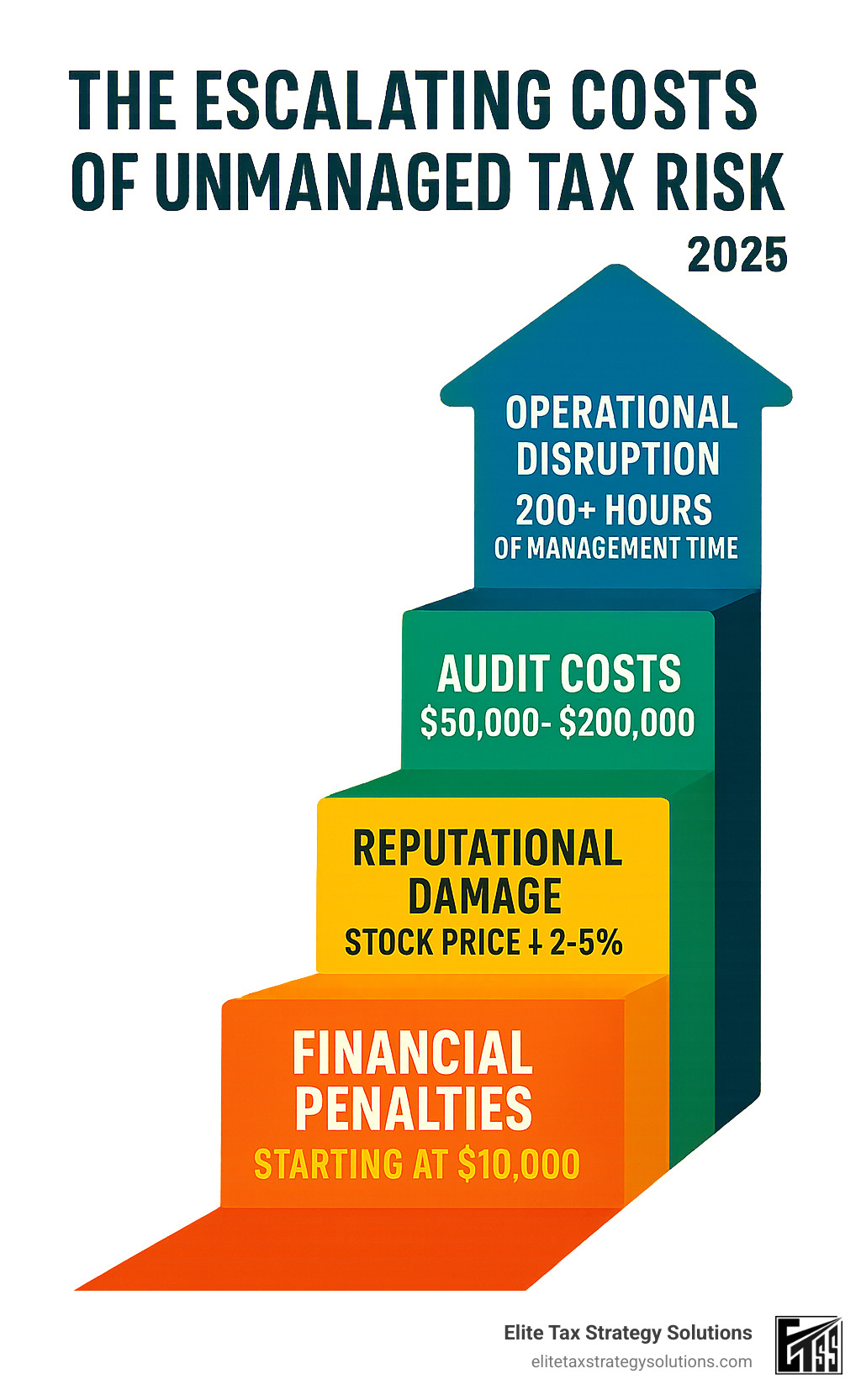
The stakes have never been higher. Only 40% of companies have implemented a formal tax risk mitigation strategy, leaving most organizations exposed to regulatory changes and increasing tax authority scrutiny. Tax authorities are deploying AI tools and improved data-sharing capabilities, leading to more aggressive audits and higher detection rates of non-compliance.
The post-pandemic shift to remote working has created unintended taxable presence in new jurisdictions, exposing companies to unplanned tax liabilities and penalties. Modern tax risks extend far beyond simple compliance failures – they include reputational damage from public tax disputes, operational blind spots from business expansion, and personal liability for senior management.
I’m David Fritch, and with 40 years of experience managing tax complexities for high-income earners and small business owners, I’ve seen how proactive tax risk management protects both financial stability and business reputation. Through my practice at Elite Tax Strategy Solutions, I help clients transform potential tax exposures into strategic advantages.
Basic tax risk management terms:
Why Tax Risk Deserves Board-Level Attention
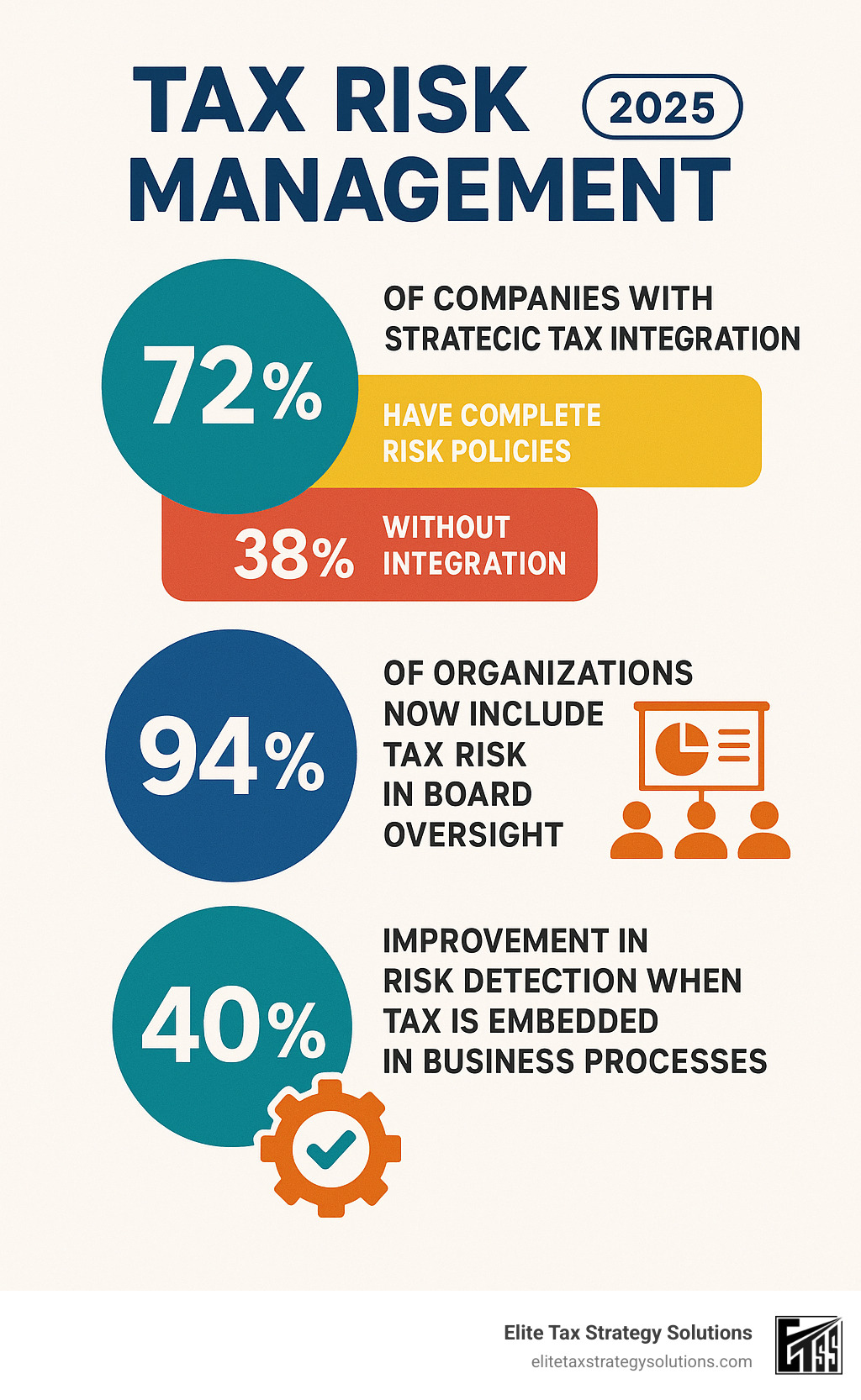
The days of treating tax as a back-office compliance function are over. With 94% of tax executives reporting that tax risk oversight is now part of board responsibilities, tax has become a strategic concern requiring C-suite engagement.
Global transparency initiatives mean your tax strategy is no longer private. Large corporations must publish annual tax strategy documents, and ESG reporting increasingly includes tax transparency metrics, making your tax risk posture a matter of public accountability.
Companies integrating tax considerations into strategic planning are nearly twice as likely to have a completed tax risk policy (72% versus 38%). This reflects the reality that effective tax risk management requires top-down commitment and cross-functional coordination.
Understanding Today’s Tax Risk Landscape
The tax world has transformed dramatically, creating a perfect storm of complexity. BEPS 2.0 initiatives are reshaping international tax rules faster than most organizations can adapt, while digitalization requirements are forcing companies to rethink their entire approach to cross-border compliance.
Remote work policies implemented during the pandemic continue to create unexpected tax obligations, while tax authorities are deploying sophisticated AI tools to detect compliance gaps. ESG reporting requirements now include tax transparency metrics, meaning your tax risk management approach directly impacts your corporate reputation and stakeholder relationships.
Tax risk exposures fall into four interconnected categories. Compliance risk involves filing errors and missed deadlines, but computational mistakes can now trigger automated penalty systems. Reputational risk has become particularly acute as aggressive tax planning strategies can quickly become public relations nightmares. Transactional risk emerges from business deals where tax implications aren’t fully considered upfront. Operational risk stems from inadequate processes, creating blind spots where departments make decisions without understanding tax consequences.
The Improving Tax Compliance Framework emphasizes that modern tax risk management must address all these interconnected exposures through systematic, enterprise-wide approaches.
Key Sources of Tax Risk for 2025
The remote work revolution has created a permanent establishment nightmare. Employees working from home in different states or countries can inadvertently trigger tax obligations in those jurisdictions. Companies often realize they have potential tax liabilities in dozens of locations simply because their telework policies weren’t properly reviewed from a tax perspective.
Transfer pricing remains one of the most significant exposure areas, especially for businesses with intercompany transactions. Tax authorities have become incredibly sophisticated in analyzing these arrangements, and documentation requirements are more stringent than ever.
Cross-border M&A activity generates complex tax implications that often surprise experienced dealmakers. Acquirers frequently find unexpected tax liabilities during due diligence, while sellers face withholding obligations they hadn’t anticipated.
Indirect taxes have become exponentially more complex with e-commerce growth. Sales and use taxes, GST, and VAT compliance across multiple jurisdictions creates a web of obligations. Changing nexus rules mean businesses can trigger tax obligations in jurisdictions where they have minimal physical presence.
Tax Authorities’ New Playbook
Tax administrations have fundamentally changed their enforcement approach. AI-powered data mining allows authorities to identify patterns across millions of returns, detecting discrepancies that would have been impossible to find manually.
International cooperation has reached unprecedented levels, with tax authorities sharing information across borders in real-time. What you report in one jurisdiction can now be instantly cross-referenced with filings in another.
Cooperative compliance programs offer reduced penalties and improved relationships with tax authorities in exchange for transparency and proactive disclosure. However, penalties have increased substantially for those who don’t participate, making proactive tax risk management essential for business survival.
Building an Effective Tax Risk Management Framework
Creating a solid tax risk management framework isn’t about checking boxes – it’s about building a system that actually protects your business while fitting naturally into how you operate.
The best frameworks start with your board’s genuine commitment. Without leadership buy-in, even sophisticated tax risk controls become expensive paperwork exercises. Your framework needs to align with your organization’s actual risk appetite.
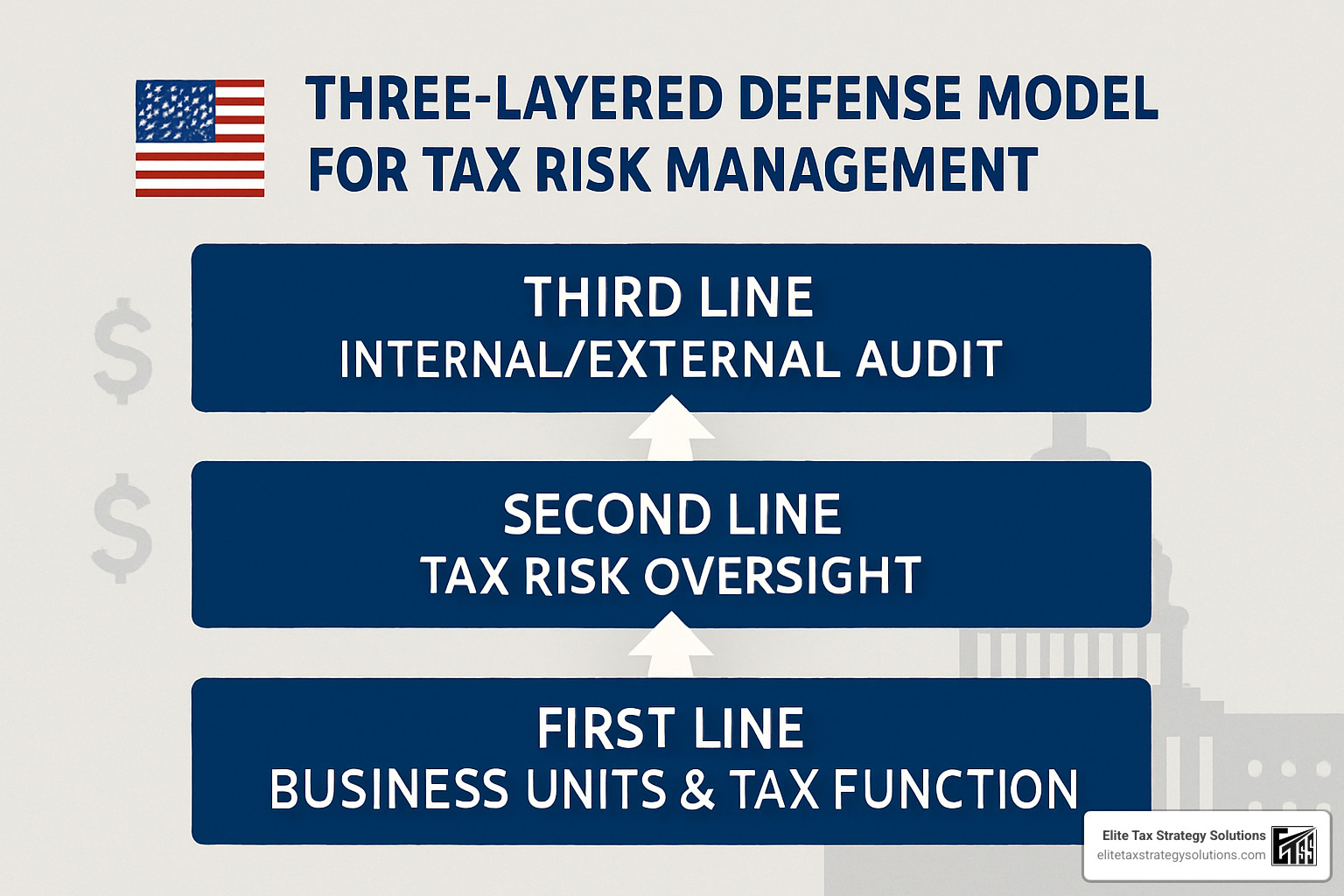
Think of tax risk management like building a house with a three-lines-of-defense model:
Your first line of defense consists of business units and tax staff handling day-to-day operations. These folks need to understand tax implications when making business decisions.
The second line provides oversight and guidance through tax risk monitoring functions that create policies and challenge decisions.
Your third line offers independent validation through internal audit or external reviewers who check whether your controls actually work in practice.
Your Tax Risk Management approach should integrate seamlessly with enterprise-wide risk management, not compete with it.
Documentation forms the backbone of everything you’re building. Tax positions need support from real, contemporaneous records – contracts, emails, board minutes, technical analysis. You can’t go back and create documentation after the fact.
Designing Your Tax Control Framework
Your tax control framework needs clearly written policies that cover all significant tax types and jurisdictions where you operate. These policies must address both routine compliance work and exceptional transactions.
Control testing separates effective frameworks from expensive filing cabinets. You need to evaluate design effectiveness (does this control actually address the risk?) and operational effectiveness (does it work consistently when people are busy or distracted?).
Many organizations implement controls that look impressive but fail in real-world conditions. Maybe the control requires approvals from someone who travels constantly, or depends on systems that crash during month-end closing.
Escalation triggers need specific dollar amounts and clear criteria. When do routine tax decisions require management approval? What dollar thresholds trigger board notification? Vague escalation protocols turn small issues into major exposures.
Creating a Tax Risk Register
A tax risk register is your comprehensive early warning system – your master list of everything that could go wrong, along with who’s responsible for making sure it doesn’t.
Your register should include the nature of each risk, affected entities and jurisdictions, financial impact assessments, and materiality evaluations. Assign clear ownership using a RA(S)CI matrix:
- Responsible: Who actually does the work
- Accountable: Who signs off and takes ultimate responsibility
- Supportive: Who provides resources or backup
- Consulted: Who provides expertise or input
- Informed: Who needs updates but isn’t directly involved
Visual tools make your register more than just another spreadsheet. Risk matrices that plot materiality against likelihood help you focus on what really matters.
The register needs continuous attention – quarterly formal reviews with monthly monitoring for significant changes. A stale risk register is worse than no register at all because it creates false confidence.
Mitigation, Monitoring & Technology
The right technology can transform your tax risk management from a constant source of stress into a smooth, predictable process. Most businesses still rely on spreadsheets and manual processes that become dangerous as operations grow across states or countries.
Automation is your friend. Modern tax technology doesn’t just speed up work – it actively prevents the human errors that cause most tax problems. When systems automatically validate data and flag unusual transactions, you catch issues while they’re still easy to fix.
The key is having clean, reliable data feeding into your systems. Even the smartest technology can’t help if you’re working with incomplete or inconsistent information.
| Reactive Approach | Proactive Approach |
|---|---|
| Respond to audit notices | Monitor compliance continuously |
| Fix errors after finding | Prevent errors through controls |
| Manual processes prone to mistakes | Automated workflows with validation |
| Limited visibility into exposures | Real-time dashboards and alerts |
| Siloed tax function | Integrated enterprise approach |
Tech That Lifts Tax Risk Management
E-invoicing systems create automatic paper trails that auditors love to see. These systems apply tax rules consistently and catch exceptions before they become problems.
AI-powered tools are getting really good at spotting patterns that humans miss. They learn what normal looks like for your business and alert you when something seems off.
Cloud-based platforms bring everything together in one place. Instead of juggling separate systems for different tax types, you get a unified view of your entire tax situation.
System integrations eliminate the manual data entry that causes so many errors. When your tax software talks directly to your accounting system, the numbers always match.
Continuous Monitoring & Scorecards
Heat maps show you at a glance where your biggest risks are hiding. Visual tools help you focus your energy where it matters most.
The best monitoring systems track both leading and lagging indicators. Leading indicators might show you’re processing more transactions manually than usual – a sign that problems could be brewing. Lagging indicators tell you about penalties after they’ve already happened.
Early-warning systems give you time to fix problems before they become expensive. They might alert you when business activities are approaching nexus thresholds, or when regulatory changes could affect your operations.
Our Tax Compliance Services focus on giving you ongoing peace of mind rather than just fixing problems after they occur. When you can see potential issues coming, you have options.
Governance, Communication & Integration
The most successful tax risk management programs don’t operate in isolation – they’re woven into how organizations make decisions and manage risk across the board.
Board oversight has evolved dramatically. Your board members need regular updates on tax risk positions, but they don’t need to become tax experts. The key is presenting information that connects tax risks to business outcomes they understand – financial performance, regulatory compliance, and reputation management.
Cross-functional teams make all the difference in preventing tax surprises. When procurement negotiates vendor contracts without considering sales tax implications, or when HR sets up remote work policies without thinking about permanent establishment risks, you’re setting yourself up for problems.
The magic happens when tax considerations become part of strategic planning from the beginning. Companies that integrate tax thinking into expansion plans and operational changes consistently avoid expensive surprises that catch their competitors off guard.
ESG reporting requirements are increasingly including tax transparency metrics. Your stakeholders are paying attention to how responsibly you manage your tax obligations. This isn’t just about compliance anymore; it’s about corporate citizenship and long-term reputation.
The Tax risk management and governance guide offers excellent frameworks for weaving tax risk into your broader governance structures.
Reporting Tax Risk to Senior Stakeholders
Dashboard reporting should tell a story, not overwhelm with data. Your executives need to understand what’s happening, what it means for the business, and what actions are being taken. Traffic light systems work well – green means we’re good, yellow means we’re watching something closely, and red means we need immediate attention.
Scenario analysis helps leadership understand the “what-ifs.” What happens if that aggressive tax position gets challenged? How would proposed legislation affect our bottom line? When you can paint these pictures clearly, decision-makers can plan accordingly.
Embedding Tax Into Enterprise Risk Management
Alignment with enterprise risk management ensures tax risks get appropriate attention alongside other business risks. When you evaluate tax risks using the same probability and impact scales as operational risks, they naturally find their proper place in management priorities.
Culture and training extend tax risk awareness beyond the tax department. Every employee making decisions with tax implications needs to understand when to ask for help.
Incentive structures should reward proactive thinking, not just compliance box-checking. When performance management systems recognize employees who identify tax risks early, you create a culture that prevents problems rather than just fixing them.
Proactive Tools: Advisors, Cooperative Compliance & Insurance
Sometimes the smartest tax risk management strategy involves knowing when to bring in outside help. External advisors offer specialized expertise that even the best internal teams can’t match across every tax area.
Think of external advisors as your specialized surgical team – you want them for complex procedures, not routine checkups. They bring fresh perspectives and deep technical knowledge that can spot risks your internal team might miss.
Cooperative compliance agreements represent a fundamental shift in how forward-thinking companies work with tax authorities. Instead of the traditional adversarial relationship, these programs create partnerships based on transparency and proactive communication.
You agree to share information about your tax positions in exchange for reduced audit risk and more reasonable treatment when disputes arise. Tax authorities get the visibility they want, and you get predictability and reduced penalties.
These programs work especially well for companies with complex international operations. We’ve seen clients reduce their audit frequency by 60% and their penalty exposure by even more through well-structured cooperative agreements.
Tax insurance has evolved far beyond basic coverage. Modern policies can protect specific tax positions, cover merger and acquisition risks, and provide synthetic coverage for uncertain tax treatments. But insurance should improve your tax risk management strategy, not replace good planning.
The key to dispute readiness is simple: assume you’ll be audited and prepare accordingly. Our Tax Audit Preparation services help clients organize their documentation before problems arise, not after audit notices arrive.

Leveraging External Support for Robust Tax Risk Management
Specialist reviews provide independent assessment of your tax positions and risk management processes. Think of these as health checkups for your tax function – they identify problems before they become serious and benchmark your practices against industry standards.
The best specialist reviews provide practical recommendations for improvement and help prioritize your efforts based on risk and resource constraints.
Managed services can handle routine compliance work, freeing your internal team to focus on strategic planning and risk management. This approach works particularly well for specialized areas like international compliance.
However, you must maintain oversight even with managed services. The service provider needs to understand your business, your risk tolerance, and your strategic objectives.
When to Consider Tax Insurance
Warranty and indemnity (W&I) policies in merger and acquisition transactions cover tax liabilities that traditional deal structures can’t adequately address. These policies are particularly valuable when seller indemnification is limited or when buyers want to reduce escrow requirements.
Synthetic tax insurance covers specific tax positions where uncertainty exists about treatment or outcomes. For example, if you’re taking an aggressive but defensible position on a complex transaction, synthetic coverage can provide confidence to proceed.
Policy pitfalls include coverage exclusions that might not be obvious, strict notification requirements, and coordination issues with other insurance policies. The most common mistake is buying insurance as standalone protection rather than integrating it with your broader tax risk management approach.
Frequently Asked Questions about Tax Risk Management
How do we quantify tax risk across multiple jurisdictions?
The challenge of measuring tax risk management across different countries and states feels overwhelming at first. But with the right approach, you can create a clear picture of where your biggest exposures lie.
Start by mapping every location where your business might have tax obligations. This includes anywhere you might have created nexus through employees, sales, or business activities. Remote work has made this exercise more critical than ever.
Build a standardized risk matrix that works across all jurisdictions. We recommend a 5×5 grid that plots probability against financial impact. For probability, consider factors like how complex the local tax rules are, whether you’ve been audited there before, and how much business activity you have in that location.
The impact side includes potential tax bills, penalty exposure, and how much operational chaos an audit would create. A small tax adjustment in a jurisdiction where you don’t speak the language can consume enormous management time and resources.
Weight everything based on materiality that makes sense for your specific situation. Your risk tolerance should drive these thresholds, not generic benchmarks. The key is consistency – use the same criteria across all jurisdictions so you can actually compare and prioritize your risks effectively.
What technologies give the fastest ROI for tax risk monitoring?
When clients ask about technology investments for tax risk management, I always point them toward solutions that prevent problems rather than just detect them after the fact.
Automated data validation systems typically deliver the fastest payback. These tools catch calculation errors, missing information, and inconsistent data entry before returns get filed. One prevented penalty easily pays for a year of software licensing.
Dashboard reporting comes in a close second for return on investment. Instead of spending hours each month pulling data from different systems and creating status reports, automated dashboards give you real-time visibility into compliance deadlines, outstanding issues, and key risk indicators.
Workflow management systems might seem less exciting, but they’re incredibly valuable for ensuring consistent processes. They make sure the right approvals happen, documentation gets saved in the right places, and nothing falls through the cracks when people go on vacation or change jobs.
Focus on tools that solve your biggest current pain points rather than the most sophisticated options available.
How often should a tax risk register be updated?
Your tax risk register is only valuable if it reflects current reality, which means it needs regular attention to stay relevant.
Quarterly formal updates work well for most organizations, with lighter monthly check-ins to catch significant changes. Tax laws, business operations, and risk factors change too quickly for annual updates to be useful.
Some events require immediate register updates regardless of your regular schedule. New business activities like opening locations or hiring employees in different states can create instant tax obligations. Regulatory changes, audit developments, and major transactions all need to be reflected right away.
Don’t forget to incorporate lessons learned from your own experiences. When you go through an audit, settle a dispute, or find a compliance gap, those insights should feed back into your risk assessment. The register should feel like a living document that actually helps with decision-making, not a compliance exercise that sits on a shelf gathering dust.
Conclusion
Think of tax risk management as your business’s insurance policy against the unexpected. When done right, it doesn’t just protect you from problems – it actually creates opportunities for smarter decision-making and competitive advantages.
Businesses that get ahead of tax risks consistently outperform those that react to problems after they happen. The right framework transforms overwhelming complexity into manageable, strategic processes.
Your tax risk management approach should feel like a natural extension of how you already run your business. The governance structures, technology tools, and monitoring systems we’ve discussed aren’t bureaucratic add-ons – they’re practical solutions that make your operations smoother and more predictable.
Every organization’s needs are different. The key is building your framework around your specific circumstances, not trying to copy someone else’s approach.
At Elite Tax Strategy Solutions, we’ve spent decades helping high-income earners and closely held businesses steer these exact challenges. What sets our approach apart is that we focus on preventing tax problems rather than just fixing them after they surface.
The financial benefits speak for themselves. Our clients consistently see reduced compliance costs, fewer surprise tax bills, and better relationships with tax authorities. But the real value goes deeper – it’s the peace of mind that comes from knowing your tax position is solid and your business decisions are informed by complete information.
The investment you make in robust tax risk management today pays dividends for years to come. You’ll sleep better knowing that regulatory changes won’t blindside you, that your business expansion plans account for tax implications, and that your organization is prepared for whatever questions tax authorities might ask.
The tax landscape will only get more complex. The organizations that thrive are those that treat these changes as opportunities to get better, not threats to worry about.
Ready to build a tax risk management system that actually works for your business? Our Proactive Tax Management services are designed around your specific situation and goals. We’ll help you create a framework that fits your organization and grows with you as your business evolves.
Your next step is simple: take an honest look at your current tax risk management approach and ask yourself if it’s really protecting your business the way it should. If you’re not completely confident in your answer, let’s talk about how we can help you build something better.