
Why Smart Tax Planning Tips Can Save You Thousands
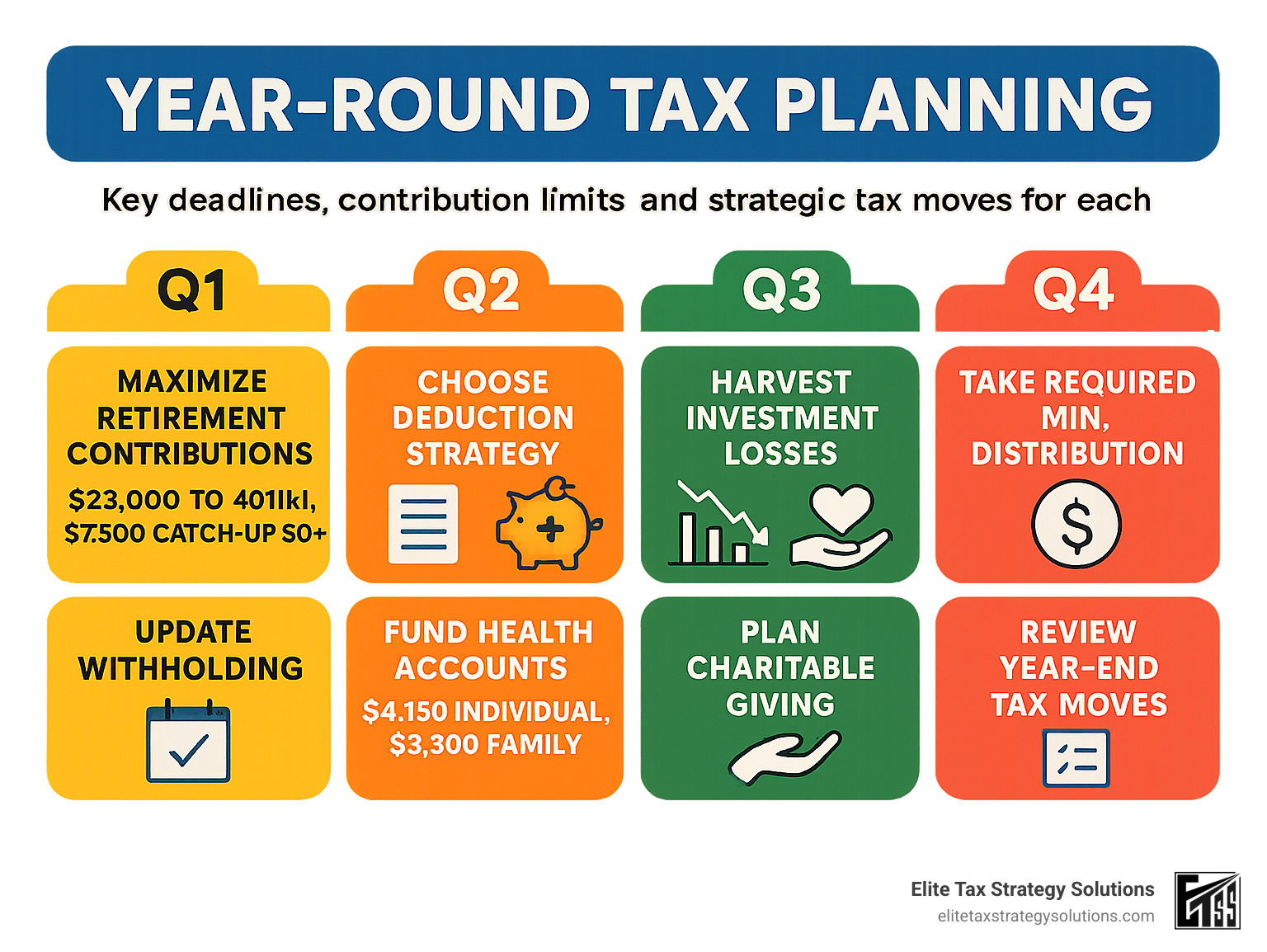
Tax planning tips are strategies that help you legally reduce your tax burden through careful timing, strategic deductions, and smart financial decisions throughout the year. Here are the most impactful tax planning tips for 2024:
Quick Tax Planning Checklist:
– Maximize retirement contributions: $23,000 to 401(k) + $7,500 catch-up if 50+
– Choose your deduction strategy: Standard deduction ($14,600 single, $29,200 married) vs itemizing
– Harvest investment losses: Offset gains and up to $3,000 ordinary income
– Fund health accounts: HSA limits $4,150 individual, $8,300 family
– Update W-4 withholding: Avoid surprises and penalties
– Plan charitable giving: Bundle donations to exceed standard deduction
– Take required distributions: RMDs start at age 73, penalties reduced to 25%
Most taxpayers wait until tax season to think about their tax bill – but that’s when it’s too late to make meaningful changes. The biggest tax savings come from planning moves throughout the year, not scrambling in April.
Whether you’re earning $200,000 as a professional or running a small business with millions in revenue, the right strategies can save you thousands. The key is understanding which moves work for your specific situation and timing them correctly.
I’m David Fritch, and I’ve spent 40 years helping high-income earners and business owners steer complex tax planning tips through my CPA practice and law firm. My focus has always been showing clients how to keep more of what they earn while staying completely compliant with tax regulations.
Key terms for tax planning tips:
– salary tax planning
– taxation strategies
– proactive tax
Top Tax Planning Tips for 2024
The U.S. uses a progressive tax system with seven brackets ranging from 10% to 37%, but you don’t pay your highest rate on every dollar you earn. For 2024, the standard deduction jumped to $14,600 for single filers and $29,200 for married couples filing jointly.
| 2024 Tax Brackets & Standard Deductions | Single Filers | Married Filing Jointly |
|---|---|---|
| Standard Deduction | $14,600 | $29,200 |
| 10% Tax Bracket | Up to $11,600 | Up to $23,200 |
| 12% Tax Bracket | $11,601 – $47,150 | $23,201 – $94,300 |
| 22% Tax Bracket | $47,151 – $100,525 | $94,301 – $201,050 |
Understand Your Tax Bracket & Marginal Rates
You pay 10% on your first $11,600, then 12% on everything from $11,601 to $47,150, and 22% only on amounts above that. This is why your “effective” tax rate is much lower than your “marginal” rate.
When planning retirement contributions, your marginal rate tells you exactly how much you’ll save. If you’re in the 24% bracket, every $1,000 you put into a traditional retirement account saves you $240 in federal taxes.
Decide Between Standard Deduction and Itemizing
About 90% of taxpayers now use the standard deduction, but high earners who own homes in states with income taxes might benefit from itemizing. Key itemized deductions include mortgage interest on loans up to $750,000, state and local taxes (capped at $10,000), medical expenses exceeding 7.5% of income, and charitable contributions.
Leverage Overlooked Deductions & Credits
Tax credits reduce your bill dollar-for-dollar. The energy-efficient home improvement credit gives you 30% back on qualifying expenses through 2032. The clean vehicle credit provides up to $7,500 for new EVs. Families often overlook the Child and Dependent Care Credit covering up to $6,000 of expenses, and the Saver’s Credit can add up to $1,000 for retirement contributions.
Optimize Deductions vs. Credits: Keep More of Your Money
Deductions reduce taxable income, while credits directly cut your tax bill dollar-for-dollar. A $1,000 deduction saves someone in the 24% bracket $240, but a $1,000 credit saves the full $1,000.
More info about Optimizing Tax Deductions
Smart taxpayers use bunching strategies – concentrating deductible expenses into years when they’ll have the biggest impact, especially for charitable giving and medical expenses.
Track, Organize & Retain Tax Records

The IRS has three years to audit returns, extending to six years for significant underreporting. Keep tax records for seven years minimum. Create digital folders for income documents, deduction receipts, investment records, and property records.
Form 4868 gives you an automatic six-month extension to October 15, but you still must pay taxes owed by April 15.
Charitable Giving Tactics, Including Donor-Advised Funds
The bunching strategy concentrates multiple years of donations into a single tax year. Instead of giving $8,000 annually, consider $16,000 every other year to exceed the standard deduction threshold.
Qualified Charitable Distributions (QCDs) let taxpayers over 70½ send up to $100,000 directly from IRAs to charity, satisfying RMDs without adding taxable income.
Donor-advised funds provide immediate tax deductions with flexibility to choose charities later. Contribute appreciated stock held over a year to deduct full market value while avoiding capital gains taxes.
Master Gift & Estate Exclusions Before 2026 Sunset
For 2024, give $18,000 per person without touching your $13.61 million lifetime exemption. These amounts sunset after 2025, potentially dropping to around $7 million. Generation-skipping transfer trusts help families lock in current exemptions before they disappear.
Smart Retirement & Health Account Strategies
Retirement and health accounts offer incredible tax planning tips that slash your current tax bill while building future wealth. For 2024, 401(k) limits increased to $23,000 plus $7,500 catch-up if 50+.
More info about Tax Saving Strategies for High Income Earners
Max Out 401(k) & IRA Contributions
Traditional 401(k) contributions reduce taxable income dollar-for-dollar. If you’re in the 24% bracket and contribute $10,000, you save $2,400 in federal taxes.
Roth contributions use after-tax dollars but provide tax-free growth and withdrawals in retirement. IRA limits for 2024 are $7,000 with $1,000 catch-up for 50+.
The backdoor Roth IRA lets high earners make non-deductible traditional IRA contributions, then convert to Roth, sidestepping income limits.
Harness Health Savings & Flexible Spending Accounts
HSAs offer triple tax benefits – deduction going in, tax-free growth, and tax-free withdrawals for medical expenses. For 2024, contribute $4,150 individual or $8,300 family coverage, plus $1,000 catch-up if 55+.
After 65, HSAs work like traditional IRAs for non-medical withdrawals, but medical expenses remain tax-free forever.
FSAs let you set aside pre-tax dollars for medical expenses, with up to $640 carryover to 2025. Dependent care FSAs allow $5,000 annually for childcare or elder care.
Steer Required Minimum Distributions (RMDs)
RMDs now start at age 73 (up from 72), with the age increasing to 75 in 2033. Penalties dropped from 50% to 25% of the missed amount, further reducing to 10% if corrected within two years.
Scientific research on RMD rules
Inherited IRAs now require most non-spouse beneficiaries to empty accounts within 10 years.
Tap 529 Plans & Dependent Care FSAs
529 plans provide tax-free growth for education expenses. The “super-funding” strategy lets you contribute $90,000 for individuals or $180,000 for couples using five years of gift exclusions.
529s now cover K-12 tuition (up to $10,000 annually), apprenticeships, and student loan repayments (lifetime limit $10,000).
Investment Moves: Harvest Losses & Manage Your Portfolio

Tax-loss harvesting involves selling declining investments to offset capital gains and reduce your tax burden. You can offset up to $3,000 of ordinary income annually, with excess losses carrying forward indefinitely.
The wash-sale rule prevents claiming losses if you repurchase the same security within 30 days. However, you can immediately buy similar investments to maintain market exposure.
Tax-Loss Harvesting 101
Losses offset gains in a specific order: short-term losses offset short-term gains first, then long-term losses offset long-term gains. Remaining losses can offset the opposite type.
Example: $12,000 gain offset by $8,000 loss leaves $4,000 taxable gain. Additional $7,000 losses eliminate all gains plus $3,000 ordinary income, with $4,000 carrying forward.
Use broad market ETFs as temporary replacements to avoid wash-sale violations while staying invested.
Align Asset Location for Tax Efficiency
Tax-inefficient investments like REITs and bonds belong in tax-deferred accounts. Tax-efficient investments like index funds work well in taxable accounts.
Municipal bonds provide federally tax-free income, often state tax-free too. For high earners, a 4% municipal bond might equal a 6-7% taxable bond.
High-growth investments work best in Roth accounts where appreciation compounds tax-free.
Plan for Capital Gains & 0% Bracket Opportunities
For 2024, single filers with taxable income up to $47,025 and married couples up to $94,050 pay 0% on long-term capital gains.
Installment sales spread gains over multiple years, avoiding higher tax brackets. Donating appreciated stock held over one year provides double benefits – full market value deduction while avoiding capital gains taxes.
Year-End Moves & Withholding Adjustments
Most tax strategies must be completed by December 31st. The taxpayers who save the most are those who plan ahead, not those scrambling in December.
More info about Proactive Tax Planning
Update Your W-4 & Estimated Taxes
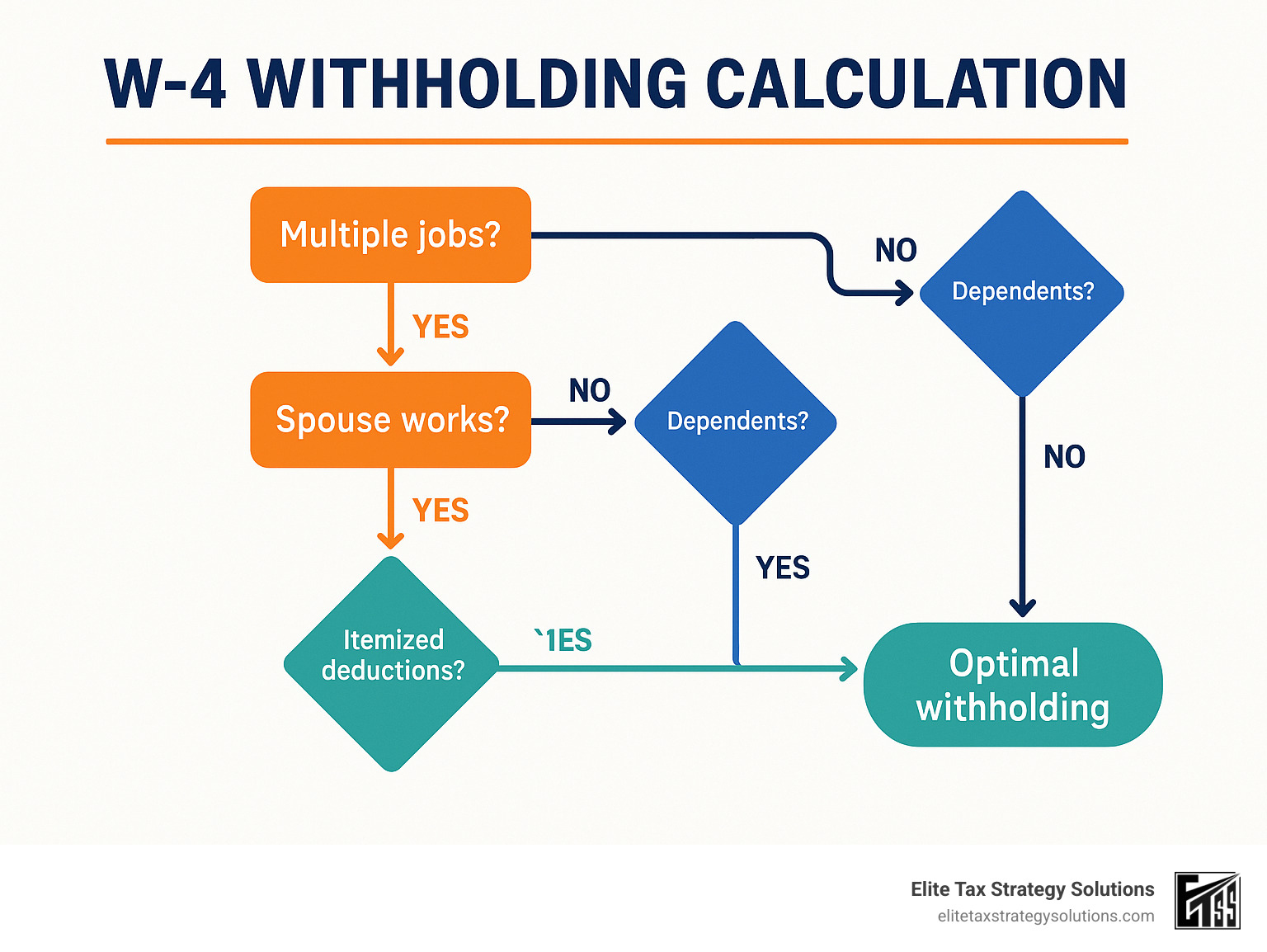
Update your W-4 when you marry, have children, start second jobs, or face other major life changes. The IRS Withholding Estimator handles complex situations involving multiple jobs or investment income.
Form 2210 helps business owners with seasonal income annualize their payments, reducing underpayment penalties.
The safe harbor rule protects against penalties if you pay 100% of last year’s tax (110% if prior-year AGI exceeded $150,000).
Execute Time-Sensitive December 31 Actions
401(k) contributions must be completed by December 31st. Consider increasing contribution percentages for final paychecks to maximize tax savings.
FSA balances disappear under “use-it-or-lose-it” rules, though up to $640 can carry over. Stock up on qualifying medical supplies or schedule postponed appointments.
RMDs can’t be delayed past December 31st without triggering penalties. Consider qualified charitable distributions if you don’t need the income.
Charitable contribution bunching concentrates multiple years of giving into the current year, potentially pushing itemized deductions above the standard deduction threshold.
Avoid Underpayment Penalties & Keep Cash Flowing
Pay 90% of current year’s tax or match last year’s payment (110% for high earners) to avoid penalties.
Quarterly estimated payments are due January 15th, April 15th, June 15th, and September 15th.
The annualized income method on Form 2210 helps those with fluctuating income adjust payments based on when income was actually earned.
Frequently Asked Questions about Tax Planning Tips
What’s the difference between a tax deduction and a tax credit?
Tax deductions reduce your taxable income, while tax credits reduce your actual tax bill dollar-for-dollar. If you’re in the 22% bracket, a $1,000 deduction saves $220, but a $1,000 credit saves the full $1,000. Credits are almost always more valuable than deductions.
When should I update my W-4 to avoid surprises?
Update your W-4 when you marry, divorce, have children, start second jobs, or when your spouse begins working. Also update when you receive significant non-wage income or make other changes affecting your deductions. Owing under $1,000 at tax time is often better than getting large refunds.
How does the wash-sale rule affect tax-loss harvesting?
You cannot claim a tax loss if you buy the same security within 30 days before or after selling at a loss. However, you can immediately purchase similar securities to maintain market exposure. Disallowed losses get added to the replacement security’s cost basis, preserving the tax benefit for future sales.
Conclusion
Smart tax planning tips aren’t about finding loopholes – they’re about understanding the tax code well enough to legally keep more of what you earn through careful planning and strategic timing.
The difference between taxpayers who save thousands and those who overpay comes down to when they start thinking about taxes. While most wait until April, successful tax planners make moves throughout the year.
Understanding your marginal tax rate becomes your compass for every financial decision. When you know each additional dollar gets taxed at 24%, you can quickly calculate whether that $10,000 traditional 401(k) contribution will save you $2,400 in taxes.
The strategies we’ve covered work because they’re built into the tax code intentionally. Congress designed retirement account incentives to encourage saving. HSAs help families manage medical costs. Tax planning tips help you take advantage of what’s already available.
Timing remains crucial for almost every tax strategy. December 31st deadlines for 401(k) contributions, RMDs, and charitable giving mean waiting until tax season eliminates most options.
At Elite Tax Strategy Solutions, we’ve watched clients transform their financial outcomes through consistent, year-round attention to tax planning. A business owner implementing proper retirement planning and loss harvesting might save $15,000 annually. A high-earning professional optimizing W-4 withholding and maximizing HSA contributions could keep an extra $8,000.
Your specific situation determines which strategies matter most. Young professionals might focus on Roth contributions. Those nearing retirement could prioritize tax-loss harvesting and charitable giving. Business owners often benefit from more complex approaches.
The tax landscape keeps evolving. Tax Cuts and Jobs Act provisions expire after 2025. Estate tax exemptions will likely decrease. New legislation could change retirement account rules.
More info about Tax Planning Strategies
The best tax planning tips are worthless unless you actually use them. Start with strategies offering the biggest impact – usually maximizing retirement contributions and getting withholding right. Build from there as you become more comfortable with tax planning concepts.
Whether you handle tax planning yourself or work with professionals, the key is starting now and staying consistent. Your future self will appreciate every dollar saved through smart, proactive planning.