Tax planning strategies for high income earners are crucial for navigating the complexities of tax rules and reducing the ever-looming tax burden. For high-income individuals, effectively managing tax liabilities is not just about compliance; it’s about strategic financial planning. Here are some quick tips that can make a significant impact:
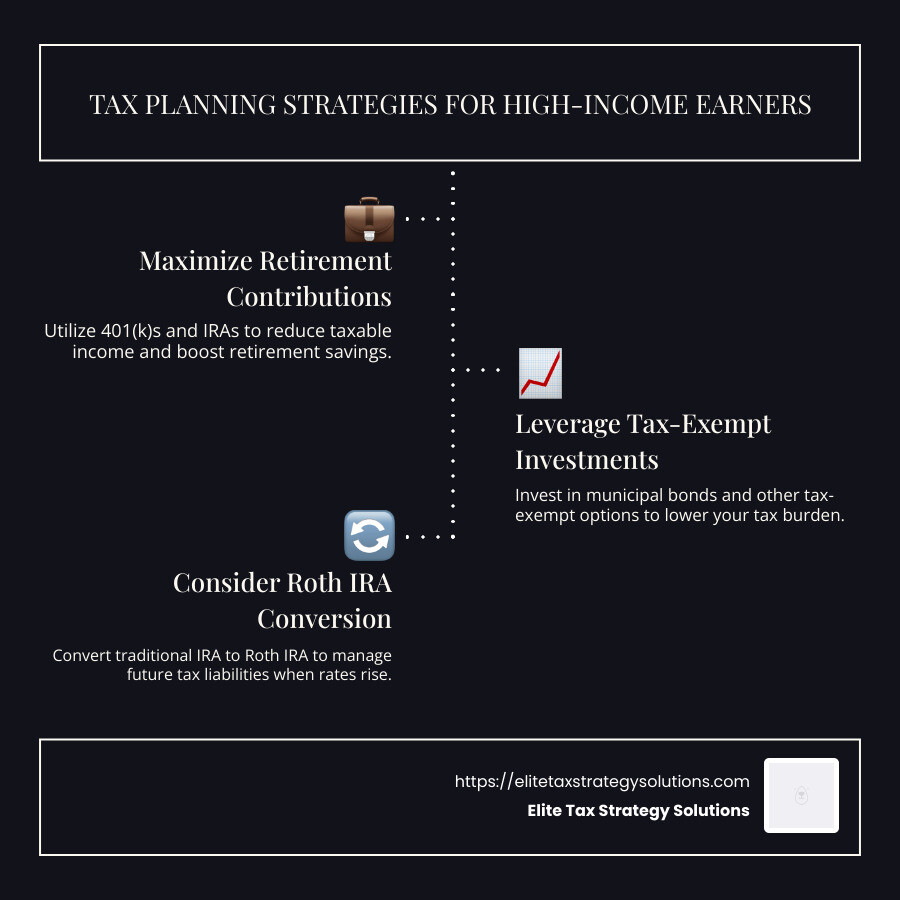
- Maximize retirement account contributions: Use 401(k)s and IRAs to lower taxable income.
- Leverage tax-exempt investments: Municipal bonds and other tax-exempt options can save.
- Consider a Roth IRA conversion: This can lower future tax bills when rates are expected to rise.
- Itemize deductions: Make sure to take full advantage of all possible deductions like mortgage interest and charitable contributions.
High-income earners face unique tax challenges due to their position in the highest tax brackets, often resulting in additional layers of complexity with new legislation and IRS guidelines. As tax laws change, staying informed and proactive becomes essential in reducing the tax burden and achieving long-term financial security.
I’m David Fritch, with 40 years of experience in owning a law firm and CPA practice, specializing in tax planning strategies for high income earners. I’ve spent my career helping clients, from small business owners to high-net-worth individuals, effectively optimize their tax savings through custom strategies.
Simple guide to tax planning strategies for high income earners terms:
- advanced tax planning strategies
- wealth management tax planning
- retirement tax strategies for high income earners
Understanding Tax Brackets for High-Income Earners
Navigating tax brackets is crucial for high-income earners. These brackets determine your tax obligations based on your taxable income. The IRS categorizes high-income earners as those who fall into the top three tax brackets.
Here’s a quick look at the tax brackets for 2024:
| Tax Bracket | Single | Married Filing Jointly |
|---|---|---|
| 32% | $197,301 – $250,525 | $394,601 – $501,050 |
| 35% | $250,526 – $626,350 | $501,051 – $751,600 |
| 37% | $626,351 or more | $751,601 or more |
Taxable income is your total income minus any deductions and exemptions. It’s the amount you actually pay taxes on. Understanding your taxable income is crucial because it helps you know which tax bracket you fall into.
IRS Definition
The IRS identifies high-income earners as those whose taxable income places them in the upper tax brackets. In 2024, this means earning more than $197,300 if you’re single, or over $394,600 if you’re married and filing jointly.
High-income earners often have complex financial portfolios. This can include salaries, bonuses, investment income, and business income. Each of these is taxed differently, adding to the complexity of calculating your tax liability.
Why Tax Brackets Matter
Knowing your tax bracket helps you plan better. It allows you to:
- Estimate your tax liability: Knowing your bracket helps you predict how much you owe.
- Plan for deductions: If you’re close to the next bracket, deductions can lower your taxable income and potentially drop you into a lower bracket.
- Strategize investments: Certain investments, like municipal bonds, can yield tax-free income, which might keep you in a lower bracket.
Understanding tax brackets is a key part of effective tax planning. It’s not just about paying what’s due, but about strategically reducing your taxable income, so you keep more of what you earn.
Tax Planning Strategies for High Income Earners
When it comes to tax planning strategies for high-income earners, there are several key approaches that can help reduce your tax burden. Let’s explore some effective strategies: retirement contributions, Roth IRA conversions, and investing in municipal bonds.
Retirement Contributions
Contributing to retirement accounts is one of the simplest ways to lower your taxable income. For 2025, you can contribute up to $23,500 to 401(k) and 403(b) accounts. If you’re over 50, you can make an additional $7,500 catch-up contribution, allowing you to save up to $31,000 annually.
These contributions reduce your taxable income now, and the money grows tax-deferred. This means you won’t pay taxes on the money until you withdraw it during retirement, ideally when you’re in a lower tax bracket.
Roth IRA Conversions
A Roth IRA conversion allows you to convert a traditional IRA into a Roth IRA. While you’ll pay taxes on the conversion amount now, your future withdrawals will be tax-free. This strategy can be particularly beneficial if you expect to be in a higher tax bracket in the future.
Pro Tip: Consider converting when your income is temporarily low, or when tax rates are expected to rise. This can minimize the taxes you pay on the conversion.
Municipal Bonds
Municipal bonds are another tax-efficient investment option. These bonds are issued by local governments to fund public projects. The big advantage? The interest income is often exempt from federal taxes, and sometimes state and local taxes too, if you live in the issuing state.
For high-income earners, this tax-free interest can be a strategic way to generate income without bumping into higher tax brackets. That municipal bonds typically offer lower interest rates compared to taxable bonds. However, their tax-equivalent yield can be quite attractive, especially for those in higher tax brackets.
These strategies are just the tip of the iceberg when it comes to tax planning for high-income earners. By leveraging retirement contributions, considering Roth IRA conversions, and investing in municipal bonds, you can effectively reduce your taxable income and improve your financial well-being.
Maximizing Deductions and Credits
High-income earners have several opportunities to reduce their tax liability by maximizing deductions and credits. Let’s break down some key strategies: itemized deductions, charitable contributions, and health savings accounts.
Itemized Deductions
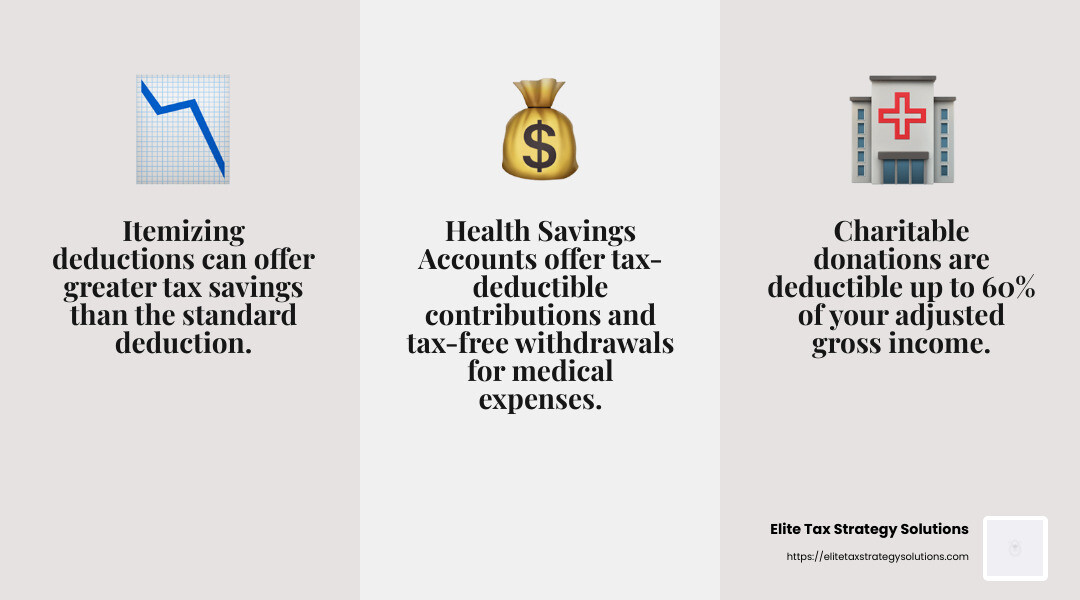
While the standard deduction is an option, itemizing your deductions can often lead to greater tax savings, especially if you have significant expenses. Some common itemized deductions include:
-
Mortgage Interest: You can deduct interest on up to $750,000 of mortgage debt for homes purchased after December 15, 2017.
-
State and Local Taxes (SALT): This deduction is capped at $10,000, but it can still offer savings if you live in a high-tax state.
-
Medical Expenses: If your medical expenses exceed 7.5% of your adjusted gross income, they are deductible.
Charitable Contributions
Giving to charity is not only fulfilling but can also provide substantial tax benefits. You can deduct cash donations up to 60% of your adjusted gross income. Consider these strategies:
-
Donor-Advised Funds: By contributing to a donor-advised fund, you can take an immediate tax deduction and distribute the funds to charities over time.
-
Private Foundations: Establishing a private foundation allows you to make large charitable contributions, providing tax deductions and the ability to manage your philanthropic efforts.
Health Savings Accounts (HSAs)
If you have a high-deductible health plan, an HSA can be a powerful tool. Contributions are tax-deductible, the money grows tax-free, and withdrawals for qualified medical expenses are tax-free. For 2025, the contribution limits are $4,300 for individuals and $8,550 for families.
Quick Tip: Max out your HSA contributions each year to fully benefit from these tax advantages.
By leveraging these strategies to maximize deductions and credits, high-income earners can effectively reduce their taxable income and improve their overall tax efficiency. In the next section, we’ll dig into investment strategies for tax efficiency to further optimize your financial situation.
Investment Strategies for Tax Efficiency
High-income earners can significantly reduce their tax burden by adopting smart investment strategies for tax efficiency. Let’s explore some key options: tax-exempt investments, dividend-paying companies, and opportunity zones.
Tax-Exempt Investments
Investing in tax-exempt securities can be a game-changer for high-income earners. These investments generate income that is not subject to federal taxes, and sometimes state taxes too. Here are some popular options:
-
Municipal Bonds: Issued by state and local governments, the interest from these bonds is often exempt from federal income tax. In some cases, if you live in the state where the bond is issued, you might also be exempt from state taxes.
-
Tax-Exempt Mutual Funds: These funds invest in a diversified portfolio of municipal bonds, offering both tax benefits and diversification.
Pro Tip: While tax-exempt investments can lower your tax bill, always consider your overall investment goals and risk tolerance.
Dividend-Paying Companies
Investing in companies that pay qualified dividends is another strategy to improve tax efficiency. Qualified dividends are taxed at the lower capital gains tax rates, which are 0%, 15%, or 20%, depending on your income level.
-
Blue-Chip Stocks: These are large, well-established companies known for stable earnings and reliable dividends.
-
Dividend Growth Funds: These funds focus on companies with a history of increasing dividends, providing both income and potential for capital appreciation.
Quick Insight: Reinvesting dividends can lead to compound growth, boosting your long-term returns while maintaining tax efficiency.
Opportunity Zones
Opportunity Zones offer a unique chance to defer or even eliminate taxes on capital gains. These zones are designated areas that encourage investment to spur economic development.
-
Tax Deferral: By investing in a Qualified Opportunity Fund, you can defer taxes on capital gains until 2026 or until you sell the investment, whichever is earlier.
-
Tax Exclusion: If you hold the investment for at least 10 years, you can exclude any additional gains from taxation.
Important Note: Opportunity Zone investments can be complex and require careful planning. Consult with a tax advisor to ensure alignment with your financial goals.
By incorporating these investment strategies for tax efficiency, high-income earners can optimize their portfolios while minimizing their tax liabilities. Next, we’ll address some frequently asked questions about tax planning for high earners to further clarify these strategies.
Frequently Asked Questions about Tax Planning for High Earners
How do high wage earners reduce taxes?
High wage earners have several options to reduce their tax liabilities. One of the most effective methods is maximizing contributions to retirement accounts like a Traditional 401(k) or IRA. Contributions to these accounts reduce your taxable income, which can lower your overall tax bill. For instance, contributing $23,000 to a Traditional 401(k) can significantly decrease your taxable income for the year.
Another strategy is a Roth conversion, where you convert a traditional IRA into a Roth IRA. This move can be beneficial if you expect to be in a higher tax bracket in the future, as withdrawals from a Roth IRA are tax-free in retirement.
Charitable donations also offer tax advantages. By donating to qualifying organizations, you can reduce your taxable income. Cash contributions can be deducted up to 60% of your adjusted gross income (AGI).
What does the IRS consider high-income earners?
The IRS defines high-income earners as individuals who report $200,000 or more in total income on their tax return. Taxable income is the key factor, which is your total income minus any deductions and exemptions. Understanding where you fall within the IRS tax brackets is crucial for effective tax planning. For 2024, the tax rate thresholds have increased slightly, which can be beneficial for high-income earners.
How can I reduce my taxes in a high-income year?
In a high-income year, strategic use of tax deductions and asset allocation can help reduce your tax burden. Start by maximizing deductions through retirement contributions and itemizing expenses like mortgage interest and property taxes.
Consider strategic investments in tax-efficient vehicles, such as municipal bonds or tax-exempt mutual funds, to lower your taxable income. Additionally, harvesting tax losses by selling underperforming investments can offset gains and reduce taxable income.
By understanding these tax planning strategies for high income earners, you can effectively manage your tax liabilities and preserve more of your hard-earned income.
Next, we’ll explore the conclusion and how Elite Tax Strategy Solutions can assist you in achieving financial stability through expert tax optimization.
Conclusion
Achieving financial stability as a high-income earner requires more than just earning a substantial salary. It involves smart tax planning and strategic financial decisions. Tax optimization is key to ensuring you don’t pay more than necessary. By understanding and utilizing various tax strategies, you can significantly reduce your tax liabilities and keep more of your income.
At Elite Tax Strategy Solutions, we specialize in helping high-income earners like you steer the complex world of taxes. Our proactive approach focuses on maximizing tax savings while ensuring compliance with current tax laws. We tailor our strategies to fit your unique financial situation, helping you align your tax planning with your long-term goals.
Our services are designed to provide you with peace of mind, knowing that your finances are optimized for success. Whether you’re in Jasper, Indiana, or in suburban areas near major cities, our team is ready to assist you.
For more information on how we can help you achieve financial stability through expert tax optimization, visit our Innovative Tax Planning page. Let’s work together to secure your financial future.