Tax planning for partnerships is a critical process that allows business owners to optimize financial outcomes and meet long-term financial goals. If you’re exploring tax strategies for your partnership or LLC, here’s a quick guide:
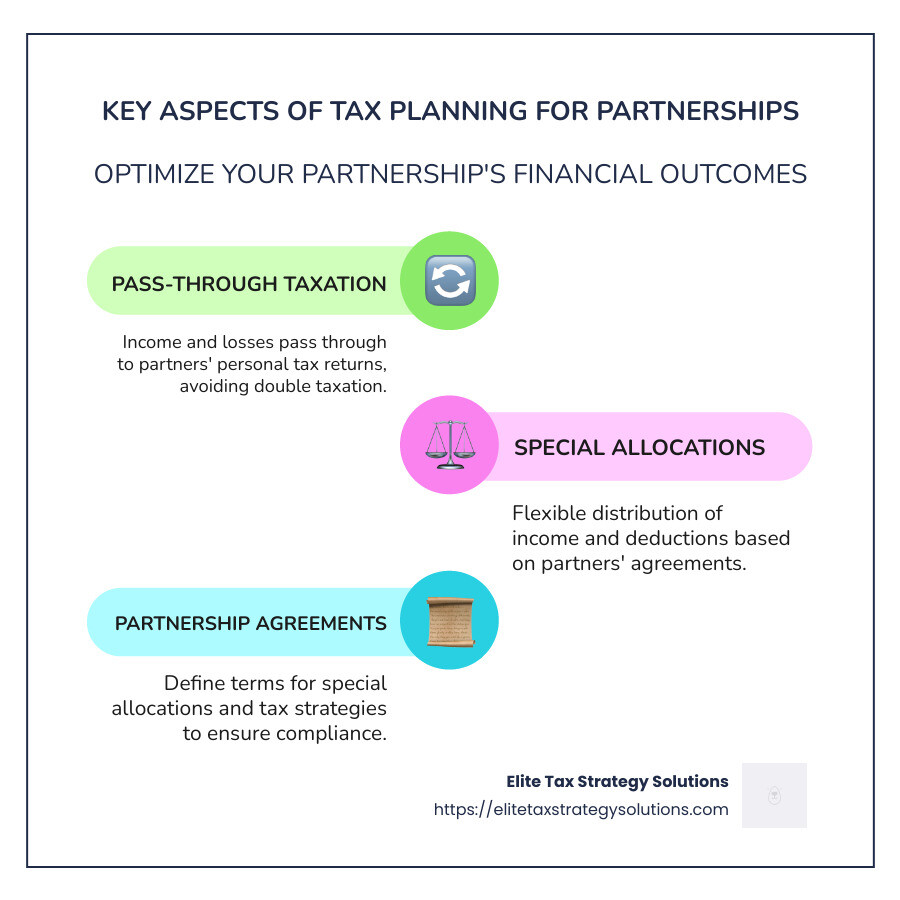
- Pass-Through Taxation: Partnerships are generally considered pass-through entities, meaning income and losses pass through to partners’ personal tax returns, avoiding double taxation.
- Special Allocations: These are unique allocations allowing for flexible distribution of income and deductions based on partners’ needs or agreements.
- Partnership Agreements: Essential for defining terms of special allocations and tax strategies, ensuring compliance and minimizing disputes.
By focusing on these aspects, partners can effectively manage liabilities and optimize their tax position.
In my 40 years of experience as a tax professional and owner of Elite Tax Strategy Solutions, I have specialized in tax planning for partnerships. My goal is to help high-income earners and small business owners steer tax complexities and maximize savings.
Tax planning for partnerships helpful reading:
Understanding Special Tax Allocations
Special tax allocations in partnerships offer unique opportunities for tax planning. These allocations allow business partners to distribute profits, losses, and deductions in a way that best suits their financial goals, regardless of ownership percentages. Let’s explore the key components that make these allocations possible.
Pass-Through Entities
Partnerships are considered pass-through entities. This means the business itself doesn’t pay income taxes. Instead, profits and losses pass through to the partners, who then report them on their personal tax returns. This can provide significant tax advantages, as it avoids the double taxation that corporations face.
Schedule K-1
Each partner receives a Schedule K-1 form, which details their share of the partnership’s income, deductions, and credits. This form is crucial for tax planning, as it dictates how partners report their share of the business’s financial activities on their personal tax returns.
Depreciation and Other Tax Benefits
One of the most compelling aspects of special allocations is the ability to allocate depreciation and other tax benefits strategically. For example, controlling partners might allocate depreciation-related deductions to investors as an incentive to bring in more capital. This approach is common in industries like real estate and oil and gas, where depreciation can be substantial.
Consider a scenario where Partner A can’t fully use a pass-through tax credit due to insufficient taxable income. Partner B, however, can benefit from it. In such cases, partners can agree to adjust their allocations, maximizing tax benefits for the entire partnership.
Maximizing Tax Benefits
Special tax allocations are not just about splitting profits and losses. They are a strategic tool for optimizing tax benefits within a partnership. By directing tax advantages where they are most beneficial, partners can improve their financial outcomes and incentivize investment.
In summary, understanding special tax allocations is vital for effective tax planning for partnerships. By leveraging these allocations, partners can strategically manage tax liabilities and improve their financial stability.
Tax Planning for Partnerships: Key Considerations
When it comes to tax planning for partnerships, there are several key considerations that can greatly impact your financial outcomes. Let’s break down these crucial elements: pass-through taxation, self-employment tax, and the partnership agreement.
Pass-Through Taxation
Partnerships enjoy a significant advantage with pass-through taxation. This means that the partnership itself does not pay income taxes. Instead, the profits and losses are passed directly to the partners, who report them on their personal tax returns. This setup helps partners avoid the double taxation issue faced by C corporations, where income is taxed at both the corporate and individual levels.
Self-Employment Tax
While pass-through taxation is beneficial, partners must also consider self-employment tax. This tax covers Social Security and Medicare contributions for individuals who work for themselves. In a partnership, each partner is typically considered self-employed, meaning they must pay self-employment tax on their share of the partnership’s income.
For example, if a partner earns $100,000 from the partnership, they are responsible for paying self-employment taxes on that amount. This is an important factor to consider in tax planning, as it can significantly affect a partner’s net income.
Partnership Agreement
The partnership agreement is a vital document that outlines how the partnership will operate, including how income, losses, and deductions will be allocated among partners. It’s important for the partnership agreement to clearly define these allocations to ensure all partners are on the same page and to avoid potential conflicts or misunderstandings.
This agreement can also include provisions for special allocations, allowing partners to strategically distribute tax benefits based on their individual financial situations. For instance, if one partner can make better use of certain tax deductions, the partnership agreement can be structured to allocate those deductions accordingly.
In conclusion, effective tax planning for partnerships involves understanding and leveraging pass-through taxation, managing self-employment tax obligations, and crafting a comprehensive partnership agreement. These elements are essential for optimizing tax outcomes and ensuring smooth financial operations within a partnership.
Advantages of Special Tax Allocations
Special tax allocations offer partnerships a world of flexibility that can be a game-changer for both the business and its investors. Let’s explore how these allocations can provide unique advantages in terms of flexibility, investor incentives, and capital raising.
Flexibility
One of the greatest benefits of special tax allocations is the flexibility they bring to the table. Partnerships can tailor the distribution of income, losses, and deductions to meet the specific needs of each partner. For example, if a partner is in a high-tax bracket, the partnership can allocate more depreciation deductions to that partner. This strategic allocation can minimize the overall tax burden for the partnership.
This flexibility is particularly useful when partners have different financial goals or tax situations. By customizing allocations, partnerships can ensure that each partner receives the maximum benefit from their investment.
Investor Incentives
Special allocations can also be a powerful tool for attracting and retaining investors. By offering custom tax benefits, partnerships can provide incentives that align with the financial interests of potential investors. For instance, a partnership might allocate a larger share of tax credits to an investor who is contributing significant capital or expertise.
These incentives can make the partnership more appealing compared to other investment opportunities, helping to attract investors who are looking for a tax-efficient way to grow their wealth.
Capital Raising
When it comes to raising capital, special tax allocations can be a significant advantage. By offering customized allocations, partnerships can entice investors who are seeking specific tax benefits. For example, an investor looking to offset other taxable income might be particularly interested in a partnership that can allocate additional losses or deductions to them.
This ability to tailor allocations not only helps in attracting new investors but also in encouraging existing partners to reinvest. By optimizing the tax benefits for each partner, the partnership can create a more attractive investment proposition, making it easier to raise the capital needed for growth and expansion.
In summary, special tax allocations provide partnerships with the flexibility to optimize tax outcomes for each partner, incentivize investors, and effectively raise capital. This strategic approach ensures that both the partnership and its partners can achieve their financial goals more efficiently.
Challenges and Disadvantages
While special tax allocations offer many benefits, it’s important to be aware of the challenges and disadvantages that can come with them. Let’s explore some key considerations, including self-employment tax, Section 704(c) rules, and disguised sale rules.
Self-Employment Tax
One of the major downsides for partners in a partnership is the exposure to self-employment tax. This tax includes a 12.4% Social Security component and a 2.9% Medicare component, totaling 15.3% on the first $147,000 of net self-employment income in 2022. For higher earners, an additional 0.9% Medicare tax applies.
Here’s the kicker: if you’re a general partner, most of your income from the partnership might be subject to this tax. This makes partnerships less attractive compared to S or C corporations, where only salaries are subject to Social Security and Medicare taxes.
Section 704(c) Rules
The Section 704(c) rules can complicate tax allocations when partners contribute assets instead of cash. These rules require partnerships to account for the difference between the asset’s tax basis and its fair market value.
For instance, if you contribute land worth $1 million with a tax basis of $250,000, the first $750,000 of gain from a sale must be allocated to you. This ensures the tax burden is fair, but it adds complexity to managing the partnership’s tax obligations.
Disguised Sale Rules
Another tricky area is the disguised sale rules. These rules prevent partners from using contributions and distributions to effectively “sell” property to the partnership without recognizing a taxable event. The IRS looks at the facts and circumstances to determine if a transaction is a disguised sale, which can lead to unexpected tax liabilities.
These rules mean that partnerships need to be careful when structuring transactions to avoid triggering a disguised sale. It’s a potential pitfall that requires careful planning and consultation with tax professionals.
In conclusion, while special tax allocations can be a powerful tool for partnerships, they come with challenges that must be steerd carefully. Understanding these complexities and working with knowledgeable professionals can help partnerships maximize their tax benefits while minimizing risks.
Frequently Asked Questions about Tax Planning for Partnerships
What are the tax rules for partnerships?
Partnerships have unique tax rules that set them apart from other business entities. Unlike corporations, partnerships don’t pay federal income tax at the entity level. Instead, they are considered pass-through entities. This means that the partnership itself files an annual information return using Form 1065 to report its income, deductions, gains, and losses. However, the partnership doesn’t pay taxes directly.
Each partner receives a Schedule K-1 from the partnership, detailing their share of the income, deductions, and other tax items. Partners then report this information on their personal tax returns. This “pass-through” nature helps avoid the double taxation issue often associated with corporations.
How are taxes split in a partnership?
In a partnership, taxes are split based on each partner’s ownership percentage. This means that the income, losses, and other tax items are distributed to partners in proportion to their ownership stake in the partnership. The details of these distributions are outlined in the partnership agreement.
For example, if a partner owns 25% of the partnership, they would typically receive 25% of the partnership’s income or loss reported on their personal tax return. The Schedule K-1 provides the necessary details to ensure accurate reporting.
Are you double taxed in a partnership?
No, one of the major advantages of partnerships is the avoidance of double taxation. With pass-through taxation, the partnership itself doesn’t pay income tax. Instead, the profits (or losses) are passed through to the partners, who report them on their personal tax returns.
This stands in contrast to corporate taxation, where the corporation pays taxes on its income, and then shareholders pay taxes again on dividends received. In a partnership, since taxes are paid only once at the individual level, it simplifies the tax process and can result in significant tax savings.
However, partners should be mindful of their personal liability for the partnership’s debts and obligations, as this is a key consideration when choosing this business structure.
Conclusion
Navigating tax planning for partnerships can be complex, but with the right guidance, it becomes a powerful tool for financial success. At Elite Tax Strategy Solutions, we specialize in offering custom tax planning services that focus on maximizing tax savings and ensuring financial stability for high earners and closely held businesses.
Our unique approach is proactive. We don’t just react to tax laws; we anticipate changes and adjust strategies to keep our clients ahead of the curve. This means staying informed about the latest tax regulations and identifying opportunities to optimize tax positions in line with long-term financial goals.
Financial stability is at the heart of what we do. By integrating tax planning into a broader financial strategy, we help our clients not only save on taxes but also achieve their broader financial aspirations. Whether it’s through maximizing deductions, utilizing credits, or selecting the right business entity, our strategies are designed to improve financial well-being.
For those interested in learning more about how we can assist with tax planning for partnerships, visit our Innovative Tax Planning page. Find how our expert team can help you steer the complexities of the tax code and achieve your financial goals.