Introduction: Beyond Busy Season Survival
Tax outsourcing is a strategic solution where accounting firms delegate tax preparation to third-party providers. This allows them to manage workload fluctuations, reduce costs by up to 50%, and focus on high-value advisory services.
Quick Answer – Tax Outsourcing Options:
- Individual Tax Returns – T1, 1040, and personal income tax preparation
- Corporate Returns – T2, 1120, and business tax compliance
- Specialized Forms – Trust returns, partnership filings, non-profit returns
- Turnaround Time – Standard 12-36 hours, expedited same-day options available
- Cost Savings – Up to 50% reduction in tax preparation costs
- Security – SOC 2, ISO 27001 compliant providers with encrypted data transfer
Tax season doesn’t have to be a battle. Instead of struggling with workload surges and staff burnout, a growing number of practices are finding a better way. The traditional approach of hiring seasonal workers and demanding overtime is outdated. In fact, firms using tax outsourcing are over 9% ahead of the national pace during tax season.
This shift is about building a sustainable practice that delivers exceptional client service year-round. By removing the compliance bottleneck, your team can focus on what clients truly value: strategic tax planning and proactive financial guidance. Firms report cost savings of 40-50%, turnaround times of 1-2 business days, and happier staff with better work-life balance.
As David Fritch, with 40 years of experience managing my own CPA practice and law firm, I’ve seen tax outsourcing transform practices from reactive compliance to proactive wealth-building for high-income clients. Firms that accept this shift are positioned to capture the growing demand for sophisticated tax planning.
Quick look at tax outsourcing:
- More info about our sales tax compliance outsourcing services
- taxing company that outsource for startups
The Core Benefits: Reclaiming Time, Capacity, and Profitability
Imagine your team leaving at a reasonable hour on March 15th, with client returns finished faster than ever and healthier profit margins. This isn’t wishful thinking; it’s the reality for firms that accept tax outsourcing as a core business strategy.
Boost Efficiency and Manage Workload Fluctuations
The annual tax season crunch doesn’t have to drown your firm in paperwork. Tax outsourcing provides consistent capacity that scales with your needs, eliminating the need to hire and train temporary staff. Whether you need 200 or 500 returns processed, your outsourcing partner can handle the volume.
The speed is remarkable. While competitors manage backlogs, you can get completed returns back in 12-36 hours, with some providers offering same-day turnaround. This efficiency is especially valuable to high-earning clients who prioritize their time. Your workflow becomes predictable, ending the feast-or-famine cycle and ensuring you meet every deadline.
Realize Significant Cost Savings
Tax outsourcing can reduce your preparation costs by up to 50%. This goes beyond salary savings by eliminating overhead like benefits, office space, equipment, and software licenses. With outsourcing, you pay only for the work performed, with no costs during slow periods and no overtime fees during busy season.
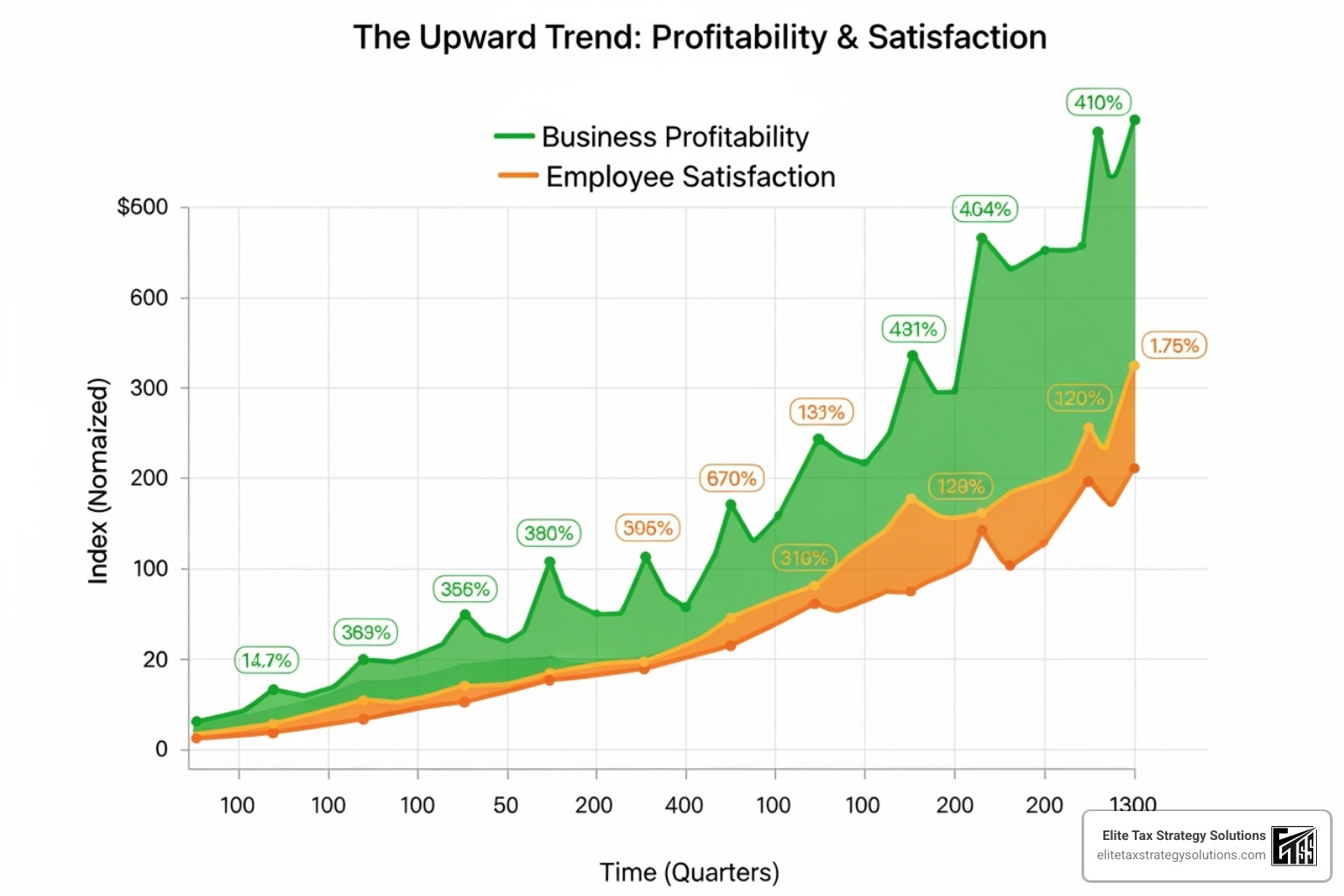
These savings directly impact your bottom line. Many firms increase their profit margins by 20-30% by shifting preparation work to a reliable partner. This capital can be reinvested into advisory services or taken as increased profits.
Improve Staff Well-being and Focus
Staff burnout is a silent killer of productivity and morale. The pressure of 70-hour workweeks during tax season leads talented professionals to leave the industry. Tax outsourcing restores work-life balance, allowing your team to focus on the challenging work they were trained for.
Instead of data entry, your staff can engage in high-value activities like tax planning, client consultations, and business development. They evolve from preparers into advisors, building stronger client relationships. This leads to happier, more engaged employees and higher staff retention, saving you significant recruiting and training costs.
For firms like Elite Tax Strategy Solutions, this shift is transformative. Our team dedicates its expertise to proactive tax strategies for high earners, rather than being bogged down by compliance. This is where real value is created and where clients are willing to pay premium fees.
Understanding the Scope and Mechanics of Tax Outsourcing
Considering tax outsourcing can feel like giving up control, but the process is designed to give you more control by freeing up your time. It integrates seamlessly with your existing practice without disrupting client relationships.

How the Outsourcing Process Works
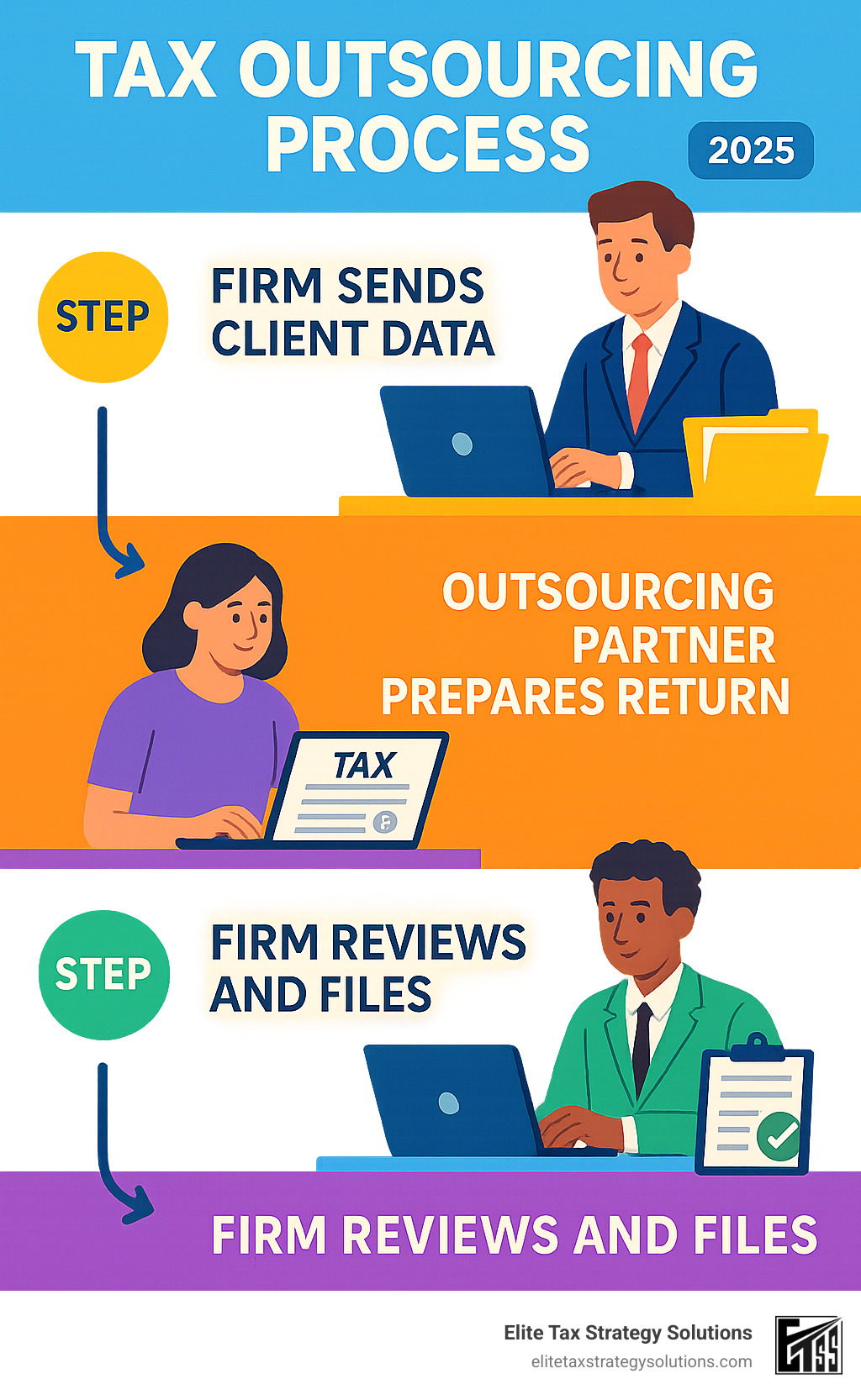
Think of tax outsourcing as an extension of your team. The process is simple:
- Gather Documents: You continue your normal client intake process. From your client’s perspective, nothing changes.
- Secure Data Transfer: Instead of in-house data entry, you upload organized documents to your partner via a secure, encrypted portal.
- Overnight Preparation: A skilled team prepares the returns, often overnight due to time zone advantages. This continuous work cycle turns your firm’s downtime into productive hours.
- Review and Finalize: You receive the prepared return with detailed review notes. This is where your firm’s strategic expertise comes in. At Elite Tax Strategy Solutions, we use this step to ensure alignment with long-term tax goals. The final review, filing, and client consultation remain entirely in your hands.
You maintain full control over client relationships while eliminating time-consuming prep work.
What Tax Returns Can Be Outsourced?
The scope of outsourcing is broad, covering far more than just simple returns. Popular options include:
- Individual Returns: Forms like the T1 (Canada) and 1040 (US) are the most common starting point.
- Corporate Returns: T2 and 1120 forms, even for complex, closely held businesses, are regularly outsourced.
- Trust and Partnership Returns: Specialized forms like the T3, 1041, T5013, and 1065 are handled by experienced providers.
- Non-Profit Returns: Informational returns such as the T3010 and 990 can be outsourced to providers with specific expertise.
- Other Filings: Many firms also outsource GST/HST returns, sales tax filings, and even expat tax returns.
The key is to find a partner with proven accuracy, especially when serving high-earning and business clients.
Common Software and Technology Integration
Compatibility is rarely an issue. Reputable outsourcing providers are fluent in all major professional tax software, including Lacerte, ProSeries, Drake, CCH Axcess Tax, GoSystem Tax RS, and UltraTax CS. They can also work with ATX, Creative Solutions, and various cloud-based platforms.
This flexibility means your team doesn’t need to learn new software, and your quality control processes remain unchanged. Outsourcing adapts to your practice, not the other way around. You can even test the process with a small batch of returns to experience the benefits with minimal risk.
Choosing the Right Partner: Security, Compliance, and Strategy
Choosing a tax outsourcing partner is a critical business decision. You are entrusting them with sensitive client data and your firm’s reputation. For us at Elite Tax Strategy Solutions, which serves high earners and closely held businesses, this decision carries significant weight. The right partner becomes an extension of your team, while the wrong one can create compliance and security risks.
Key Considerations for Your Tax Outsourcing Strategy
When evaluating partners, look beyond marketing and focus on these core areas:
- Expertise: Ensure they have qualified preparers who understand complex US, Canadian, or international tax law, especially for high-net-worth clients.
- Communication: The process should be seamless, with prompt responses and clear updates.
- Service Level Agreements (SLAs): A solid SLA defines turnaround times, quality standards, and data security protocols.
- Scalability: Your partner must handle peak season volume without sacrificing quality.
- Risk Management: Inquire about their processes for error handling, staying current on tax law, and internal controls.
Ensuring Data Security and Client Confidentiality
Data security is non-negotiable, especially when dealing with high-earning clients. Reputable providers make it their top priority. Look for partners with verifiable security credentials:
- SOC 2 Compliance: An audit that verifies a provider’s controls for security, availability, confidentiality, and privacy.
- ISO 27001/27701 Certifications: International standards for comprehensive information security and privacy management.
- GDPR Compliance: Essential for any clients with European ties, governing how personal data is handled.
Behind these certifications, top providers use secure data centers, staff confidentiality agreements, strict access controls, and end-to-end encryption for all data transfers. At Elite Tax Strategy Solutions, we rigorously vet partners to ensure their security protocols meet the highest standards our clients deserve.
Onshore vs. Offshore Tax Outsourcing
The choice between onshore and offshore partners involves balancing cost, communication, and workflow. Both have distinct advantages.
| Feature | Onshore Tax Outsourcing | Offshore Tax Outsourcing (e.g., India) |
|---|---|---|
| Cost Implications | Generally higher cost, but still more economical than in-house | Significantly lower costs (up to 50% savings) |
| Time Zone | Similar time zone, easier real-time collaboration | Significant time zone difference, enabling “overnight” turnaround |
| Communication | Native language/cultural understanding, fewer communication barriers | Potential for minor language/cultural nuances, but often highly proficient staff |
| Regulatory Knowledge | Expertise in local tax laws, but may not specialize in international | Strong expertise in US/Canadian tax laws, often with international specialization |
| Data Security | Robust security protocols, often subject to domestic laws | Robust security protocols (e.g., ISO, SOC 2), subject to international standards |
| Talent Pool | Limited by local availability | Vast pool of qualified accounting professionals |
Offshore tax outsourcing is popular for its significant cost savings and the productivity boost from time zone differences, enabling overnight turnarounds. Onshore options are ideal for firms that prioritize real-time collaboration and shared cultural context.
The key is finding a partner who aligns with your firm’s values, security requirements, and quality standards. A great partner, regardless of location, becomes a powerful tool for growth.
The Strategic Impact: Evolving from Compliance to High-Value Advisory
The true value of tax outsourcing isn’t just about cost or speed; it’s about fundamentally changing your practice from a reactive compliance shop to a proactive advisory firm. For high earners and closely held businesses, this shift is the difference between basic tax filing and true wealth optimization.

The Role of Technology and AI in Modern Outsourcing
Modern tax outsourcing providers leverage cutting-edge technology to improve efficiency and accuracy. AI-powered preparation automates data extraction from source documents, processing them far faster than manual methods. Data analytics and Robotic Process Automation (RPA) work behind the scenes to spot potential issues, streamline workflows, and reduce errors.
This technology increases accuracy and reduces audit risk. More importantly, it automates routine tasks, freeing accountants to focus on interpretation, strategy, and client relationships—the human skills that AI cannot replicate.
How Tax Outsourcing Benefits Firms of All Sizes
Tax outsourcing is a scalable solution that benefits practices of any size:
- Small firms can instantly scale capacity to compete with larger competitors, offering faster service without the overhead.
- Mid-size firms can grow their client base and expand services without the headaches of hiring and training, all while maintaining quality.
- Large firms can reduce workload stress on their expert staff, preventing burnout and freeing up specialists for complex, high-margin work.
Transitioning to Advisory Services
This is where tax outsourcing becomes transformative for practices like Elite Tax Strategy Solutions. When compliance no longer consumes all your time, you can become the strategic partner your clients need.
Freeing up partner time allows a shift from looking backward at last year’s numbers to looking forward with proactive tax planning. Client strategy sessions become deeper and more meaningful. For businesses, this evolves into business growth consulting, succession planning, and other high-value advisory services.
This newfound capacity also opens doors to new service lines like wealth management integration or estate planning. By outsourcing routine work, your team becomes a group of strategic advisors, open uping greater value for your clients and your firm.
Frequently Asked Questions about Tax Outsourcing
Let’s be honest – the idea of tax outsourcing probably raises some eyebrows. We get it. You’re thinking about trusting someone else with your clients’ most sensitive financial information. That’s a big decision, and we’ve heard all the questions before. Here are the answers that matter most.
How long does it take to get a prepared return back?
Here’s where tax outsourcing really shines – speed. Most standard tax returns come back to you in 12 to 48 hours. That’s not a typo. While your team is sleeping, skilled preparers are working on your files.
The magic happens with time zones. Send your documents at 5 PM, and you’ll often find completed returns waiting in your inbox the next morning. It’s like having a night shift without paying for one.
Need something even faster? Many providers offer expedited options. Some can turn around urgent returns in just a few hours. This speed helps you meet those impossible deadlines that used to keep you up at night.
Is it safe to send my clients’ sensitive data to a third party?
This is the question that keeps firm owners awake at night, and rightfully so. The short answer? Yes, it’s safe – when you choose the right partner.
Think about it this way: reputable outsourcing providers treat security like their life depends on it. Because it does. Their entire business model crumbles if they can’t protect client data.
The best providers use ISO 27001 certification, which means they’ve passed rigorous security audits. They also maintain GDPR compliance and SOC 2 standards. These aren’t just fancy acronyms – they’re proof that independent auditors have verified their security measures.
Your data travels through encrypted channels and gets stored in secure data centers with better security than most banks. Access is strictly limited to authorized personnel who’ve signed confidentiality agreements.
At Elite Tax Strategy Solutions, we don’t take chances with our high-net-worth clients’ information. We thoroughly vet any outsourcing partner to ensure their security protocols exceed industry standards. Your clients’ financial privacy is non-negotiable.
Will outsourcing work with my firm’s current software and processes?
This might be the easiest question to answer: absolutely. The best tax outsourcing providers didn’t get where they are by forcing firms to change everything.
They work with all the major platforms you’re already using – CCH, Lacerte, Drake, ProSeries, UltraTax CS, GoSystem Tax RS. The list goes on. These providers understand that asking you to switch software is like asking you to learn a new language during busy season.
The integration happens seamlessly. They can access your systems through secure remote connections, work within cloud-based platforms, or use their own compatible software that matches your workflow. You keep using what you know, they handle what they do best.
The goal is simple: make outsourcing feel invisible to your daily operations. You should barely notice the difference, except that your workload becomes manageable and your stress levels drop significantly.
Conclusion: Make Tax Outsourcing Your Competitive Advantage
The accounting world is changing. Firms that thrive are working smarter, not just harder. Tax outsourcing is the strategic decision that separates growing practices from those stuck in the cycle of busy season burnout.
Imagine your firm a year from now: confidently scaling with trusted partners, enjoying cost savings of up to 50%, and delivering faster service. Your team, freed from the compliance grind, is energized by high-value advisory work. You’re no longer just preparing taxes; you’re offering strategic tax planning for high earners and proactive consulting for businesses.
This shift creates a powerful competitive advantage. While others are buried in compliance, you’re building lasting relationships as a trusted financial strategist.
At Elite Tax Strategy Solutions, we’ve seen this change firsthand. By offloading compliance, firms can dedicate their expertise to delivering the high-value, proactive tax strategies their clients need. It’s the difference between being a tax preparer and a wealth-building partner.
Tax outsourcing is already reshaping the industry. The only question is whether you’ll lead the change or be left trying to catch up.
Ready to see what this could mean for your practice? Let’s explore how we can help you make this strategic shift: