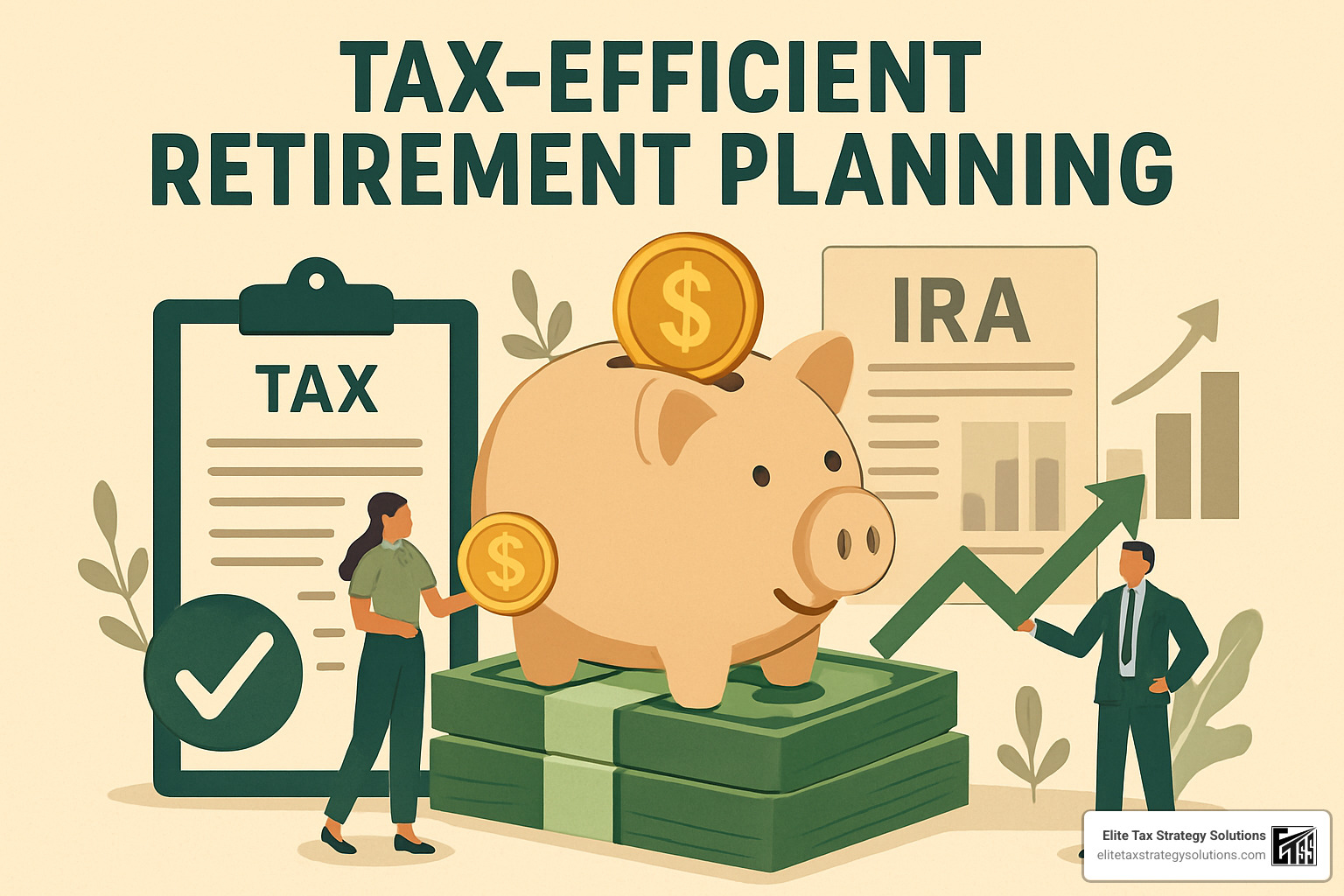
Why Tax-Efficient Retirement Planning Can Make or Break Your Golden Years
Tax-efficient retirement planning is the strategic approach to managing your retirement savings across different account types to minimize taxes and maximize your after-tax income throughout retirement. Here’s what you need to know:
The 3 Tax Buckets Framework:
- Tax-Now (Taxable) – Brokerage accounts, savings (pay taxes on gains/income annually)
- Tax-Later (Tax-Deferred) – Traditional 401(k), IRA (pay taxes on withdrawals)
- Tax-Never (Tax-Free) – Roth IRA, Roth 401(k), HSA (no taxes on qualified withdrawals)
Key Strategies:
- Withdrawal sequencing – Generally taxable → tax-deferred → tax-free
- Roth conversions during low-income years to lock in lower tax rates
- Required Minimum Distributions (RMDs) planning starting at age 73
- Asset location – placing investments in the most tax-efficient accounts
The stakes are high. Research shows that nearly 60% of Americans worry that higher taxes will eat away at their retirement income. Even more concerning, a proportional withdrawal strategy can reduce total taxes paid by almost 40% compared to traditional approaches – yet most retirees never implement these strategies.
Why does this matter so much? Unlike your working years when you have limited control over tax timing, retirement gives you unprecedented flexibility. You can choose when to take income, which accounts to tap, and how much to withdraw. These decisions compound over 20-30 years of retirement, potentially saving or costing you hundreds of thousands of dollars.
The tax landscape is also shifting. The Tax Cuts and Jobs Act provisions sunset in 2025, potentially pushing rates higher. Meanwhile, Required Minimum Distribution ages keep changing – from 70½ to 72, then 73, and soon 75 for younger retirees. Up to 85% of Social Security benefits may become taxable depending on your other income sources.
I’m David Fritch, and over my 40 years as a CPA and tax strategist, I’ve helped countless high-income earners and business owners steer the complex world of tax-efficient retirement planning. Through my firm Elite Tax Strategy Solutions, I’ve seen how the right strategies can add years to your portfolio’s lifespan while preserving more wealth for your legacy.
Handy tax-efficient retirement planning terms:
What Is Tax-Efficient Retirement Planning—and Why It Matters
Picture this: two retirees with identical $1 million portfolios. One understands tax-efficient retirement planning, the other doesn’t. After 25 years, the savvy planner has $200,000 more to spend. Same starting point, dramatically different outcomes.
Tax-efficient retirement planning is your strategy for legally keeping more of your hard-earned money by smartly managing when and how you pay taxes on your retirement savings. It’s like having a GPS for your financial journey — helping you avoid the expensive toll roads and find the most efficient route to your destination.
This isn’t just about saving a few bucks here and there. We’re talking about maximizing your cash-flow longevity — making sure your money outlives you, not the other way around.
The stakes couldn’t be higher. Research shows that over half of American households risk not maintaining their pre-retirement lifestyle. Poor tax planning accelerates this nightmare by unnecessarily handing over money to Uncle Sam that could have stayed in your pocket.
Here’s where the magic of compounding comes into play. Save $10,000 annually through smart tax planning, and over 25 years that’s $250,000. But if that saved money grows at 5% annually, you’re looking at nearly $475,000 in additional wealth. That’s a game-changer.
The flip side is equally dramatic. Poor planning can trigger Medicare surcharges (those nasty IRMAA penalties), bump you into higher tax brackets, and create sequence risk — where market downturns combined with hefty tax bills can devastate your portfolio just when you need it most.
The Rising Tax Landscape
We’re living in what many tax professionals call the “calm before the storm.” Current rates are historically low, but several storm clouds are gathering on the horizon.
The Tax Cuts and Jobs Act sunset looms large. After 2025, we could see the top rate jump from 37% back to 39.6%. More concerning for everyday retirees, the comfortable 12% bracket might revert to 15%, and the 22% bracket could become 25%. That’s not pocket change.
SECURE 2.0 brought mixed news. Yes, Required Minimum Distributions got pushed back (hooray!), but the stretch IRA disappeared for most beneficiaries. Now inherited accounts must be emptied within 10 years, creating potential tax bombs for your heirs.
Then there’s the sneaky stuff. Inflation indexing sounds protective, but bracket adjustments often lag behind real cost increases. Meanwhile, Social Security taxation thresholds and Medicare IRMAA limits aren’t fully indexed, creating stealth tax increases that hit retirees especially hard.
Add in demographic pressures — an aging population and growing federal deficits — and retirement accounts’ $30 trillion-plus become an increasingly tempting target for higher future rates.
3 Core “Tax Buckets” You Must Master
Think of tax-efficient retirement planning like organizing your closet, but instead of sorting by season, you’re sorting by tax treatment. Master these three buckets, and you’ll have the flexibility to dress appropriately for any tax weather.
Your Tax-Now Bucket (Taxable Accounts) includes brokerage accounts, savings, and CDs. You pay taxes annually on interest, dividends, and capital gains — like paying rent every month. The upside? You’ve already paid the tax bill, so withdrawing your original money is free and clear. Plus, long-term capital gains get the VIP treatment with rates of 0%, 15%, or 20% depending on your income.
Your Tax-Later Bucket (Tax-Deferred Accounts) holds traditional 401(k)s, 403(b)s, traditional IRAs, and pensions. These accounts gave you a tax break upfront — like borrowing money from your future self. But eventually, the tax man comes calling, and every withdrawal gets taxed as ordinary income, even growth that would normally qualify for lower capital gains rates.
Your Tax-Never Bucket (Tax-Free Accounts) contains Roth IRAs, Roth 401(k)s, and Health Savings Accounts for medical expenses. You paid the tax upfront, but qualified withdrawals are completely tax-free forever. HSAs are the ultimate triple threat — tax-deductible contributions, tax-free growth, and tax-free withdrawals for medical expenses.
The real power emerges when you have money in all three buckets. This gives you the flexibility to manage your tax bracket year by year, taking advantage of low-income years and avoiding unnecessary spikes that trigger higher rates or Medicare surcharges. It’s like having multiple tools in your toolbox — you can choose the right one for each job.
How Retirement Accounts Are Taxed & The Optimal Withdrawal Sequence
Think of your retirement accounts like different flavors of ice cream — they might all be cold and sweet, but the experience of eating each one is completely different.
Taxable accounts are like vanilla — straightforward and predictable. You’ve already paid income tax on the money you put in, so you only owe taxes on the growth. When you sell investments, you’ll pay capital-gains tax on any profits. Here’s the sweet part: if you’ve held investments for over a year, you might pay 0% capital-gains tax if your taxable income stays under $47,025 as a single filer in 2024.
Traditional IRAs and 401(k)s are more like rocky road — they seemed like a good idea at the time, but now every bite comes with some hard pieces to deal with. Every single dollar you withdraw gets taxed as ordinary income, whether it was your original contribution or decades of growth. The IRS doesn’t care that some of that money came from stock investments that would normally qualify for lower capital-gains rates.
Roth IRAs and 401(k)s are the premium flavor — you paid extra upfront (no tax deduction), but now you get to enjoy tax-free withdrawals forever. Once you’re 59½ and have held the account for five years, every penny comes out clean.
Pensions and annuities typically get taxed as ordinary income, though the details depend on whether you funded them with pre-tax or after-tax dollars. Social Security is the wildcard — depending on your total income, anywhere from zero to 85% of your benefits might be taxable.
| Account Type | Tax on Contributions | Tax on Growth | Tax on Withdrawals |
|---|---|---|---|
| Taxable | Paid with after-tax dollars | Annually on dividends/interest | Capital gains on growth only |
| Traditional IRA/401(k) | Tax-deductible | Tax-deferred | Ordinary income rates |
| Roth IRA/401(k) | After-tax (no deduction) | Tax-free | Tax-free (qualified) |
| HSA | Tax-deductible | Tax-free | Tax-free (medical expenses) |
Required Minimum Distributions (RMDs): Rules, Penalties, and Planning
Just when you thought you could control your retirement withdrawals forever, along come Required Minimum Distributions — the IRS’s way of saying “party’s over, time to pay some taxes.”
RMDs kick in at age 73 under current rules, though this bumps up to age 75 for folks who turn 74 after December 31, 2032. If you’re still working and own less than 5% of your company, you can delay RMDs from your current employer’s 401(k) until you actually retire. It’s one of the few times the IRS rewards you for staying busy.
Miss your RMD and you’ll face a penalty that’ll make your accountant weep — up to 25% of the amount you should have withdrawn. The good news? Under SECURE 2.0, if you catch your mistake quickly and fix it, that penalty drops to a more manageable 10%. Still painful, but not quite as devastating.
The IRS calculates your RMD by taking your account balance from December 31 of the previous year and dividing it by a life-expectancy factor. As you get older, they assume you have fewer years left, so the percentage you must withdraw gets larger each year.
Here’s a planning gem: RMDs only apply to tax-deferred accounts. Your Roth IRA can sit there growing tax-free for your entire lifetime, making it a fantastic tool for leaving money to your kids or grandchildren. You can also use Qualified Charitable Distributions (QCDs) to send up to $105,000 directly from your IRA to charity, satisfying your RMD while reducing your taxable income.
The legacy impact is huge, too. Thanks to the SECURE Act, most non-spouse beneficiaries must empty inherited retirement accounts within 10 years. This can create nasty tax surprises for your children during their peak earning years. For detailed RMD rules and updates, check the official guidance at IRS.gov.
Withdrawal Sequencing for tax-efficient retirement planning
For decades, the retirement planning world preached a simple gospel: withdraw from taxable accounts first, then tax-deferred, then tax-free. The logic seemed bulletproof — let your tax-advantaged accounts grow as long as possible while spending the money you’ve already paid taxes on.
But here’s where tax-efficient retirement planning gets interesting. Recent research shows this “conventional wisdom” can actually cost you serious money over a 20- to 30-year retirement.
The taxable-first approach still works well if you expect to stay in similar tax brackets throughout retirement. You preserve that tax-advantaged growth and keep your Roth accounts as a flexible backup plan.
However, the proportional method can be a game-changer. Instead of completely draining one account type before touching another, you withdraw from all your accounts based on their percentage of your total portfolio. This strategy can reduce your total lifetime taxes by nearly 40% compared to the traditional approach. That’s not a typo — we’re talking about potentially hundreds of thousands of dollars in savings.
Bracket topping is another smart strategy where you fill up your current tax bracket with tax-deferred withdrawals before moving to other sources. If you’re in the 12% bracket, for example, you’d take enough from your traditional IRA to reach the top of that bracket, then switch to other sources for additional income needs.
The 0% capital-gains sweet spot deserves special attention. If your taxable income stays under $47,025 (for single filers in 2024), you can harvest long-term capital gains completely tax-free. This makes taxable-account withdrawals incredibly attractive during lower-income years.
Tax-Efficient Retirement Planning With Large One-Time Events
Life has a funny way of throwing curveballs just when you think you’ve got your tax-efficient retirement planning all figured out. Large one-time events can either create massive tax headaches or present golden opportunities — it all depends on how you handle them.
Selling a business can create a tax tsunami if you’re not careful. That large capital gain might catapult you into the highest tax brackets for the year. Consider spreading the sale over multiple years through an installment sale, or use the proceeds to cover several years of living expenses while keeping your retirement-account withdrawals minimal.
Receiving a large inheritance might temporarily boost your income, but it can also create a unique planning opportunity. This could be the perfect time to live off your inheritance while doing substantial Roth conversions at your normal, lower tax rates. You’re essentially using inherited money to pay for conversions that will benefit you for decades.
Market downturns might make your portfolio statements painful to read, but they can create silver linings for tax planning. Your RMDs will be lower since they’re calculated on the prior year-end balance. Plus, it might be an ideal time for Roth conversions while your account values are temporarily depressed — you’ll convert more shares for the same tax cost.
Medicare IRMAA surcharges add another wrinkle to consider. These income-based surcharges look back two years, so a one-time income spike in 2024 will hit your Medicare premiums in 2026. Plan your subsequent years carefully to avoid extending the pain longer than necessary.
The key is staying flexible and viewing these events as planning opportunities rather than just tax problems. With the right strategy, what looks like a crisis can become a chance to optimize your long-term tax situation.
Key Strategies: Diversification, Conversions & Giving
Once you understand the basics of tax-efficient retirement planning, it’s time to master the advanced strategies that can add hundreds of thousands to your retirement wealth. Think of these as the secret weapons in your tax-fighting arsenal.
The three game-changing strategies are asset location (putting the right investments in the right accounts), Roth conversions (paying taxes now to avoid them later), and charitable giving techniques that benefit both your favorite causes and your tax bill.
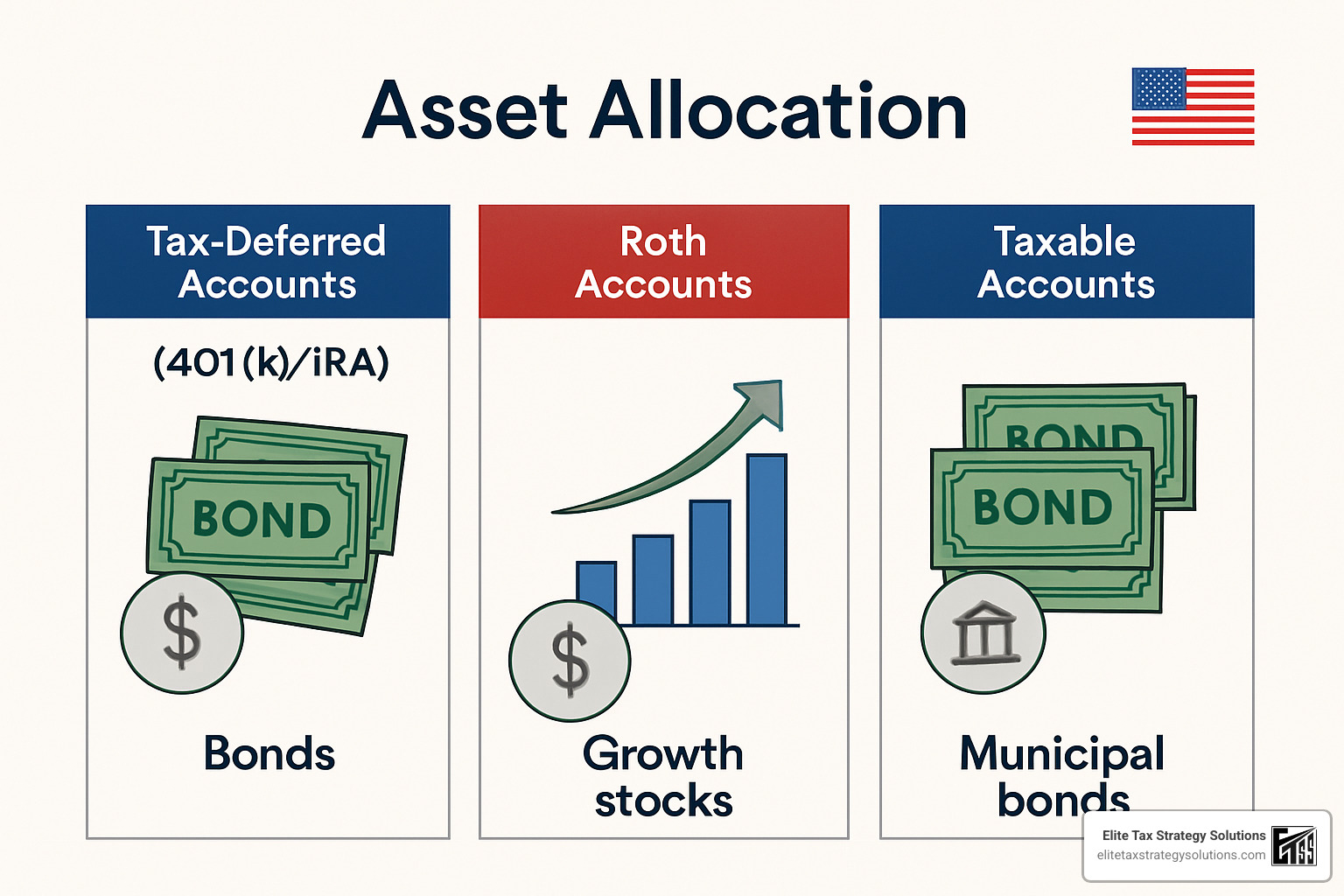
Let’s start with asset location, which isn’t about how much you put in stocks versus bonds — that’s asset allocation. Asset location is about being strategic with where you hold different types of investments. It’s like organizing your closet, but instead of putting winter coats with winter coats, you’re putting tax-hungry investments in tax-sheltered accounts.
Here’s the basic idea: bonds and REITs generate lots of ordinary income that gets taxed at high rates, so they belong in your tax-deferred accounts like traditional 401(k)s. Growth stocks that rarely pay dividends are perfect for Roth accounts where they can grow tax-free for decades. Municipal bonds, which already produce tax-free income, work well in taxable accounts.
Tax diversification gives you something money can’t buy — flexibility. When you have funds spread across all three tax buckets, you become the master of your own tax destiny. Low-income year? Perfect time for a big Roth conversion. High-income year? Lean on those tax-free Roth withdrawals or harvest some capital gains at favorable rates.
Scientific research on asset location shows this strategy can boost your after-tax returns by 0.10% to 0.75% annually. That might sound small, but over 20-30 years of retirement, it compounds into serious wealth.
Don’t forget about state taxes either. Your withdrawal strategy should consider both federal and state implications, especially if you’re thinking about relocating in retirement.
Roth IRA Conversions for tax-efficient retirement planning
Roth conversions might be the most powerful tool in tax-efficient retirement planning, yet they’re often misunderstood or ignored completely. Think of a conversion as paying the IRS now to get them off your back forever.
Here’s how it works: you move money from a traditional IRA or 401(k) into a Roth IRA, paying taxes on the converted amount at today’s rates. In return, that money grows tax-free and comes out tax-free in retirement.
The golden window for conversions usually opens when you retire and closes when RMDs begin at age 73. During these years, your income often drops significantly, putting you in lower tax brackets and making conversions incredibly attractive.
Bracket management is the key to smart conversions. You want to convert just enough to “fill up” your current tax bracket without pushing yourself into the next one. For 2024, that might mean converting up to the top of the 12% bracket ($47,150 for married couples) or the 22% bracket ($201,050 for married couples).
Every dollar you convert today lowers your future RMDs, potentially keeping you in lower tax brackets throughout retirement. This becomes especially valuable when Social Security kicks in or your investments have grown substantially.
Bear markets create golden conversion opportunities. When your account values are down 20% or 30%, you can convert more shares for the same tax cost. If the market recovers, all that growth happens in your tax-free Roth account — it’s like getting a do-over on market timing.
For high earners who make too much to contribute directly to a Roth IRA, conversions provide a “backdoor” method to build tax-free wealth. You can learn more about this strategy in our guide on Traditional IRA for High-Income Earners.
Timing matters tremendously. Spread conversions over multiple years to avoid bracket spikes. Consider your state’s tax situation too — some states don’t tax retirement income, making conversions more attractive if you’re planning to relocate.
Charitable Tools That Slash Taxes
Charitable giving isn’t just good for your soul — it can be fantastic for your tax situation when done strategically. The key is using techniques that maximize both your charitable impact and your tax savings.
Qualified Charitable Distributions (QCDs) are pure magic for retirees. Once you hit age 70½, you can send up to $105,000 annually directly from your IRA to qualified charities. These distributions count toward your RMD but aren’t included in your taxable income — essentially making them tax-free money to charity.
The bunching strategy works brilliantly when combined with the higher standard deductions we have today. Instead of giving $5,000 to charity every year, consider giving $15,000 every three years. In the big giving year, you itemize and get the full deduction. In the other years, you take the standard deduction.
Donor-advised funds let you have your cake and eat it too. Make a large charitable contribution in one year (getting the full tax deduction), then recommend grants to specific charities over time. The funds grow tax-free while you decide where the money should go.
For larger estates, split-interest trusts like charitable remainder trusts can be incredibly powerful. You donate appreciated assets, avoid capital-gains taxes, receive income for life, and get a partial tax deduction upfront. Your heirs benefit from a reduced taxable estate, and your favorite charity gets a meaningful gift.
These strategies create legacy benefits that extend far beyond your lifetime, reducing your taxable estate while supporting causes that matter to your family.
Managing State & Local Taxes in Retirement
While everyone focuses on federal taxes, state and local taxes can take a serious bite out of your retirement income. The good news? You have more control over these than you might think.
Tax-friendly relocation can save you thousands every year. Seven states have no income tax at all: Alaska, Florida, Nevada, South Dakota, Tennessee, Texas, and Wyoming. Three others — Illinois, Mississippi, and Pennsylvania — don’t tax certain retirement distributions. Moving to one of these states can be like giving yourself a permanent raise.
Municipal bonds become especially attractive if you’re staying put in a high-tax state. Bonds from your state provide tax-free income at both federal and state levels. Just be sure to compare after-tax yields carefully — sometimes taxable bonds still come out ahead.
Here’s the catch: states with no income tax often make up the difference through higher property taxes or sales taxes. Consider your total tax burden, not just income taxes, when evaluating a move. A retiree who doesn’t buy much might prefer higher sales taxes over income taxes, while someone with an expensive home might feel differently.
Timing considerations can save you serious money if you’re planning to relocate. Consider completing large distributions or Roth conversions while you’re still in a low-tax state, or delay them until after moving somewhere more tax-friendly.
Social Security, Medicare & Life Changes

Here’s where tax-efficient retirement planning gets really interesting — and where many retirees get blindsided. Social Security and Medicare aren’t just government benefits you receive. They’re integral parts of your tax strategy that can either work for you or against you, depending on how well you plan.
I’ve seen too many clients get hit with what we call the “Social Security tax torpedo.” Picture this: you withdraw an extra $10,000 from your traditional IRA, expecting to pay maybe $2,200 in taxes (22% bracket). Instead, you get a tax bill for $4,000 because that withdrawal made more of your Social Security benefits taxable. Ouch.
The culprit is something called provisional income. The IRS adds up your adjusted gross income, any tax-exempt interest you earned, and half of your Social Security benefits. Cross certain thresholds — $25,000 for singles or $32,000 for married couples — and suddenly up to 50% of your Social Security becomes taxable. Push past $34,000 (singles) or $44,000 (married), and up to 85% gets taxed.
This creates effective tax rates that can soar past 40%, even if you think you’re in a lower bracket. It’s like a hidden tax trap that catches millions of retirees off guard.
Then there’s Medicare IRMAA — those dreaded surcharges that can add hundreds to your monthly Medicare premiums. What makes this especially tricky is that IRMAA is based on your income from two years ago. So that Roth conversion you did in 2022? It might come back to bite you with higher Medicare premiums in 2024.
For 2024, these surcharges kick in at $103,000 for individuals and $206,000 for couples. The highest earners can pay over $500 extra per month for Medicare Part B alone.
Claiming Benefits the Tax-Smart Way
The million-dollar question isn’t just when to claim Social Security — it’s how your claiming decision fits into your overall tax strategy. This is where smart planning can save you tens of thousands of dollars.
Delaying benefits to age 70 isn’t just about getting a bigger monthly check. It’s about buying yourself precious years to execute tax-smart strategies. While you’re waiting for Social Security, you can do substantial Roth conversions without worrying about provisional-income thresholds. Think of it as a golden window for tax planning.
Spousal coordination adds another layer of opportunity for married couples. Consider having the spouse with lower lifetime earnings claim benefits early while the higher earner delays until 70. This strategy provides some current income while preserving the maximum survivor benefit — remember, when one spouse dies, the couple gets to keep the higher of the two Social Security benefits.
The Roth bridge strategy is particularly neat. Use tax-free Roth withdrawals to cover your expenses between retirement and Social Security claiming. Since Roth withdrawals don’t count toward provisional income, they won’t trigger taxation of your future Social Security benefits. It’s like having your cake and eating it too.
For the most current claiming strategies and tax implications, the Social Security Administration provides comprehensive guidance on how benefits are taxed and optimized.
Spousal benefits still offer some planning opportunities, especially if you were born before 1954. While most of the aggressive claiming strategies have been eliminated, coordinated planning between spouses can still add thousands to your lifetime benefits.
Adapting Plans to Major Life Events
Life has a way of throwing curveballs just when you think you have everything figured out. The key to successful tax-efficient retirement planning is building flexibility into your strategy and knowing how to pivot when circumstances change.
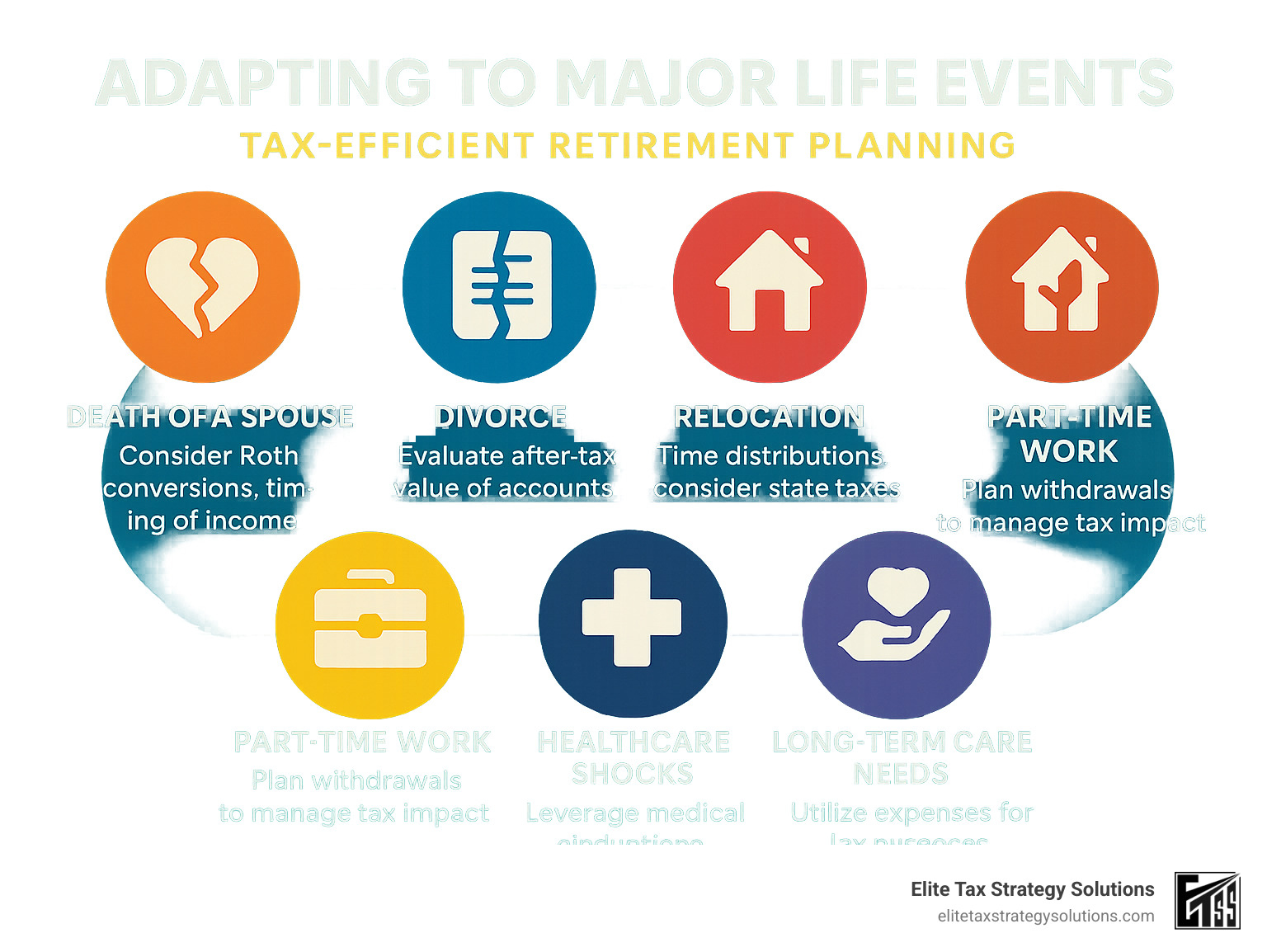
The death of a spouse creates one of the most dramatic shifts in retirement tax planning. Suddenly, the surviving spouse faces the harsh reality of single-filer tax brackets — which are roughly half the width of married-filing-jointly brackets. A couple comfortably sitting in the 12% bracket might find the survivor pushed into the 22% bracket with the same income.
But here’s the silver lining: this transition period often creates an ideal opportunity for Roth conversions. The surviving spouse typically has lower overall income in the year of death and possibly the following year, before Social Security survivor benefits and RMDs push income back up.
Divorce brings its own tax complications, especially when splitting retirement accounts. Here’s what many people miss: a $100,000 traditional 401(k) is not equal to a $100,000 Roth IRA. The traditional account comes with a future tax bill, while the Roth is yours free and clear. Always consider the after-tax value when negotiating retirement-asset divisions.
Relocation can be a game-changer for your tax situation. Moving from California (top rate 13.3%) to Florida (no state income tax) is like giving yourself an immediate raise. But timing matters. If you’re planning a big Roth conversion or taking a large distribution, coordinate it with your move to maximize state-tax savings.
Returning to part-time work is increasingly common, but it can complicate your tax picture. If you’re under full retirement age, Social Security has earnings limits that can reduce your benefits. Plus, that extra income might push you into higher tax brackets or trigger IRMAA surcharges. Plan your withdrawal strategy carefully to minimize the overall impact.
Healthcare shocks and long-term care needs can actually create tax-planning opportunities. Large medical expenses that exceed 7.5% of your adjusted gross income are deductible. If you’re facing a big medical year, it might be the perfect time to accelerate other income or do Roth conversions, since you’ll already be itemizing deductions.
This is where having money in all three tax buckets — taxable, tax-deferred, and tax-free — becomes invaluable. When life throws you a curveball, you have the flexibility to choose which accounts to tap based on your current tax situation.
Tools, Pitfalls & Professional Guidance
Let’s be honest — even the smartest tax-efficient retirement planning strategy can fall apart faster than a house of cards if you’re not using the right tools or if you stumble into common traps. After four decades of helping clients steer these waters, I’ve seen brilliant strategies derailed by simple oversights and modest plans succeed through careful execution.
The good news? Most pitfalls are completely avoidable once you know what to watch for.
Getting Your Bearings with Planning Tools
Today’s technology offers some impressive resources for retirement tax planning. Fidelity’s tax estimator and similar tools from other major brokerages can give you a decent starting point for basic projections. These calculators help you estimate your tax liability across different withdrawal scenarios.
But here’s where I see people get tripped up — these tools often miss the nuances that can make or break your strategy. They might not account for your specific state-tax situation, Medicare IRMAA surcharges, or the dreaded Social Security tax torpedo we discussed earlier. Think of them as helpful for the big picture, but don’t bet your retirement on their precision.
Professional-grade software creates what we call “tax maps” — detailed year-by-year projections that show your effective marginal tax rates including every tax and surcharge that might hit you. These maps reveal the sweet spots for Roth conversions and help identify when you’re approaching dangerous territory that could trigger Medicare surcharges.
The Costly Mistakes I See Over and Over
After working with hundreds of retirees, certain mistakes keep appearing with frustrating regularity. The missed RMD penalty tops my list of preventable disasters. The IRS doesn’t send friendly reminders, and that 25% penalty (even with the recent reduction to 10% if corrected quickly) can devastate your retirement income.
I always tell clients to set up automatic distributions or put multiple calendar reminders in place. Don’t rely on your memory — even the sharpest minds can forget when juggling multiple accounts.
Ignoring state taxes ranks as another expensive oversight. I’ve watched retirees craft beautiful federal tax strategies that end up costing them thousands in state taxes they never considered. A Roth conversion that makes perfect sense federally might push you into a higher state bracket or affect state-specific retirement-income exemptions.
The over-converting trap catches many enthusiastic planners. Yes, Roth conversions can be powerful, but more isn’t always better. Converting too aggressively can rocket you into higher tax brackets, trigger those painful Medicare surcharges, or affect other income-based benefits you’re receiving.
Asset location mistakes quietly erode returns over time. Holding tax-inefficient investments like bonds or REITs in taxable accounts while keeping tax-efficient growth stocks in tax-sheltered accounts essentially throws money away year after year.
Poor beneficiary planning creates headaches for your family when they’re already dealing with grief. Not updating beneficiaries after major life events or failing to consider the tax burden you’re passing to your heirs can turn your legacy into a tax nightmare for the people you love most.
For comprehensive strategies that avoid these pitfalls while maximizing your tax efficiency, our Financial and Tax Planning services integrate all these elements into a cohesive strategy.
When to Call In the Pros
I’m obviously biased here, but let me share when I genuinely believe professional help becomes essential rather than just helpful.
The complexity threshold typically hits when your retirement assets exceed $500,000 across multiple account types. Below that level, you can often manage with good self-education and basic tools. Above it, the potential tax savings from professional optimization usually far exceed the cost of guidance.
Complex situations almost always benefit from professional insight. If you own a business, have rental properties, hold substantial taxable investments, or face major life transitions like divorce or significant inheritance, the moving parts become too numerous for most people to coordinate effectively.
Coordinating Social Security timing with tax-efficient withdrawal strategies requires modeling multiple scenarios and understanding how these decisions interact over decades. Get this wrong, and you could leave tens of thousands of dollars on the table.
The team approach works best for comprehensive tax-efficient retirement planning. You want a CFP (Certified Financial Planner) who understands the big-picture investment and income strategy, working alongside a CPA who can handle the tax-specific details and compliance requirements. At Elite Tax Strategy Solutions, we provide this integrated approach because we’ve seen how disconnected advice can create gaps and missed opportunities.
Stress-testing your strategy involves modeling scenarios you hope never happen — market crashes during early retirement, significant health events, major tax-law changes, or living much longer than expected. Professional planning software can run thousands of scenarios to identify strategies that remain robust under various conditions.
Ongoing monitoring might be the most valuable service of all. Tax laws change regularly, markets fluctuate, and your personal situation evolves. Having professionals who track these changes and adjust your strategy accordingly provides peace of mind and often catches opportunities you might miss on your own.
The key is finding advisors who view tax-efficient retirement planning as an ongoing relationship rather than a one-time project. Your strategy should evolve as your life changes, and the best outcomes come from consistent, proactive adjustments rather than reactive scrambling when problems arise.
Frequently Asked Questions about Tax-Efficient Retirement Planning
How are Social Security benefits taxed, and can I reduce it?
Here’s something that surprises many retirees: your Social Security benefits might be taxable, and the rules are more complex than most people realize. The IRS uses something called “provisional income” to determine how much of your benefits get taxed.
Your provisional income includes your adjusted gross income, plus any tax-exempt interest from municipal bonds, plus half of your Social Security benefits. It’s like the IRS is saying, “We’re going to look at all your income, even the stuff that’s supposed to be tax-free, to decide how much of your Social Security we can tax.”
Here’s how the thresholds work: If you’re single and your provisional income exceeds $25,000, up to 50% of your Social Security becomes taxable. Exceed $34,000, and up to 85% gets taxed. For married couples filing jointly, the thresholds are $32,000 and $44,000 respectively.
The good news? You can absolutely reduce this tax burden with smart tax-efficient retirement planning. Roth IRA withdrawals are your secret weapon because they don’t count toward provisional income at all. Neither do withdrawals of your original contributions from taxable accounts.
Consider municipal bonds carefully — while the interest is federally tax-free, it still counts toward provisional income and could make more of your Social Security taxable. Sometimes a taxable bond yielding slightly more ends up better after considering the Social Security impact.
Timing is everything. If you’re approaching the thresholds, be strategic about when you take other income. Maybe delay that traditional IRA withdrawal until next year, or accelerate it into this year if you’re already past the threshold.
What’s the best age for Roth conversions?
The “golden window” for Roth conversions typically opens when you retire and closes when RMDs begin at age 73. During these years, you often have the lowest income of your entire adult life — no more W-2 wages, Social Security hasn’t started yet, and RMDs are still years away.
But the “best” age really depends on your unique situation. If you retire in your early 60s, those gap years before Social Security kicks in are often perfect for conversions. You’re living off savings while converting traditional IRA money at historically low tax rates.
Market downturns create unexpected opportunities regardless of your age. When your account values drop 20% or 30%, you can convert the same number of shares for much less tax cost. If the market recovers (and historically it has), all that growth happens in your tax-free Roth account.
The bracket-filling strategy works at any age. Look at your current tax bracket and convert just enough to “fill it up” without pushing yourself into the next higher bracket. For 2024, that might mean converting up to the top of the 12% bracket ($47,150 for married couples) or the 22% bracket ($201,050 for married couples).
One thing to watch out for: don’t convert so much that you trigger Medicare surcharges. Those IRMAA penalties can add hundreds of dollars monthly to your Medicare premiums, potentially wiping out the tax benefits of your conversion.
Do I pay state tax on my pension if I move?
This question comes up constantly, and the answer is refreshingly simple for most people: you’ll pay state tax based on where you live in retirement, not where you earned the pension.
Most private-company pensions follow what tax professionals call the “source vs. residence” rule, and residence usually wins. So if you earned your pension working in high-tax California but retire to no-tax Florida, you’ll generally pay Florida’s rate (which is zero) on your pension income.
Government pensions can be trickier. Some states have special rules that let them tax their former employees’ pensions even after they move away. But even here, many states are moving away from this practice because it’s difficult to enforce and creates administrative headaches.
The timing of your move matters more than you might think. If you’re planning a big pension lump-sum distribution, consider whether to take it before or after your relocation. A $200,000 distribution could save you $20,000 or more in state taxes with proper timing.
Before making any major moves, research both your current state and your target state’s rules. Some states that don’t tax regular retirement income might still tax lump-sum distributions differently. And remember — tax-efficient retirement planning means looking at the whole picture, including property taxes, sales taxes, and overall cost of living, not just income-tax rates.
When in doubt, consult with a tax professional who understands multi-state tax issues. The rules change frequently, and what was true last year might not apply to your situation today.
Conclusion
Tax-efficient retirement planning isn’t just about saving money – it’s about creating a roadmap that gives you real control over your financial future. Think of it as building a bridge between your working years and the retirement you’ve always imagined, with fewer detours through Uncle Sam’s toll booths along the way.
The strategies we’ve explored together can genuinely transform your retirement experience. We’re not talking about small change here – proper planning can save you hundreds of thousands of dollars over your retirement years. More importantly, it gives you the flexibility to handle whatever life throws your way, whether that’s a market downturn, unexpected health expenses, or simply wanting to be more generous with your grandchildren.
The beauty of tax-efficient retirement planning lies in its flexibility. Diversifying across tax buckets means you’re never locked into one approach. Having money in taxable, tax-deferred, and tax-free accounts is like having multiple tools in your toolbox – you can choose the right one for each situation.
Strategic withdrawal sequencing can feel overwhelming at first, but you don’t have to figure it all out on day one of retirement. You can adjust year by year, taking advantage of low-income periods and avoiding unnecessary tax spikes. Roth conversions during those golden window years between retirement and RMDs often provide the biggest bang for your buck.
Don’t underestimate the importance of coordinating your Social Security and Medicare decisions with your overall tax strategy. These programs don’t exist in isolation – they’re part of a bigger puzzle that affects your entire retirement income picture.
Here’s something I’ve learned over four decades of helping clients: life rarely goes according to plan. Markets crash, health issues arise, tax laws change, and family situations evolve. The most successful retirees aren’t those who created perfect plans – they’re the ones who built flexible strategies that could adapt to changing circumstances.
The complexity can feel daunting, and honestly, it should. With changing RMD rules, Medicare surcharges, Social Security taxation quirks, and state tax considerations, there are a lot of moving pieces. That’s exactly why professional guidance has become more valuable than ever. The cost of getting it wrong compounds over decades, while the benefits of getting it right do too.
At Elite Tax Strategy Solutions, we’ve seen how proper tax-efficient retirement planning can transform someone’s retirement experience. Our clients in Jasper, Indiana, and the surrounding areas often tell us that the peace of mind is worth as much as the tax savings. Knowing you have a strategy that adapts to changing laws and life circumstances lets you actually enjoy retirement instead of constantly worrying about money.
The truth is, the best time to start was probably years ago. But the second-best time is right now, whether you’re still working or already retired. The principles we’ve discussed work at any stage – they just get applied differently based on where you are in your journey.
If you’re ready to take control of your retirement tax strategy, our comprehensive financial planning services can help you implement these concepts in a way that makes sense for your specific situation. We’ll work together to create a plan that evolves with your needs and the ever-changing tax landscape.
Retirement planning isn’t a “set it and forget it” proposition. It’s more like tending a garden – it needs regular attention and occasional adjustments to keep growing strong. But with the right foundation and ongoing care, you can create the retirement you’ve worked so hard to achieve while keeping more of what you’ve earned in your pocket where it belongs.