
Why Understanding Tax Deductible Expense Categories Is Your Path to Financial Success
Tax deductible expense categories are the foundation of smart financial management for any business. These are legitimate costs the IRS allows you to subtract from your income, which directly reduces your taxable income and overall tax bill. However, many high-income earners and business owners miss out on thousands in savings each year.
The key rule is that any business expense must be ordinary and necessary for your trade or business. Common categories include:
- Office and Property: Rent, utilities, supplies, insurance.
- Personnel: Salaries, benefits, contractor payments.
- Travel and Vehicle: Business trips, mileage, and 50% of business meals.
- Professional Fees: Legal, accounting, and bank charges.
- Marketing: Advertising, website costs, and promotional materials.
- Home Office: Costs for a dedicated workspace.
- Technology and Equipment: Software, computers, and machinery.
Understanding these categories is about maximizing your financial success. Every valid deduction reduces your taxable income. For those in higher tax brackets, this translates to substantial savings. The challenge is the complexity of IRS rules, which can lead to missed deductions or errors that trigger audits.
I’m David Fritch. With 40 years of experience running a CPA practice and law firm, I’ve helped countless clients steer tax deductible expense categories for maximum savings and full compliance. At Elite Tax Strategy Solutions, we use proven systems to help high-income earners and business owners find every legitimate deduction.
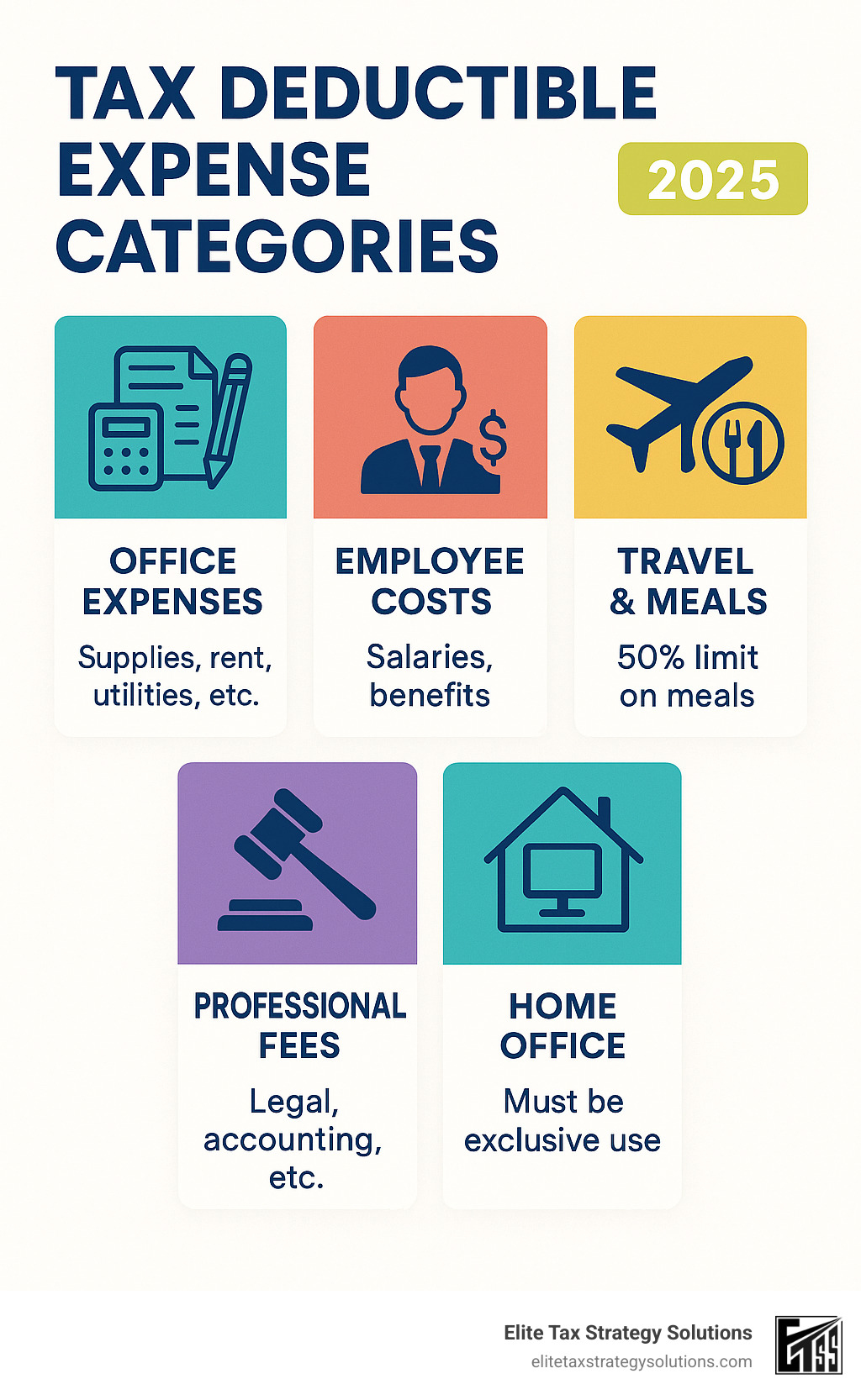
Simple guide to tax deductible expense categories:
A Comprehensive Guide to Tax Deductible Expense Categories
Understanding your tax deductible expense categories is a fundamental strategy for reducing your taxable income. The IRS rule is simple: an expense must be “ordinary and necessary” for your business. “Ordinary” means it’s common in your industry, and “necessary” means it’s helpful and appropriate. Let’s explore the core categories every business owner should master.

Getting a handle on these categories is vital for effective Business Expenses Examples.
Office and Property Expenses
Costs related to your workspace are almost always deductible.
- Office Supplies: Everyday items like pens, paper, printer ink, and specialized materials for your trade.
- Rent or Lease Payments: Money paid for your business premises or rented equipment is generally 100% deductible.
- Utilities: The cost of lights, water, internet, and phone services for your business location.
- Business Insurance: Premiums for liability, property, and workers’ compensation insurance are deductible.
- Maintenance and Repairs: Routine fixes that keep your property in working order are immediately deductible. Major improvements that add value (capital improvements) are depreciated over several years.
- Property Taxes: Taxes assessed on business-owned real estate are fully deductible.
To dive deeper into classifying these, explore Business Expense Categories.
Employee and Contractor Costs
Your team is a significant investment, and many related costs are deductible.
- Salaries and Wages: Compensation paid to employees, including bonuses and commissions. For S-Corp owners, a “reasonable salary” paid to yourself is also a deductible business expense.
- Employee Benefits: Premiums for group health insurance, contributions to retirement plans like 401(k)s, and other perks are largely deductible.
- Education and Training: Costs for courses and workshops that are directly related to your employees’ job functions.
- Payroll Taxes: The employer’s share of Social Security, Medicare (FICA), and unemployment taxes (FUTA/SUTA) is fully deductible.
- Payments to 1099 Contractors: Fees paid to freelancers and consultants are deductible. Remember to issue a Form 1099-NEC for payments of $600 or more in a year.
Travel, Meals, and Vehicle Expenses
These common expenses have specific rules you must master.
- Business Travel: When you travel away from your “tax home” primarily for business, you can deduct airfare, hotels, and local transportation.
- Meals: Business meals with clients or during business travel are generally 50% deductible. Client entertainment, like tickets to sporting events, is no longer deductible.
- Motor Vehicle Expenses: You have two options for deducting vehicle use:
- Standard Mileage Rate: A simple method where you multiply your business miles by a rate set by the IRS ($0.67 per mile for 2024).
- Actual Expenses: A more detailed method where you deduct the business portion of actual costs like gas, repairs, insurance, and depreciation. This requires meticulous record-keeping.
- Vehicle Depreciation: Under the actual expense method, you can also depreciate the business portion of your vehicle. Special rules like Section 179 expensing or bonus depreciation (60% in 2024) can accelerate these deductions.
Professional, Administrative, and Marketing Fees
These are the essential costs that keep your business compliant and visible.
- Legal and Accounting Fees: Payments to attorneys and accountants for business matters are deductible.
- Bank Fees and Interest: Monthly service charges, wire transfer fees, and interest on business loans are deductible.
- Business Licenses and Permits: Fees paid to legally operate your business are fully deductible.
- Advertising and Promotion: Costs for online ads, website development, business cards, and other promotional activities are 100% deductible.
- Dues and Subscriptions: Fees for professional organizations and business-related publications or software are deductible. Dues for social clubs are not.
- Business Gifts: The deduction is limited to $25 per recipient per year.
Home Office and Other Specific Tax Deductible Expense Categories
For many entrepreneurs and high-income earners, the home office isn’t just convenient; it’s a legitimate powerhouse among your tax deductible expense categories, provided you follow the IRS rules. It can offer a significant deduction if set up correctly.

The space must be used exclusively and regularly as your principal place of business. You have two ways to calculate the deduction:
- Simplified Option: Deduct $5 per square foot, up to 300 square feet (a maximum of $1,500).
- Regular Method: Deduct a percentage of your actual home expenses (mortgage interest, utilities, insurance, depreciation) based on the portion of your home used for business. This requires more calculation but can yield a larger deduction.
Other specific deductions include costs for your own Continuing Education to maintain or improve your business skills. Mastering these specific deductions is a key part of Deduction Optimization.
Advanced Concepts: Capital, Startup, and Non-Deductible Costs
Understanding the timing of your deductions is crucial for optimizing your tax deductible expense categories. Some expenses are deducted immediately, while others are spread over several years.

The key is knowing which expenses fall into which category and how to maximize the benefit from each. For a deeper dive into these strategies, visit Tax Optimization Strategies.
Current vs. Capital Expenses: The Timing of Your Deductions
Current expenses are costs used up within a year, like office supplies or monthly rent. You deduct them in the year you incur them. Capital expenses are investments in long-term assets like equipment, buildings, or patents. You deduct these costs over time through depreciation (for tangible assets) or amortization (for intangible assets).
| Feature | Current Expenses | Capital Expenses |
|---|---|---|
| Deductibility | Deducted in the year incurred | Depreciated/Amortized over time |
| Purpose | Day-to-day operations | Acquire long-term assets |
| Example | Office supplies, rent | Equipment, buildings, patents |
The IRS provides powerful tools to accelerate capital expense deductions. The Section 179 deduction allows you to expense the full cost of qualifying equipment in the first year, up to certain limits. Bonus depreciation provides an additional first-year deduction (60% for property placed in service in 2024). These strategies can dramatically reduce your current year’s taxable income but require careful planning.
Startup Costs and Organizational Fees
Before your business earns revenue, you incur startup and organizational costs. The IRS allows you to deduct up to $5,000 in startup costs (e.g., market research, advertising) and another $5,000 in organizational costs (e.g., incorporation fees) in your first year of business.
If your costs exceed $50,000, the initial $5,000 deduction is reduced. Any remaining costs must be amortized over 15 years. This election must be made on your first tax return. It’s important to distinguish these from investigatory costs for a business you decide not to start, which are generally not deductible. Understanding these rules is important for strategies like Maximizing Your Qualified Business Income (QBI) Deduction Before It Expires.
What You Can’t Deduct: Common Non-Deductible Expenses
Knowing what you can’t deduct is as important as knowing what you can. Claiming non-deductible expenses can trigger audits and penalties. Key non-deductible items include:
- Personal Expenses: Your daily commute, non-uniform clothing, and personal grooming.
- Fines and Penalties: Traffic tickets, government fines, and illegal payments.
- Political Contributions: Donations to political parties or candidates and lobbying expenses.
- Client Entertainment: Costs for events like concerts or sporting games are not deductible, though the meal portion may be 50% deductible if business is discussed.
- Club Dues: Membership fees for golf, country, or other social clubs.
- Life Insurance Premiums: Premiums on policies where your business is the beneficiary.
- Value of Your Own Labor: You can only deduct monetary expenses, not the value of your time.
Compliance and Record-Keeping: Your Key to Audit-Proof Deductions
To maximize your tax deductible expense categories and remain audit-ready, meticulous record-keeping is non-negotiable. The IRS’s golden rule is: “If it’s not documented, it didn’t happen.” Without proper proof, even legitimate expenses can be disallowed, leading to more taxes and penalties.
Your documentation should include several key items. Receipts are your primary defense, showing the date, vendor, amount, and a description of the purchase. The IRS requires proof of expense for any transaction above $75, but keeping all receipts is the safest strategy.
Bank and credit card statements serve as secondary proof, verifying payments but often lacking detail. For vehicle expenses, a detailed mileage log is critical, recording the date, destination, business purpose, and mileage for each trip. Supporting documents like calendars, invoices, and contracts also help establish the business purpose of your expenses.
Accurate records not only provide audit protection but also offer valuable financial insight into your business. The IRS generally has three years to audit a return (six if they suspect substantially under-reported income), so we recommend keeping all business records for at least seven years.
Good record-keeping is the foundation of your strategy for Tax Liability Reduction. It allows you to confidently claim every deduction you’re entitled to, maximizing savings while minimizing risk.
Frequently Asked Questions about Business Tax Deductions
We understand that navigating tax deductible expense categories can bring up a lot of questions. It’s perfectly normal to wonder how certain rules apply to your unique situation. Here at Elite Tax Strategy Solutions, we often hear some common questions from high earners and business owners. Let’s tackle them head-on!
What is the difference between a tax deduction and a tax credit?
This is one of the most fundamental questions we get, and understanding the difference can truly impact your tax bill. Think of it this way:
-
A tax deduction reduces your taxable income. If you have $10,000 in deductions, you pay tax on $10,000 less income. The value of the deduction depends on your tax bracket; a $1,000 deduction saves a taxpayer in the 24% bracket $240.
-
A tax credit, on the other hand, is like a coupon that directly reduces the amount of tax you owe, dollar-for-dollar. If you owe $5,000 in taxes and you have a $1,000 tax credit, your tax bill immediately drops to $4,000. It’s a direct reduction! Some credits can even be “refundable,” meaning they can put money back in your pocket even if you didn’t owe any tax to begin with.
In simple terms: deductions reduce your income that’s subject to tax, while credits reduce the actual tax you owe. Generally, a tax credit is more valuable than a deduction of the same amount because it’s a direct reduction of your tax bill.
How do I handle expenses that are for both business and personal use?
This is a fantastic question, as many business owners use items or services for both work and personal life. The key here is prorating – you can only deduct the portion of the expense that is directly related to your business. You simply cannot deduct the entire amount.
For example, if you use your personal cell phone for business 40% of the time, you can deduct 40% of your monthly phone bill. The same principle applies to your vehicle (based on business mileage) and home office (based on the percentage of your home used for business). The key is to use a consistent and reasonable method for allocating the business portion and to keep excellent records to support your claim.
Can I deduct business expenses if I take the standard deduction?
Yes, absolutely! This is a very common source of confusion, especially for new small business owners or sole proprietors. Let’s clear this up once and for all!
Think of your tax return as having two distinct “sections” for deductions:
-
Business Expenses (“Above the Line”): All the wonderful tax deductible expense categories we’ve discussed – like office supplies, rent, employee costs, travel, and professional fees – are deducted first. For sole proprietors, these are reported on Schedule C (Profit or Loss from Business). These deductions are subtracted from your gross business income to arrive at your net business profit (or loss). This net profit is then carried over to your personal tax return (Form 1040) and becomes part of your Adjusted Gross Income (AGI). These are called “above the line” deductions because they reduce your AGI.
-
Standard Deduction or Itemized Deductions (“Below the Line”): After your AGI has been calculated, you then choose whether to take the standard deduction (a set amount based on your filing status) or to itemize your personal deductions (like mortgage interest, state and local taxes, or charitable contributions). These are subtracted from your AGI to arrive at your final taxable income. These are often called “below the line” deductions.
So, you see, these two types of deductions operate independently. You first reduce your business income with your legitimate business expenses, and then you decide on your personal deduction strategy. You can absolutely claim all your qualified business expenses and still take the standard deduction on your personal tax return. They work together to help you achieve the best possible tax outcome!
Conclusion: Proactive Planning for Maximum Savings
We’ve covered a lot of ground, from everyday deductions like office supplies to the complexities of capital expenses and the strategic value of a home office. Understanding and applying the principles of tax deductible expense categories is a cornerstone of financial success for high earners and closely held businesses. Every legitimate deduction reduces your taxable income, keeping more money in your pocket to reinvest or enjoy.
For businesses and individuals in Jasper, Indiana, and suburban areas near major cities, navigating these rules can be a challenge. This is where Elite Tax Strategy Solutions excels. We believe in a proactive approach, partnering with you year-round to identify every deduction, optimize your financial structure, and ensure you are always prepared.
Don’t leave money on the table. Let our expertise turn tax complexity into clarity and savings into tangible growth.
Ready to see how much you can save? Learn more about How To Reduce My Income Tax.
It’s time to take control of your financial future. Contact us for high-income individual tax planning and let’s build your path to sustained financial success together.