Why Tax Risk is Now a Boardroom Conversation
Tax compliance risk management is the systematic process of identifying, assessing, and controlling tax-related risks to ensure accurate tax reporting and minimize potential penalties. This strategic approach helps organizations protect their financial health while maintaining regulatory compliance.
Key Components of Tax Compliance Risk Management:
- Risk Identification – Spotting potential compliance gaps, legislative changes, and process failures
- Risk Assessment – Evaluating the likelihood and impact of identified tax risks
- Control Implementation – Establishing procedures and safeguards to mitigate risks
- Monitoring & Testing – Regularly reviewing controls to ensure they remain effective
- Reporting & Communication – Keeping stakeholders informed of tax risk status and issues
The landscape has changed dramatically. As one industry expert notes: “It is becoming increasingly clear that organisations should pay as much attention to tax risk as they do to other risk areas such as anti-money laundering or fiduciary risk.”
Tax risk is no longer just a compliance issue – it’s a strategic imperative. With 36% of Canadian CEOs reporting that government regulation has changed how their companies create value, and 44% expecting further regulatory impact in the next three years, tax compliance has moved from the back office to the boardroom.
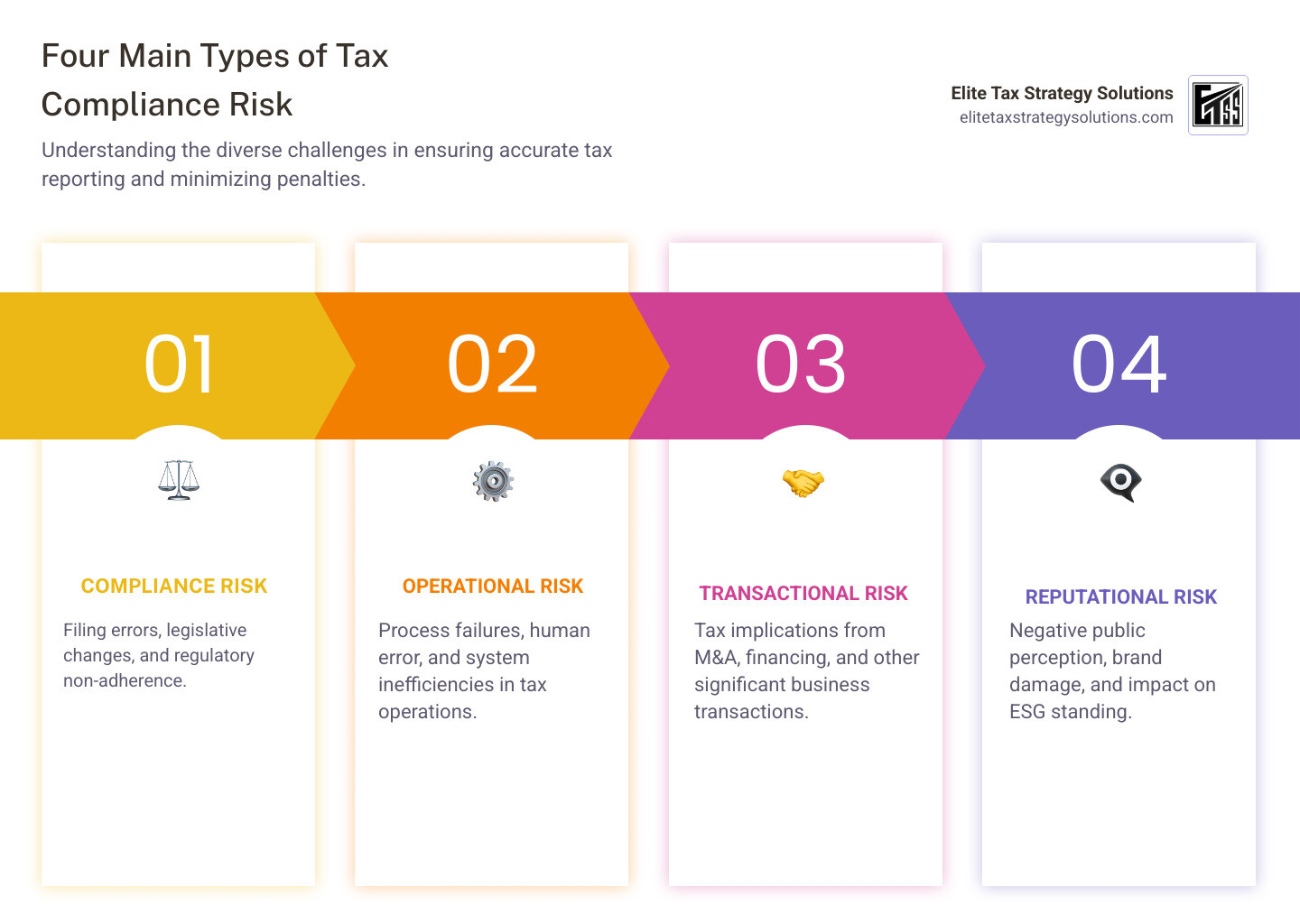
Organizations now face increased scrutiny from regulators, investors, and the public. They must demonstrate robust tax governance frameworks and prove their controls are working effectively. The stakes are higher than ever, with potential consequences including financial penalties, reputational damage, and loss of stakeholder confidence.
I’m David Fritch, and with 40 years of experience in tax and accounting practice, I’ve helped countless business owners steer the complexities of tax compliance risk management while optimizing their financial outcomes. My expertise spans from working at Arthur Andersen to building specialized practices that focus on proactive tax strategies and risk mitigation for high-income earners and small business owners.
Similar topics to tax compliance risk management:
The Shifting Sands: Global Trends Demanding Proactive Tax Risk Management
The tax world is changing faster than ever, and it’s happening on a global scale. If you think your business can stay in its own little bubble, think again. International tax developments are reshaping how companies everywhere handle their tax obligations, whether you’re a multinational corporation or a small business in Toronto.
Let’s talk about Pillar Two – it sounds technical, but it’s actually quite straightforward. This initiative, part of the OECD’s Base Erosion and Profit Shifting (BEPS) project, creates a global minimum tax rate for large companies. Even if your business primarily operates in Canada, these rules could affect you if you have any international dealings. It’s like having a new referee in a game you’ve been playing for years – suddenly, the rules are different.
The demand for transparency has never been higher. Country-by-Country (CbC) reporting means tax authorities now share information across borders like never before. They’re using advanced data-driven audits and cross-border collaboration to spot inconsistencies and potential compliance issues with remarkable efficiency.
The OECD’s guidance on Compliance Risk Management shows us just how sophisticated tax authorities have become. They’re using systematic, data-driven approaches that would make a tech company proud. Gone are the days of random paper audits – today’s evolving tax authority approaches include macro-economic analyses, data matching, and behavioral surveys to identify compliance gaps.
Here’s what really caught my attention: 36% of Canadian CEOs report that government regulation has already changed how their company creates value in the past five years. Even more striking? 44% expect further regulatory impact in the next three years. This isn’t just about filling out forms anymore – regulatory impact on value creation is real and measurable.

What does this mean for your business? Simply put, proactive tax compliance risk management isn’t optional anymore – it’s essential for survival and growth. The old approach of “let’s deal with tax issues when they come up” is like trying to steer a ship by looking only at the wake behind you.
I’ve seen too many businesses get caught off guard by these changes. The smart ones are those who adapt early and turn potential threats into manageable parts of their business strategy. After 40 years in this field, I can tell you that staying ahead of these trends isn’t just about avoiding problems – it’s about finding opportunities that your competitors might miss.
Want to dive deeper into how these global shifts might impact your business? Explore More info about our Tax Advisory Services.
Building Your Fortress: Key Components of a Tax Control Framework
Think of building a tax compliance risk management framework like constructing a fortress to protect your most valuable assets. Just as a medieval castle needed strong walls, strategic watchtowers, and vigilant guards, your tax framework needs robust components working together to shield your business from compliance risks and regulatory threats.
The days of treating tax as a back-office function are long gone. Today’s regulatory environment demands that we lift tax risk to the same level of importance as other critical business risks. This means integrating tax into corporate governance, defining your risk appetite clearly, and ensuring your board takes appropriate oversight responsibility.

A well-designed framework does much more than help you avoid penalties. It optimizes how you use your resources and promotes voluntary compliance throughout your organization. This systematic approach helps you steer complexity while building a tax strategy that can weather any storm.
The four pillars of an effective framework are Governance, Risk Assessment, Controls, and Monitoring. Each plays a crucial role in creating a comprehensive defense system that protects your business while supporting your growth objectives.
Ready to see how a comprehensive framework can transform your tax operations? Find More info about our Tax Management Services.
Step 1: Establish Strong Governance and Strategy
Strong governance is the foundation of your framework, embedding tax considerations into your organization’s DNA. It begins with board oversight, ensuring tax decisions align with business objectives and company values. As the Australian Taxation Office’s governance review guide notes, tax risk management is simply “part of good corporate governance.” Defining a formal tax policy creates a clear roadmap for compliance, risk tolerance, and audit management. Management accountability translates these principles into action. Using a RACI matrix to define who is Responsible, Accountable, Consulted, and Informed for each tax process eliminates confusion. For instance, with my clients in Jasper, Indiana, establishing clear roles prevents common issues and saves significant penalties. The key is aligning your tax strategy with business objectives from the start for smarter, compliant decisions.
Step 2: Identify, Assess, and Prioritize Tax Risks
This step involves systematically identifying potential tax risks. Your risk identification process should be comprehensive, examining internal operations and transactions as well as external factors like legislative changes. Data mining and analytics are powerful tools for uncovering patterns that signal risk. All findings should be logged in a comprehensive risk register, where each risk is evaluated for its likelihood of occurrence and potential impact. Using risk heat maps helps visualize this data, making it easy to prioritize high-impact, high-likelihood risks for immediate attention. For example, proactive risk identification helped my clients steer changing sales tax nexus rules for e-commerce, catching “hidden” exposures before they became costly. The goal is to turn uncertainty into a prioritized action plan.
Want comprehensive protection for your business? Learn about our More info about Tax Risk Management services.
Step 3: Implement and Document Controls and Processes
Once risks are identified, you must implement controls to address them. Developing internal controls involves creating systematic checks and balances for all tax processes, from data entry to final filing approval. Process documentation is critical. Clear, step-by-step procedures for tax preparation, software use, and outsourcing are invaluable during audits or staff changes. Pay special attention to controls for tax effect accounting, documenting the frequency, responsibilities, and process to ensure a clear audit trail. For managing tax risks in significant transactions like M&A, integrating tax expertise early is crucial to prevent costly errors and optimize the deal structure. Well-designed controls should streamline work, not complicate it.
For expert guidance on your business tax obligations, explore our More info about Business Tax Compliance services.
Step 4: Monitor, Test, and Report
A tax framework requires constant attention to remain effective. This involves regular inspections, testing, and reporting to leadership. Ongoing monitoring should be built into your daily processes to ensure controls are working as intended. Periodic testing provides a deeper evaluation of whether controls are preventing or detecting issues as designed. Use Key Performance Indicators (KPIs), such as error-free filing rates, to track progress objectively. Reporting to leadership and the board is essential for alignment, covering the current risk profile and control effectiveness. Finally, creating feedback loops drives continuous improvement. When a deficiency is found, fix it, but also analyze the root cause to prevent recurrence. This adaptive approach ensures your framework evolves with new threats and business changes.
The Modern Arsenal: Leveraging Technology and Collaboration
The Role of Technology in Modern Tax Compliance Risk Management
Let me share something I’ve learned in my 40 years in this business: technology isn’t just changing how we do taxes – it’s completely revolutionizing what’s possible. When I started at Arthur Andersen, we were still working with paper files and calculators. Today’s tax compliance risk management landscape is a whole different world, and frankly, it’s exciting.
Tax technology, or TaxTech as we call it, has become absolutely essential. I’ve watched clients transform their entire approach using Governance, Risk, and Compliance (GRC) tools. These systems are incredibly smart – they can automatically flag mandatory disclosure rules when your treasury department refinances debt. No more missed deadlines because someone forgot to loop in the tax team.
The real game-changer is ERP system integration. When we help clients design their Enterprise Resource Planning systems with tax considerations built right in, everything becomes smoother. The data flows naturally, tax provisioning becomes more accurate, and those dreaded manual errors practically disappear. It’s like having a well-oiled machine instead of a collection of separate parts.
Data analytics for anomaly detection is another tool I’m passionate about. These systems can spot unusual patterns that might signal trouble long before a human would notice. And automation? It’s freed up our most talented tax professionals to focus on strategy instead of data entry. As one industry expert puts it, a “human-led, tech-powered approach” is essential for managing new tax risks.
The businesses that accept these technologies move faster and think differently about tax risk. They gain real competitive advantages while their competitors are still stuck in the old ways of doing things.
Want to see how technology can transform your tax approach? Check out More info about Proactive Tax Strategies.
Breaking Down Silos: The Power of Cross-Functional Collaboration
Here’s something that might surprise you: the biggest tax risks often come from communication gaps, not complex tax law. I’ve seen million-dollar problems created simply because the tax department didn’t know what the treasury team was doing. It happens more often than you’d think.
Effective tax compliance risk management demands that everyone talks to each other. The tax department can’t operate in isolation anymore. When different departments work in silos, important information falls through the cracks, and that’s when costly mistakes happen.

The tax function needs to be closely connected with Treasury to understand financing activities, intercompany loans, and foreign exchange transactions. Legal teams provide crucial insights into contracts, litigation, and regulatory changes. Operations helps us grasp the tax impact of supply chain changes, new products, or expansion plans. And M&A teams need tax input from day one – especially now with Pillar Two requirements affecting deal modeling.
I’ve built my practice around this collaborative approach. Whether I’m working with a high-income family in suburban Indiana or a closely held business expanding nationally, breaking down these communication barriers is essential. When everyone understands how their decisions affect tax obligations, we can spot opportunities early and prevent expensive surprises.
This collaborative spirit isn’t just good practice – it’s how modern tax management works. The days of the tax department working alone in the back office are over. Today’s successful businesses integrate tax considerations into every major decision from the very beginning.
From Threat to Advantage: Consequences and Opportunities
The High Cost of Inaction: Consequences of Poor Management
Let me be straight with you: ignoring tax compliance risk management is like leaving your front door wide open in a storm. The consequences aren’t just uncomfortable – they can be devastating.
I’ve seen too many businesses learn this lesson the hard way. Financial penalties and interest hit first and hit hard. What starts as a minor filing error can snowball into massive interest charges over time. Tax authorities don’t mess around when it comes to collecting what they’re owed, and those penalty calculations can be eye-watering.
But the financial hit is just the beginning. Severe reputational damage follows close behind, and in our connected world, bad news travels fast. Once your company becomes the subject of tax controversy headlines, rebuilding trust with customers, employees, and partners becomes an uphill battle. This is especially true now that ESG considerations are front and center for many stakeholders.
Your investors won’t be happy either. Shareholder value erosion happens quickly when tax scandals break. Stock prices can plummet, and attracting future investment becomes much harder when your company has a reputation for tax troubles.
Here’s where it gets really uncomfortable: persistent compliance issues put you on the tax authorities’ radar for increased scrutiny and audits. Once you’re flagged as high-risk, expect more frequent visits and deeper dives into your records. These audits are time-consuming, expensive, and disruptive to your business operations.
The scariest consequence? Personal liability for directors. In many jurisdictions, company leaders can be held personally responsible for tax non-compliance, especially when negligence is involved. This is why tax risk truly belongs in the boardroom – it’s not just the company’s problem anymore.
How to Leverage Tax Changes for Strategic Gain
Here’s the exciting part: while tax changes create risks, they also create incredible opportunities. Our research shows that 40% of Canadian companies actually see regulatory changes as opportunities for their organization. That’s the mindset we need to adopt.
Think about it this way: when new tax rules come into play, everyone has to adapt. The companies that move quickly and strategically gain a significant competitive advantage over those that drag their feet. Take Pillar Two, for example. Businesses that proactively restructure their operations and integrate these new rules into their planning can optimize their global tax position while competitors are still figuring out what hit them.
Integrating tax into deal modeling is where we see some of the biggest wins. When you’re looking at mergers or acquisitions, understanding tax implications upfront can make or break the deal’s value. A Canadian multinational borrowing to acquire another company can dramatically improve their return on investment by addressing excessive interest and financing expense rules before closing the transaction, not after.
This proactive approach helps you optimize capital costs and ROI across the board. By staying ahead of regulatory changes, you can make financing decisions that are tax-efficient from day one. Instead of scrambling to comply after the fact, you’re using the new rules to your advantage.
Don’t forget about the hidden treasures either. Many regulatory changes come with new tax credits and incentives for activities like research and development, job creation, or green technology investments. Companies that spot these opportunities early can secure significant benefits that directly boost their bottom line.
The key is shifting your perspective. Instead of viewing tax compliance as a necessary evil, start seeing it as a strategic tool for growth and profitability. That’s exactly how we help our clients approach their tax planning.
Ready to turn tax challenges into opportunities? Learn more about More info about Tax Planning for Businesses.
Frequently Asked Questions about Tax Compliance Risk Management
What is the difference between tax planning and tax risk management?
Tax planning is proactive and strategic; it’s about designing your financial structure to legally minimize tax liability through smart decisions on timing, entity structure, and investments. In contrast, tax compliance risk management is the defensive framework of controls and processes. It ensures your tax strategies are executed correctly and that all obligations are met accurately and on time, protecting you from penalties and audits. The two are distinct but interconnected. Strong risk management is essential to safeguard the savings achieved through good tax planning.
Want to explore strategic approaches to tax savings? Check out More info about Tax Planning Strategies.
How often should a tax risk framework be reviewed?
A tax risk framework should be reviewed at least annually. However, more frequent reviews are necessary to stay proactive. An immediate review should be triggered by significant events such as:
- Major business changes (mergers, acquisitions, new market entry)
- New tax legislation (like Pillar Two or updated nexus rules)
- Changes in key personnel (like a CFO or bookkeeper)
Regular reviews ensure you remain responsive to change, helping you identify and fix potential issues before they become costly problems.
Can small businesses benefit from tax risk management?
Absolutely. Small businesses may need tax compliance risk management even more than large corporations because a significant tax penalty can be an existential threat. It doesn’t have to be complex. Effective Tax Planning for Small Businesses that incorporates risk management can be as simple as documenting processes, regularly reviewing obligations, and ensuring timely filings. These practices prevent most common problems. Small businesses are also nimble and can adapt to tax law changes quickly. Implementing good risk management provides a solid foundation for growth, makes the business more attractive to investors, and offers peace of mind.
Conclusion: Securing Your Financial Future with a Proactive Strategy
Throughout this exploration of tax compliance risk management, we’ve witnessed a fundamental change in how businesses must approach their tax obligations. What once lived quietly in the back office has now earned its rightful place in the boardroom, demanding the same strategic attention as any other critical business risk.
The landscape has shifted dramatically. From the complexities of international tax developments like Pillar Two to the sophisticated, data-driven approaches of modern tax authorities, the old “wait and see” mentality is no longer viable. The statistics speak volumes: with 36% of Canadian CEOs reporting that government regulation has already changed how their companies create value, and 44% expecting further regulatory impact, the writing is clearly on the wall.
The path forward requires a comprehensive, documented framework that encompasses strong governance, systematic risk identification and assessment, robust controls and processes, and continuous monitoring and improvement. We’ve seen how leveraging technology and breaking down departmental silos can transform your tax function from reactive to proactive. Most importantly, we’ve finded that while the consequences of poor tax risk management can be severe – from financial penalties to reputational damage – those who accept change can turn regulatory shifts into competitive advantages.
Continuous improvement isn’t just a nice-to-have; it’s a success factor. Your tax control framework must evolve as quickly as the regulations themselves. This means regular reviews, responsive adjustments, and a commitment to staying ahead of the curve rather than playing catch-up.
At Elite Tax Strategy Solutions, we’ve spent decades helping high-income individuals and closely held businesses steer these complexities with confidence. Our proactive approach doesn’t just ensure compliance – it optimizes your entire financial strategy for both savings and sustainability. We believe that with the right guidance and framework in place, tax risk management becomes less about avoiding problems and more about creating opportunities.
Your financial future deserves more than a reactive approach. It deserves a strategic partner who understands that effective tax planning and risk management work hand in hand to protect and grow your wealth.
Ready to transform your tax strategy from a source of stress into a cornerstone of financial success? Take control of your financial future with expert tax planning for high-income individuals.