Introduction: What is Tax Compliance and Why It Matters
Tax compliance for businesses means adhering to all tax laws from local, state, and federal governments. This includes accurately reporting income and expenses and paying all taxes on time.
Why is this so important for your business?
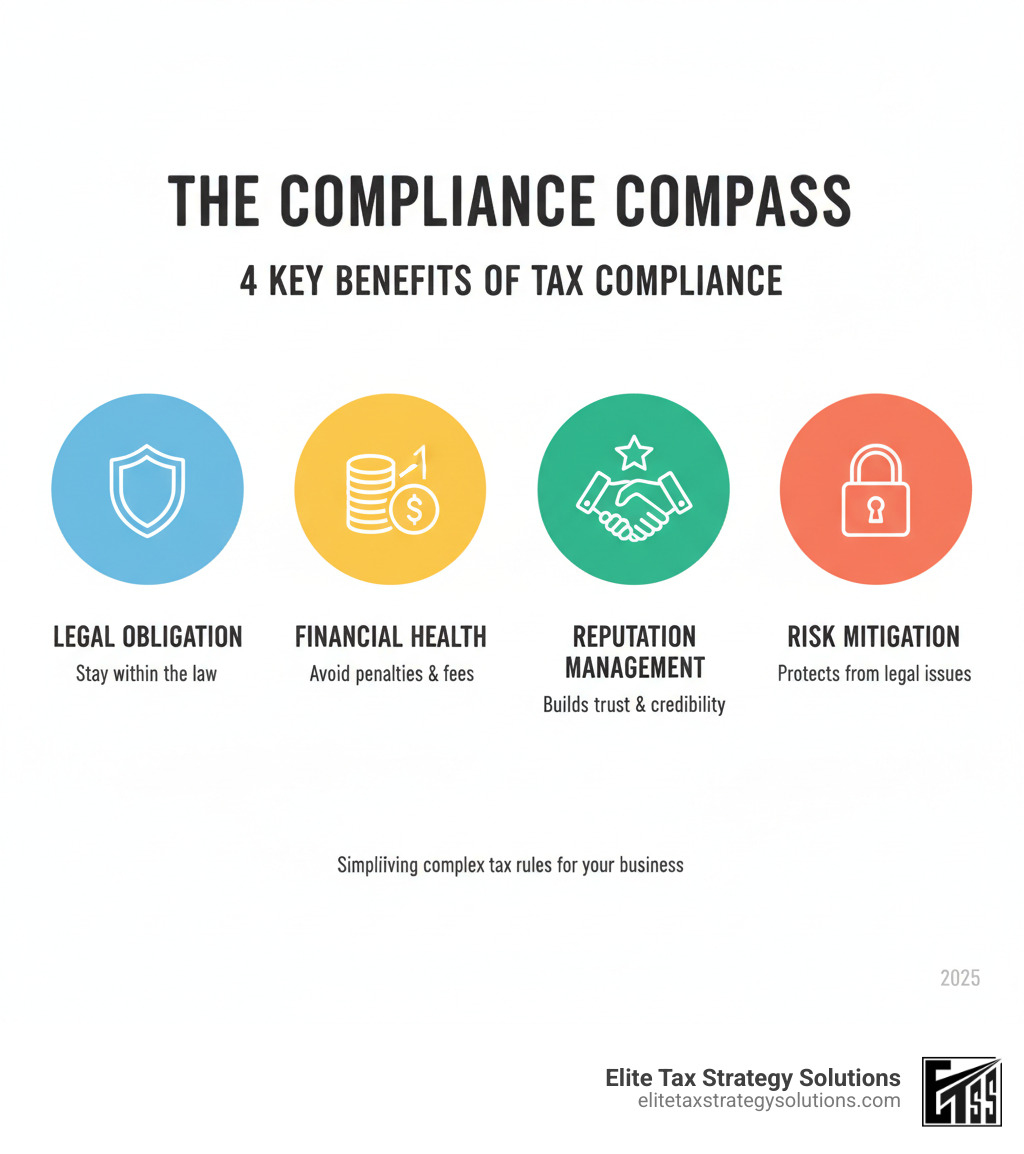
- Legal Obligation: It’s the law, and non-compliance can lead to serious trouble.
- Financial Health: It keeps your business financially stable by avoiding penalties.
- Reputation Management: It builds trust with customers, investors, and regulators.
- Risk Mitigation: It helps you avoid fines, interest, and legal issues.
Running a business involves significant responsibilities, with tax duties being one of the most critical. This guide will help you understand and manage these tasks and steer the complex world of business tax rules.
I’m David Fritch. With 40 years of experience, I help small business owners manage and grow their profits through effective tax compliance for businesses. My goal is to simplify complex tax rules so you can focus on your core business.
Must-know Tax compliance for businesses terms:
The Building Blocks of Business Taxation
A strong foundation for your business’s financial future starts with understanding business taxation. Your business structure is a blueprint for your tax duties at the federal, state, and local levels. Whether your business is in Jasper, Indiana, or another U.S. city, knowing these layers is key for effective Tax compliance for businesses.
Understanding the Different Types of Business Taxes
No matter the size or type of your business, you’ll encounter several kinds of taxes. Familiarizing yourself with each helps you plan and pay correctly.
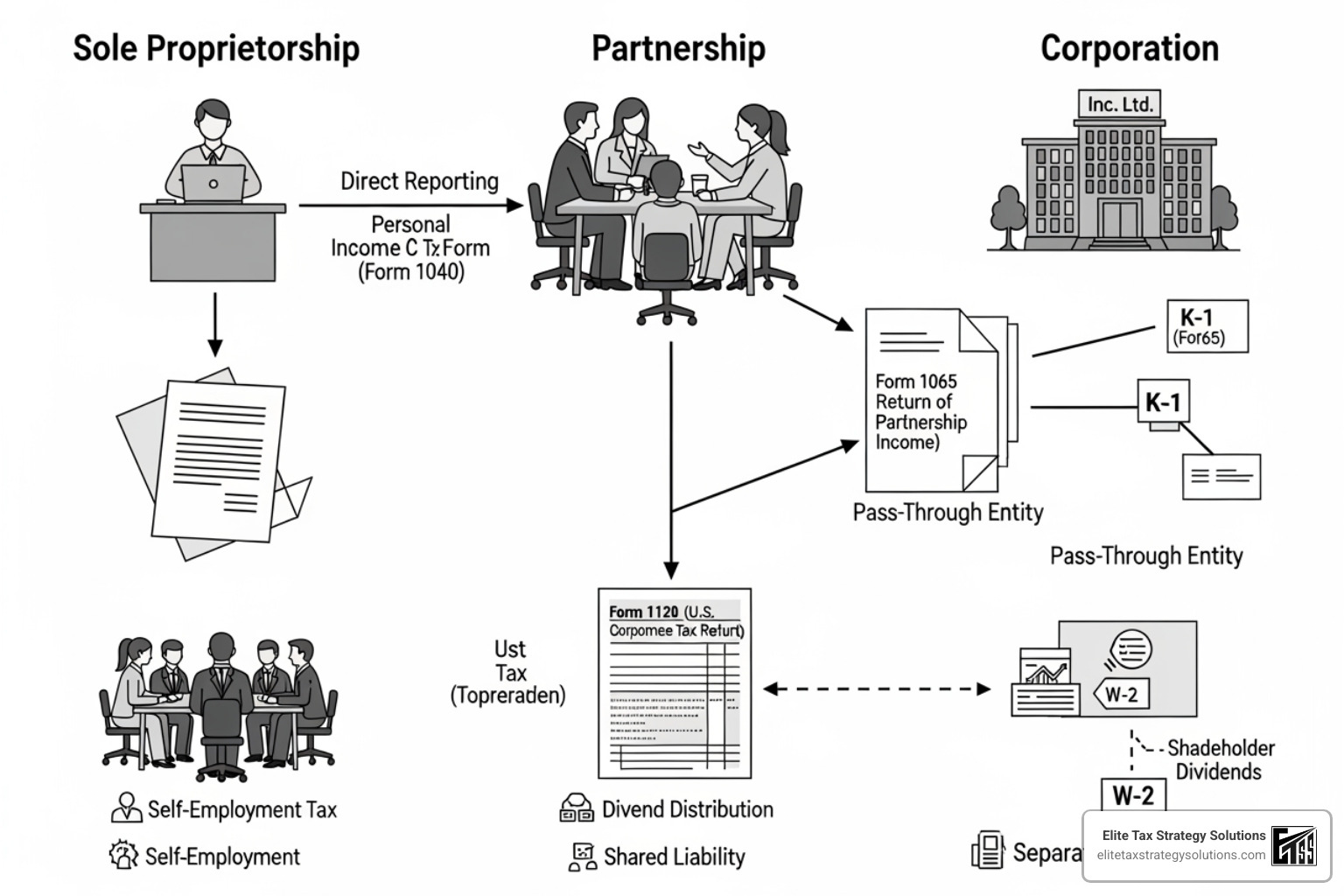
Income Tax: Businesses pay federal income tax on their profits. The payment method depends on the business structure. C-corporations file their own return (Form 1120), while income from sole proprietorships, partnerships, and S-corporations “passes through” to the owners’ personal tax returns. Most businesses must file an annual income tax return.
Self-Employment Tax: Sole proprietors and partners are considered self-employed and must pay their own Social Security and Medicare taxes. This tax applies to net earnings of $400 or more.
Employment Taxes: Hiring employees brings on several tax duties, including:
- Social Security and Medicare Taxes: Withhold a portion from employees’ paychecks and pay a matching amount.
- Federal Income Tax Withholding: Hold back federal income tax from wages based on W-4 forms.
- Federal Unemployment Tax (FUTA): Paid by employers, this tax helps fund unemployment benefits.
For a deeper dive into these responsibilities, check out our insights on Employee Tax Compliance.
Excise Taxes: These are special taxes on certain goods, services, or activities like fuel, alcohol, and tobacco. Your business is responsible for collecting and remitting these taxes. Businesses in niche markets may have specific excise tax rules. Learn more in our guide to Excise Tax Compliance.
How Business Structure Affects Your Tax Obligations
Your business structure significantly impacts your tax obligations and has long-lasting effects, so choose carefully.
Sole Proprietorship: The easiest and most common setup. You and your business are one for tax purposes. You report business income and expenses on your personal tax return (Schedule C, Form 1040) and pay self-employment taxes.
Partnership: Involves two or more owners. The partnership files an informational return (Form 1065), and profits “pass through” to the partners, who report their share on their individual returns and pay self-employment tax. For more advice, see our guide on Tax Planning for Partnerships.
Corporations come in two main types:
- A C Corporation (C Corp) is a separate legal entity that pays income tax at the corporate level (Form 1120). When profits are paid to shareholders as dividends, they are taxed again on the individual’s return, known as “double taxation.” The federal corporate tax rate is a flat 21%.
- An S Corporation (S Corp) avoids double taxation. Income and losses “pass through” to the owners’ personal income, avoiding corporate tax rates. S corps file an informational return (Form 1120-S). Our S Corp Survival Guide offers great strategies.
Limited Liability Company (LLC): This structure offers liability protection with tax flexibility. An LLC can be taxed as a sole proprietorship, a partnership, an S corporation, or a C corporation, making it a popular choice for finding the best tax setup.
Mastering Core Compliance: Records, Filings, and Payments
Effective tax compliance for businesses requires diligent day-to-day financial management, including meticulous record-keeping, timely filings, and prompt payments. These practices form the backbone of a compliant business. A solid foundation in Accounting and Tax Compliance is vital for success.
Best Practices for Maintaining Accurate Financial Records
Accurate record-keeping is the bedrock of smart financial management and is essential for tax compliance for businesses. Without good records, substantiating your income and expenses for tax authorities can become a major challenge.
Track all money coming in and going out. This includes gross receipts (all income), expenses (costs to run the business), and assets (equipment or property). To claim deductions, expenses must be ‘ordinary’ and ‘necessary,’ as detailed in our IRS Business Expense Categories Guide. Maintain supporting documents like invoices, receipts, and bank statements. It’s best to create ‘contemporaneous records’ at the time of the transaction.
Whether you use paper or digital systems, keep records organized, accessible, and secure. Cloud-based accounting software is an efficient option with excellent backup capabilities.
How long should you keep records? The IRS generally suggests three years from your filing date, but there are exceptions. Keep records for 7 years for losses from worthless securities or bad debt, and for 6 years if you underreport income by more than 25%. Records must be kept indefinitely in cases of fraud or failure to file. Employment tax records must be kept for at least 4 years.
Estimated Tax Payments and Ongoing Filing Requirements
Business taxes are rarely a once-a-year task. Staying proactive with regular payments and filings throughout the year helps avoid last-minute stress.
The US tax system is ‘pay-as-you-go.’ If your business expects to owe $1,000 or more in taxes for the year, you’ll likely need to make quarterly estimated tax payments. These cover income and self-employment taxes and are typically due on April 15, June 15, September 15, and January 15. Missing these dates can lead to penalties. Find more details on the IRS website.
Beyond your annual return, other federal filing requirements include:
- Payroll Tax Filings: If you have employees, you must file forms like Form 941 (quarterly) and Form 940 (annually for FUTA).
- Information Returns (1099s): If you pay independent contractors or other vendors $600 or more, you must issue them a Form 1099-NEC or other relevant 1099s. This is a crucial part of tax compliance for businesses. Learn more in our guide on 1099 Tax Compliance.
Don’t forget state and local filing requirements, which vary by location. Common obligations include State Income Tax, Sales and Use Tax, Annual Reports for corporations and LLCs, Franchise Tax, and Property Tax. Staying on top of these local nuances is key to solid tax compliance for businesses.
Navigating Common Challenges in Tax Compliance for Businesses
The path of tax compliance for businesses can be a maze of changing rules and new challenges. Understanding these challenges is the first step to overcoming them. We offer smart Tax Risk Management strategies to help you steer these tricky waters.

Common Tax Compliance Mistakes to Avoid
Avoiding common tax compliance mistakes can save your business significant worry and money.
Underreporting Income: Failing to report all business earnings, whether accidental or intentional, is a major red flag for tax authorities. It can lead to significant penalties, interest, and legal trouble. All income must be reported.
Deduction Errors: Claiming unallowed deductions, miscategorizing expenses, or lacking proper documentation can lead to problems. Our team can help with Optimizing Tax Deductions to ensure you get it right.
Ignoring State and Local Taxes: These duties are just as important as federal ones and can include state income tax, sales tax, and property tax. Obligations can become complex if you operate in multiple locations.
Missing Deadlines: Failing to file or pay on time almost guarantees penalties and interest. These charges accumulate quickly, turning a small error into a large financial problem. If you face penalties, our guide on How to Handle IRS Penalties offers helpful tips.
Overcoming Key Challenges in tax compliance for businesses
Beyond simple mistakes, businesses face larger challenges that require smart planning.
The U.S. tax code is notoriously complex and constantly changing. Keeping up with new laws, such as potential 2025 changes to equipment write-offs (bonus depreciation or Section 179) or research costs, is a significant effort. Understanding the Tax Law Changes Impact is crucial.
Another common and costly error is misclassifying employees as independent contractors. This can result in large penalties for unpaid employment taxes. The IRS has clear rules based on who controls the work, payment methods, and the overall relationship. It’s vital to understand the criteria for employee classification to avoid these issues.
How Technology and Professional Help Can Streamline Compliance
You don’t have to tackle complex tax rules alone. Technology and expert help can make tax compliance for businesses much smoother.
Technology is a compliance superpower. Modern accounting and tax software can automate tasks like tracking income and expenses, calculating sales tax, and generating reports. These tools reduce errors, save time, and provide a clear financial picture. Businesses can leverage technology and software solutions to simplify compliance. The IRS also offers digital tools like the Business Tax Account and IRIS for e-filing.
Sometimes, the best solution is an expert. A qualified tax professional or Certified Public Accountant (CPA) keeps up with changing laws, offers strategic advice, ensures accurate filings, and can represent you in an audit. For complex tax situations, hiring a CPA is often the smartest move. Our Small Business Tax Consultant services provide this specialized help.
Staying Current: Key Regulations and Updates
The world of tax compliance for businesses is constantly changing. Staying current on new laws and rules is vital for keeping your business compliant and financially healthy, helping you avoid surprises and maintain a clear financial path.
Federal Tax Compliance Considerations for 2024
We at Elite Tax Strategy Solutions monitor federal tax changes to keep you prepared. Here are some key federal points for 2024:
Corporate Tax Rate: For C-corporations, the federal corporate tax rate remains a flat 21%, requiring careful planning for estimated tax payments.
Standard Deduction: While primarily for individuals, changes to the standard deduction ($14,600 for single filers, $29,200 for married filing jointly in 2024) can affect the total taxable income for owners of pass-through businesses.
Qualified Business Income (QBI) Deduction: Eligible businesses may deduct up to 20% of their qualified business income. This complex deduction has limits for certain service businesses and high earners. Understanding qualification and calculation is key to maximizing this benefit, as explained in our guide on Maximizing Your QBI Deduction.
Payroll Tax Updates: Employers must continue to withhold and pay federal income tax, Social Security tax (up to the annual wage base), and Medicare tax (1.45%, plus an extra 0.9% for high earners). These figures can shift annually.
For a complete overview, see our Federal Tax Compliance Complete Guide.
State-Specific Spotlight: North Carolina Example
State and local tax compliance is just as vital as federal compliance. If your business operates in North Carolina, understanding its specific rules is crucial.
Every state and locality has unique tax laws. For businesses in North Carolina, keep these points in mind:
- State Corporate Tax Rate: Businesses must stay updated on the latest rate from the North Carolina Department of Revenue.
- Sales and Use Tax: North Carolina has a base state sales tax rate of 4.75%, which businesses must collect and remit. Local sales taxes may also apply. More details are available here.
- Franchise Tax: This is a tax on corporations for the privilege of doing business in the state.
- Withholding Tax: Employers in North Carolina must withhold state income tax from employee paychecks.
- Property Tax: Businesses pay property taxes on real estate and sometimes business personal property, with rates set by local counties and cities.
State and local tax rules are highly specific. Our Multi-State Tax Planning services can help businesses steer these complex regulations.
Other Key Compliance Areas for Your Business
Beyond income and employment taxes, other areas require attention for complete tax compliance for businesses.
Affordable Care Act (ACA) Reporting: Applicable large employers (ALEs), generally those with 50 or more full-time equivalent employees, must report information about health coverage offerings to the IRS. Non-compliance can lead to significant penalties. Learn more on our ACA Tax Compliance page.
Licenses, Permits, and Certifications: Most businesses need various federal, state, and local licenses to operate legally. These can range from general business licenses to specific professional or environmental permits, many of which require regular renewal.
Other Federal Regulations: Businesses must also follow non-tax federal rules concerning marketing, copyright, workplace safety (OSHA), and the Americans with Disabilities Act (ADA). Non-compliance can lead to significant legal and financial problems.
Frequently Asked Questions about Business Tax Compliance
What is a tax compliance report?
A tax compliance report is an official IRS document showing if your business has filed returns and paid taxes on time, often needed for loans or government contracts. It provides a high-level summary of your status (compliant, non-compliant, or issue). Unlike a detailed tax transcript, this report gives a broader overview of your filing and payment history. It can cover late payments for the past four tax years and late or unfiled returns for the past six years, giving lenders a comprehensive look at your tax compliance for businesses history.
When should a business seek professional tax assistance?
While some businesses manage taxes independently, expert help is crucial in many situations. Seek professional assistance for:
- Complex Situations: Operating in multiple states multiplies tax obligations. A CPA skilled in Multi-State Tax Planning is essential.
- Growth or Structural Changes: A CPA can advise on the most tax-efficient setup when starting, changing structure (e.g., to an S-corp), or experiencing rapid growth.
- Audit Support: If audited, a professional can represent you, manage communications with tax authorities, and protect your interests. Our Small Business Tax Consultant services provide this support.
- Specialized Tax Areas: A CPA can help maximize complex deductions and credits, like the QBI deduction, by staying current on tax law.
- Peace of Mind: Outsourcing tax compliance for businesses allows you to focus on growing your business, knowing your tax affairs are handled correctly.
What are the main legal and financial implications of non-compliance?
Non-compliance has severe consequences for your business’s financial and legal standing.
- Financial Penalties and Interest: Late filing, payment, or inaccurate returns lead to substantial penalties. Interest accrues on unpaid taxes, compounding the debt. Our guide on How to Handle IRS Penalties offers potential strategies.
- Increased Audit Risk: Non-compliance flags your business for audits, which are time-consuming, stressful, and can lead to more penalties.
- Liens and Levies: Tax authorities can place liens on business assets (property, equipment) or levy bank accounts to collect unpaid taxes, crippling operations.
- Reputation Damage: Tax troubles can harm your standing with customers, investors, and lenders, making it difficult to secure loans or contracts.
- Criminal Charges: Willful non-compliance or fraud can lead to criminal charges, including heavy fines and jail time.
The costs of non-compliance far exceed the investment in proper tax compliance for businesses.
Conclusion: Charting a Course for Proactive Compliance
Tax compliance for businesses is not a one-time task but an ongoing, vital part of running a successful enterprise. A proactive approach—diligently keeping records and staying informed—does more than avoid penalties. It enables strategic tax planning that contributes to long-term financial stability and growth.
At Elite Tax Strategy Solutions, we understand that navigating tax compliance for businesses can be overwhelming. We partner with you to craft intelligent, forward-thinking strategies that turn tax rules into a strategic advantage.
Whether your business is in Jasper, Indiana, or another suburban area, our mission is to maximize your tax savings and ensure rock-solid compliance. Don’t let changing tax regulations slow you down. Partner with us to chart a confident, compliant course for your future. Discover our innovative tax planning strategies today!