Why Tax and Wealth Planning Is Your Key to Financial Success
Tax and wealth planning is a strategic process to legally minimize your tax burden while building and preserving wealth. For high-income earners and business owners, it’s about taking control of your financial destiny, not just filing returns.
Core Tax and Wealth Planning Strategies:
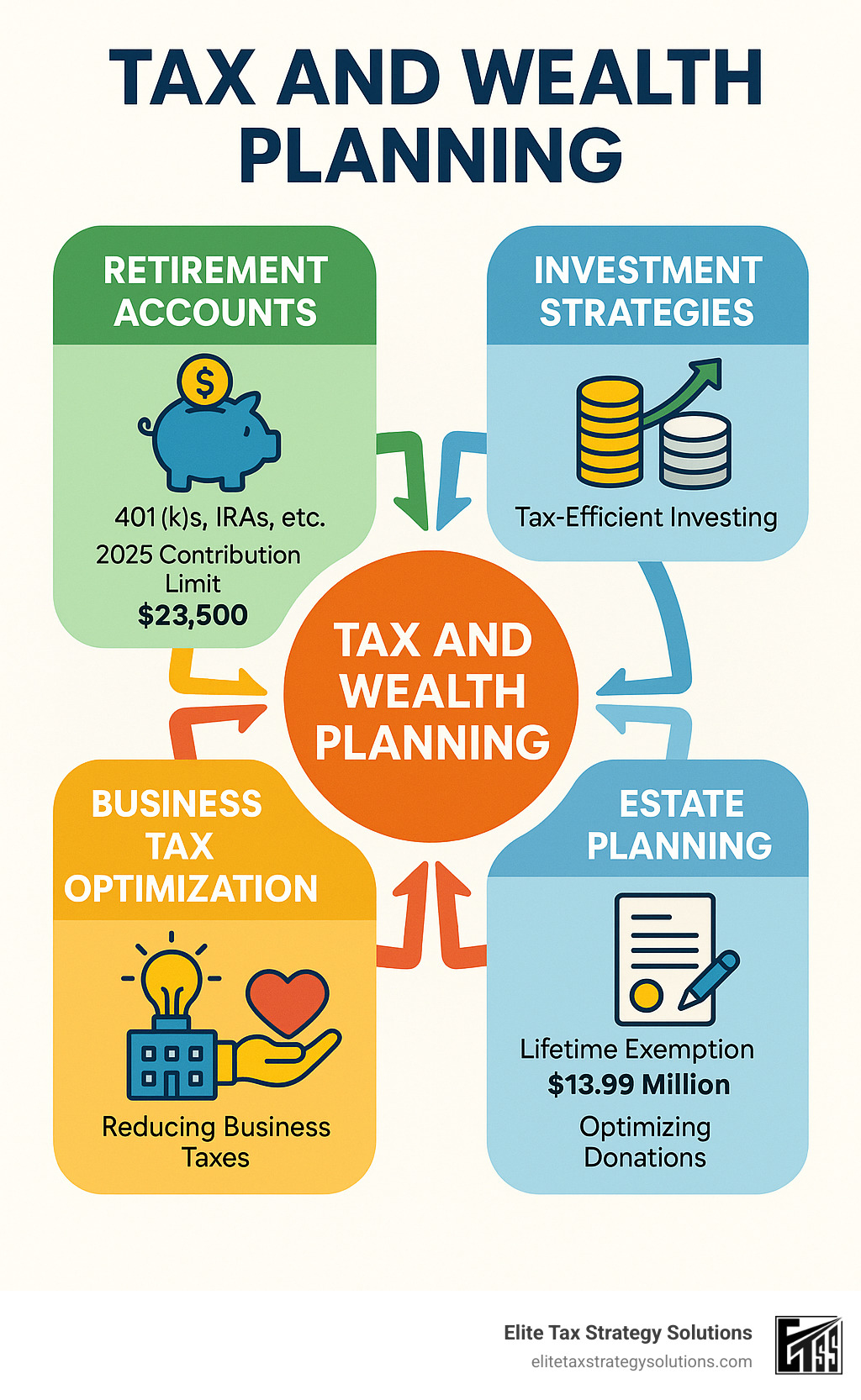
- Maximize tax-advantaged accounts – 401(k)s, IRAs, HSAs with 2025 limits up to $23,500
- Strategic income timing – Defer or accelerate income based on tax brackets
- Investment tax management – Tax-loss harvesting, asset location, municipal bonds
- Estate planning integration – Annual gifting ($19,000 limit), lifetime exemptions ($13.99 million)
- Charitable giving optimization – Donor-advised funds, qualified charitable distributions
- Business tax strategies – Entity selection, QBI deduction, succession planning
The stakes are high. Estate and gift tax exemptions are projected to drop from approximately $14 million to around $7 million per person at the end of 2025. Without proactive planning, high earners face mounting tax burdens that can erode wealth.
Many successful professionals remain reactive, missing valuable opportunities to optimize their financial position. The difference between tax planning and tax preparation is like prevention versus treatment. Tax preparation is reactive, looking at what’s already happened. Tax and wealth planning is proactive, creating forward-looking strategies to legally minimize what you owe while aligning with your long-term goals.
I’m David Fritch, and for 40 years, I’ve helped high-income earners and business owners master tax and wealth planning through my law firm, CPA practice, and specialized tax strategy solutions. My approach combines legal expertise with practical strategies to build sustainable wealth.
Tax and wealth planning vocab to learn:
The Foundation: Understanding Tax and Wealth Planning
Tax and wealth planning is a proactive approach to building your financial future. Unlike tax preparation, which looks backward, tax planning maps out the most efficient route forward to legally reduce your tax liabilities. Our goal is to help you retain as much of your hard-earned money as possible, allowing your investments to grow faster and contributing to your long-term financial security. We believe incorporating tax strategies into every aspect of your financial plan is essential.
For a deeper dive, explore our insights on the Benefits of tax planning.
Who Benefits from Tax and Wealth Planning?
A common misconception is that tax and wealth planning is only for the ultra-wealthy. While high-net-worth individuals benefit greatly, anyone who pays taxes can and should engage in tax planning. High-income earners, such as doctors, lawyers, and business owners, face progressive tax rates that can erode a significant portion of their income without a deliberate strategy.
Beyond income, individuals with complex investments, those planning for retirement or selling a business, and families looking to create a legacy all stand to gain. Proactive tax planning helps you maximize every opportunity to grow your wealth tax-efficiently, no matter the size of your portfolio.
The Core Principles of Tax and Wealth Planning
Effective tax and wealth planning boils down to a few core principles that create a powerful financial blueprint.
The foundational strategies we employ include:
- Maximizing Deductions: Using every legal deduction and credit to reduce your taxable income.
- Deferring Income: Pushing taxable income into future years, often when you expect to be in a lower tax bracket, allowing money to grow tax-deferred.
- Converting Income Types: Strategically changing income types (e.g., ordinary income to capital gains) to take advantage of lower tax rates.
- Splitting Income: Legally distributing income among family members in lower tax brackets to reduce the overall household tax burden.
These are integrated components of a dynamic tax plan that grows with you, aligning with your overarching financial goals. A real financial plan is inherently tax-efficient.
To see how these principles come together, read our insights on Comprehensive tax planning.
Core Strategies for Tax-Efficient Wealth Growth
Smart financial management ensures your hard-earned wealth isn’t unnecessarily diminished by taxes. Here, we’ll explore fundamental strategies that form the bedrock of tax-efficient wealth growth. These are essential tools for smart preservation and distribution.
For a broader view, check out our insights on Tax savings strategies.
Maximizing Tax-Advantaged Retirement Accounts
Using tax-advantaged retirement accounts is a powerful tool in tax and wealth planning. These accounts are growth engines that can reduce your current tax bill while building future wealth.

Contributions to accounts like 401(k)s and Traditional IRAs are often tax-deductible, lowering your taxable income now. Your investments grow tax-deferred, and you only pay taxes upon withdrawal in retirement. For 2025, you can contribute up to $23,500 to your 401(k), 403(b), and most 457 plans.
If you’re 50 or older, you can make an additional $7,500 in catch-up contributions in 2025. For those aged 60-63, a ‘super’ catch-up contribution of $11,250 is allowed for 401(k)s in 2025, pushing the total to $34,750.
With Roth IRAs, you contribute after-tax dollars, but qualified withdrawals in retirement are entirely tax-free. This is attractive if you expect to be in a higher tax bracket later or want a source of tax-free funds. These contributions help your wealth compound more effectively.
For more details, refer to the official IRS guidance on 2025 contribution caps.
Leveraging Health Savings Accounts (HSAs)
The Health Savings Account (HSA) is a powerful tool with a unique triple-tax advantage. Here’s why HSAs are so effective: contributions are tax-deductible, investments grow tax-free, and withdrawals for qualified medical expenses are tax-free. This makes it an incredibly efficient way to save for healthcare costs.
For 2025, HSA contribution limits are $4,300 for singles and $8,550 for families. Those 55 and older can contribute an additional $1,000 catch-up.
The HSA is also flexible. Unused funds roll over indefinitely. After age 65, it functions like a traditional retirement account, where non-medical withdrawals are taxed as ordinary income. This makes the HSA a versatile vehicle for both tax savings and long-term wealth building.
You can learn more about Extending HSA contributions beyond age 65 and refer to the official IRS guidance on HSAs.
Foundational Gifting and Estate Planning
Effective tax and wealth planning includes strategically planning for the transfer of your wealth. Smart gifting strategies can significantly reduce your taxable estate and minimize potential estate taxes.
The Annual Gift Tax Exclusion allows you to give up to $19,000 per recipient in 2025, tax-free, without impacting your lifetime exemption. A couple could collectively give $38,000 to any individual each year.
Beyond that, the Lifetime Gift Tax Exemption allows you to transfer a larger amount tax-free during your life or at death. For 2025, this exemption is $13.99 million per person.
Proactive planning is critical here: these high exemptions are scheduled to “sunset” at the end of 2025, potentially falling to around $7 million per person in 2026. This creates a significant, time-sensitive opportunity for high-net-worth individuals.
Even 529 plans are useful gifting tools. You can “front-load” five years of annual exclusions at once, and up to $10,000 (lifetime) from a 529 plan may be used to pay back student loans. Leveraging these strategies helps ensure more of your wealth passes to your beneficiaries.
For more, explore our guide on Tax-efficient estate planning.
Advanced Tax and Wealth Planning for High-Income Earners
For those with substantial income, basic strategies are just the starting point. Sophisticated solutions can dramatically reduce your tax burden while building generational wealth. The complexity of high-income tax situations is an opportunity, as the tax code often provides advantages for those who know how to steer it. That’s where our expertise in Advanced tax planning strategies and High-income tax planning becomes invaluable.
Sophisticated Investment Tax Management
Your portfolio must grow tax-efficiently. For high earners, managing for after-tax returns can save tens of thousands of dollars annually.

- Tax-loss harvesting involves strategically selling investments at a loss to offset capital gains and up to $3,000 of ordinary income annually. Excess losses carry forward. Our guide on Understanding the wash-sale rule helps you steer this safely.
- Asset location means placing investments in the right accounts. High-dividend stocks might go in a 401(k), while investments with long-term capital gains potential stay in taxable accounts. Your highest-growth assets are ideal for a Roth IRA, where gains are never taxed.
- Tax-efficient investments like index funds, ETFs, and municipal bonds form the backbone of a taxable portfolio, generating fewer taxable events or providing tax-free income.
- Qualified Opportunity Zones offer the potential to eliminate capital gains taxes on investments held for 10 years.
Advanced Retirement and Income Strategies
High earners have unique retirement planning opportunities. While income limits may block some strategies, sophisticated alternatives can boost your savings.
- The Backdoor Roth IRA allows you to bypass income limits for direct Roth contributions by contributing to a Traditional IRA and then converting it.
- The Mega Backdoor Roth may allow up to $46,500 in additional after-tax contributions to a 401(k) in 2025, which can then be converted to Roth, for a potential total of $70,000 in annual contributions.
- Roth conversions are powerful during lower-income years. You pay taxes now at a potentially lower rate to secure decades of tax-free growth.
- Defined benefit and cash balance plans allow business owners to contribute over $100,000 annually, dramatically reducing current taxes.
These strategies require expert guidance. Our insights on Retirement tax strategies for high income earners dive deeper.
Integrating Charitable Giving for Maximum Impact
Philanthropy and tax and wealth planning are natural partners, amplifying both your charitable impact and your tax savings.
- Donor-Advised Funds (DAFs) act like charitable investment accounts. You contribute assets, get an immediate tax deduction, and recommend grants over time. This allows for “bunching” donations for greater tax efficiency.
- Qualified Charitable Distributions (QCDs) allow those 70½ and older to transfer up to $100,000 annually from an IRA to charity. This counts toward your RMD but isn’t included in taxable income. Learn more about How QCDs work.
- Gifting appreciated securities instead of cash lets you deduct the full market value while avoiding capital gains taxes.
- Charitable Remainder Trusts (CRTs) are a sophisticated tool where you transfer assets, receive an income stream for life, get an immediate tax deduction, and leave the remainder to charity.
The Holistic Approach: Integrating Tax with Your Total Financial Life
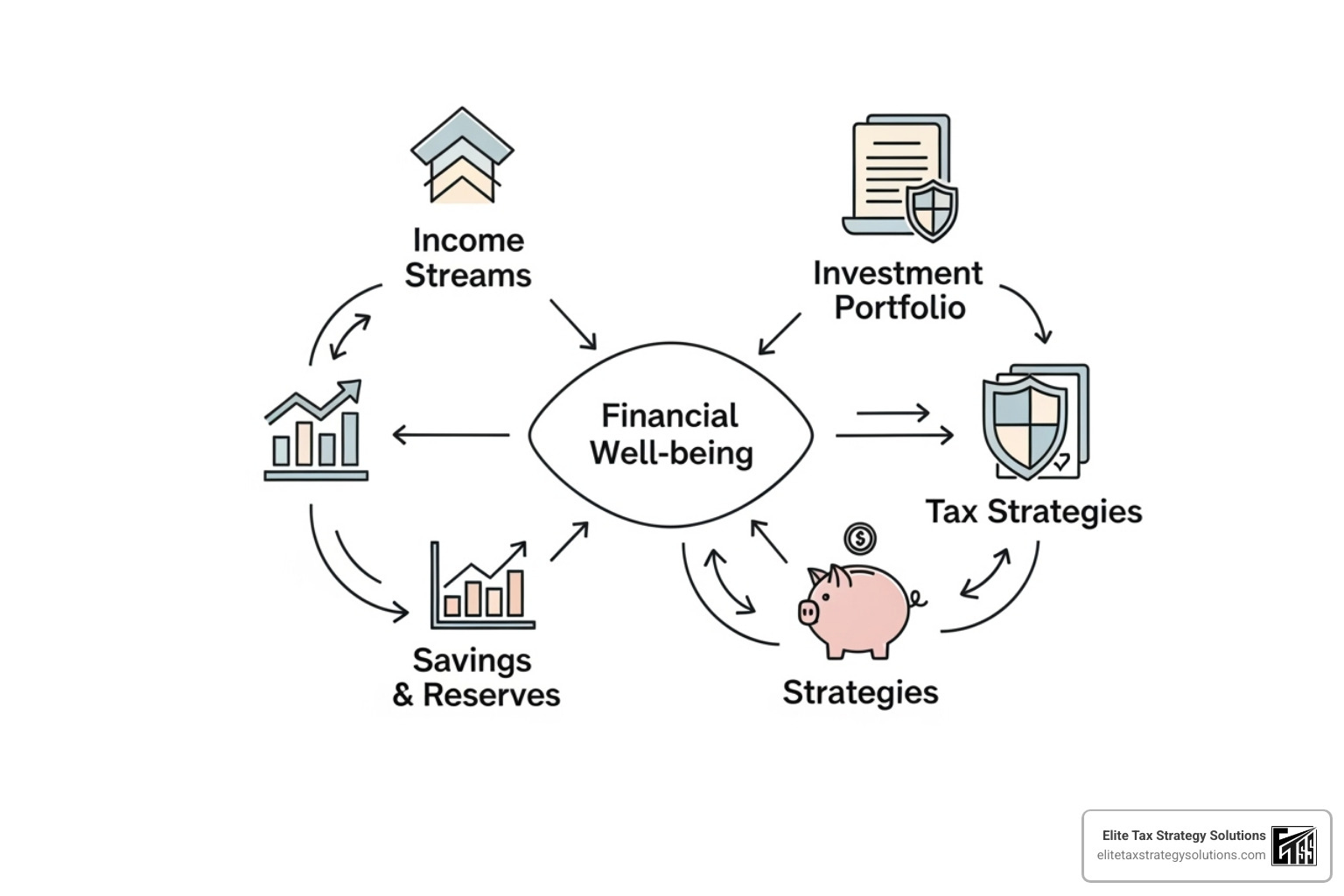
True financial mastery requires a holistic approach, not treating your finances as separate boxes. Our integrated tax and wealth planning strategy ensures your financial decisions work in harmony, creating a unified plan that optimizes every part of your financial life.
For a deeper understanding of this integrated perspective, explore our insights on Financial and tax planning.
Aligning Tax Planning with Retirement Goals
Effective retirement planning ensures you can use your savings without losing a large portion to taxes. Our approach to tax and wealth planning focuses on meeting your retirement goals with the smallest possible tax bill.

We help you achieve tax diversification by spreading investments across taxable, tax-deferred (401(k)s), and tax-free (Roth IRAs) accounts. This provides flexibility in retirement, allowing you to draw from different accounts to manage your tax bracket each year.
We also help manage tax brackets in retirement by strategically converting pre-tax funds to Roth accounts during lower-income years. We plan around Required Minimum Distributions (RMDs), which start at age 73 (increasing to 75 in 2033), to lessen their tax impact. By minimizing taxes on withdrawals, we help your portfolio last longer.
The Critical Role of Tax and Wealth Planning in Your Estate
Effective tax and wealth planning is vital to ensure your legacy is passed on smoothly with a minimal tax burden. This involves using smart tools to protect your wealth for future generations.
We use trusts as powerful estate planning tools. A Spousal Lifetime Access Trust (SLAT) can move assets out of your taxable estate while allowing spousal access. An Intentionally Defective Grantor Trust (IDGT) can “freeze” the value of assets for estate tax purposes, so future growth occurs outside your taxable estate.
The Generation-Skipping Transfer (GST) tax applies to transfers to beneficiaries two or more generations younger. The $13.99 million per person exemption for 2025 can be used with tools like dynasty trusts to pass wealth for generations without additional transfer taxes.
Life insurance strategies, often using an irrevocable life insurance trust (ILIT), can provide tax-free funds to pay estate taxes, preventing heirs from having to sell assets. With exemptions set to drop at the end of 2025, proactive planning is more important than ever. For details, see our guide on High net worth tax planning.
Tax Considerations for Business Owners and Entrepreneurs
For business owners, personal and business finances are intertwined. Our integrated tax and wealth planning approach optimizes both to ensure your business success builds personal wealth.
- Entity selection (S-Corp, LLC, C-Corp) has significant tax implications. We help you choose the best structure to lower business and self-employment taxes.
- The Qualified Business Income (QBI) deduction allows many to deduct up to 20% of their business income. We help you maximize this deduction.
- We help you identify and properly record all legitimate business expenses.
- Succession planning is critical. We help structure a sale or transfer to lower capital gains tax and maximize your value, using strategies like installment sales.
By combining business and personal tax strategies, we create a seamless plan to support your entrepreneurial journey. Learn more about the Best tax strategy for small business.
Navigating Complexity: Why Professional Guidance is Non-Negotiable
The tax code is notoriously complex and constantly changing. For high-income earners and business owners, attempting to steer it without expert guidance is risky. The rules are voluminous and evolve with new legislation, IRS guidance, and court rulings, creating a landscape where costly mistakes are common.
Professional expertise in tax and wealth planning isn’t a luxury—it’s essential protection for your financial future. We provide Personalized tax advice to cut through the complexity and keep you on the most advantageous path.
Keeping Pace with Evolving Tax Laws and Regulations
Tax laws change constantly, and proposals to increase taxes on high-income individuals, capital gains, and estates emerge regularly.

The 2025 estate tax exemption sunset is a significant shift. The current high exemption will revert to roughly half its amount at the end of 2025, creating an urgent and closing window of opportunity for many families.
Capital gains inclusion rates also remain in flux. Ongoing discussions about rate changes highlight why staying informed and adapting your strategy is not optional.
We continuously monitor the legislative landscape so you don’t have to. Proactive tax planning is never a “set it and forget it” proposition; it requires regular review and adjustment as laws and circumstances evolve.
For insights into legislative changes, explore our Analysis of federal budget changes.
Managing Complex Scenarios and Cross-Border Issues
Many high-earners have financial lives that span multiple tax jurisdictions. Multi-state tax compliance can be a puzzle, with different rules, deduction limits, and filing requirements for each state.
International assets and cross-border issues add another layer of complexity. Individuals with U.S. and Canadian ties, for example, must steer tax treaties, foreign tax credits, and complex reporting requirements. Scenarios like being a Canadian “snowbird” in the U.S. require specialized knowledge to avoid double taxation and penalties.
These situations demand expertise to ensure compliance while avoiding costly mistakes. We provide comprehensive International tax compliance guidance.
The Value of a Proactive and Customized Tax Plan
An off-the-shelf tax plan doesn’t fit a unique financial situation. Your tax and wealth planning strategy should be custom-built for your specific goals, risk tolerance, and family circumstances.
We believe in year-round planning, not a last-minute scramble. This proactive approach allows us to:
- Identify opportunities as they emerge.
- Mitigate risks by staying ahead of legislative changes.
- Adapt your plan to life changes like new business ventures or shifts in financial goals.
A dynamic and proactive tax plan that works and grows with you can preserve wealth, optimize returns, and provide true financial peace of mind.
Learn more about our approach to Proactive tax planning and how a customized strategy can transform your financial future.
Conclusion
Your journey through tax and wealth planning is an ongoing process. We’ve explored how smart strategies, from maximizing retirement accounts to sophisticated charitable giving, can transform your financial future. These are proven tools that can save you thousands annually while building lasting wealth.
What makes the difference is recognizing that tax and wealth planning is not a one-time event. It’s a continuing relationship with your financial future. Tax laws change, your income evolves, and your goals shift. Each change creates new opportunities and potential pitfalls.
The power lies in proactive management—staying ahead of these changes rather than reacting to them. When you integrate tax planning with every aspect of your financial life, you create a unified strategy that compounds your success year after year.
Every dollar saved in taxes is a dollar that can grow and work for you. Over time, these savings can mean the difference between a comfortable retirement and true financial freedom, allowing you to leave a meaningful legacy.
At Elite Tax Strategy Solutions, we’ve spent decades helping families and businesses steer this complex landscape. Our thorough, proactive approach means you’re not just filing returns—you’re building wealth strategically and legally.
The estate tax exemption changes coming in 2026 and the constantly evolving legislative landscape all point to one truth: the time for action is now. Professional guidance is essential.
For a truly integrated approach to your finances that brings together tax planning, investment management, and wealth preservation, explore our comprehensive financial planning services. Your future self will thank you for the decisions you make today.