
The Strategic Value of Tax and Financial Planning
Tax and financial planning is the process of organizing your finances to minimize tax liability while maximizing wealth growth. When implemented correctly, it can help you keep more of what you earn and build toward your long-term financial goals.
What is tax and financial planning?
- A year-round strategy (not just a tax season activity)
- The integration of tax considerations into broader financial decisions
- A proactive approach to reducing tax liability
- A method to align financial goals with tax-efficient strategies
Effective tax and financial planning involves:
- Timing income and expenses strategically
- Maximizing deductions and credits you’re eligible for
- Utilizing tax-advantaged accounts like 401(k)s, IRAs, and HSAs
- Planning for major life events with tax implications
- Staying informed about tax law changes that could affect your finances
The less money you pay in taxes, the more you have to devote toward your financial goals. By implementing strategic tax planning techniques, you can potentially save thousands of dollars each year that can be redirected toward investments, retirement savings, or other priorities.
I’m David Fritch, with over 40 years of experience as both a CPA and attorney specializing in tax and financial planning for small business owners and high-income individuals, helping them maximize profits while minimizing tax burdens.
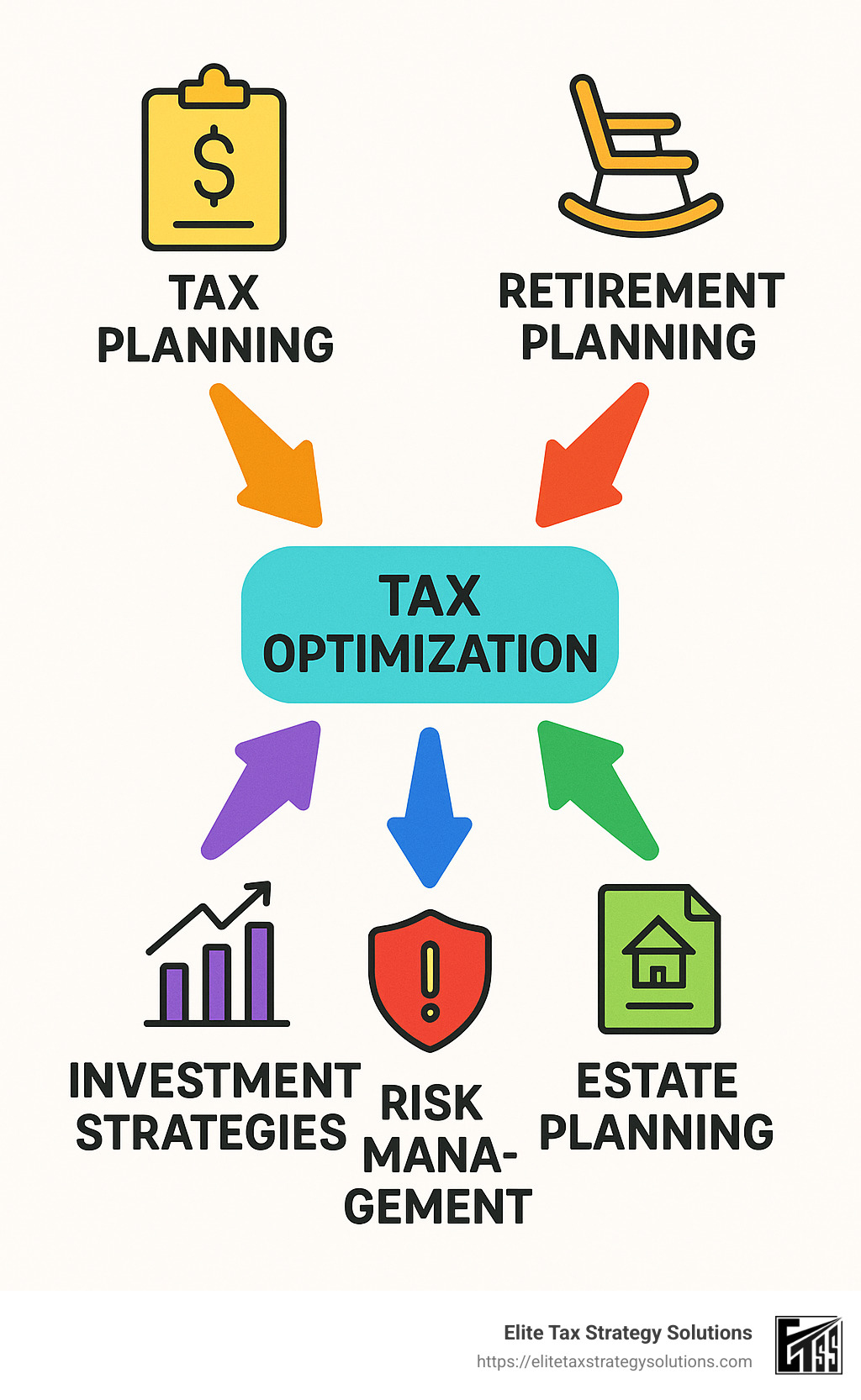
Understanding the Basics of Tax and Financial Planning
Let’s clear up a common confusion right away – tax preparation is not the same as tax planning. When you prepare your taxes, you’re looking backward, reporting what already happened financially. But tax and financial planning looks forward, helping you shape future financial decisions to minimize your tax burden.
As one of my favorite tax professionals likes to say, “Tax planning is analyzing your financial situation to ensure all elements work together so you pay the lowest taxes possible.” It’s like having a financial GPS that helps you steer the most efficient route to your goals.
Here at Elite Tax Strategy Solutions, we’ve seen how taxation often becomes the biggest obstacle to building income and long-term wealth. Even saving a few hundred dollars on taxes this year can snowball into significant wealth accumulation over time – it’s the power of compounding working in your favor!
Integrating Tax and Financial Planning Strategies
Think of tax and financial planning as two dancers who perform best when moving together in harmony. When these two disciplines work in sync, they create a powerful partnership that dramatically improves your financial outcomes.
Here’s a real-world example: You might be diligently saving for retirement (good for you!), but if you’re not considering the tax implications of where and how you’re investing, you could be leaving thousands of dollars on the table. Similarly, making tax decisions without considering your broader financial goals might save you money this April but cost you much more down the road.
I remember working with Mark, a small business owner from Jasper, Indiana. He had built a successful manufacturing business but was watching too much of his hard-earned money disappear to taxes each year. By looking at his tax situation alongside his business and retirement goals, we restructured his operations and retirement contributions. The result? Over $37,000 in annual tax savings while simultaneously strengthening his retirement portfolio. That’s the power of integration!
A holistic approach means reviewing your entire financial picture, identifying opportunities for tax efficiency, aligning strategies with your personal goals, and regularly reassessing as your life and tax laws evolve.
The Importance of Timing Income and Deductions
One of my favorite strategies in tax and financial planning is the strategic timing of income and deductions. This approach is like surfing – it’s all about catching the right wave at the right moment.
If you expect to be in a lower tax bracket next year, pushing some income from December to January could result in meaningful tax savings. On the flip side, if you’re in a higher bracket this year, accelerating deductible expenses into the current year maximizes their value.
This strategy becomes particularly powerful for:
Business owners who can control year-end bonuses or billing cycles
Pre-retirees planning their transition from earned income
Anyone experiencing income fluctuations from year to year
Those hovering near tax threshold boundaries where an extra dollar of income triggers additional taxes
For my high-income clients, timing strategies become even more critical as they face additional taxes like the 3.8% Net Investment Income Tax that kicks in at higher income levels.
Leveraging Tax Deductions and Credits
Understanding the difference between deductions and credits can save you thousands. Tax deductions reduce your taxable income, while tax credits directly reduce your tax bill dollar-for-dollar. Given the choice between a $1,000 deduction or a $1,000 credit, the credit is almost always more valuable!
We help our clients identify every available deduction and credit – from the obvious ones like mortgage interest to often-overlooked opportunities like the home office deduction for eligible business owners.
Some of my favorite powerful but frequently underused tax benefits include business expense deductions for entrepreneurs, education credits for yourself or dependents, energy-efficient home improvement credits, strategic charitable giving, and medical expense deductions when they exceed 7.5% of your adjusted gross income.
Tax laws are constantly evolving. The Tax Cuts and Jobs Act dramatically altered many deductions, and its provisions are scheduled to expire after 2025. This changing landscape makes it essential to stay informed or work with professionals who track these changes and can help you adapt your tax and financial planning strategies accordingly.
Utilizing Retirement Accounts for Tax Efficiency

When it comes to building wealth while keeping Uncle Sam’s hands out of your pockets, retirement accounts are truly your best friends. As powerful tools in your tax and financial planning toolkit, these accounts offer incredible tax advantages that can dramatically reduce what you owe now while growing your nest egg for the future.
It’s actually quite shocking – IRS data shows that maximizing retirement contributions could save a high-income earner over $12,500 in taxes annually. Yet so many eligible folks leave this money on the table, essentially handing it over to the government instead of keeping it for themselves!
The Role of 401(k) and Traditional IRA in Tax Planning
Think of traditional retirement accounts like 401(k)s and IRAs as time machines for your tax bill. The money you contribute today reduces your current taxable income, effectively letting you postpone taxes until retirement when you might be in a lower tax bracket.
For 2025, you can contribute up to $24,500 to your 401(k), or $32,500 if you’re 50 or older with those catch-up contributions. Traditional IRAs allow $7,500, or $8,500 for the 50+ crowd.
Let me share a real-world example. Sarah, a marketing executive earning $100,000 annually, maxed out her 401(k) with $24,500. This immediately dropped her taxable income to $75,500. Not only did this potentially push her into a lower tax bracket, saving thousands in current taxes, but that money is now growing for her retirement years.
If you’re a business owner, you’ve got even juicier options. Solo 401(k)s, SEP IRAs, and defined benefit plans often allow for significantly higher contributions than standard employee plans. I’ve seen business owners legally shelter over $100,000 from taxes using these strategies!
When deciding between Traditional and Roth options, think about your tax situation like a chess game. Are you likely to be in a higher tax bracket now or in retirement? How long until you need the money? What might future tax laws look like? These questions help determine the best approach for your unique situation.
Benefits and Considerations of Roth IRA Conversion
A Roth conversion is like ripping off a Band-Aid tax-wise – it might sting now, but you’ll be better off later. You transfer funds from a Traditional IRA to a Roth IRA, pay taxes on that money now, and then enjoy completely tax-free growth and withdrawals in retirement.
This strategy can be brilliant when the stars align. One of our clients, Dr. James, a cardiologist in his mid-50s, executed a series of strategic Roth conversions during a sabbatical year when his income temporarily dropped. By converting portions of his Traditional IRA during this lower-income period, he minimized the tax hit while setting up tax-free growth for his golden years.
Roth conversions make the most sense when you expect higher tax brackets in retirement, have many years before you’ll need the money, can pay the resulting tax bill from other funds, find yourself temporarily in a lower tax bracket, or want to leave tax-free assets to your family.
But they’re not for everyone! You need to carefully consider the immediate tax bill (which can be substantial), the five-year holding requirements before penalty-free withdrawals, potential impacts on Medicare premiums, and state tax implications.
At Elite Tax Strategy Solutions, we don’t just throw random strategies at you. We carefully analyze your complete financial picture to determine if and when Roth conversions make sense as part of your comprehensive tax and financial planning strategy. Sometimes the best move is to convert a portion each year to spread out the tax impact while gradually building your tax-free retirement bucket.
Retirement accounts aren’t just savings vehicles – they’re powerful tax management tools when used strategically as part of an integrated financial plan.
Strategies for Minimizing Capital Gains Taxes

Let’s talk about something that makes most investors cringe: capital gains taxes. These taxes can take a significant bite out of your investment returns if you don’t have a plan. With federal long-term capital gains rates ranging from 0% to 20% (plus that pesky 3.8% Net Investment Income Tax for higher earners), having strategies to minimize this burden is essential for your financial health.
The IRS defines capital gains simply as the profits you make when selling investments like stocks, bonds, real estate, and other assets. If you’re serious about managing these taxes, I’d recommend familiarizing yourself with IRS Topic No. 409, Capital Gains and Losses – it’s not exactly beach reading, but it’s crucial information for effective tax and financial planning.
Implementing Tax-Loss Harvesting Effectively
Tax-loss harvesting might sound like agricultural jargon, but it’s actually one of the most powerful tools in your investment tax strategy toolkit. Think of it as making lemonade from lemons – you’re using investment losses to offset gains and reduce your tax bill.
Here’s how it works in real life: Imagine you sold some tech stocks this year and realized a $15,000 gain. Great news for your portfolio, but not so great for your tax bill. With effective tax-loss harvesting, you might identify underperforming investments in your portfolio and sell them at a $15,000 loss. The result? Those losses offset your gains, and suddenly your tax liability on those gains disappears.
The beauty of tax-loss harvesting is that it allows you to maintain your investment strategy while managing your tax burden. After selling a losing position, you can reinvest in something similar (but not identical – more on that in a moment) to maintain your desired asset allocation. Your portfolio stays balanced, but your tax bill shrinks.
Timing matters tremendously with this strategy. While December often sees a flurry of tax-loss harvesting activity, savvy investors look for opportunities year-round, especially during market corrections. One of our clients, a retired healthcare executive, saved over $22,000 in taxes by strategically harvesting losses during a market dip last year. Even better, we helped him reposition his portfolio for stronger long-term growth at the same time.
Not all capital gains are created equal. Short-term gains (from investments held less than a year) are taxed at your higher ordinary income rates, while long-term gains enjoy those preferential tax rates of 0%, 15%, or 20%. This means you’ll typically want to use your losses to offset short-term gains first when possible – it simply gives you more bang for your buck.
Understanding the Wash Sale Rule
Now for the fine print that trips up many investors: the wash sale rule. This IRS regulation can derail your tax-loss harvesting if you’re not careful. Simply put, if you sell an investment at a loss and then buy the same or a “substantially identical” security within 30 days before or after the sale, the IRS will disallow your loss deduction.
I’ve seen this happen too many times with well-intentioned investors. They sell Company XYZ stock at a loss on December 15th for tax purposes, then can’t resist buying it back on December 28th when it looks like a bargain. Unfortunately, that quick repurchase means they can’t claim the tax loss they were counting on.
“The wash sale rule is one of the most common pitfalls we see with self-directed investors,” our tax specialist at Elite Tax Strategy Solutions often tells clients. “Many don’t realize that the rule applies across all their accounts, including IRAs and spousal accounts.”
To steer around this rule while still maintaining your investment strategy, you have several options. You can wait at least 31 days before repurchasing the same security, or you can immediately purchase similar but not identical investments – like buying a different ETF in the same sector. For example, if you sell an S&P 500 index fund from one provider, you could purchase a similar large-cap fund from another provider.
What’s particularly tricky is that the wash sale rule applies across all your accounts – including retirement accounts and even your spouse’s accounts. That means selling a losing position in your brokerage account and buying it back in your IRA still triggers the wash sale rule. The IRS is always one step ahead!
By understanding these capital gains strategies and carefully implementing them as part of your comprehensive tax and financial planning approach, you can significantly reduce the tax drag on your investment returns. This means more of your money stays invested and working for your future, rather than going to Uncle Sam.
Planning for Major Life Events to Optimize Taxes
Life happens – and when it does, your tax situation often changes right along with it. From saying “I do” to welcoming a new baby, buying a home or launching a business, these milestone moments bring both joy and significant financial implications. With thoughtful tax and financial planning, these transitions can become opportunities to save rather than sources of tax surprises.
Think about the major life events that might be on your horizon – each carries unique tax considerations:
- Marriage: Your filing status changes, potentially triggering a “marriage penalty” or “marriage bonus” depending on your incomes
- Children: New bundles of joy bring valuable tax credits and dependent care benefits
- Home purchase: Mortgage interest deductions and property tax considerations
- Job change: Time to plan for retirement plan rollovers and stock option strategies
- Starting a business: Decisions about entity selection and self-employment taxes await
- Retirement: Social Security taxation and required minimum distributions require careful planning
- Death of a spouse: A difficult transition that brings filing status changes and potential step-up in basis for inherited assets
Navigating Tax Changes During Major Life Transitions
I’ve seen how proactive planning around life’s big moments can make a dramatic difference in your tax situation. Let me share a few real-world examples of how we’ve helped clients steer these transitions.
When Sarah and Michael from suburban Indianapolis tied the knot last year, their combined income unexpectedly pushed them into a higher tax bracket – the classic “marriage penalty” in action. We quickly adjusted their withholding, maximized their retirement contributions, and strategically timed their remaining deductions. This proactive approach saved them thousands in their first year as newlyweds, turning a potential tax headache into a manageable situation.
Tax and financial planning becomes especially crucial when starting a business. Jessica’s story illustrates this perfectly. When she launched her consulting practice, we carefully evaluated her options – sole proprietorship, LLC, S-corporation, or C-corporation. Each structure comes with different tax implications. By electing S-corporation status and implementing a strategic compensation plan, Jessica saved over $14,000 in self-employment taxes during her first profitable year alone.
The approach to retirement requires perhaps the most careful tax planning of all. For clients within five years of this major transition, we develop comprehensive withdrawal strategies considering several key factors. We look at the optimal sequence for withdrawing from different account types – typically starting with taxable accounts, then tax-deferred accounts like traditional IRAs, and finally tax-free accounts like Roth IRAs. We also identify opportunities for Roth conversions during lower-income years and develop Social Security claiming strategies to minimize taxation.
As one client approaching retirement recently told me, “I never realized how much control I could have over my tax situation in retirement until Elite Tax Strategy Solutions showed me how to sequence my withdrawals. It’s made a world of difference.”
The key with all these transitions is timing and foresight. Most tax strategies require planning well before the tax filing deadline. When you can anticipate these life changes, you gain the advantage of time – time to implement strategies that can significantly reduce your tax burden during these transitions.
Tax and financial planning isn’t just about responding to life events after they happen. It’s about preparing for them proactively, understanding the tax implications before they arrive, and positioning yourself to benefit financially as you move through life’s most significant chapters.
The Impact of Tax Legislation on Your Financial Plan
If there’s one constant in taxes, it’s change. Tax laws evolve regularly, which is why staying informed is a crucial part of your tax and financial planning journey. The Tax Cuts and Jobs Act (TCJA) of 2017 brought sweeping changes to how Americans file their taxes, but here’s the kicker – many of these provisions are set to expire after 2025.
Think of tax legislation like weather patterns – you need to know what’s coming to plan accordingly. At Elite Tax Strategy Solutions, we’re constantly watching the tax forecast to help our clients prepare for whatever changes appear on the horizon.
Preparing for the Expiration of the Tax Cuts and Jobs Act
Remember when the TCJA arrived and changed the tax landscape? It introduced lower individual tax rates, nearly doubled the standard deduction, and capped state and local tax (SALT) deductions at $10,000. It also expanded the Child Tax Credit, raised estate tax exemptions, and created that valuable 20% pass-through business income deduction (Section 199A) that many business owners have come to rely on.
But like a good party, these tax breaks won’t last forever. Unless Congress extends these provisions, we’re heading back to pre-2018 tax rules after 2025.
So what does this mean for your financial future? Well, it creates what I like to call a “tax planning window of opportunity.”
Many of our clients are taking advantage of the current lower tax rates in creative ways. Take Mike and Jennifer from Evansville, for example. They’re accelerating income into these lower-tax years by strategically exercising stock options now rather than waiting until after the TCJA expires. Meanwhile, they’re holding off on certain deductions that might be more valuable in higher-tax years.
Roth conversions have also become increasingly popular. Paying taxes now at potentially lower rates to enjoy tax-free growth and withdrawals later can be particularly smart with rate increases on the horizon. As one client put it, “It’s like getting a discount on your future tax freedom.”
For our wealthier clients, estate planning has taken on new urgency. The estate tax exemption is currently at historic highs ($14.16 million per person in 2025), but it’s scheduled to drop by roughly half when the TCJA expires. We’re helping families take advantage of the higher exemption amounts while they’re still available.
Business owners face perhaps the most complex decisions. The Section 199A deduction has been a game-changer for many pass-through entities, and its potential expiration requires thoughtful planning around business structure, timing of income, and compensation strategies.
“The key is to be proactive, not reactive,” as our senior tax strategist often reminds clients. “The worst tax planning happens in April when options are limited. The best planning happens years in advance when you can see the legislative changes coming.”
By partnering with Elite Tax Strategy Solutions, you won’t have to steer these shifting tax laws alone. We’ll help you develop flexible strategies that can adapt to whatever tax changes come your way, ensuring you’re always positioned for optimal tax efficiency regardless of what Congress decides to do next.
Leveraging Tax-Advantaged Accounts
When it comes to tax and financial planning, retirement accounts are just the beginning. There’s a whole world of specialized tax-advantaged accounts that can work wonders for your financial health. Think of these accounts as secret weapons in your tax-saving arsenal – each designed with specific life goals in mind.
Maximizing Health Savings Accounts (HSAs) and 529 Plans
Let’s talk about HSAs first – what I like to call the “triple threat” of tax advantages. If you’re eligible for an HSA (meaning you have a qualifying high-deductible health plan), you’re sitting on a gold mine of tax opportunities.
Health Savings Accounts offer something truly special: tax-deductible money goes in, grows tax-free, and comes out tax-free when used for qualified medical expenses. It’s like the government is giving you three tax breaks in one neat package! For 2024, you can contribute up to $4,150 for individual coverage or $8,300 for family coverage. And if you’re 55 or older, toss in an extra $1,000 as a catch-up contribution.
What makes HSAs particularly powerful isn’t just the immediate tax benefits. Unlike their cousin the Flexible Spending Account, HSA funds roll over year after year. No “use it or lose it” pressure here! This means your HSA can transform from a simple healthcare spending account into a serious long-term investment vehicle.
“I wish I’d understood HSAs earlier,” shared Michael, a client from Bloomington. “For years I was just using it to pay current medical bills. Now I pay those out-of-pocket when I can and let my HSA investments grow. It’s become a significant part of my retirement health planning.”
Here’s a smart HSA strategy: keep your receipts for medical expenses you pay out-of-pocket. Years later, you can reimburse yourself from your HSA, giving your money more time to grow tax-free. There’s no time limit on when you can reimburse yourself – talk about flexibility!
Now let’s shift to education planning with 529 plans. These state-sponsored education savings accounts have become increasingly versatile in recent years. Your contributions grow tax-free, and withdrawals for qualified education expenses come out tax-free as well. Many states even offer income tax deductions or credits for your contributions – it’s like getting paid to save for education!
The beauty of 529 plans is their expanding flexibility. Congress has gradually broadened what counts as “qualified expenses.” Originally just for college costs, 529 funds can now be used for K-12 tuition (up to $10,000 annually), apprenticeship programs, student loan repayments (with a $10,000 lifetime limit), and even rollovers to Roth IRAs (subject to certain limitations).
One of our clients, Sarah from Fort Wayne, started a 529 plan when her daughter was born. “We contributed just $150 monthly, nothing extraordinary,” she told us. “By the time college came around, we had over $50,000 tax-free for her education. Plus, Indiana’s tax credit saved us over $4,000 in state taxes over those years. It was the easiest financial decision we ever made.”
When setting up these accounts, timing and ownership matter. For 529 plans, consider who should own the account (parents, grandparents, or others) and how it might affect financial aid eligibility. For HSAs, think about your current health needs versus future ones, and your ability to pay medical expenses from other sources to maximize HSA growth.
Tax and financial planning isn’t just about this year’s tax return – it’s about creating long-term strategies that grow with you through life’s various stages and needs. These specialized tax-advantaged accounts are perfect examples of how thoughtful planning can address specific life goals while keeping your tax bill as low as possible.
At Elite Tax Strategy Solutions, we help our clients integrate these powerful tools into their comprehensive financial strategy. The result? More money staying in your pocket and working toward your goals, rather than going to Uncle Sam.
Making the Most of the Annual Gift Tax Exclusion
Wealth transfer is an important component of comprehensive tax and financial planning, especially for those with substantial assets. The annual gift tax exclusion provides an opportunity to transfer wealth to the next generation while minimizing tax implications.
For 2025, the annual gift tax exclusion allows you to give up to $19,000 per recipient without triggering gift tax consequences or using any of your lifetime estate and gift tax exemption. For married couples, this amount doubles to $38,000 per recipient through gift splitting.
Strategies for Wealth Transfer Using Gift Tax Exclusions
Systematic Annual Gifting
One of the simplest yet most effective strategies is establishing a systematic annual gifting program. Imagine a couple with three children and six grandchildren – they could transfer up to $342,000 annually ($38,000 × 9 recipients) without any gift tax implications. That’s a significant amount of wealth moving to the next generation each year!
I recently worked with the Johnsons, a retired couple from Bloomington who wanted to help their family while reducing their eventual estate tax burden. By establishing a regular gifting schedule to their children and grandchildren, they’re transferring assets that would otherwise be subject to estate taxes later on, while getting the joy of seeing their family benefit from their generosity today.
Over time, this approach can transfer significant wealth while removing future appreciation from the donor’s taxable estate – a double win for tax-conscious families.
Education and Medical Payments
Beyond the annual exclusion amount, you have another powerful tool in your giving arsenal. Payments made directly to educational institutions for tuition or to medical providers for healthcare expenses are completely exempt from gift tax—with no dollar limit. This creates an additional pathway for tax-free transfers beyond the annual exclusion amount.
Robert, a successful business owner client, paid his granddaughter’s college tuition directly to the university – about $45,000 annually – while also giving her the maximum annual exclusion amount for living expenses. This thoughtful approach allowed him to fully support her education while efficiently transferring wealth outside the gift tax system. His granddaughter graduated debt-free, and Robert was able to significantly reduce his taxable estate.
Strategic Asset Selection
The type of assets you choose to give can dramatically impact the effectiveness of your gifting strategy. When selecting what to gift, consider these smart approaches:
Give appreciating assets to remove future growth from your estate. That tech stock that might double in the next few years? Gifting it now means all that future appreciation happens in your beneficiary’s portfolio, not yours.
Consider gifting minority interests in family businesses or real estate, which may qualify for valuation discounts. This effectively increases the amount you can transfer within your annual exclusion limit.
Transferring income-producing assets can shift income to family members who might be in lower tax brackets, creating immediate tax savings for the family as a whole.
Starting the “Seven-Year Clock”
For larger gifts that exceed the annual exclusion, consider the strategy of starting the “seven-year clock.” While this uses some of your lifetime exemption, gifts made today are removed from your estate along with all future appreciation.
“Many clients don’t realize that the current lifetime gift and estate tax exemption is scheduled to be cut approximately in half after 2025,” explains our estate planning specialist. “This creates a significant opportunity for larger wealth transfers before the reduction occurs.”
I recently helped Martha, a widow with substantial investments, implement this strategy. By making larger gifts now that slightly exceeded the annual exclusion, she’s protected those assets from potential estate tax changes while ensuring her children receive the maximum benefit from her lifetime of careful saving.
At Elite Tax Strategy Solutions, we help clients develop comprehensive wealth transfer strategies that align with their overall financial goals while minimizing tax implications. The annual gift tax exclusion is just one tool in our arsenal, but when used strategically, it can create significant tax savings while helping you support the people and causes you care about most.
The Role of Financial Advisors in Tax and Financial Planning

Let’s be honest—the world of taxes and finances can feel like navigating a maze blindfolded. While some folks can manage certain aspects on their own, there’s a point where having a knowledgeable guide by your side makes all the difference, especially as your financial picture becomes more complex.
How Financial Advisors Can Assist in Tax and Financial Planning
Think of a financial advisor as your personal financial detective. They start by piecing together your complete financial story—not just bits and pieces. They look at your income sources, your investment mix, retirement accounts, insurance policies, and even your future dreams and worries.
Sarah, a physician from Bloomington, came to us feeling overwhelmed by her scattered financial life. “I had a 401(k) here, an old IRA there, some stocks my grandfather gave me, and absolutely no idea if I was on track for retirement,” she told us. Within our first few meetings, we helped her see the complete picture and develop a roadmap that aligned with her goals of early retirement and traveling extensively.
Comprehensive assessment is just the beginning. With this full picture in view, your advisor can spot opportunities and potential problems that might be invisible when looking at each piece separately.
When it comes to tax and financial planning, timing is everything. Rather than scrambling at tax time, we believe in year-round strategizing. As one of our clients humorously put it, “My old accountant was like a firefighter—showing up when there was already smoke. My advisor at Elite Tax is more like a fire inspector, making sure a fire never starts in the first place.”
This proactive approach means we’re constantly looking for ways to optimize your tax situation—whether that’s strategically timing your income and deductions, placing investments in the most tax-efficient accounts, or identifying tax-loss harvesting opportunities when markets dip.
I’ll never forget Mark, a business owner who was preparing to retire. Despite working with the same accountant for decades, no one had ever discussed Roth conversion strategies with him. We developed a five-year plan to convert portions of his traditional IRA during his transition to retirement when his income was lower. Now he’s set up for completely tax-free withdrawals during his golden years—a change that will save him tens of thousands in taxes.
Coordinated expertise is another crucial benefit. Effective tax and financial planning often requires a team approach—tax specialists, financial advisors, estate attorneys, and insurance professionals all working in harmony. At Elite Tax Strategy Solutions, we either coordinate with your existing team or can bring in trusted professionals to ensure your financial orchestra plays in perfect tune.
Perhaps the most underrated benefit of working with an advisor is behavioral coaching. Money is emotional, and even the most logical people can make irrational financial decisions when markets get volatile or life throws curveballs.
During the market plunge of March 2020, one of our clients called in a panic, wanting to sell everything and “wait until things settle down.” Instead of executing that order, we talked through his long-term goals and the historical patterns of market recoveries. That conversation saved him from locking in substantial losses and missing the remarkable recovery that followed.
As Warren Buffett wisely noted, “The most important quality for an investor is temperament, not intellect.” Sometimes, the greatest value we provide is helping you maintain the discipline to stick with your long-term plan when emotions are screaming for short-term reactions.
Finally, a good financial advisor provides ongoing monitoring and adjustment. Tax laws don’t stand still—they evolve constantly. Markets shift. Your personal circumstances change. What works perfectly today might need fine-tuning tomorrow. We’re there to make those adjustments, ensuring your plan remains optimized as your life and the financial landscape evolve.
For most people with complex financial situations, the value provided by professional guidance significantly exceeds the associated costs. Beyond the dollars saved through strategic planning, there’s also the priceless peace of mind that comes from knowing experts are watching over your financial future.
At Elite Tax Strategy Solutions, we believe that tax and financial planning isn’t just about numbers—it’s about creating the freedom to live the life you want, with confidence that your financial house is in perfect order.
Frequently Asked Questions about Tax and Financial Planning
How can I effectively reduce my tax liability throughout the year?
When clients first come to see me, they often ask this exact question – and the answer isn’t a quick tax season fix, but rather a year-round strategy.
The most powerful way to reduce your tax bill starts with maximizing your retirement contributions. Every dollar you put into your 401(k), IRA, or HSA is a dollar that won’t be taxed this year. For many of my clients, this simple step saves thousands annually.
Timing is everything in tax and financial planning. I remember working with a small business owner who strategically deferred receiving a large payment until January, pushing that income into the next tax year when he anticipated being in a lower bracket. This single decision saved him over $4,000 in taxes!
When it comes to investments, tax-loss harvesting can be your friend. By selling investments that have declined in value, you can offset capital gains elsewhere in your portfolio. Just be careful to avoid those tricky wash sale rules we discussed earlier.
Life changes should trigger tax planning reviews. Whether you’ve recently married, divorced, or lost a spouse, your filing status might need adjustment to maximize tax advantages. Similarly, don’t leave tax credits on the table – these dollar-for-dollar reductions in your tax bill are too valuable to ignore.
For charitable-minded clients, I often recommend “bunching” donations into a single year. One client doubled her usual annual giving in alternating years, allowing her to itemize deductions in those years while taking the standard deduction in between.
Business owners have even more opportunities. The structure of your business – whether it’s a sole proprietorship, LLC, or S-corporation – can dramatically impact your tax situation. And don’t forget to review your withholding or estimated payments to avoid both penalties and overpayments.
At Elite Tax Strategy Solutions, we believe each person’s financial situation deserves a customized approach rather than one-size-fits-all advice.
What are the advantages of consulting a financial advisor for tax and financial planning?
“I could have done this myself,” said no one who saved thousands in taxes after working with a professional. The truth is, tax and financial planning has become increasingly complex, and the advantages of professional guidance are substantial.
First and foremost, financial advisors bring specialized knowledge to the table. Tax laws change constantly – just consider how the Tax Cuts and Jobs Act transformed the landscape, and how its upcoming expiration will do so again. Keeping up with these changes is a full-time job (literally!).
I often find that clients appreciate having an objective voice in the room. Money decisions are emotional, and having someone who can provide unbiased guidance based on facts rather than feelings can be invaluable. As one client told me after we prevented him from panic-selling during a market downturn, “You saved me from myself.”
The comprehensive approach we take at Elite Tax Strategy Solutions means we’re looking at how all the pieces fit together. A tax decision doesn’t exist in isolation – it affects your retirement planning, investment strategy, estate planning, and more. We consider the complete picture.
For busy professionals and business owners, time is perhaps the most precious resource. Developing effective tax strategies requires significant research and analysis – time most people simply don’t have. As one client put it, “I’d rather spend my weekends with my grandkids than researching tax code.”
Perhaps most importantly, we’re proactive rather than reactive. Instead of scrambling at tax time, we’re planning months or even years ahead, positioning you to take advantage of opportunities as they arise.
We also coordinate with your other professional advisors. Some of our most successful client outcomes have come from collaborative meetings with their accountant, attorney, and our team, ensuring everyone is working toward the same goals.
The accountability factor shouldn’t be underestimated either. Regular meetings with an advisor help ensure strategies are actually implemented rather than remaining good intentions.
How do retirement accounts contribute to my overall tax and financial planning strategy?
Retirement accounts are the workhorses of effective tax and financial planning – and for good reason. They offer unique tax advantages that can dramatically improve your financial picture both now and in the future.
The immediate benefit is often what catches people’s attention: contributions to traditional retirement accounts directly reduce your current taxable income. One of my clients, a physician in a high tax bracket, saves over $12,000 annually just from her 401(k) contributions. That’s a substantial tax break that also builds her retirement security.
But the magic of retirement accounts goes beyond the upfront tax deduction. Inside these accounts, your investments grow without the drag of annual taxation. No tax bills for dividends, interest, or capital gains as your investments compound over time. This tax-deferred growth can add hundreds of thousands of dollars to your retirement nest egg over a career.
Many of my clients find themselves in lower tax brackets during retirement than during their peak earning years. This creates a powerful opportunity – defer taxes when rates are high, then pay them when rates are lower. It’s like getting a discount on your tax bill.
I’m a big believer in tax diversification. Having both traditional (tax-deferred) and Roth (tax-free) accounts gives you flexibility to manage your tax situation in retirement. As one client approaching retirement told me, “I love having different tax buckets to draw from depending on what makes sense each year.”
There are additional benefits beyond taxes, too. Most retirement accounts offer significant protection from creditors under federal and state laws – an important consideration for professionals in high-liability fields. And certain accounts, particularly Roth IRAs, can be effective wealth transfer vehicles for leaving money to the next generation.
For 2025, maximizing contributions could reduce your taxable income by over $32,000 between 401(k) and IRA contributions, with even higher limits for those over 50. That’s a powerful tax planning tool!
At Elite Tax Strategy Solutions, we help our clients think strategically about which accounts to fund, when to consider Roth conversions, and how to develop tax-efficient withdrawal strategies for retirement – all as part of an integrated approach to financial success.
Conclusion
Effective tax and financial planning is not a one-time event but an ongoing process that evolves with your financial situation, goals, and changes in tax legislation. By taking a proactive, integrated approach, you can significantly reduce your tax burden while building wealth more efficiently.

When I think about what makes the difference between people who thrive financially and those who struggle despite good incomes, it almost always comes down to planning. The most successful financial outcomes don’t happen by chance—they result from careful planning, strategic implementation, and ongoing management of both your finances and your tax situation.
Integration is essential in everything we do at Elite Tax Strategy Solutions. I’ve seen too many clients come to us after years of having their tax preparation handled separately from their financial planning, creating missed opportunities and inefficiencies. Tax planning should never be separated from your broader financial planning because each financial decision ripples through your tax situation in ways that compound over time.
Timing matters tremendously in tax planning. One of our clients, a business owner approaching retirement, saved over $37,000 in a single year simply by strategically timing when he recognized income and claimed deductions. These timing strategies aren’t complicated, but they require foresight and planning that happens well before tax season arrives.
I’m consistently amazed by how much wealth can be built through tax-advantaged accounts when used properly. These powerful tools—retirement accounts, HSAs, and 529 plans—create multiple tax benefits that compound dramatically over decades. One client who maximized her HSA contributions for just ten years accumulated over $100,000 in tax-free funds for healthcare in retirement, simply by treating the account as an investment vehicle rather than a spending account.
Life is full of transitions, and each one brings both challenges and opportunities for your finances. Life transitions create planning opportunities that, when handled properly, can yield significant benefits. Whether it’s marriage, children, career changes, or retirement, these pivotal moments are when the right tax strategy adjustments can have outsized impacts on your long-term financial picture.
As tax laws grow increasingly complex and change frequently, professional guidance adds value that typically far exceeds its cost. One of our new clients had been overpaying taxes by more than $22,000 annually for years before working with us—money that could have been funding their retirement or children’s education instead of unnecessarily flowing to the IRS.
Perhaps the most important lesson I’ve learned in my decades of experience is that proactive planning beats reactive tax preparation every single time. The clients who achieve the greatest financial success are those who engage with tax planning year-round, not just in April.
At Elite Tax Strategy Solutions, we specialize in helping high-income individuals and closely held business owners implement comprehensive tax and financial planning strategies. Our approach focuses on minimizing tax burdens while maximizing long-term financial stability and growth.
As one of our clients aptly stated, “It is not how much you make… it is how much you keep!” This philosophy drives our commitment to helping clients keep more of what they earn through strategic tax planning.
I’d like to invite you to schedule a complimentary initial consultation to discuss your specific situation. We’ll explore how our personalized approach to tax and financial planning can help you achieve your financial goals more efficiently, with less stress and greater confidence in your financial future.
For more information about our comprehensive financial planning services, please visit our comprehensive financial planning page or contact our office in Jasper, Indiana.