Why Small Business Tax Planning Strategies 2025 Matter More Than Ever
Small business tax planning strategies 2025 are critical because the “One Big Beautiful Bill Act” (OBBBA) has reshaped the tax landscape, creating unprecedented savings opportunities. Acting strategically is key.
Top Small Business Tax Planning Strategies for 2025:
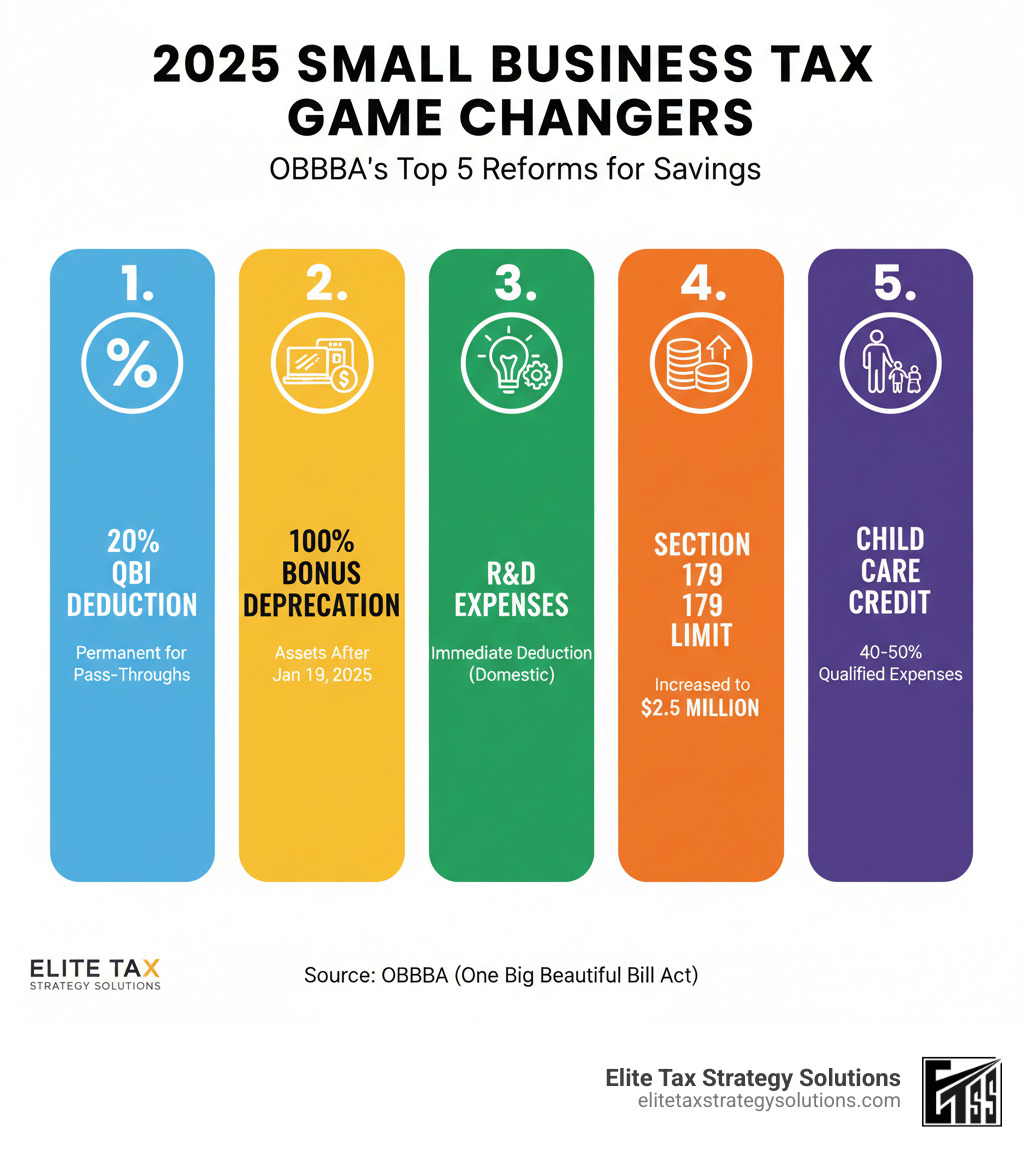
- Claim the Permanent 20% QBI Deduction – Pass-through entities can now permanently deduct 20% of qualified business income.
- Maximize 100% Bonus Depreciation – Fully deduct equipment and asset purchases made after January 19, 2025.
- Expense R&D Costs Immediately – Domestic research expenses are now fully deductible in 2025.
- Leverage Increased Section 179 – Deduct up to $2.5 million in qualifying property purchases.
- Optimize Your Business Structure – An S-Corp election can save thousands in self-employment taxes.
- Contribute to Retirement Plans – Solo 401(k)s allow up to $70,000 in tax-deductible contributions for 2025.
- Claim Improved Credits – The new Employer-Provided Child Care Credit offers 40-50% of qualified expenses.
The stakes are high. A Small Business & Entrepreneurship Council survey found 18% of owners cited taxes as a top concern. The OBBBA addresses many of these worries, but capitalizing on them requires action.
Tax planning is now a year-round strategy that can mean the difference between overpaying or reinvesting profits. The new law introduces sweeping changes, and without proactive planning, you risk leaving money on the table.
I’m David Fritch, and in my 40 years as a CPA and attorney, I’ve seen how strategic tax planning can transform a company’s finances. At Elite Tax Strategy Solutions, we help small business owners steer complex tax legislation to maximize savings and ensure compliance.
This guide breaks down what you need to do to slash your 2025 tax bill.
Small business tax planning strategies 2025 terms to remember:
Understanding the 2025 Tax Landscape: Key Changes from the OBBBA
The “One Big Beautiful Bill Act” (OBBBA), signed into law on July 4, 2025, is a significant tax overhaul for small businesses. These changes are overwhelmingly positive for owners who know how to use them. Let’s break down what matters for your bottom line.
The Permanent 20% Qualified Business Income (QBI) Deduction
The 20% Qualified Business Income (QBI) deduction is now permanent. If you operate as a sole proprietor, partnership, or S-corporation, you can deduct up to 20% of your qualified business income. The previous uncertainty around this deduction’s expiration is gone, allowing for confident long-term planning.
For the 2026 tax year, a new minimum $400 deduction begins for qualifying businesses, and phase-in thresholds increase to $150,000 for joint filers and $75,000 for single filers. This means more small businesses will qualify for larger savings. Maximizing this deduction depends on eligibility criteria like your entity type, W-2 wages paid, and tangible assets.
Improved Deductions for Asset Purchases
Planning to buy new equipment? 2025 is your year. The OBBBA has transformed how businesses can deduct asset purchases.

First, 100% bonus depreciation is back and permanent for qualified property acquired and placed in service after January 19, 2025. You can immediately deduct the full cost of eligible equipment, machinery, and vehicles in the year you start using them.
Section 179 expensing also received a major upgrade. The limit has more than doubled to $2.5 million, with the phase-out starting at $4 million in purchases. For most small businesses, this means you can fully expense significant asset purchases in the year you make them.
Additionally, a new factory deduction allows you to fully deduct the costs of new factories and manufacturing structures if construction begins between January 20, 2025, and December 31, 2028. These provisions are game-changers for small business tax planning strategies 2025, encouraging reinvestment while providing immediate tax relief.
Immediate Deductibility for R&D and Expanded QSBS
Innovation just got more affordable. Starting in 2025, you can immediately deduct 100% of domestic R&D expenses, reversing the previous requirement to amortize these costs over five to ten years.
Even better, small businesses with average annual gross receipts of $31 million or less can apply this benefit retroactively for tax years 2022-2024. This may allow you to amend returns and claim significant refunds.
For businesses considering C-corporation status, the Qualified Small Business Stock (QSBS) rules have been expanded. The exclusion limit for QSBS acquired after July 4, 2025, increases to $15 million for 2026. You can exclude 50% of gains for stock held three years, 75% for four years, and 100% for five years. The asset threshold for qualifying businesses also increased to $75 million, making C-corporations a more attractive option for high-growth ventures.
New and Improved Tax Credits
Tax credits reduce your tax bill dollar-for-dollar. The Employer-Provided Child Care Credit now allows you to claim up to 40% of qualified child care expenses, with small businesses (gross receipts of $31 million or less) potentially claiming up to 50%, capped at $600,000. This is a powerful tool for attracting talent.
Renewable energy credits have a more complicated outlook. The OBBBA accelerates their phase-out, creating limited windows to benefit. For solar and wind credits, construction must begin by July 4, 2026, or the project must be completed by December 31, 2027. These phase-out timelines are aggressive, so the time to act is now.
Foundational Strategies: Entity, Accounting, and Record-Keeping
Before claiming deductions, you need a solid foundation. Your entity type, accounting method, and record-keeping practices impact your tax liability all year. Getting these right is one of the smartest small business tax planning strategies 2025 you can make.
Optimizing Your Business Structure for Optimal Small Business Tax Planning Strategies in 2025
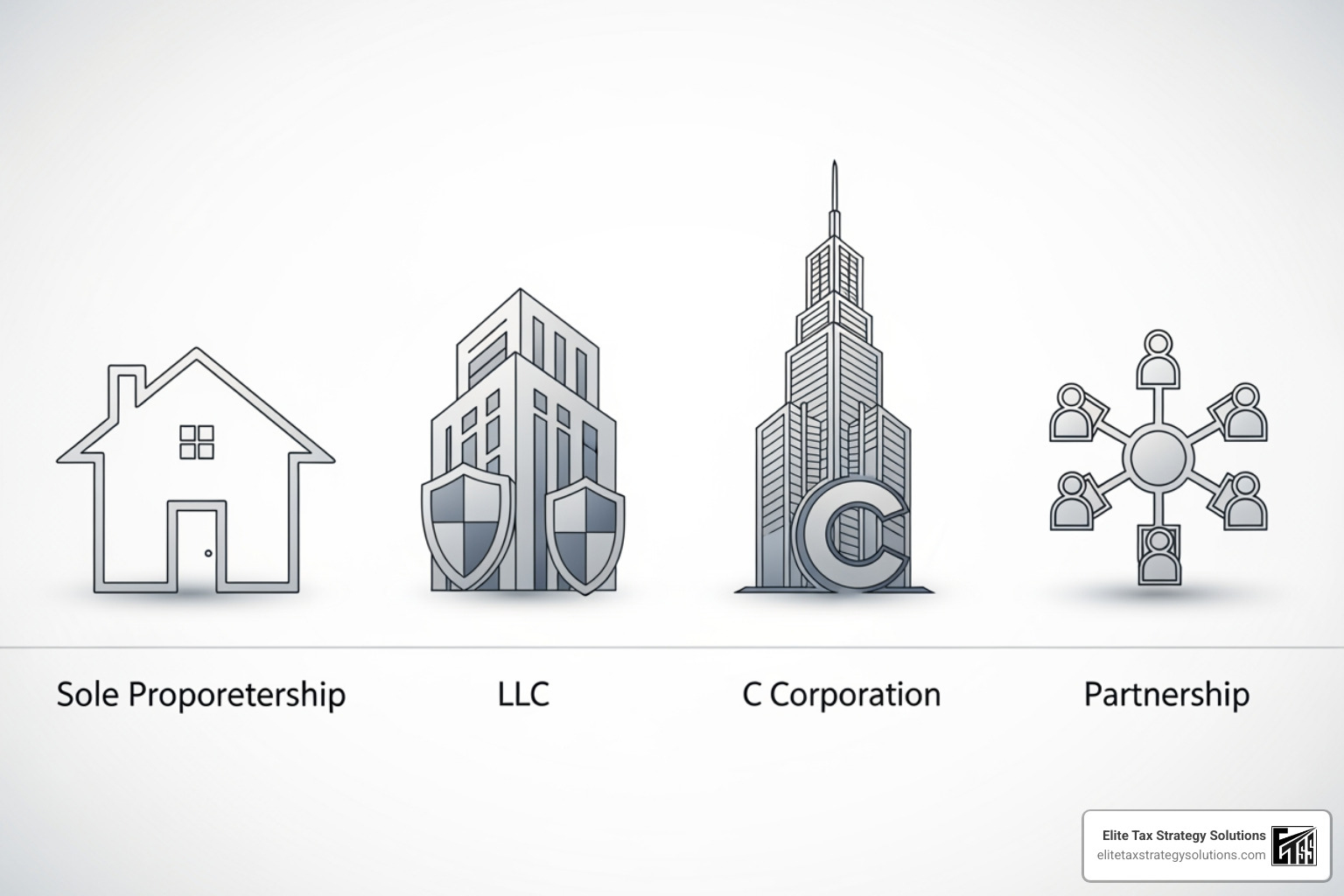
Choosing the right business structure is a strategic decision affecting your taxes, liability, and attractiveness to investors. Many start as sole proprietorships, where income flows to your personal return via Schedule C (Form 1040). While simple, this can become costly as you grow.
For example, a profitable business could save thousands in self-employment taxes by electing S-corporation status. As an S-corp, you pay yourself a reasonable salary (subject to self-employment tax) and take the rest as distributions (not subject to self-employment tax). An S-Corp calculator can estimate savings, but a personalized analysis is best.
| Feature | Sole Proprietorship | LLC (Single Member) | S-Corporation | C-Corporation |
|---|---|---|---|---|
| Taxation | Pass-through to owner’s 1040 (Schedule C) | Pass-through to owner’s 1040 (Schedule C) | Pass-through, but owner can take salary and distributions | Corporate tax rate, then dividends taxed to shareholders |
| Self-Employment Tax | Yes, on all net income (15.3%) | Yes, on all net income (15.3%) | Only on W-2 salary, not distributions | No (owners are employees or shareholders) |
| Liability Protection | None (owner personally liable) | Yes (owners generally protected from business debts) | Yes | Yes |
| Setup/Compliance | Easiest, minimal paperwork | Moderate, state filing required | More complex, IRS election, payroll | Most complex, double taxation, extensive compliance |
| QBI Deduction | Yes, if eligible | Yes, if eligible | Yes, if eligible | No (QBI for pass-through entities) |
| QSBS Eligibility | No | No | No | Yes (for qualifying C-corps) |
C-corporations, despite “double taxation,” are now more attractive for high-growth businesses due to the OBBBA’s expanded Qualified Small Business Stock (QSBS) benefits. The potential for a 100% gain exclusion on up to $15 million (for 2026) can be transformative. Your ideal structure depends on your income, growth plans, and goals, making regular strategic reviews with a professional essential.
Choosing the Right Accounting Method
Your accounting method is a powerful tool for timing tax payments. The two main methods are cash and accrual.
With the cash method, you recognize income when money is received and expenses when paid. This offers flexibility. You can delay December invoices to push income into the next year or prepay expenses to increase current-year deductions.
The accrual method recognizes income when earned and expenses when incurred, regardless of payment. This method, required for some larger businesses, still offers planning opportunities. You may be able to defer advance payments to the following year or deduct certain prepaid expenses immediately.
With higher interest rates, deferring taxable income keeps valuable working capital in your business longer.
Best Practices for Impeccable Record-Keeping
Good record-keeping is essential. It proves your deductions, protects you in an audit, and provides data for smart decisions. Without it, even the best small business tax planning strategies 2025 fail.
- Separate Finances: Open a dedicated business bank account and credit card. Never mix personal and business expenses. The IRS is scrutinizing electronic payment systems, so clean separation is vital.
- Use Accounting Software: Use a reliable program like QuickBooks, Keeper, or Wave to track income, categorize expenses, and generate reports. Review your statements monthly to catch all deductible expenses.
- Build an Audit-Proof System: Keep all invoices, receipts, mileage logs, and payroll records organized and accessible. Generally, keep records for at least three years, but sometimes longer. Digital records are fine if backed up securely.

For vehicle use, maintain a detailed mileage log. For meals, note the business purpose and attendees. For a home office, document your dedicated workspace. Detailed records provide confidence in claiming every legitimate deduction.
Maximizing Deductions and Credits: Your 2025 Action Plan
This is your action plan for translating tax law into real savings. The right deductions and credits can dramatically reduce your 2025 tax bill.
Strategic Retirement and Health Savings Contributions
Retirement contributions are one of the most powerful small business tax planning strategies 2025. They reduce your current tax bill while you build your nest egg.
A Solo 401(k) allows self-employed individuals to contribute as both employee and employer, up to a combined $70,000 in 2025 (or $77,500 if 50 or older). A SEP IRA is a simpler option, allowing contributions up to 25% of compensation, with the same dollar ceiling.
For businesses with employees, a SIMPLE IRA allows employees to contribute up to $16,000 in 2025 (plus catch-up contributions), with a required employer match or non-elective contribution. This builds loyalty and provides you with a tax deduction.
A Health Savings Account (HSA), for those with a high-deductible health plan, offers a triple tax benefit: deductible contributions, tax-free growth, and tax-free withdrawals for medical expenses. Flexible Spending Accounts (FSAs) also let you use pre-tax dollars for healthcare or dependent care. Self-employed individuals can often deduct 100% of their health insurance premiums.
New retirement plans may be eligible to receive a tax credit for startup costs for various types of employee retirement plans.
Here’s a quick reference for 2025 contribution limits:
- 401(k) (Employee): $23,500
- 401(k) (Age 50+ Catch-up): $7,500
- 401(k) (Age 60-63 Catch-up): $11,250
- Solo 401(k) (Combined): Up to $70,000
- SEP IRA: Up to $70,000
- SIMPLE IRA (Employee): $16,000
- HSA (Self-Only): $4,300
- HSA (Family): $8,550
- FSA: $3,300
- DCFSA: $5,000

Leveraging All Available Business Expense Deductions
Capturing every legitimate business expense is the backbone of smart tax planning. The IRS allows you to deduct deductible expenses that are ordinary and necessary for your business.
Common deductions include:
- Office rent, utilities, supplies, and equipment
- Business insurance premiums
- Professional fees for lawyers, accountants, and consultants
- Advertising and marketing costs
- Employee expenses like salaries, wages, and benefits
Don’t miss these often-overlooked deductions:
- Home office deduction: Deduct a portion of your home expenses if you use a space exclusively and regularly for business.
- Vehicle expenses: Deduct actual costs or use the standard mileage rate. Meticulous records are essential.
- Travel and meals: Business travel is fully deductible, and business meals are generally 50% deductible. Document the business purpose.
The IRS provides guidance on deductions and credits. Credits are more valuable as they reduce your tax bill dollar-for-dollar.
Gifting and Charitable Giving Strategies
Strategic gifting and charitable giving offer powerful long-term tax benefits.
The annual gift tax exclusion for 2025 allows you to gift up to $19,000 per person without tax consequences, helping you transfer wealth to family members. For business owners, gifting business shares can be a smart estate planning move to gradually move assets out of your estate, potentially reducing future estate taxes.
Charitable contributions also deserve attention. Making donations before year-end is wise, as new deduction floors for corporations and individuals take effect in 2026. Use resources like Charity Navigator and Guidestar to find reputable organizations, and follow IRS rules on charitable contribution deductions.
Proactive Tax Management: Year-Round Small Business Tax Planning Strategies for 2025
Effective tax planning is a year-round process. Consistent attention to your finances is key to the most successful small business tax planning strategies 2025.
Key Year-End Tax Planning Strategies for 2025
As December approaches, you have a limited window to make strategic moves. With a clear picture of your annual income, you can make informed decisions about timing.
- Deferring income: If you operate on a cash basis, you can delay final invoices until January to push income recognition into 2026, which is useful if you expect to be in a lower tax bracket.
- Accelerating deductions: To reduce 2025 taxable income, you can prepay expenses or purchase assets before year-end. The OBBBA’s 100% bonus depreciation and increased Section 179 limit make this especially powerful.
- Harvesting tax losses: Review your accounts receivable and write off uncollectible debts. Selling investments at a loss can also generate capital losses to offset capital gains.

Planning ahead is crucial. By November, you should have a good sense of your income and can decide whether to defer or accelerate.
Managing Estimated Taxes and Cash Flow
Most small business owners must pay estimated taxes throughout the year. This helps you avoid a large bill and penalties in April.
You generally need to make estimated tax payments if you expect to owe at least $1,000 in tax ($500 for corporations). The year is divided into four payment periods, with payments due on April 15, June 15, September 15, and January 15.
To avoid underpayment penalties, you must pay at least 90% of your current year’s tax or 100% of your prior year’s tax (110% if your AGI was over $150,000). Recalculating your estimated payments quarterly is a best practice, especially if your income fluctuates. This helps with cash flow optimization by ensuring you don’t overpay or underpay.
You can pay online via IRS Direct Pay or EFTPS, or mail payments with Form 1040-ES.
When to Consult a Tax Advisor
This guide covers many small business tax planning strategies 2025, but there’s no substitute for personalized, professional guidance. The best time to engage a tax professional is early in the year, not during the April filing rush.
Definitely reach out for help with:
- Planning for major asset purchases to maximize deductions.
- Complex transactions like selling your business or restructuring.
- Navigating expanded QSBS rules or deciding on a C-corporation structure.
- Business expansion into new locations or product lines.
Even if your situation seems simple, an annual planning meeting can uncover hidden savings. We’ve helped countless Jasper-area businesses find opportunities they didn’t know existed.

Come to a meeting prepared with your current financial statements, a list of any significant planned purchases or sales, and information about changes in your business. The relationship with your tax advisor should be a collaborative, ongoing partnership to help you build long-term financial stability.
Frequently Asked Questions about Small Business Tax Planning
You’re serious about getting your small business tax planning strategies 2025 right. Let’s tackle some of the most common questions.
What is the single biggest tax change for small businesses in 2025?
While the “One Big Beautiful Bill Act” (OBBBA) is packed with changes, two stand out for their immediate cash flow impact: the permanent reinstatement of 100% bonus depreciation and the immediate deduction for domestic R&D expenses.
Bonus depreciation allows you to deduct the full cost of qualifying equipment in the year you place it in service. This provides thousands of dollars in immediate tax savings that can be reinvested into your business. Similarly, the ability to immediately deduct R&D costs—instead of amortizing them over years—rewards innovation and frees up capital. Small businesses may even be able to apply this retroactively for 2022-2024 and claim refunds.
How do I know which business structure is best for my taxes?
There’s no one-size-fits-all answer; the best structure depends on your income, liability, and long-term goals.
- A sole proprietorship is simple for new businesses, but you pay self-employment tax on all net income and have no personal liability protection.
- An S-Corporation can save profitable businesses thousands in self-employment taxes by splitting income between a reasonable salary and tax-free distributions. It requires more administrative work, but the savings often outweigh the hassle.
- A C-Corporation may be ideal if you plan to seek investors, especially with the OBBBA’s expanded Qualified Small Business Stock (QSBS) rules, which offer significant tax exclusions on gains from a future sale.
- An LLC offers liability protection with pass-through taxation and the flexibility to be taxed as an S-Corp later.
This is a critical decision that warrants a professional consultation to analyze your specific numbers and goals.
Can I really deduct 100% of a new equipment purchase in 2025?
Yes, for qualified property acquired and placed in service after January 19, 2025, the law permanently reinstated 100% bonus depreciation. This allows you to deduct the entire cost of new machinery, vehicles, or software in the year you start using it.
In addition, the Section 179 deduction limit has been increased to $2.5 million, with a phase-out starting at $4 million in purchases. This gives most small and mid-sized businesses incredible flexibility to fully expense significant asset purchases in the year they’re made.
For example, if you purchase a $150,000 piece of qualifying equipment, you can deduct the full $150,000 on your 2025 tax return. This is a powerful incentive to invest in your business’s growth. We can help you steer the rules to ensure you maximize these deductions.
Conclusion
The small business tax planning strategies 2025 landscape has been fundamentally changed by the “One Big Beautiful Bill Act.” The opportunities for savings are substantial.
The permanent 20% QBI deduction, 100% bonus depreciation, $2.5 million Section 179 limit, immediate R&D deductibility, and expanded QSBS rules are all powerful tools for small business owners. However, knowing about these benefits and capturing them are two different things.
The key is a proactive, year-round approach. This means choosing the right business structure, keeping impeccable records, and making strategic decisions about timing income and expenses. You’re busy running your business; tax planning is our expertise.
At Elite Tax Strategy Solutions, we partner with business owners in Jasper, Indiana, and other suburban areas to implement strategies that keep more money in your pocket. Our proactive approach identifies opportunities and prevents pitfalls long before they impact your bottom line.
The OBBBA has created a window of opportunity. Don’t let these benefits slip away because you waited too long or lacked the right guidance.
Your business deserves a customized strategy. Whether you’re a sole proprietor, a manufacturer, or a tech entrepreneur, we’re here to help you make informed decisions that lead to real tax savings and long-term financial stability.
Learn more about our comprehensive tax planning for small businesses and let’s start building your 2025 tax strategy together. The best time to plan is right now.