Why Sales Tax Complexity Threatens Your Business Success
Sales tax consulting helps businesses steer the increasingly complex world of multi-state tax obligations, audit defense, and compliance management. Here’s what you need to know:
Core Sales Tax Consulting Services:
- Nexus Studies – Determine where you owe taxes
- Audit Defense – Protect against aggressive state auditors
- Compliance Management – Handle multi-jurisdictional filing
- Refund Recovery – Identify and recover overpayments
- Voluntary Disclosure – Resolve past liabilities safely
- Technology Implementation – Automate tax processes
The numbers tell a sobering story. Sales and use taxes can reduce your organization’s bottom line by more than eight percent – a staggering impact that most business owners never see coming. With California’s 7.25% state sales tax leading the nation and combined state-local rates climbing even higher, the financial stakes have never been greater.
State and local governments are hunting for revenue more aggressively than ever. Companies face sales tax audits more frequently than any other type of tax, making expert guidance not just helpful but essential for survival.
The complexity exploded after the 2018 Wayfair decision destroyed the old “physical presence” rules. Now, selling online across state lines creates a web of obligations that can trap even careful businesses. Each state has unique rules, changing requirements, and thousands of local jurisdictions with their own rates and exemptions.
Why This Matters Now:
- E-commerce growth created new nexus obligations
- Remote selling triggers multi-state compliance
- Audit frequency increased dramatically
- Average penalties and interest compound quickly
- Technology alone can’t solve complex compliance issues
I’m David Fritch, and after 40 years of managing tax compliance for businesses, I’ve seen how sales tax consulting can transform a company’s financial health and operational peace of mind. My experience includes working with Arthur Anderson and helping countless small business owners steer these exact challenges that keep entrepreneurs awake at night.
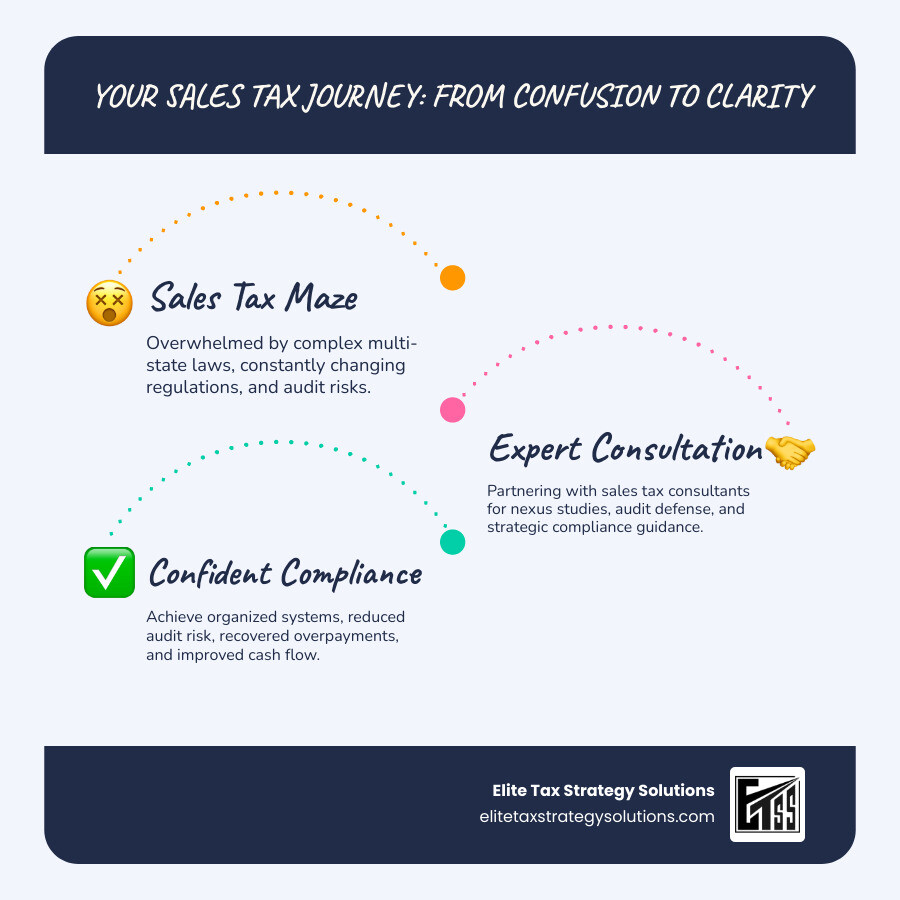
The Evolving Tax Maze: Navigating Modern Sales Tax Challenges
Picture this: you’re running a successful business, and suddenly you realize you’re juggling tax obligations across dozens of states, each with their own quirky rules. Welcome to the modern sales tax consulting landscape, where what used to be simple has become bewilderingly complex.
The numbers alone tell the story. We’re dealing with thousands of sales and use tax jurisdictions across the country. Each one has its own rates, rules, and requirements that seem to change faster than you can keep track of them. It’s like trying to hit a moving target while blindfolded.
The e-commerce boom turned everything upside down. What worked for traditional brick-and-mortar stores – where you only worried about tax in your home state – simply doesn’t apply anymore. Every online sale potentially creates new obligations in states you’ve never even visited.
Here’s what makes it particularly challenging: state and local governments are more aggressive than ever in pursuing tax revenue. They’re conducting sales tax audits more frequently than any other type of tax. That means your business faces higher scrutiny and greater risk of costly penalties.
Even determining what’s taxable has become a puzzle. Digital products, software subscriptions, and bundled services often fall into gray areas. Is your SaaS product taxable in Ohio but exempt in Nevada? The answer might surprise you – and cost you if you get it wrong.
Common Problems Businesses Face
The biggest headache most business owners face is nexus determination. Simply put, nexus is your connection to a state that creates a tax obligation. In the old days, you needed a physical presence like a store or warehouse. Now? Attending a trade show, having an affiliate, or even storing inventory temporarily can trigger nexus.
Product taxability creates endless confusion. Your widget might be tax-free in one state but fully taxable in another. Digital goods add another layer of complexity – some states tax downloadable software while others don’t. Industry-specific exemptions make it even trickier.
Exemption certificate management might seem boring, but it’s a silent business killer. Missing or invalid resale certificates are among the top reasons businesses face massive audit assessments. I’ve seen companies owe hundreds of thousands simply because paperwork wasn’t properly maintained.
Every state plays by different rules. Varying state laws mean your compliant process in California could violate Texas regulations. Local jurisdictions add their own twist, creating a patchwork of requirements that’s nearly impossible to track manually.
Keeping up with changes requires constant vigilance. New court decisions, legislative updates, and administrative interpretations emerge regularly. Most business owners simply don’t have time to monitor 50+ state tax departments for updates.
The audit risk is real and growing. States are becoming more sophisticated in identifying non-compliant businesses. Without proper documentation and processes, your company becomes an easy target for aggressive auditors looking to maximize revenue.
The Rise of Economic Nexus and E-Commerce
Everything changed with the 2018 Supreme Court decision in South Dakota v. Wayfair, Inc. This landmark ruling threw out the old “physical presence” requirement that had protected many online sellers.
Before Wayfair, you generally only collected sales tax where you had a physical presence – a store, office, or warehouse. The court’s decision established economic nexus, meaning you can owe sales tax in a state simply based on your sales volume or transaction count there.
Most states now use sales thresholds (typically $100,000 in annual sales) or transaction thresholds (often 200 separate transactions) to determine when you owe tax. Cross either line, and you’re on the hook for registration and ongoing compliance.
The thresholds aren’t uniform, of course. Some states set higher limits, others lower. Some count only the current year, others look at the previous year. It’s yet another variable in an already complex equation.
Marketplace facilitator laws added another wrinkle. Platforms like Amazon now collect tax on behalf of sellers for transactions through their marketplace. While this helps with some sales, it doesn’t eliminate your obligations for direct sales or sales through other channels.
For online businesses, this new reality means every state becomes a potential compliance obligation. The convenience of e-commerce comes with the burden of multi-state tax responsibilities that can quickly overwhelm unprepared businesses.
Understanding your obligations across different jurisdictions is crucial. You can see how rates vary by checking out State Sales Tax Rates for state-level information, and Sales Tax Rates in Major Cities, Midyear 2024 for more detailed local rates.
The bottom line? The old approach of handling sales tax in-house or hoping for the best simply doesn’t work anymore. The complexity demands expertise that most businesses can’t afford to develop internally.
The Expert Advantage: Core Services and Benefits of Sales Tax Consulting

Picture this: instead of losing sleep over complex tax rules, you’re focused on what you do best – growing your business. That’s the real power of sales tax consulting. It’s not just about avoiding penalties (though that’s certainly important). It’s about turning one of your biggest headaches into a strategic advantage.
When you partner with the right tax professionals, you’re not just buying compliance. You’re investing in strategic value that touches every part of your business. Risk mitigation becomes second nature. Hidden cash savings surface from places you never knew to look. Your internal processes get smoother and more efficient. And you gain access to industry-specific expertise that would take years to develop in-house.
Here’s what makes this approach so powerful: sales tax consulting transforms a reactive scramble into a proactive strategy. Instead of waiting for problems to find you, you’re staying three steps ahead of them.
Key Services in Sales Tax Consulting
The best consulting firms offer a complete toolkit designed to handle every aspect of your sales tax world. Think of it as having a Swiss Army knife for tax compliance – the right tool for every situation you’ll encounter.
Nexus studies form the foundation of everything else. These determine exactly where your business owes taxes, taking the guesswork out of your obligations. No more wondering if that trade show in Denver created a tax requirement, or whether your online sales into Florida triggered compliance duties.
Taxability reviews dive deep into what you’re actually selling. Is your software taxable in some states but not others? What about that bundled service package? These studies ensure you’re charging the right amount in every jurisdiction.
For businesses dealing with audit defense, having experts in your corner changes everything. They manage the entire process, from that first scary letter to final resolution. They speak the auditor’s language and know how to negotiate settlements that protect your interests.
Voluntary disclosure agreements offer a lifeline for businesses that find past compliance gaps. Instead of waiting for states to find you, these programs let you come forward on your terms, often with reduced penalties and limited look-back periods.
One of the most exciting services is refund recovery – essentially reverse audits that find money you’ve overpaid. Many businesses find they’ve been paying sales tax on purchases that should have been exempt, or remitting taxes they never actually collected.
Compliance outsourcing takes the entire burden off your shoulders. From filing returns to managing notices, everything gets handled by specialists who live and breathe this stuff daily. Technology implementation ensures you have the right systems in place to automate routine tasks and catch errors before they become expensive problems.
How Your Business Benefits from a Consultant
The financial impact alone makes sales tax consulting worthwhile. We’re talking about real money – the kind that shows up directly on your bottom line. Many clients save over 20% on their tax obligations through proper planning and recovery of overpayments.
But the benefits go far deeper than dollars saved. Reduced liability means you can sleep better knowing your exposure to audit assessments is minimized. Increased profitability comes from identifying exemptions you didn’t know existed and recovering taxes you shouldn’t have paid in the first place.
The time savings might be the most valuable benefit of all. How many hours do you currently spend wrestling with tax questions? How much could you accomplish if that time was freed up for strategic work instead?
Improved compliance processes create lasting value. Once proper systems are in place, maintaining compliance becomes routine rather than stressful. Your team knows exactly what to do, when to do it, and how to document everything properly.
Perhaps most importantly, you gain peace of mind. No more wondering if you’re doing things right. No more anxiety about potential audits. No more sleepless nights worrying about unknown obligations. When seasoned professionals are managing your sales tax world, you can focus on what really matters – building your business and serving your customers.
The numbers don’t lie: businesses working with expert consultants typically see their audit risk drop significantly while their cash position improves through recovered overpayments and proper exemption management. It’s not just about compliance – it’s about competitive advantage.
In-House vs. Outsourced: Making the Right Choice for Your Tax Strategy

When it comes to managing sales tax, you’re facing a choice that could make or break your compliance strategy: should you build an in-house team or partner with sales tax consulting experts? It’s a decision that keeps many business owners up at night, and for good reason.
Here’s the reality most businesses face: tight budgets, overworked staff, and crushing deadlines have become the norm in accounting departments everywhere. Even your most dedicated internal team members are drowning in daily tasks, leaving little time to master the ever-changing maze of sales tax regulations.
Many companies make the mistake of believing their existing systems or general accounting staff provide complete protection from audit assessments. Unfortunately, this confidence often proves costly when state auditors come knocking.
The choice between in-house and outsourced sales tax consulting ultimately comes down to four critical factors: cost-effectiveness, access to specialized knowledge, efficient resource allocation, and scalability. Let’s break down exactly what this means for your business.
[TABLE] comparing In-House Tax Department vs. Sales Tax Consultant
| Aspect | In-House Tax Department | Sales Tax Consultant |
|---|---|---|
| Expertise | Limited to current staff knowledge and experience; requires ongoing training investment | Deep, specialized expertise across all jurisdictions; decades of combined experience |
| Cost | Full-time salaries, benefits, training, technology licenses, and overhead costs | Project-based or retainer fees; no benefits or overhead; often more cost-effective |
| Technology Access | Must purchase and maintain expensive software licenses and updates | Access to cutting-edge proprietary tools and automation software included |
| Scalability | Difficult to scale up or down; fixed costs regardless of workload | Easily scalable based on business needs and seasonal requirements |
| Focus | Divided attention between sales tax and other accounting responsibilities | 100% focused on sales tax compliance and optimization |
| Objectivity | May have internal biases or pressure to minimize findings | Independent, objective analysis with no internal conflicts |
The numbers tell a compelling story. While an in-house tax specialist might cost $75,000-$120,000 annually (plus benefits and training), specialized sales tax consulting services often provide superior expertise at a fraction of the cost.
Cost considerations go beyond just salaries. Your in-house team needs expensive software licenses, ongoing training, and time to stay current with changing regulations. Meanwhile, consultants bring enterprise-level tools and decades of experience to every project.
Expertise gaps represent perhaps the biggest challenge for in-house teams. Sales tax regulations change constantly, and keeping up requires dedicated focus. A general accountant handling payroll, bookkeeping, and sales tax simply cannot match the depth of knowledge that specialized consultants bring to the table.
The Role of Technology in Modern Sales Tax Consulting
Technology has revolutionized how sales tax consulting works, and this is where the gap between in-house and outsourced solutions becomes most apparent.
Professional consultants use automation software that can process thousands of transactions in minutes, identifying patterns and potential issues that would take in-house staff weeks to uncover. These aren’t tools you can simply purchase off the shelf.
Proprietary review tools developed specifically for sales tax analysis give consultants capabilities that most businesses could never justify purchasing. We’re talking about systems that cost hundreds of thousands of dollars to develop and maintain.
Data analytics and advanced reporting capabilities allow consultants to dive deep into your transaction history, identifying both risks and opportunities that less sophisticated approaches would miss entirely.
Perhaps most importantly, AI-powered tax research tools help consultants stay current with regulatory changes across all jurisdictions. This technology ensures nothing falls through the cracks, providing a level of coverage that even large in-house teams struggle to match.
Data integrity becomes crucial when dealing with complex multi-state compliance. Professional consultants have systems and processes to ensure accuracy that most businesses simply cannot replicate internally.
The bottom line? While building an in-house team might seem like the right choice for control and immediacy, the reality is that specialized sales tax consulting typically provides better results at lower cost. Your internal team can focus on what they do best – running your business – while experts handle the complexities of sales tax compliance.