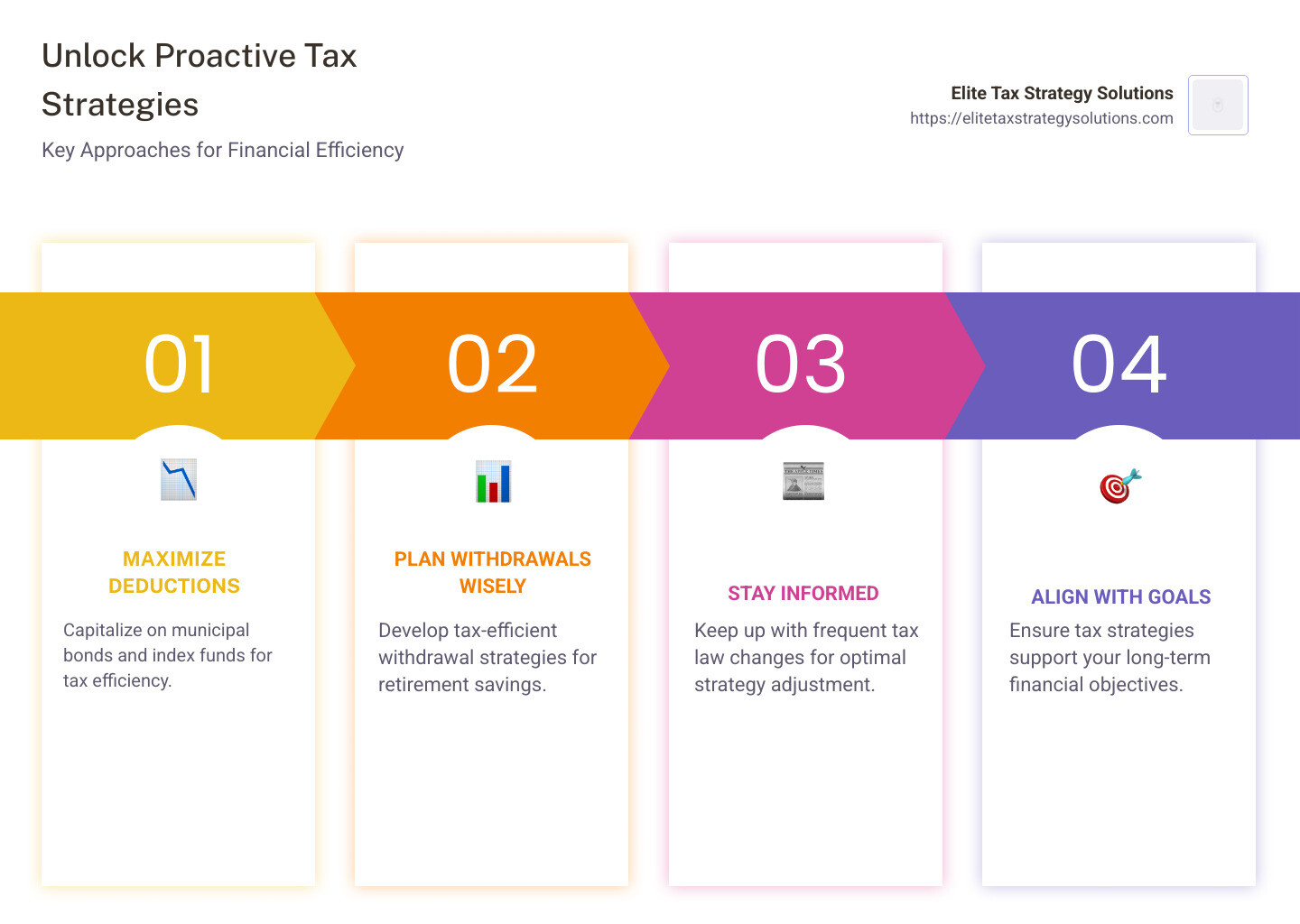
Proactive tax strategies are essential for anyone aiming to steer the intricate U.S. tax code. By adopting these strategies, you can open up numerous tax-saving opportunities that align with your financial goals. Here’s a quick breakdown of how to use proactive tax strategies:
- Maximize Deductions: Use tools like tax-efficient index funds, capitalize on municipal bonds, and engage in meticulous tax-loss harvesting.
- Plan Withdrawals Wisely: Develop tax-efficient withdrawal strategies to preserve your retirement funds.
- Stay Updated: Tax laws change frequently. Stay informed to continually adjust your strategies for maximum benefit.
In this complex landscape, effective tax planning isn’t merely about filing returns but involves strategic efforts to minimize liabilities and improve your financial well-being. By aligning tax strategies with your long-term objectives, you pave the way for financial efficiency and stability.
I’m David Fritch, with over 40 years of experience in law and accounting, focusing on proactive tax strategies. Having owned and managed my firm, I’ve dedicated my career to helping individuals and small business owners optimize their financial outcomes through custom tax planning. Now, let’s dive deeper into what makes proactive tax strategies essential for achieving your financial goals.
Learn more about proactive tax strategies:
– proactive tax planning opportunities
– taxation strategies
– taxes and financial planning
Understanding Proactive Tax Strategies
Proactive tax strategies are all about getting ahead of the game. They help you manage your finances in a way that minimizes your tax bill and maximizes your savings. Let’s break down some key components: tax brackets, withholding strategies, and taxable income.
Tax Brackets
The U.S. uses a progressive tax system, which means the more you earn, the higher your tax rate might be. There are seven federal income tax brackets: 10%, 12%, 22%, 24%, 32%, 35%, and 37%. Your bracket depends on your income and filing status.
Understanding where you fall can help you make informed decisions throughout the year. For example, if you’re close to moving into a higher tax bracket, you can use strategies to keep your taxable income lower. This might include maximizing deductions or contributing more to retirement accounts.
Withholding Strategies
Your employer deducts taxes from your paycheck based on the information you provide on your Form W-4. If you withhold too much, you might get a refund, but you also give the government an interest-free loan. Withholding too little could mean a big bill at tax time.
To get it just right, you can use the IRS tax withholding estimator. It helps you see how different withholding amounts affect your refund or the taxes you owe. Adjusting your withholding can ensure you’re not caught off guard come April.
Taxable Income
Your taxable income is what’s left after subtracting deductions from your total income. This is the amount the IRS uses to determine your tax bill. Reducing your taxable income can significantly lower your tax liability.
Some ways to reduce taxable income include contributing to a 401(k) or IRA, taking advantage of deductions, and considering tax-efficient investments. By planning ahead, you can strategically manage your taxable income and avoid surprises when it’s time to file your return.
By understanding and implementing these proactive tax strategies, you can effectively steer the tax code, reduce your tax burden, and align your financial actions with your long-term goals. Next, we’ll explore key strategies for proactive tax planning, focusing on maximizing retirement contributions, optimizing investment portfolios, and charitable giving strategies.
Key Strategies for Proactive Tax Planning
Maximize Retirement Contributions
Retirement accounts offer a great way to save for the future while enjoying tax benefits today. Here’s how you can make the most of them:
401(k) Contributions: Contributing to a 401(k) plan can reduce your taxable income. For 2024, you can contribute up to $23,000. If you’re 50 or older, you can add an extra $7,500 as a catch-up contribution. These contributions not only lower your tax bill now but also grow tax-deferred.
IRA Contributions: Similar to a 401(k), contributing to an Individual Retirement Account (IRA) can also provide tax savings. In 2024, you can contribute up to $7,000, and if you’re over 50, you can add another $1,000. Whether you choose a traditional or Roth IRA, both have unique tax advantages worth considering.
Optimize Investment Portfolio
Investing wisely can help you keep more of your returns. Here are a few strategies to consider:
Tax-Loss Harvesting: This involves selling investments that have lost value to offset gains from other investments. It can reduce your taxable capital gains and even offset up to $3,000 of ordinary income each year. If you have more losses than gains, you can carry them forward to future years.
Tax-Efficient Investments: Choosing investments that generate less taxable income can make a big difference. For example, municipal bonds often provide tax-free income, and index funds typically have lower capital gains distributions compared to actively managed funds.
Charitable Giving Strategies
Giving to charity can be rewarding in more ways than one. Here’s how you can maximize your impact:
Donor-Advised Funds: These funds allow you to donate cash or appreciated securities and receive an immediate tax deduction. You can then recommend grants to charities over time, giving you flexibility in your giving strategy.
Appreciated Securities: Donating stocks or other securities that have increased in value can provide a double tax benefit. You can deduct the full market value of the securities and avoid paying capital gains tax on the appreciation.
By implementing these proactive tax strategies, you can effectively manage your tax liabilities, maximize your savings, and support causes you care about. Next, we’ll discuss how to manage tax liabilities by reviewing withholding amounts and estimated tax payments.
Managing Tax Liabilities
Review Withholding Amounts
One important proactive tax strategy is to regularly review your withholding amounts. This ensures you don’t face a surprise bill or miss out on potential savings.
Paycheck Withholding: Your employer withholds taxes from your paycheck based on the information you provide on your Form W-4. If you find yourself consistently receiving a large tax refund, you might be withholding too much. Conversely, if you owe a lot at tax time, you might be withholding too little.
IRS Tax Withholding Estimator: To get a clearer picture, use the IRS tax withholding estimator. This tool helps you calculate the right amount to withhold based on your current financial situation. Adjusting your withholding can lead to a more balanced tax outcome at the end of the year.
Form W-4: If adjustments are needed, submit a new Form W-4 to your employer. This form lets you specify how much federal income tax should be withheld from your paycheck. You can update it anytime to reflect changes in your financial situation, such as a new job, marriage, or additional income sources.
Estimated Tax Payments
For those with income not subject to withholding, like self-employment income or significant investment returns, estimated tax payments are crucial.
Self-Employment Income: If you’re self-employed, you need to pay taxes on your earnings throughout the year. This includes income from freelancing, consulting, or other ventures. Failing to make estimated payments can result in penalties.
Dividends and Capital Gains: If you earn substantial income from dividends or capital gains, consider making estimated tax payments. This helps avoid a hefty tax bill at year-end. Consulting a tax professional can help determine the appropriate amount and frequency of these payments.
By keeping a close eye on your withholding amounts and making estimated tax payments when necessary, you can effectively manage your tax liabilities. This proactive approach helps ensure you meet your tax obligations without unexpected surprises.
Next, we’ll explore tax deductions and credits, including the choice between standard and itemized deductions.
Tax Deductions and Credits
Standard vs. Itemized Deductions
When it’s time to file your taxes, you have two main options to lower your taxable income: standard deductions and itemized deductions. Choosing the right one can make a big difference in how much you pay or save.
Standard Deduction: This is a fixed dollar amount that reduces your taxable income. It’s simple and requires no calculations. For 2025, the standard deduction is $15,000 for single filers and $30,000 for married couples filing jointly. Most people choose this option for its simplicity.
Itemized Deductions: If your eligible expenses exceed the standard deduction, itemizing could save you more. Common deductions include:
-
Mortgage Interest: If you own a home, the interest you pay on your mortgage can be deducted. This can be a significant deduction if you have a large mortgage balance.
-
Charitable Donations: Donations to qualified charities can be deducted. Consider using strategies like “bunching,” where you make several years’ worth of donations in one year to maximize deductions.
-
Medical Expenses: You can deduct medical and dental expenses that exceed 7.5% of your adjusted gross income (AGI). Keep all receipts and documents related to these expenses.
Here’s a quick comparison table to help decide which deduction might be right for you:
| Deduction Type | When to Choose |
|---|---|
| Standard Deduction | Simple, no calculations, expenses less than standard deduction amount |
| Itemized Deductions | Total eligible expenses exceed standard deduction, significant mortgage or donations |
Tax Credits for Energy Efficiency
Investing in energy efficiency not only helps the environment but can also provide valuable tax credits.
Energy-Efficient Improvements: Starting in 2024, you can claim up to $1,200 annually for energy-efficient home improvements like new doors, windows, or insulation. This credit encourages homeowners to make eco-friendly upgrades.
Residential Clean Energy Credit: This credit covers improvements like solar panels and has been extended to 2034. You can claim a 30% credit on qualified costs, making it a great incentive for those looking to reduce their carbon footprint while saving on taxes.
By understanding these deductions and credits, you can make informed decisions to reduce your tax bill. Next, we’ll tackle frequently asked questions about proactive tax strategies to help you stay ahead in your tax planning.
Frequently Asked Questions about Proactive Tax Strategies
What does it mean to be proactive in tax?
Being proactive in tax means taking charge of your tax situation before deadlines loom. It’s about planning ahead to reduce your tax liability and maximize savings. Instead of waiting until tax season, proactive tax planning involves year-round strategies that align with your financial goals.
Think of it as a way to uncover tax-saving opportunities and make decisions that benefit you in the long run. For instance, understanding your tax bracket can help you decide when to make certain financial moves, like selling investments or making charitable donations. By doing so, you ensure you’re not caught off guard when it’s time to file your taxes.
What are the three basic tax planning strategies?
Tax planning can be boiled down to three basic strategies: timing, income shifting, and conversion.
-
Timing: This involves deciding when to recognize income and expenses. For example, if you’re close to moving into a higher tax bracket, you might defer income to the next year to stay in a lower bracket this year.
-
Income Shifting: This strategy involves moving income to family members in lower tax brackets. For example, a business owner might pay their children a salary for legitimate work done, reducing the family’s overall tax burden.
-
Conversion: This involves changing the nature of income or assets to reduce taxes. A common example is converting a traditional IRA to a Roth IRA, which can be beneficial if you expect to be in a higher tax bracket in the future.
How do I avoid the 3.8% investment tax?
The 3.8% investment tax, also known as the Net Investment Income Tax (NIIT), applies to individuals with significant investment income. Here are some ways to minimize or avoid it:
-
Donate Appreciated Assets: Instead of selling stocks, consider donating them to charity. This way, you avoid capital gains tax and potentially lower your taxable income.
-
Manage Capital Gains: Use strategies like tax-loss harvesting to offset gains with losses. This can help reduce your overall taxable income from investments.
-
Monitor Your Income: Keep an eye on your modified adjusted gross income (MAGI). If it’s close to the threshold where the NIIT kicks in, consider strategies to reduce it, like contributing to retirement accounts.
By understanding these strategies, you can effectively manage your tax liabilities and keep your hard-earned money working for you.
Next, we’ll explore the role of Elite Tax Strategy Solutions in providing personalized tax planning to improve your financial stability.
Conclusion
At Elite Tax Strategy Solutions, we believe that personalized tax planning is the cornerstone of financial stability. Our proactive approach to tax optimization is designed to help you steer the complex tax landscape with ease and confidence.
We know that every financial journey is unique. That’s why our team of seasoned tax professionals is dedicated to crafting custom strategies that align with your personal financial goals. Whether you’re a high-income earner or a small business owner, our services are designed to maximize your tax savings and ensure compliance with ever-changing tax regulations.
Our commitment to proactive tax planning means we don’t just prepare your taxes; we work with you year-round to uncover tax-saving opportunities and minimize liabilities. By integrating tax planning with your broader financial strategy, we help you achieve long-term financial success.
Ready to take control of your tax planning? Explore our innovative tax planning services and find how we can help you achieve financial efficiency. Let’s work together to keep your financial future secure and prosperous.