Why Personal Tax Compliance Is Your Shield Against IRS Headaches
Personal tax compliance means filing accurate returns on time, reporting all income, claiming proper deductions, and paying what you owe when it’s due. Here’s what you need to know:
Core Requirements:
- File by deadline (April 30 in Canada, April 15 in US)
- Report all income from employment, business, investments
- Keep records for 3-7 years depending on situation
- Pay on time to avoid penalties and interest
- Respond promptly to any tax authority inquiries
The cost of getting it wrong is steep. Late filing penalties start at $100 and compound quickly. Interest charges pile up daily. But most compliance issues are completely avoidable with the right approach.
The U.S. tax system runs on “voluntary compliance” – you’re expected to calculate and pay your taxes honestly. Research shows the average Canadian spends 1.5 hours and $130 per year on personal tax compliance.
This isn’t just about avoiding penalties. Smart compliance protects your wealth, reduces stress, and gives you confidence that you’re maximizing every legal deduction.
I’m David Fritch, and I’ve spent 40 years helping clients steer personal tax compliance through my CPA practice and law firm, including experience at Arthur Anderson’s tax department.
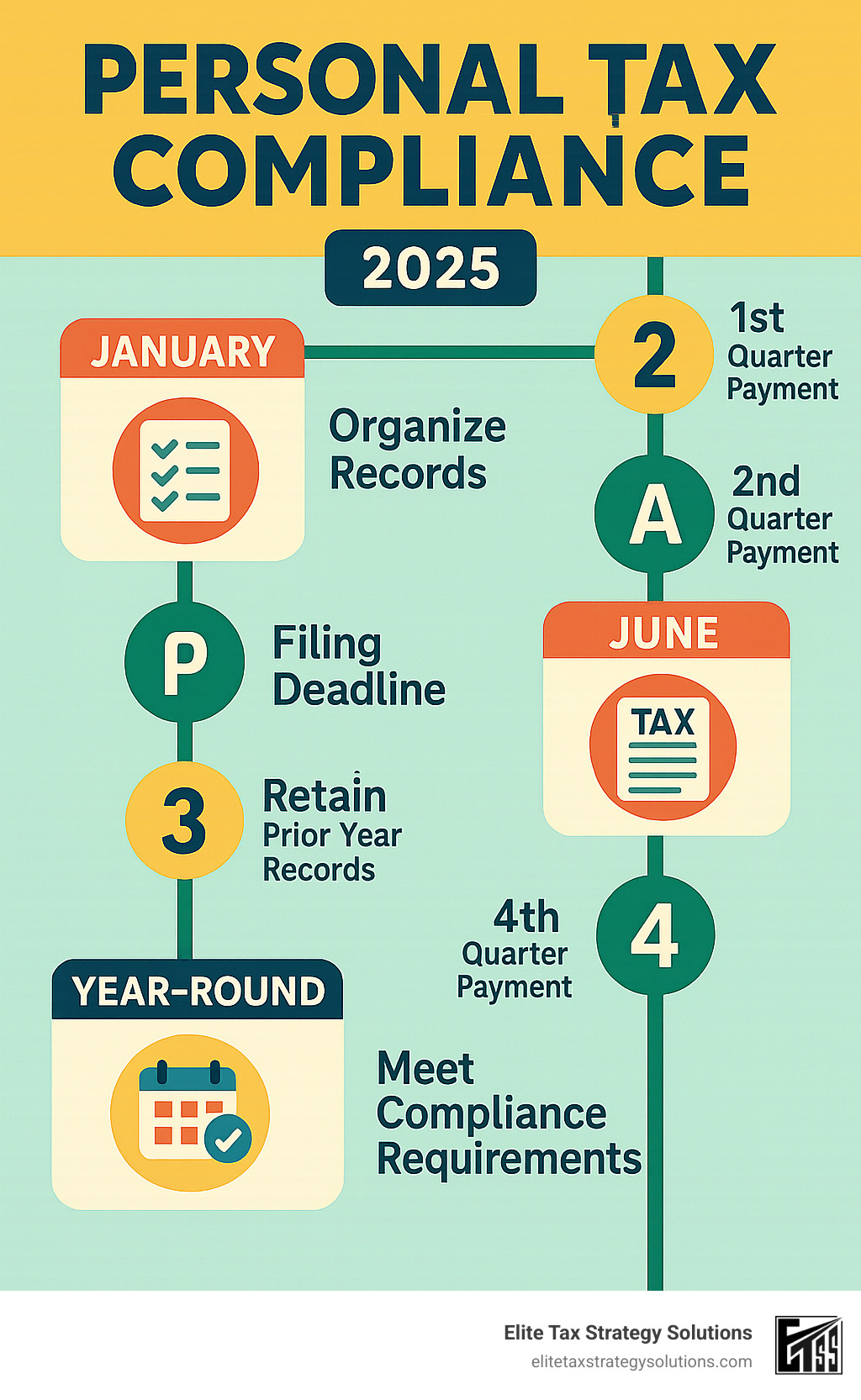
Basic personal tax compliance vocab:
What Is Personal Tax Compliance and Why It Matters
Personal tax compliance means doing your taxes right and doing them on time. The government trusts you to figure out what you owe and pay it voluntarily. This “voluntary compliance” system works because most people want to do the right thing, but tax rules keep getting more complicated.
Scientific research on compliance behaviour shows that even taxpayers who genuinely want to comply often struggle with complexity, creating a “tax gap” – billions in uncollected taxes, often due to confusion rather than intentional cheating.
The stakes are real. Poor compliance means missing deductions, creating audit red flags, and adding stress. But good personal tax compliance optimizes your financial position while providing peace of mind.
The Core Pillars of Personal Tax Compliance
Solid personal tax compliance rests on four pillars:
Registration: Having proper paperwork – Social Security Number, ITIN, or EIN for businesses.
Timely filing: Beyond April deadlines, this includes quarterly filings for self-employed and foreign asset reporting with separate deadlines.
Accurate reporting: Every dollar of income reported with proper deduction backup. Most people stumble here due to confusion, not fraud.
Timely payment: Filing on time means nothing without paying what you owe. Extensions to file don’t extend payment deadlines.
Personal Tax Compliance vs. “Just Filing a Return”
There’s a difference between throwing receipts in a shoebox and panicking in March versus tracking income and expenses year-round, making estimated payments, and keeping organized records.
Tax authorities expect proactive self-assessment – good records, understanding basic rules, and informed decisions. Sloppy or inconsistent returns trigger their radar. Good compliance actually reduces audit risk because returns look professional and consistent.
Step-by-Step Checklist to Ace Your Return

Personal tax compliance doesn’t have to be a yearly nightmare. The secret is working smarter with a clear plan.
Start in January gathering W-2s, 1099s, and income statements. Create a simple filing system – even a manila folder works.
By February, collect deduction receipts – medical bills, charitable donations, business expenses. Check credit card statements for missing receipts.
March is decision time – choose your approach:
| Method | Time Investment | Average Cost | Best For |
|---|---|---|---|
| DIY Software | 3-5 hours | $50-100 | Simple returns, W-2 income |
| Tax Preparer | 1-2 hours | $150-300 | Moderate complexity |
| Professional Service | 30 minutes | $500+ | Complex situations, high earners |
Gathering Records the Smart Way
Income documentation includes all W-2s, 1099s, and business income records. The IRS gets copies too, so missing income creates red flags.
For deductions, organize medical expenses, charitable donations (need receipts for amounts over $20), and business expenses with clear business purposes.
Record retention: Keep everything for at least three years after filing. Exceptions include seven years for worthless securities, six years for underreported income over 25%, and indefinitely for unfiled returns or fraud.
Clients with organized records rarely get audited, and when they do, audits go smoothly. Our Tax Filing Assistance service helps clients set up automatic systems.
Filing Your Return & Staying on Schedule
Electronic filing is the gold standard – faster processing, fewer errors, immediate confirmation, and quicker refunds with direct deposit.
Deadlines matter: April 15th (US) or April 30th (Canada) aren’t suggestions. Missing these triggers automatic penalties. File on time even if you can’t pay immediately – failure-to-file penalties are much steeper than failure-to-pay penalties.
Payment options include direct bank transfer, credit cards (with fees), or installment agreements. Early filers have significantly fewer compliance issues and less stress.
Cutting Time, Money & Stress Out of Personal Tax Compliance
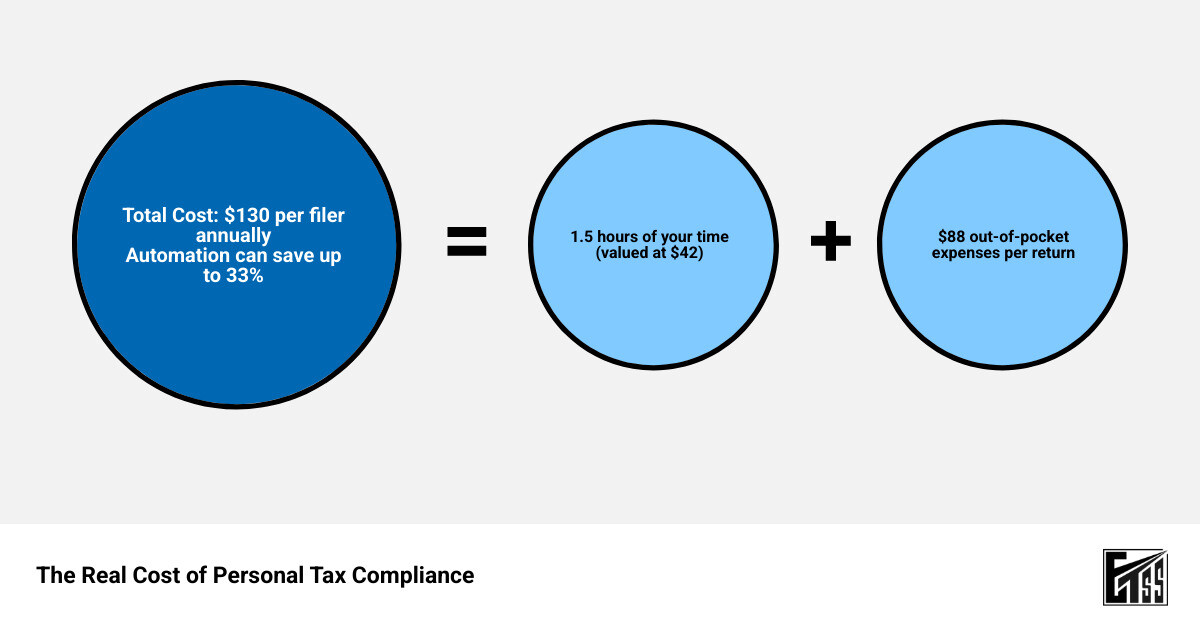
The average Canadian spends 1.5 hours and $88 out-of-pocket per return. Including time value, the total hits $130 annually. Scientific research on cost reduction shows automation and prefilled returns could cut personal tax compliance costs by a third.
About half of people prepare their own returns (85% use software), while 37% use paid preparers. Business owners and high earners often see costs double or triple.
Tech Hacks to Streamline Personal Tax Compliance
Certified tax software approved by the IRS handles calculations correctly and securely transmits data. Professional-grade software spots deductions you might miss.
Cloud-based recordkeeping apps track expenses, log miles, and capture receipts instantly. Choose apps that integrate with tax software for seamless data transfer.
Software that imports data from banks and brokers eliminates manual entry errors. Secure cloud storage beats paper filing and provides encrypted access.
At Elite Tax Strategy Solutions, we help clients set up systems that make compliance easier each year.
Personal Tax Compliance for High Earners & Investors
Six-figure earners face additional complexity. Capital gains require tracking every transaction and calculating cost basis correctly. The wash sale rule can eliminate valuable deductions if timing is wrong.
Passive income from rentals or partnerships means extra forms and stricter rules. High earners must consider Alternative Minimum Tax (AMT).
Foreign accounts over $10,000 require FBAR filing (Form 114). Higher thresholds trigger Form 8938 requirements. Missing these creates steep penalties.
Estimated tax payments are required if you expect to owe over $1,000. Missing quarterly payments means penalties even if you pay the full amount later.
Audit-Proofing: Records, Red Flags & Compliance Checks
Scientific research on HMRC checks shows tax authorities want everyone to pay the right amount at the right time. Most audits are triggered by avoidable issues: unusually high deductions, inconsistent year-to-year numbers, math errors, business losses, or unreported income.
Tax authorities use computer systems to scan returns and flag unusual patterns. You might face correspondence audits (letters), office audits, or field audits depending on the issues.
Building an Iron-Clad Documentation System
The burden of proof is on you. Build a system that impresses auditors.
Make contemporaneous records – write details when things happen. For business lunches, note attendees and discussion topics on receipts immediately.
Go digital – scan receipts into labeled folders with cloud backup and encryption. Keep paper copies of critical documents.
Track property basis for homes, investments, and business equipment, especially improvements. Keep employment tax records for four years.
Retention periods:
- Tax returns and support: 3 years minimum
- Property records: Until 3 years after sale
- Business records: 3 years for income, 7 for employment taxes
- Worthless securities: 7 years
Our Tax Audit Preparation service helps set up systems that save hours during audits.
Surviving an IRS or CRA Audit Without Drama
Don’t panic if you get an audit notice. Read it carefully to understand what’s requested. Gather only the requested documents – don’t overshare.
Be polite and professional. Take notes on calls and keep copies of submissions. You have rights: professional representation, understanding why you’re audited, and appealing decisions.
At Elite Tax Strategy Solutions, we represent clients through audits from start to finish, handling auditor communications so stress stays with us, not you.
Advanced Scenarios: Cross-Border Rules, FATCA & Non-Residents
International personal tax compliance is complex. U.S. citizens and residents must report all worldwide income – overseas paychecks, foreign business profits, international dividends, and foreign rental income.
Tax residency rules vary by country. You can be a resident in multiple countries simultaneously, potentially owing taxes in both places.
FATCA compliance requires reporting foreign assets above certain thresholds: $50,000 for single U.S. residents, $200,000 for those abroad. File Form 8938 with your return.
FBAR (Form 114) is required if foreign accounts total over $10,000 at any point during the year. This goes directly to Treasury, not with your regular return.
Our IRS Tax Compliance team specializes in international compliance.
Staying Compliant Across Borders
Tax treaties prevent double taxation and provide tie-breaker rules for dual residents. They enable foreign tax credits and dispute resolution.
Common expat pitfalls include missing U.S. returns while abroad, forgetting FBAR/FATCA forms, or claiming wrong credits. Planning opportunities include foreign earned income exclusion and optimized foreign tax credits.
Voluntary Disclosure & Getting Back on Track
If you’ve fallen behind, both IRS and CRA offer voluntary disclosure programs. The IRS streamlined procedures help expats catch up with reduced penalties by filing three years of returns and six years of FBARs.
Canada’s Voluntary Disclosures Program (VDP) allows correction of past errors while avoiding penalties and prosecution.
Qualifying disclosures must be voluntary (before contact), complete (all missing items), and involve potential penalties. You’ll still owe taxes and interest.
Frequently Asked Questions about Personal Tax Compliance
How much time and money will I really spend each year?
Most people spend 1.5 hours and $130 annually. Simple W-2 returns take under an hour with $50-100 software costs. Business income, investments, or rentals require 5-15 hours DIY or $500-2,500 professionally. High-net-worth individuals need professional help costing $2,500-10,000+ but save far more in taxes than fees paid.
What records should I keep—and for how long?
Keep tax returns, income statements, deduction receipts, investment records, property improvements, and business expenses. Standard retention is three years from filing, with exceptions:
- Six years for underreported income over 25%
- Seven years for bad debts or worthless securities
- Indefinitely for property until three years after sale
- Four years for employment taxes
Use secure digital storage with cloud backups, keeping important originals safe.
How do I reduce my chances of an audit?
File accurately and on time, report all income, and ensure deductions match your income level. Use professional software or preparers for complex returns. Certain situations attract attention: large deductions, repeat business losses, cash businesses, math errors, or missing information.
If audited, respond quickly, provide only requested documents, and consider professional representation. You can always appeal disagreeable findings.
Conclusion & Next Steps
Personal tax compliance doesn’t have to be an annual nightmare. After four decades helping clients, I’ve learned that successful taxpayers build smart systems and know when to get help.
Start with your foundation – create a record-keeping system that captures information when it happens. Choose your approach based on complexity: quality software for simple returns, professional guidance for business income, investments, or foreign assets.
Proactive taxpayers spend less time and money while achieving better results. They file accurately, avoid penalties, and have peace of mind.
Elite Tax Strategy Solutions makes the difference with comprehensive Tax Compliance Services that go beyond filing returns. We monitor law changes, build year-round strategies, and provide the expertise high earners and business owners need.
Our Jasper, Indiana clients appreciate our proactive approach – their compliance is handled professionally while we simultaneously reduce their tax burden legally and ethically.
With my Arthur Anderson background, Elite Tax Strategy Solutions provides enterprise-level expertise with personal attention. We handle everything from business ownership complexities to international requirements.
Personal tax compliance becomes simple with the right systems and support. Stress disappears when records are organized, returns are accurate, and you have expert representation for any questions.
Don’t wait until next tax season. Build better compliance habits now, when you’re not under deadline pressure. The peace of mind and tax savings often pay for professional services many times over.
Personal tax compliance done right protects your wealth, reduces stress, and maximizes every legal opportunity to minimize taxes. That’s not just good business – it’s good life planning.
zxq8273lkjhqwe