Why Personal Property Tax Compliance Matters More Than You Think
Personal property tax compliance affects millions of businesses across the United States, yet many owners don’t fully understand their obligations until they face penalties or audits. This comprehensive guide will walk you through everything you need to know about managing your personal property tax responsibilities effectively.
Quick Answer: Personal Property Tax Compliance Essentials
– What it covers: Movable business assets like equipment, computers, furniture, and machinery
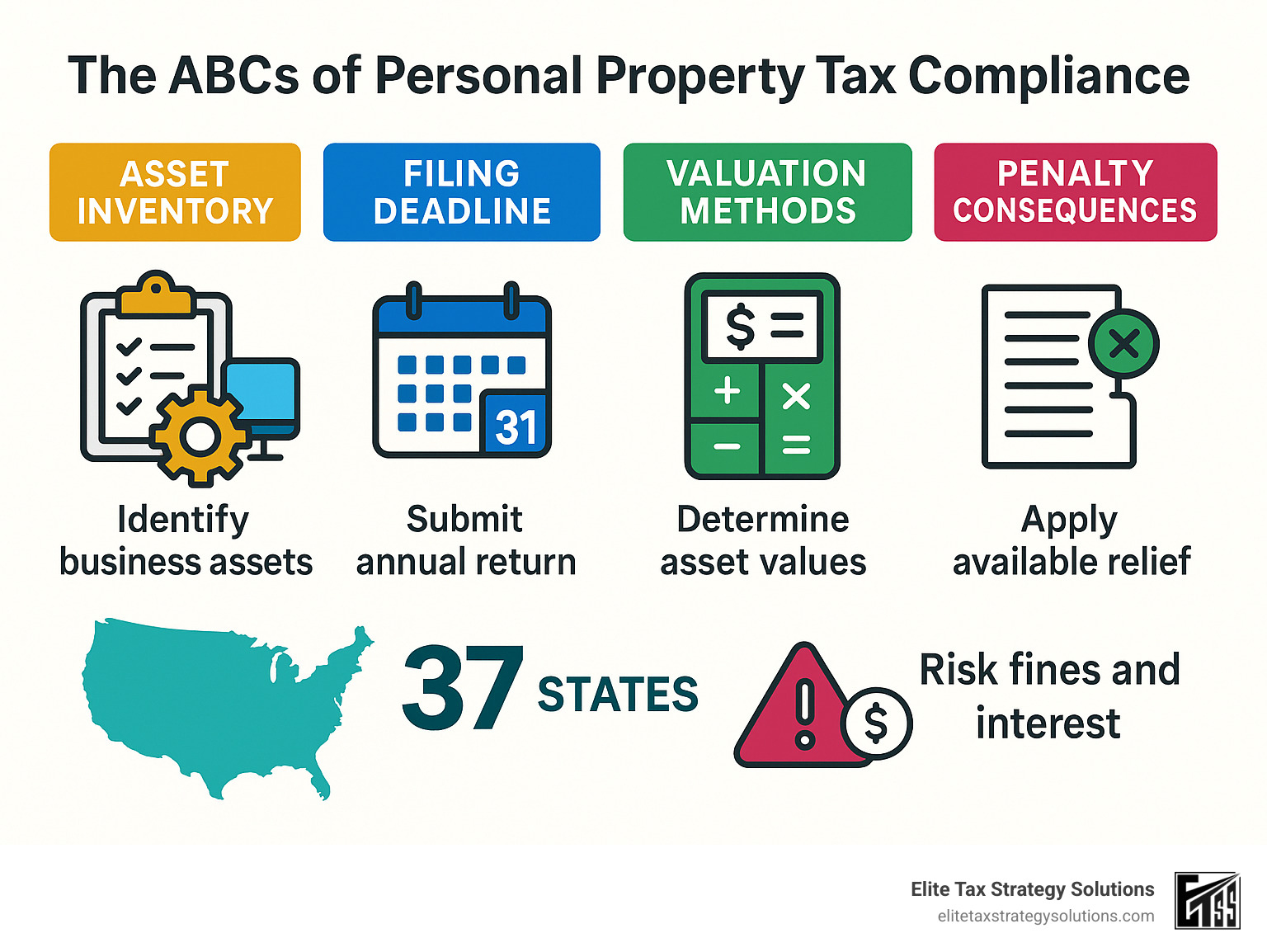
– Where it applies: 37 states plus DC tax business personal property; 13 also include inventory
– When to file: Annual returns due by jurisdiction-specific deadlines (often January 31)
– Key risk: Late filing can increase total tax cost by 10% or more due to penalties and interest
– Best practice: Maintain detailed asset records and file early to avoid mail delays
Personal property tax isn’t just about real estate. If your business owns valuable equipment, computers, or machinery, you likely have filing obligations that vary dramatically by location.
Missing deadlines is costly. Penalties range from 5% to 25% of unpaid tax, and some states like Missouri charge 1% monthly interest with annual penalties up to 18%. Even worse, unpaid taxes can result in liens on your property or asset seizure.
The good news? With proper planning and systems, personal property tax compliance becomes manageable. This guide will show you exactly how to stay compliant while minimizing your tax burden.
I’m David Fritch, and I’ve spent 40 years helping business owners steer complex tax obligations including personal property tax compliance through my CPA practice and law firm. My experience with high-income earners and small business owners has shown me that proactive tax planning, including proper personal property tax management, is essential for long-term financial success.
Personal property tax compliance glossary:
– business tax compliance
– irs tax compliance
– tax compliance audit
Mastering Personal Property Tax Compliance Basics
Think of personal property tax compliance as dealing with everything in your business that you could theoretically pack up and move to a new location. Unlike real estate taxes on your building or land, personal property tax covers all those movable assets that keep your business running day to day.
The basics are straightforward once you understand the key concepts. Every year, usually on January 1st (called the “lien date”), tax assessors take a snapshot of what business property you own and where it’s located. This taxable situs – fancy tax speak for “where your stuff sits” – determines which local government gets to tax your assets.
Assessors use depreciation schedules and cost manuals like Marshall & Swift to figure out what your property is worth today. They start with what you paid originally, then apply depreciation rates based on the asset’s age and expected useful life.
The whole process hinges on the cost approach to valuation. Unlike your home, which gets valued based on what similar houses sold for, business personal property gets valued by working backwards from its original cost and accounting for wear, tear, and obsolescence.
| Personal Property | Real Property |
|---|---|
| Movable assets (computers, machinery, furniture) | Land and permanently attached buildings |
| Must file annual returns with asset details | Assessed automatically by tax office |
| Valued using cost approach with depreciation | Valued using market comparisons |
| Owner responsible for reporting | Assessor handles most of the process |
Personal Property Tax Compliance vs. Real Property Tax
The difference between personal and real property taxes might seem obvious, but the classification rules can surprise you. That expensive piece of equipment bolted to your factory floor? Still personal property if you can unbolt it without damaging the building. But those built-in cabinets in your office? They’re likely considered real property because removing them would damage the structure.
Movable assets are the heart of personal property taxation. Your desk, computer, manufacturing equipment, and company vehicles all fall into this category. The key test is whether you could reasonably relocate the item to a different building without major reconstruction work.
Land and buildings follow completely different rules. Your local assessor handles real property valuations, typically comparing your property to recent sales of similar properties in the area. You might get a notice in the mail, but you don’t usually need to file detailed paperwork listing every room and fixture.
The assessment basis creates the biggest practical difference. With real property, you mostly wait to see what the assessor decides your building is worth. With personal property, you’re actively involved in the process – filing returns, listing assets, providing purchase dates and costs, and calculating depreciation.
Key Assets Subject to Personal Property Tax Compliance
Your business probably owns more taxable personal property than you realize. The machinery and equipment category covers everything from manufacturing equipment down to specialized tools and even that expensive coffee machine in the break room (though most jurisdictions have minimum value thresholds that exclude small items).
Computers and technology represent a growing portion of most businesses’ personal property tax burden. Servers, laptops, tablets, printers, and telecommunications equipment all count. The good news? Technology typically depreciates faster than other assets, so that expensive server from three years ago might have a much lower taxable value today.
Don’t overlook furniture and fixtures – desks, chairs, filing cabinets, and movable lighting all add up. The trick is distinguishing between fixtures you can remove (taxable personal property) and those permanently installed (real property).
Business vehicles create their own complexity. Some states handle these through separate motor vehicle taxes, while others include them in personal property assessments. Check your local rules to avoid double-filing.
Inventory rules vary dramatically by state and can significantly impact your tax bill. Only thirteen states include business inventory in personal property assessments, but if you’re in one of them, raw materials, work-in-progress, and finished goods on hand during the lien date all count as taxable property.
Navigating the Jurisdictional Maze
If you think personal property tax compliance is complicated in one location, try managing it across multiple states. Thirty-seven states plus the District of Columbia tax business personal property, and each one follows a different rulebook.
Counties and cities pile on their own requirements, turning those 37 systems into thousands of distinct forms, deadlines, and penalty structures.
In Texas, for instance, 254 counties maintain separate depreciation schedules. A server might have a 10-year life in Dallas County but only seven years in neighboring Tarrant County.
Deadlines vary widely. Many states use January 31, but others don’t; some accept electronic filings, while others insist on paper returns delivered by 5:00 PM. Miss the window and penalties—often 10 % – 25 %—apply immediately.
Certain counties in Idaho, New Mexico, and Rhode Island reject standardized state forms, forcing you to locate local paperwork.
Inventory rules add complexity. Only 13 states tax inventory, so manufacturers and retailers must track stock on each assessment date in those locations.
Download our 2023 guide for a detailed state-by-state breakdown.
Which States Tax What?
Knowing each state’s scope can save you serious money. Arizona assumes everything is taxable unless you prove otherwise. Nevada exempts inventories and intangibles but still taxes equipment and leasehold improvements. Texas combines its 254 county schedules with inventory reporting but exempts computer software. North Carolina does the reverse—no inventory tax, but it does assess software.
Common Exemptions & Deductions
Most jurisdictions offer valuable relief—provided you claim it:
- De minimis thresholds: low-value items (often $500–$5,000) are excluded.
- In-transit inventory: goods merely passing through may be fully exempt.
- Pollution-control equipment: frequently receives special incentives.
- Veterans’ exemptions: can reduce or eliminate liability for qualifying owners.
- Installation, freight, and sales tax: sometimes excludable from the cost basis used for depreciation calculations.
The Personal Property Tax Compliance Lifecycle

Managing personal property tax compliance throughout the year follows a predictable rhythm, but each step requires careful attention to avoid costly mistakes.
The process starts with valuation methods. Most tax assessors use what’s called the cost approach, which sounds fancy but is actually straightforward. They take what you originally paid for each asset, then reduce that value based on how old it is and how long they think it should last.
Useful life tables are the assessor’s crystal ball for determining depreciation. Office furniture typically gets pegged at a 10-year useful life, while computers usually get 5-7 years before they’re considered worthless for tax purposes.
Return preparation is where the rubber meets the road. You’ll need to list every qualifying asset with its description, when you bought it, what you paid, and where it lives. Some jurisdictions want every stapler and desk lamp itemized, while others let you group similar items together.
Filing requirements are still largely stuck in the paper age. Despite living in a digital world, most jurisdictions want printed returns mailed the traditional way. No clicking “submit” at 11:59 PM like your income taxes – these need to be postmarked or physically delivered by the deadline.
Payment processing usually comes 30-60 days after filing, giving you time to budget for the bill. Some jurisdictions offer payment plans or early-payment discounts, which can be worth exploring if you’re managing cash flow carefully.
If you disagree with an assessment, the appeals process gives you a formal way to challenge it. But these have strict deadlines and specific evidence requirements.
Record retention is your insurance policy against future audits. Most jurisdictions can look back 3-4 years, so keeping detailed records isn’t just good practice – it’s essential protection.
Why Personal Property Tax Compliance Deadlines Matter
The lien date is the most important date you’ve probably never heard of. Usually January 1st, this is when assessors take a snapshot of what you own and where it’s located. Think of it as the tax equivalent of musical chairs – wherever your assets are sitting when the music stops is where they get taxed.
Filing windows are notoriously unforgiving. Unlike income taxes where extensions are common, personal property tax deadlines are typically set in stone. Miss the deadline, and you’re looking at immediate consequences.
Late fees can be brutal, ranging from 5% to 25% of your unpaid tax. Missouri is particularly aggressive, charging 1% monthly interest plus annual penalties that can hit 18%. These aren’t gentle nudges – they’re designed to get your attention fast.
Interest accrual often starts ticking the day after the deadline, even if you file just a few days late. Some jurisdictions are especially tough, charging interest from the original due date regardless of when you actually get your paperwork in.
The paper-based filing system creates its own deadline risks. Mail delays, missing signatures, or addressing errors can cause rejections that trigger late penalties even when you technically filed on time.
Technology & Automation Tools
Modern technology can transform personal property tax compliance from a paper-shuffling nightmare into a manageable process. Property tax management software centralizes everything – asset tracking, depreciation calculations, and compliance calendars across thousands of jurisdictions.
OCR technology can scan and extract data from tax bills automatically, eliminating hours of manual data entry and reducing the errors that come with typing numbers all day.
Automated dashboards give you a bird’s-eye view of all your compliance obligations. No more wondering if you missed a deadline in some obscure county – everything’s visible in one place with real-time status updates.
Audit logs maintained by compliance software create the paper trail you need if auditors come knocking. Every change to asset records gets tracked and stored, providing the detailed documentation that can make or break an audit defense.
Integration capabilities connect your property tax software with existing accounting systems, automatically updating asset records when equipment gets purchased, sold, or moved between locations.
For businesses juggling multiple locations and jurisdictions, these tools aren’t just convenient – they’re essential for maintaining accurate personal property tax compliance without drowning in paperwork.
More info about Tax Compliance Services
Reducing Liability & Avoiding Audits
The best defense against personal property tax compliance problems is a good offense. Smart businesses don’t just file their returns and hope for the best – they actively manage their liability and prepare for potential audits before they happen.
Ghost assets are probably costing you more money than you realize. These are assets that have been sold, scrapped, or donated but somehow keep appearing on your tax returns year after year. A manufacturing client of mine found they were paying taxes on equipment that had been sold in 2019 – they saved over $8,000 annually just by cleaning up their asset records.
Regular asset audits help eliminate these phantom tax bills. Walk through your facility at least once a year and compare what you actually see with what’s on your tax returns.
Obsolescence adjustments can dramatically reduce your tax burden when equipment isn’t performing like it used to. That printing press from 2015 might have cost $100,000 new, but if it now only runs at 60% capacity due to wear and technological changes, it shouldn’t be valued as if it’s still brand new.
Misclassification issues create unnecessary tax bills. Sometimes the same equipment gets counted twice – once as part of the building’s value and again on personal property returns. Other times, assets get placed in the wrong depreciation category, extending their taxable life beyond what’s reasonable.
Learn more about Tax Planning Strategies
Understanding audit triggers helps you avoid unwanted attention from assessors. Late filings are like waving a red flag – they immediately put you on the radar for potential audits. Significant changes in your asset listings without clear explanations also raise eyebrows, especially if those changes result in lower taxes.
Documentation standards don’t have to be complicated, but they need to be consistent. Keep your purchase invoices, disposal records, and any correspondence with assessors organized and easily accessible.
Proactive reviews of your compliance procedures can catch problems before assessors do. Compare your fixed asset ledger with your tax returns annually. Look for discrepancies, missing disposals, or classification errors.
Preparing for (and Surviving) an Audit
Personal property tax audits don’t have to be scary if you’re prepared. Most audits are triggered by obvious red flags that you can avoid with proper planning.
Late filings are the most common audit trigger. Assessors figure that if you can’t file on time, you probably aren’t paying close attention to accuracy either. Missing returns for multiple years practically guarantees an audit.
Asset shifts between locations or categories can also raise questions. If you move equipment from a high-tax county to a low-tax county, assessors want to make sure the equipment actually moved rather than just disappearing from the tax rolls.
Unsubstantiated exemptions are another major audit trigger. Claiming a veterans’ exemption without proper documentation, or applying inventory exemptions incorrectly, can result in both audits and penalties.
Defense files should be prepared before any audit notice arrives. For each major asset category, maintain organized documentation including purchase invoices, depreciation schedules, disposal records, and photographs showing current condition.
When an audit notice arrives, don’t panic. Most auditors are reasonable people doing their job. Respond promptly to document requests and be honest about any uncertainties.
Professional representation can be valuable, especially for complex valuations or when dealing with multiple jurisdictions.
Multi-State Best Practices
Managing personal property tax compliance across multiple states feels like juggling while riding a unicycle – it’s complicated, but definitely doable with the right systems.
A central calendar tracking all filing deadlines, payment due dates, and appeal windows is absolutely essential. Missing a deadline in one state while focused on another is an expensive mistake that’s easily preventable.
Standardized asset tags help track equipment across locations and ensure consistent reporting. Each asset should have a unique identifier linking to detailed records including acquisition cost, purchase date, location history, and current condition.
Expert reviews of your procedures can identify opportunities you’re missing and ensure compliance across all jurisdictions. What works in Texas might not work in Nevada, and keeping track of all the differences requires careful attention to detail.
Outsourcing considerations may make financial sense for businesses with complex multi-state obligations. Professional property tax services provide jurisdiction-specific expertise and often reduce overall costs compared to trying to manage everything internally.
Centralized record keeping ensures consistency across all jurisdictions while providing the detailed documentation needed for audits or appeals. Cloud-based systems allow access from multiple locations while maintaining security and backup capabilities.
Frequently Asked Questions about Personal Property Tax
What happens if I miss a filing deadline?
Penalties hit fast. Most jurisdictions impose 5 % – 25 % of the unpaid tax, and interest starts accruing from the original due date. In Missouri, interest builds at 1 % per month with annual penalties up to 18 %. Late filings also increase audit risk and can trigger liens or even business-license revocation. File early—mail delays and simple errors can prove costly.
How is the value of my equipment assessed?
Assessors rely on the cost approach: begin with your original cost (often including shipping and installation) and apply standardized depreciation tables. Because schedules differ—even between neighboring counties—identical equipment can have different taxable values. You may appeal by showing functional or economic obsolescence or unusual wear and tear.
Which assets are usually exempt?
Key savings opportunities include:
- De minimis rules excluding items below $500–$5,000
- Full or partial inventory exemptions (though 13 states still tax inventory); in-transit inventory often qualifies for relief
- Pollution-control equipment incentives
- Veterans’ exemptions for qualifying owners
- Potential exclusion of installation, freight, and sales tax from the asset’s taxable cost basis
Always clarify in lease agreements which party is responsible for personal property taxes on leased assets.
Conclusion
Managing personal property tax compliance effectively comes down to understanding the basics and putting the right systems in place. When you get this right, you’re not just avoiding penalties – you’re actually saving money through smart exemption strategies, accurate asset valuations, and thoughtful planning.
The truth is, most businesses leave money on the table simply because they don’t realize what opportunities exist. Ghost assets sitting on your books, unclaimed exemptions, and outdated valuations can cost you thousands in unnecessary taxes year after year.
At Elite Tax Strategy Solutions, we see personal property tax as one piece of a much larger puzzle. Our approach looks at your entire tax picture – from income tax optimization to strategic business planning – helping high earners and closely held businesses build comprehensive strategies that work together seamlessly.
The real benefits go beyond compliance. When you organize your asset records properly, you gain better visibility into what you actually own. This supports smarter financial decisions and creates audit-ready documentation that can save you hours of stress if questions ever come up.
Whether you handle compliance internally or work with professional advisors, investing in proper systems pays for itself quickly. The peace of mind alone is worth it, but the real value comes from lower taxes and reduced risk over time.
Ready to take control of your property tax strategy? We specialize in helping businesses create compliance systems that actually work – minimizing taxes while keeping you fully compliant across all jurisdictions where you operate.