Why Pass-Through Entity Tax Planning Is Critical for Your Financial Success
Pass-through entity tax planning is essential for high-income earners and business owners seeking to minimize their tax burden. A comprehensive strategy can help you avoid double taxation, maximize deductions, and leverage state-level workarounds to save thousands of dollars annually.
Key pass-through entity tax planning strategies include:
- Avoiding Double Taxation: Unlike C-corporations, pass-through entities are taxed only once at the owner level.
- PTET Elections: Using state-level pass-through entity taxes to bypass the $10,000 SALT deduction cap.
- Section 199A QBI Deduction: Claiming up to a 20% deduction on qualified business income (expires in 2025).
- Holding Company Structures: Protecting assets and enabling tax-efficient wealth transfer.
- Multi-State Planning: Navigating complex state regulations for optimal tax outcomes.
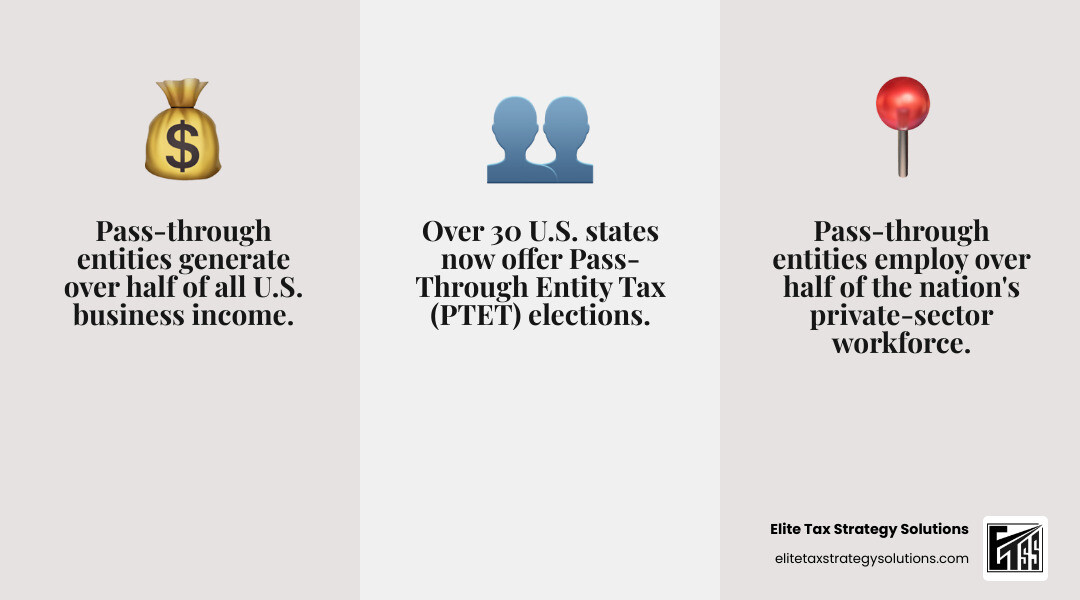
Pass-through entities generate more than half of all business income in the United States and employ more than half of the nation’s private-sector workforce. With over 30 states now offering pass-through entity tax elections, the opportunities for tax optimization are significant.
However, the complexity of these strategies requires expert guidance. State rules vary, and not all owners benefit equally from PTET elections. I’m David Fritch, and with 40 years of experience in tax planning and business management, I’ve helped countless clients implement pass-through entity tax planning strategies that reduce their tax burden while ensuring full compliance.
Understanding Pass-Through Entities: The Fundamentals
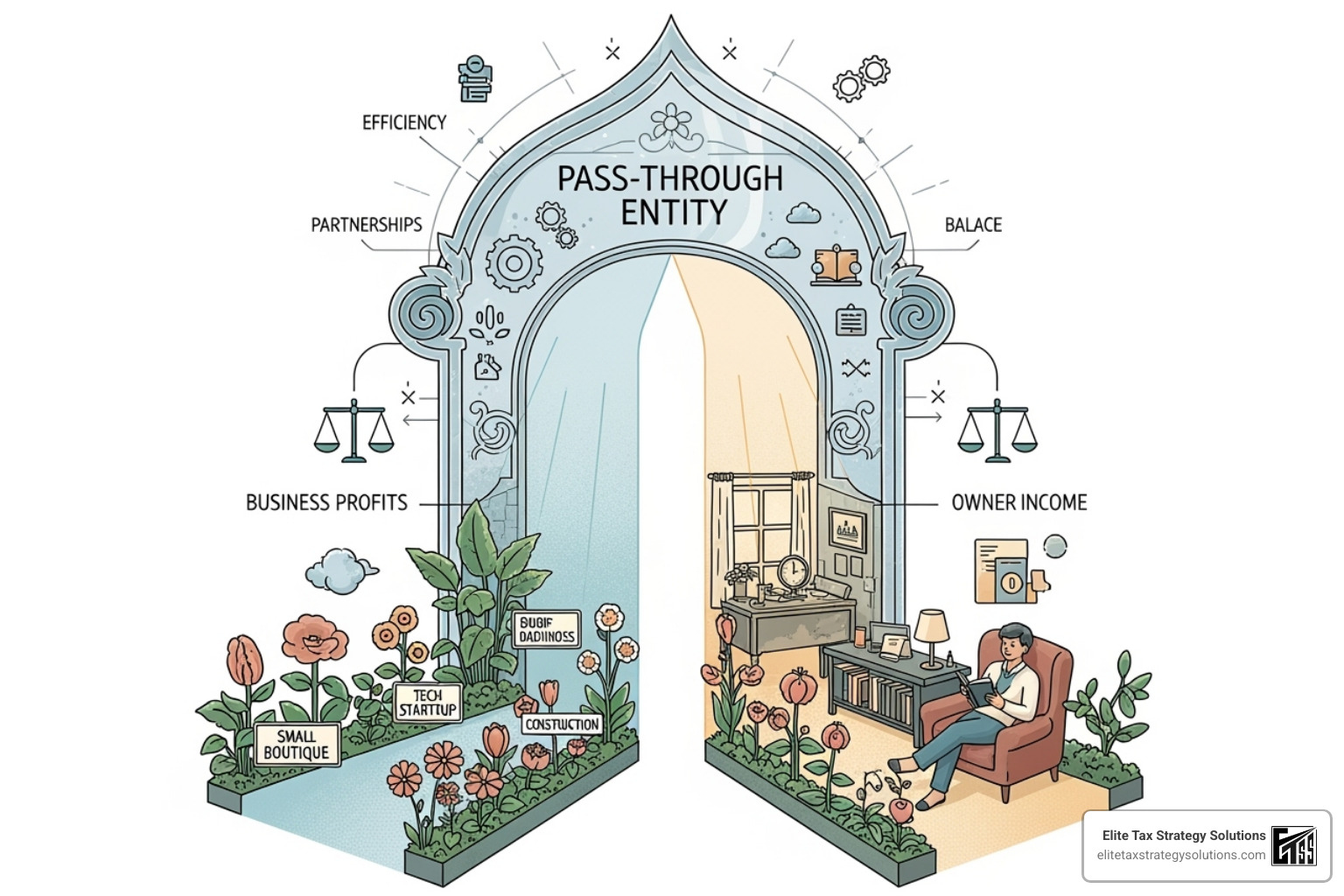
A pass-through entity acts as a financial pipeline. Instead of the business paying corporate income tax, it passes its income, losses, deductions, and credits directly to the owners’ personal tax returns. You simply report your share of the business results and pay taxes at your personal rates.
This structure avoids the double taxation faced by C-corporations, where profits are taxed first at the corporate level and again when distributed to shareholders as dividends. Pass-through entity tax planning helps you avoid this costly scenario.

The primary advantage of pass-through taxation is avoiding double taxation. Your business income is taxed just once on your personal return, which can mean significant savings.
Another benefit involves Net Operating Loss (NOL) deductions. When your pass-through entity has a loss, it flows to your personal tax return and can often be used to offset other income, potentially reducing your overall tax liability.
However, there are challenges. Phantom income occurs when the entity earns income but doesn’t distribute cash to owners, yet you are still taxed on your share of the profits. Additionally, owners of pass-through entities typically pay self-employment taxes on their earnings to cover Social Security and Medicare, an extra layer to the tax burden.
For deeper insights into how different business structures impact your tax strategy, explore our comprehensive guide on Business Tax Planning.
Common Types of Pass-Through Entities
The pass-through landscape offers several structures, each designed for different business needs. Understanding your options is key to effective pass-through entity tax planning.
- Sole Proprietorships: The simplest form for a single business owner. Income and expenses flow to your personal tax return (Schedule C). The main drawback is that there is no legal separation between you and the business, leaving personal assets vulnerable.
- Partnerships: Formed when two or more people operate a business. Profits and losses are divided among partners, who report their share (from a Schedule K-1) on their individual returns. Different types (GP, LP, LLP) offer varying levels of liability protection.
- S-Corporations: A hybrid structure providing limited liability protection with pass-through taxation. A key advantage is that owners can pay themselves a reasonable salary (subject to employment taxes) and take remaining profits as distributions, which avoid self-employment taxes.
- Limited Liability Companies (LLCs): Popular for their flexibility, combining corporate-style liability protection with partnership-style tax advantages. LLCs can elect various tax treatments, making them highly adaptable.
| Feature | Sole Proprietorship | Partnership | S-Corporation | LLC (Default) |
|---|---|---|---|---|
| Number of Owners | 1 | 2 or more | 1-100 | 1 or more |
| Liability Protection | None | Limited (LP, LLP) / None (GP) | Limited Liability | Limited Liability |
| Taxation | Owner’s Schedule C | Partner’s Schedule K-1 | Shareholder’s Schedule K-1 | Owner’s Schedule C (SMLLC) / Partner’s Schedule K-1 (MMLLC) |
| Self-Employment Tax | All Profits | All Profits (General Partners) | Salary Only | All Profits (Active Members) |
| Formalities | Few | Moderate | High | Moderate |
Choosing the right entity structure is the foundation of successful pass-through entity tax planning.
How LLC Taxation Works
LLCs are known for their tax flexibility. While providing legal liability protection, their tax classification is customizable.
- Single-member LLCs (SMLLCs) are treated as “disregarded entities” by the IRS. Income and expenses flow directly to the owner’s personal tax return (Schedule C), avoiding separate corporate filings.
- Multiple-member LLCs (MMLLCs) default to partnership taxation. The LLC files an informational return (Form 1065), and each member receives a Schedule K-1 to report their share of income and deductions on their personal returns.
The real power of an LLC comes from its ability to elect corporate tax status. Many LLCs choose S-corporation taxation (by filing Form 2553) to create pass-through entity tax planning opportunities, such as reducing self-employment taxes on distributions. Less commonly, an LLC can elect C-corporation taxation, which eliminates pass-through benefits but may be useful for retaining significant earnings for growth.
Understanding these distinctions helps optimize your LLC tax structure. For detailed guidance on S-corp strategies, explore our resource on Tax Planning for S Corporations.
The SALT Cap Workaround: A Deep Dive into Pass-Through Entity Tax (PTET)
The Tax Cuts and Jobs Act (TCJA) of 2017 introduced a major change for high earners in states like California and New York: the $10,000 cap on state and local tax (SALT) deductions. This meant individuals could no longer fully deduct their state income and property taxes on their federal returns.
In response, states developed the Pass-Through Entity Tax (PTET), a clever workaround that allows eligible pass-through entities to pay state income taxes at the business level.
Why is this critical for your pass-through entity tax planning? When a business pays state taxes at the entity level, those payments are treated as ordinary business expenses, fully deductible on the federal return. This effectively bypasses the $10,000 individual SALT cap, allowing a full deduction for state taxes paid by the business.
The IRS approved this approach in IRS Notice 2020-75, confirming that these entity-level state tax payments are deductible for federal purposes. This strategy has become one of the most powerful tools in modern pass-through entity tax planning. To explore how we implement these approaches, check out our insights on More on Advanced Tax Strategies.
How PTET Elections Work
The mechanics vary by state, but the core concept is simple. Your pass-through entity elects to pay state income tax at the business level. The entity pays the state, and you, as an owner, receive a credit on your personal state tax return.
Most states offer elective PTET programs, giving you the flexibility to participate each year. This entity-level tax payment reduces your business’s federal taxable income, which in turn lowers your personal federal tax bill. Meanwhile, the state credit typically covers your personal state tax liability.
The details are complex. States have different tax rates, eligibility rules, and election procedures. Some states require specific forms by certain deadlines, while others use estimated payments to trigger the election. The credit treatment for owners also differs—some are refundable, while others carry forward.
More than 30 states now offer a form of PTET. Connecticut was first in 2018, and states like California (9.3%), New York (up to 10.9%), and Illinois (4.95%) have followed. Keeping up with these constantly evolving rules is a full-time job, which is why expert guidance is essential to steer this complex landscape.
Key Considerations for Your Pass-Through Entity Tax Planning
PTET elections are not a one-size-fits-all solution. The primary advantage is bypassing the $10,000 SALT cap, which can lead to thousands in federal tax savings for high earners. There is also an Alternative Minimum Tax (AMT) benefit, as PTET payments are generally not subject to AMT limitations.
However, there are challenges and costs to consider:
- Compliance Burden: PTET adds a layer of complexity to tax filings, with state-specific rules, deadlines, and payment requirements, often leading to higher accounting fees.
- Calculation Complexities: Multi-state businesses or entities with complex ownership structures face daunting calculations. Errors can lead to penalties or missed opportunities.
- Overpayments and Refunds: A PTET refund paid to the business will likely be treated as taxable income for federal purposes, reducing the overall benefit. Excess credits at the owner level may not be refundable.
- Resident State Credits: If you live in a different state from where your business operates, your home state might not grant a credit for PTET paid to another state, potentially resulting in double taxation.
A thorough analysis is required before making a PTET election. The benefits can be substantial, but only if the strategy fits your specific situation. For more on managing these risks, explore our guide on More on Tax Risk Management.
Advanced Pass-Through Entity Tax Planning Strategies
Beyond the fundamentals, advanced pass-through entity tax planning can open up significant tax savings and long-term wealth-building opportunities. These strategies are like moving from checkers to chess, where every move is strategic.

Two of the most powerful advanced strategies are maximizing the Section 199A Qualified Business Income (QBI) deduction and implementing holding company structures. These approaches are particularly effective for high-net-worth individuals and closely held businesses looking to minimize current taxes and build a foundation for wealth preservation.
These advanced techniques actively optimize your entire financial structure. They often work together, creating a powerful one-two punch for tax optimization. For business owners who’ve built substantial wealth, these strategies are essential. To see how they fit into a comprehensive wealth strategy, check out our insights on More on High Net Worth Tax Strategies.
Maximizing the Section 199A Qualified Business Income (QBI) Deduction
The Section 199A deduction is one of the most valuable provisions for pass-through entity owners. It allows eligible individuals to deduct up to 20% of their qualified business income, plus 20% of qualified REIT dividends and publicly traded partnership income. It’s like getting a 20% discount on a large portion of your business income.
However, this deduction is set to expire on December 31, 2025. Unless Congress extends it, this tax break will disappear. We are working with clients now to maximize this benefit while it’s available.
The QBI deduction has complex rules. Income thresholds can limit the deduction based on factors like W-2 wages paid or the value of qualified property. The most significant limitation affects Specified Service Trade or Business (SSTB) owners—such as doctors, lawyers, and consultants—whose ability to claim the deduction is restricted or eliminated at higher income levels.
State conformity rules add another layer of complexity, as not all states recognize the federal QBI deduction. The key to maximizing this deduction is understanding these limitations and planning around them. With the 2025 expiration looming, it’s never been more important to optimize this strategy. Learn more about Maximizing Your Qualified Business Income (QBI) Deduction Before It Expires.
The Role of Holding Companies in Pass-Through Entity Tax Planning
A holding company, or “Holdco,” is a versatile tool in advanced pass-through entity tax planning. It doesn’t conduct daily operations but instead owns and manages assets like shares of your operating companies or real estate, creating a protective umbrella over your wealth.
- Asset Protection: A Holdco creates a legal barrier between your accumulated wealth and the operational risks of your active business. If your operating company faces a lawsuit, the assets held in the Holdco are generally protected.
- Tax-Efficient Investing: A Holdco can facilitate tax deferral by allowing you to reinvest earnings at corporate tax rates, which are often lower than top personal rates. This lets your money grow more efficiently until you need to distribute it.
- Intergenerational Wealth Transfer: For families planning for the next generation, holding companies excel at wealth transfer. Strategies like estate freezes can cap the value of your current holdings for estate tax purposes, allowing future growth to benefit your heirs.
- Income-Splitting: While rules have tightened, properly structured Holdcos can sometimes allow for income to be distributed to family members in lower tax brackets, provided certain requirements are met.
Implementing a holding company requires careful analysis of setup costs and ongoing compliance. But for the right client—particularly those with growing businesses and long-term wealth transfer goals—the benefits in asset protection, tax optimization, and estate planning can be immense. To explore how these structures might benefit you, learn more about More on Corporate Tax Planning.
Navigating Multi-State and Compliance Complexities
For businesses operating across multiple states, pass-through entity tax planning becomes exponentially more intricate. Each state has its own unique set of rules, creating a maze of compliance challenges.

Here are some of the multi-state challenges we help clients steer:
- Varying PTET Regulations: The rules for Pass-Through Entity Tax differ significantly from state to state. A one-size-fits-all strategy is not feasible.
- Nexus Issues: “Nexus” determines if your business has enough connection to a state to be subject to its taxes. This can be triggered by a physical presence, economic activity, or even remote sales.
- Apportionment of Income: States use different formulas (based on sales, payroll, and property) to determine how much of your business’s income is taxable within their borders.
- Credit for Taxes Paid to Other States: Most states offer a credit for income taxes paid to other states to prevent double taxation. However, this credit may not apply to entity-level PTET payments, which could lead to unintended tax consequences.
Managing these complexities requires a meticulous approach. We ensure our clients remain compliant while optimizing their tax positions across all jurisdictions. For comprehensive support, explore our Tax Compliance Services.
Best Practices for Managing PTET Compliance
Adopting best practices is essential for effective pass-through entity tax planning, especially in a multi-state context. It’s about being proactive, precise, and prepared.
- Accurate Record-Keeping: Meticulous records of income, expenses, and PTET elections for each state are foundational for accurate reporting and justifying deductions.
- Understanding Deadlines: States have strict deadlines for PTET elections and estimated payments. Missing these dates can mean forfeiting the benefits for that tax year.
- Planning for Estimated Payments: Proper calculation and planning of estimated PTET payments are crucial to avoid underpayment penalties.
- Seeking Professional Advice: The tax landscape is dynamic. A qualified tax professional can help determine eligibility, perform a cost-benefit analysis, ensure proper calculations, and identify other strategic opportunities.
- Proactive Tax Management: Don’t wait until year-end to think about taxes. Proactive management means consistently reviewing your financial situation throughout the year to identify opportunities and make timely adjustments.
By adhering to these best practices, we empower our clients to confidently steer the complexities of pass-through entity tax planning. Find out how our proactive approach can benefit you by visiting Proactive Tax Planning.
Frequently Asked Questions about Pass-Through Entity Tax Planning
These are common and important questions about pass-through entity tax planning. Here are clear, concise answers to the most frequent concerns.
What is the primary benefit of a pass-through entity?
The single biggest benefit is avoiding double taxation. Unlike a C-corporation, where profits are taxed at the corporate level and again when distributed to owners as dividends, a pass-through entity’s profits are taxed only once on the owners’ personal tax returns. This single layer of taxation can result in significant savings.
Is a PTET election always beneficial?
Not always. A PTET election can be highly beneficial, but its value depends on several factors. The decision requires a careful cost-benefit analysis. Key considerations include:
- Your individual tax situation, especially if you are already impacted by the $10,000 SALT cap.
- The specific rules and administrative burden of your state’s PTET program.
- Your entity’s income level, as higher-income entities typically see more benefit.
- Whether your resident state provides a credit for PTET paid to other states, to avoid potential double taxation.
Is the Section 199A QBI deduction permanent?
No, it is not. The Section 199A Qualified Business Income (QBI) deduction is set to expire on December 31, 2025. It was enacted as part of the Tax Cuts and Jobs Act of 2017 and includes a sunset provision.
This creates a limited window to maximize this powerful deduction, which can save up to 20% on qualified business income. While Congress could extend it, smart pass-through entity tax planning involves taking full advantage of the deduction while it is guaranteed to be available.
Conclusion
It’s clear that pass-through entity tax planning offers a wealth of opportunities to reduce your tax burden and secure your financial future. We’ve journeyed through the fundamentals, explored the clever PTET workaround for the SALT cap, and dived into advanced strategies that can save you thousands annually.
The versatility of pass-through entity tax planning is its greatest strength. Whether it’s using PTET to deduct state taxes, maximizing the Section 199A QBI deduction before it expires, or implementing holding companies for asset protection, these strategies can be custom to your unique situation.
However, the tax landscape is constantly shifting. State rules change and federal legislation evolves. The complexity of multi-state operations and intricate calculations makes this far from a DIY project. A cookie-cutter approach simply doesn’t work in the nuanced world of pass-through entities.
At Elite Tax Strategy Solutions, we’ve built our reputation on navigating these complex waters. Our thorough, proactive approach ensures that clients in Jasper, Indiana, and surrounding areas don’t just comply with tax laws—they thrive. We turn tax complexity into opportunity, helping you maximize savings while maintaining full compliance.
The key to success is not just understanding the rules, but knowing how to strategically apply them. We’re here to help you transform potential tax burdens into powerful strategic advantages.
Ready to open up the full potential of these strategies for your business? Don’t let another tax year pass without optimizing your position. Develop your innovative tax plan with us and find how much you could be saving.