Why Nonprofit Tax Compliance Matters for Your Organization
Nonprofit tax compliance is the process of meeting federal and state requirements to maintain your tax-exempt status. It involves accurate annual returns, proper financial management, and adherence to donation and payroll rules. Neglecting compliance can lead to penalties, loss of tax-exempt status, and a decline in donor confidence.
Quick compliance checklist for Canadian nonprofits:
- File annual returns: T3010 for charities or T1044 for qualifying NPOs.
- Register for GST/HST: Required if taxable revenue exceeds $50,000 annually.
- Keep records: Maintain financial documents for at least 6 years.
- Issue receipts correctly: Only registered charities can issue official donation receipts.
- Remit payroll deductions: Withhold and remit CPP, EI, and income tax for all employees.
Quick compliance checklist for U.S. nonprofits:
- File annual returns: Form 990, 990-EZ, or 990-N as applicable; file Form 990-T if you have unrelated business taxable income.
- Maintain state registrations: Register and renew charitable solicitation licenses where required before fundraising.
- Keep records: Retain books and records as required by the IRS and states; secure digital backups are acceptable if legible and accessible.
- Acknowledge contributions properly: Provide contemporaneous written acknowledgments for donations of $250 or more and make quid pro quo disclosures when a donor receives benefits.
- Remit payroll taxes: Withhold and remit Social Security, Medicare, and income tax; issue Forms W-2 to employees and 1099-NEC to applicable payees.
Across the U.S. and Canada, compliance frameworks share similarities but differ in key details. In Canada, over 170,000 nonprofits operate under specific CRA regulations. The key distinction is between a Non-Profit Organization (NPO) and a Registered Charity, which dictates filing obligations, receipting ability, and rebate eligibility. In the United States, the IRS oversees more than a million tax-exempt organizations that must meet federal and state requirements, including filing the Form 990 series. Common mistakes like late filing, incorrect GST/HST handling, or missing Form 990 filings can result in penalties or even revocation of status.
At Elite Tax Strategy Solutions, our experienced CPAs guide nonprofits through registration, annual filings, and CRA or IRS audits. We help you steer complex nonprofit tax compliance requirements in both the U.S. and Canada to protect your mission.
Simple nonprofit tax compliance glossary:
Step 1: Define Your Structure and Registration Path
Choosing your nonprofit structure is a foundational decision that impacts your nonprofit tax compliance obligations and fundraising capabilities. The first choice is whether to operate as a Non-Profit Organization (NPO) or a Registered Charity.
In Canada, nonprofits can be structured as corporations (federal or provincial), trusts, or unincorporated associations. A federally incorporated nonprofit is governed by The Canada Not-for-Profit Corporations Act. Regardless of structure, your activities must serve a public benefit, a key criterion for the Canada Revenue Agency (CRA), especially for charitable status. You can review their General Requirements for Charitable Registration for details. Getting this right is crucial for long-term Business Tax Compliance.

NPO vs. Registered Charity: Key Differences
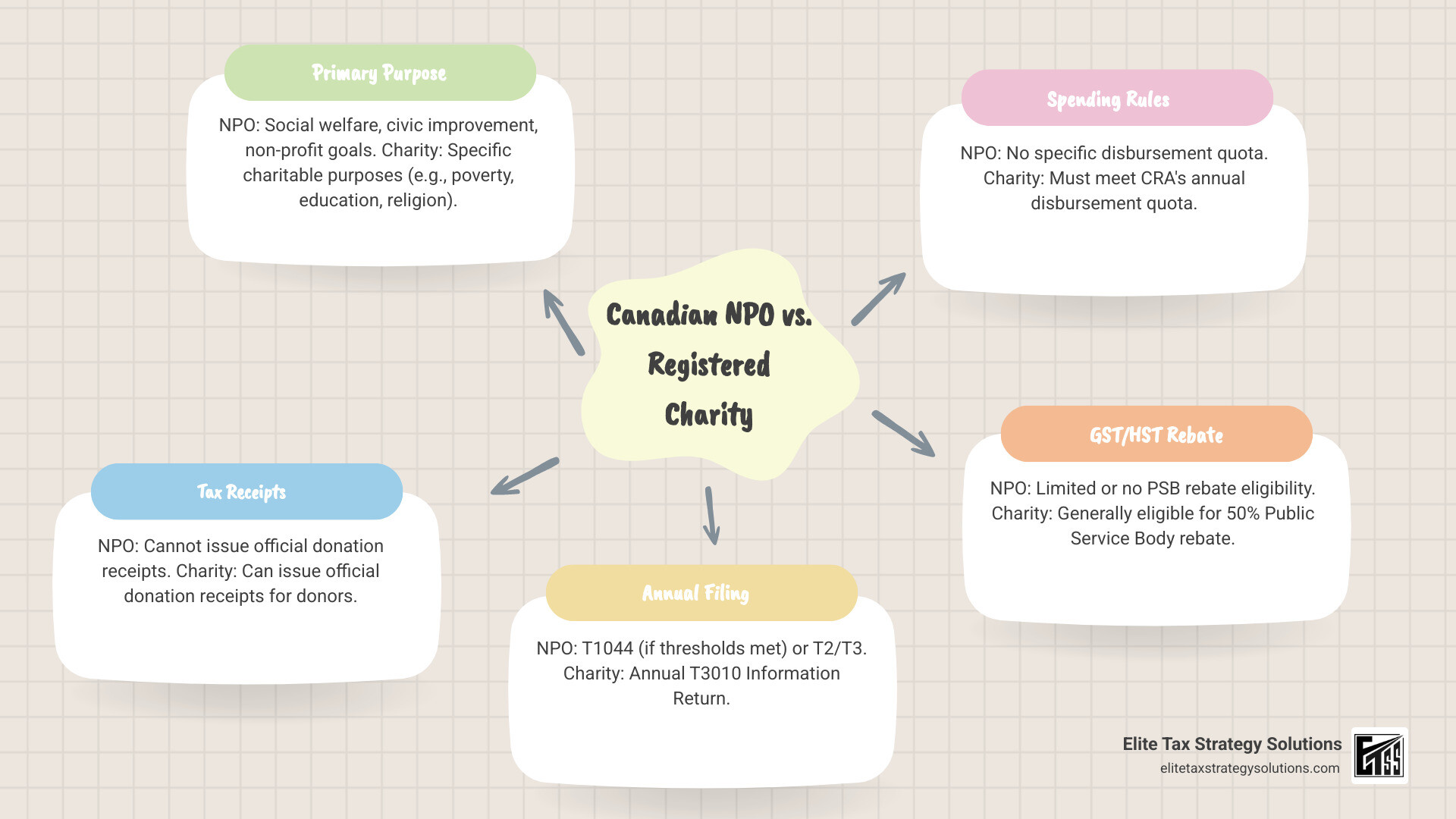
While both NPOs and Registered Charities serve the community, their operational rules differ significantly. The most critical distinction is that only Registered Charities can issue official donation receipts for tax credits. Charities must also have exclusively charitable purposes (e.g., relieving poverty, advancing education), while NPOs can have broader social, recreational, or civic goals.
Filing requirements also vary. Charities must file Form T3010 annually, which is public information. NPOs only file Form T1044 if assets exceed $200,000 or investment income tops $10,000. Furthermore, charities must meet a disbursement quota, ensuring they spend a minimum amount on charitable activities each year.
| Feature | Non-Profit Organization (NPO) | Registered Charity |
|---|---|---|
| Purpose | Social welfare, civic improvement, recreation, or any other non-profit purpose | Exclusively charitable: relief of poverty, advancement of education, advancement of religion, or other community benefit |
| Ability to Issue Tax Receipts | Cannot issue official donation receipts | Can issue official donation receipts, making them qualified donees |
| Annual Filing Requirements | Form T1044 only if assets exceed $200,000 or investment income exceeds $10,000 | Must file Form T3010 annually, regardless of size |
| Spending Requirements | No specific spending requirements | Must meet disbursement quota—minimum spending on charitable activities |
| GST/HST Rebate Eligibility | Generally eligible for 50% rebate on GST | Eligible for 50% rebate on GST and 82% on HST |
U.S. counterpart: 501(c) organizations and charitable status
- In the U.S., nonprofits typically incorporate at the state level as nonprofit corporations, then seek federal tax-exempt recognition with the IRS under section 501(c).
- Charitable organizations generally apply for 501(c)(3) status using Form 1023 or 1023-EZ; other common types include 501(c)(4), 501(c)(6), and more.
- Only donations to 501(c)(3) public charities and private foundations are tax-deductible for donors, and organizations must provide appropriate contribution acknowledgments.
- Annual federal reporting is through the Form 990 series (990, 990-EZ, 990-N, or 990-PF for private foundations), which is publicly available.
- There is no Canadian-style disbursement quota, but 501(c)(3) public charities must meet public support tests to maintain status.
How to Register Your Organization
Once you’ve chosen a structure, the registration process begins.
For NPO incorporation, you file articles of incorporation with either federal or provincial authorities, ensuring your governing documents state a non-profit purpose. NPOs are generally tax-exempt but must file a T1044 if they meet the financial thresholds.
Applying for charitable status is more involved. Your organization must be constituted exclusively for charitable purposes. The application requires Form T2050 (Application to Register a Charity under the Income Tax Act), governing documents, financial statements, and a detailed description of activities. The CRA review process can take several months. Once approved, you receive a registration number and can issue donation receipts.
Remember to check provincial registration requirements, as many provinces regulate fundraising and require separate corporate filings. Getting this foundational step right is key to solid nonprofit tax compliance.
Step 2: Master Your Annual Financial and Reporting Obligations
Strong nonprofit tax compliance is built on a foundation of solid financial management. Keeping your financial house in order makes annual reporting straightforward and demonstrates accountability to donors and the CRA. Good Accounting and Tax Compliance practices are essential.
Essential Record-Keeping Practices
The CRA requires meticulous record-keeping. Your records are your first line of defense in an audit and provide clarity on your financial health.
- Books and Records: Maintain accurate accounting records (ledgers, journals) for every transaction.
- Source Documents: Keep all supporting documents, including invoices, receipts, bank statements, and contracts.
- Donation Records: For charities, track donor names, addresses, dates, and amounts to support official donation receipts.
- Payroll Records: Document hours worked, wages paid, and all deductions and remittances to the CRA.
- Retention Period: The CRA requires you to keep records for at least six years from the end of the last tax year they relate to.
- Digital vs. Paper: Both are acceptable. Ensure digital records are secure, backed up, and can produce legible copies.
Annual Information Returns and Filing Deadlines for 2025
Missing filing deadlines can result in costly penalties. Here are the key federal returns for Canadian nonprofits.

- T3010, Registered Charity Information Return: All registered charities must file this public-facing return within six months of their fiscal year-end. For a December 31, 2024 year-end, the deadline is June 30, 2025.
- T1044, Non-Profit Organization Information Return: NPOs must file if their investment income exceeds $10,000, total assets exceed $200,000, or they have previously been required to file. The deadline is also six months after the fiscal year-end.
- T2 Corporation Income Tax Return: Some nonprofit corporations, particularly those with business activities, may need to file a T2 return. The deadline is six months after the corporation’s fiscal year-end.
- T3 Trust Income Tax and Information Return: Nonprofits structured as trusts must file a T3 return within 90 days of the trust’s year-end.
For U.S. organizations, similar annual reporting obligations apply.
- Form 990/990-EZ/990-N, Return of Organization Exempt From Income Tax: Due on the 15th day of the 5th month after fiscal year-end (e.g., May 15, 2025 for a December 31, 2024 year-end). Extensions are available via Form 8868.
- Form 990-T, Exempt Organization Business Income Tax Return: Required if you have $1,000 or more of gross unrelated business income; generally due when the Form 990 is due.
- State filings: Many states require annual corporate reports and separate charitable solicitation renewals. Deadlines vary by jurisdiction.
Staying on top of these obligations is crucial for maintaining smooth nonprofit tax compliance.
Step 3: Manage Ongoing Canadian Nonprofit Tax Compliance
Beyond annual filings, day-to-day nonprofit tax compliance involves managing a steady stream of obligations related to sales taxes, payroll, and fundraising. Our Tax Compliance Services help organizations build healthy habits for ongoing compliance.
GST/HST Registration, Collection, and Rebates
The Goods and Services Tax (GST) and Harmonized Sales Tax (HST) rules can be complex for nonprofits. While many activities are exempt, you must register for and collect GST/HST if your annual revenue from taxable supplies (goods or services) exceeds $50,000. This is known as the small supplier threshold.
The major benefit is the Public Service Body (PSB) Rebate, which allows you to recover a portion of the GST/HST you pay on expenses.
- Registered Charities can typically claim a 50% rebate on GST and an 82% rebate on the federal portion of HST.
- Qualifying NPOs may be eligible for a 50% rebate on GST paid.
This rebate can provide significant savings. For organizations selling online, our GST Compliance for E-commerce Operator resources offer specialized guidance.
U.S. state and local tax considerations
- Sales and use tax rules vary by state. Some states exempt nonprofits from sales tax on purchases, but many still require collection of sales tax on taxable goods or services sold.
- Register where required and monitor economic nexus thresholds for online sales across state lines.
- Property and other local tax exemptions are state- and locality-specific and often require separate applications.
Payroll and Compensation Compliance
Hiring employees introduces a new set of compliance duties. It’s critical to distinguish between employees and contractors, as misclassification can lead to penalties.
Key payroll obligations include:
- Registering a payroll account with the CRA immediately upon hiring.
- Deducting and remitting Canada Pension Plan (CPP) contributions, Employment Insurance (EI) premiums, and income tax.
- Issuing T4 slips to employees and T4A slips to contractors or other recipients by the end of February each year.
Be cautious with volunteer compensation. While you can reimburse expenses, providing stipends or honorariums may create an employment relationship, triggering payroll obligations. The principles of Multi-state Payroll Tax Compliance apply across jurisdictions, emphasizing the need for accuracy.
U.S. payroll essentials
- Obtain an EIN and set up payroll. Withhold and remit federal income tax and FICA (Social Security and Medicare).
- File Forms 941 quarterly and 940 annually if subject to FUTA; comply with state payroll tax filings.
- Issue Forms W-2 to employees and 1099-NEC to applicable contractors by January 31 each year.
- Apply proper worker classification based on IRS common-law factors.
Rules for Donations and Fundraising
The CRA closely monitors how donations are handled to protect the integrity of the tax system.
- Issuing Receipts: Only registered charities can issue official donation receipts that donors use for tax credits. NPOs cannot. The CRA maintains a public list of these qualified donees on its CRA website.
- Split-Receipting: If a donor receives a benefit (e.g., a gala ticket) in exchange for a donation, you must subtract the benefit’s fair market value from the donation amount on the receipt.
- Fundraising Costs: The CRA scrutinizes fundraising costs. If they consistently exceed 35% of donation revenue, it may trigger a review.
- Use of Funds: All funds donated to a charity must be used for its stated charitable purposes. Misusing funds can lead to severe penalties, including revocation of charitable status.
U.S. rules highlights
- Provide contemporaneous written acknowledgments for contributions of $250 or more and make quid pro quo disclosures when a donor receives a benefit in exchange for a payment over $75.
- Most states require charitable solicitation registration before fundraising from their residents, including online appeals.
- Funds must further exempt purposes; private inurement and excess benefit transactions are prohibited and can trigger excise taxes.
Step 4: Avoid Common Pitfalls and Severe Penalties
Even well-intentioned nonprofits can stumble into compliance issues. Most of these problems are preventable with proactive planning and an understanding of what to watch for.

A CRA audit doesn’t have to be a nightmare. With solid records and adherence to regulations, it’s a manageable process. Our Tax Compliance Audit expertise helps organizations steer these reviews with confidence.
Top 3 CRA Compliance Mistakes and How to Avoid Them
Three common, avoidable mistakes frequently trip up nonprofits:
- Failing to File or Filing Late: Many organizations forget deadlines or mistakenly assume they don’t need to file if activity was low. Solution: Treat filing deadlines as absolute. Use calendars, set reminders, or engage a professional to manage them.
- Incorrect GST/HST Handling: Organizations often fail to register when they cross the $50,000 taxable revenue threshold or miss out on valuable PSB rebates. Solution: Understand your GST/HST status, track taxable revenue, and carefully record GST/HST paid on expenses to maximize rebates.
- Improper Payroll Management: Common errors include misclassifying employees as contractors and failing to remit proper deductions. Solution: Correctly classify workers from the start, use CRA tools to calculate deductions, and remit them on time.
U.S.-specific pitfalls to watch
- Missing Form 990 filings: Failure to file a Form 990-series return for three consecutive years leads to automatic IRS revocation of tax-exempt status.
- UBIT issues: Underreporting unrelated business activities or missing Form 990-T can trigger tax, penalties, and interest.
- Donor acknowledgment errors: Incomplete or missing acknowledgments and quid pro quo disclosures can jeopardize donor deductions and raise audit risk.
Understanding the Rules on Political Activities
The CRA has specific rules to ensure nonprofits remain non-partisan.
- Registered Charities can engage in non-partisan political activities that further their charitable purpose. However, they are strictly prohibited from directly or indirectly supporting or opposing any political party or candidate. The CRA provides detailed CRA guidance on political activities.
- NPOs have more flexibility but their primary purpose must remain non-profit, not political.
U.S. rules are similarly strict for charities.
- 501(c)(3) organizations are absolutely prohibited from participating or intervening in any political campaign. Lobbying must be insubstantial unless the organization makes a 501(h) election to use expenditure tests.
- Other 501(c) entities (e.g., 501(c)(4)) have more latitude for lobbying and some political activity, but contributions are generally not tax-deductible.
Consequences of Non-Compliance
The consequences of poor nonprofit tax compliance can be severe and threaten your organization’s existence.
- Financial Penalties: These include late-filing penalties (e.g., $25/day for a T1044) and compounding interest on unpaid taxes.
- CRA Audits: Persistent non-compliance can trigger time-consuming and costly audits.
- Revocation of Charitable Status: For serious violations, the CRA can revoke a charity’s registration, ending its tax-exempt status and ability to issue donation receipts.
- Director Liability: Board members can be held personally liable for certain unpaid taxes, like payroll deductions.
- Loss of Public Trust: Compliance failures can damage your reputation with donors, funders, and the community, which is often the most devastating consequence.
- IRS actions (U.S.): Automatic revocation after three consecutive missed Form 990-series filings and potential excise taxes (intermediate sanctions) for excess benefit transactions.
Frequently Asked Questions about Nonprofit Tax Compliance
What happens if a nonprofit makes a profit?
A nonprofit making a “profit” or surplus is acceptable, but how that money is used is critical. For an NPO, any surplus must be reinvested into the organization’s non-profit objectives; it cannot be distributed to members for personal gain. For a registered charity, profits from a “related business”—an activity that directly supports its charitable purpose—are permissible as long as they are used to further the charity’s mission. In the U.S., tax-exempt organizations likewise must reinvest surpluses in exempt purposes and cannot inure benefits to insiders; income from unrelated activities may be subject to unrelated business income tax (UBIT) and reported on Form 990-T.
Can a nonprofit operate outside of its home country?
Yes, nonprofits can work internationally, but rules apply. For Canadian registered charities, a charity conducting foreign activities must maintain “direction and control” over its resources and projects, often through formal agreements with local partners. This ensures funds are used for purposes that meet Canadian charitable law. In the U.S., 501(c)(3) organizations must maintain control and discretion over grants and resources used abroad and may use approaches such as expenditure responsibility or equivalency determinations to document compliance.
What tax benefits are available to nonprofits?
Understanding and using available tax benefits is a key part of nonprofit tax compliance and financial stewardship. Key benefits include:
- Income Tax Exemption: Both NPOs and registered charities are generally exempt from paying federal income tax on their earnings. In the U.S., qualifying organizations recognized under section 501(c) are generally exempt from federal income tax.
- Property Tax Exemptions: Many municipalities and provinces (or U.S. states and localities) offer full or partial exemptions from property taxes for land and buildings used for non-profit purposes.
- GST/HST Rebates: Qualifying NPOs and registered charities can claim a Public Service Body (PSB) rebate to recover a significant portion of the GST/HST paid on expenses.
- Benefits for Donors (Charities Only): This is a major advantage for registered charities. They can issue official donation receipts, which provide individual donors with a tax credit and corporate donors with a tax deduction, incentivizing giving. In the U.S., donors to 501(c)(3) organizations may claim a charitable deduction subject to applicable limits.
Conclusion
Navigating nonprofit tax compliance—from structure and registration to annual filings and ongoing duties—requires diligence and commitment. But compliance is more than just avoiding penalties; it’s about building trust. Good governance, financial stewardship, and proactive compliance demonstrate to your donors, community, and the CRA that you manage your resources with integrity.
Maintaining your tax-exempt status is essential for your organization’s survival and effectiveness. It enables you to access tax benefits and, for charities, to issue the donation receipts that are vital for fundraising.
We know this can be overwhelming. At Elite Tax Strategy Solutions, our team specializes in the unique challenges nonprofits face. We provide expert guidance to help you manage these complexities with confidence, allowing you to focus on your mission. Whether you’re starting out, growing, or facing a specific challenge, professional support is a sound investment in your organization’s future.
Don’t let tax complexities distract you from your cause. Get expert tax support and compliance assistance from our experienced team. We’re ready to help you build a strong, compliant foundation.