The Growing Challenge of Multi-State Payroll
Remember when payroll was simple? Those days are quickly fading into the rearview mirror. As our workforce becomes increasingly mobile and distributed, businesses face a new reality: multi state payroll tax compliance has become one of the most challenging aspects of running a modern company.
So what exactly does this mean? Multi state payroll tax compliance refers to the process of correctly managing payroll taxes for employees who work across multiple states, including properly withholding, reporting, and remitting taxes to the appropriate jurisdictions. If you have employees working from different states or even just commuting across state lines, you’re in this boat.
The landscape has transformed dramatically in recent years. With 78% of employers believing hybrid work will become the norm within the next two years, the traditional model of everyone working under one roof in one tax jurisdiction is disappearing. Today’s reality often involves employees living in one state while working in another—or bouncing between multiple locations throughout the year.
Here’s what you need to know at a glance:
| Key Element | What You Need to Know |
|---|---|
| Nexus | The connection that creates a tax obligation in a state (physical presence, remote workers, or sales volume) |
| Withholding Requirements | Generally withhold for the state where work is performed, with exceptions for reciprocity agreements |
| Registration | Must register with each state’s tax authority before processing payroll |
| Compliance Challenges | Steer 7,400+ tax jurisdictions across the US with different rates, rules, and deadlines |
| Key Taxes | State income tax, unemployment insurance (SUTA), disability, paid family leave |
The stakes couldn’t be higher. Getting multi state payroll tax compliance wrong isn’t just an administrative headache—it can result in significant penalties, interest charges, and in severe cases, even potential criminal charges. Many states have become increasingly aggressive in enforcing their non-resident state income tax withholding rules, seeing this as an important revenue source.
I’ve seen this firsthand. I’m David Fritch, a CPA with over 40 years of experience helping small business owners steer complex tax regulations including multi state payroll tax compliance. Before establishing my practice focused on helping businesses optimize their tax strategies, I worked in Arthur Andersen’s tax department. Over the decades, I’ve watched this issue evolve from a niche concern to a mainstream challenge affecting businesses of all sizes.
As we dive deeper into this topic, you’ll gain a clear understanding of how to protect your business while ensuring your employees’ payroll taxes are handled correctly across state lines. If you’re already feeling overwhelmed, know that you’re not alone—and that there are solutions to make this manageable.
For those looking to expand their knowledge on related tax compliance areas, we offer detailed guidance on multi state sales tax compliance, IRS tax compliance, and tax compliance for companies.
Understanding Nexus: When Payroll Obligations Cross Borders
Let’s talk about “nexus” – the foundation of multi state payroll tax compliance. Think of nexus as the relationship between your business and a state that triggers tax obligations. It’s like crossing an invisible line that suddenly makes you accountable to that state’s tax laws.
As the American Payroll Association explains, “Nexus is a crucial concept in multi-state taxation. It refers to the minimum level of connection a business must have with a state before it becomes subject to that state’s tax laws.”
The nexus landscape has evolved dramatically in recent years. Traditionally, you needed a physical office or employees working in a state to create nexus. But the game changed significantly after the 2018 Supreme Court decision in South Dakota v. Wayfair.
While Wayfair primarily addressed sales tax, its ripple effects have touched all areas of taxation. The Court acknowledged that “an internet seller may be present in a state in a meaningful way without that presence being physical in the traditional sense of the term.”
Today, nexus can emerge through:
Physical presence – Your traditional offices, warehouses, and retail locations
Employee presence – Remote workers logging in from their home offices or sales teams traveling between states
Economic nexus – Reaching certain sales thresholds in a state (mainly affects sales tax but influences your overall tax strategy)
For payroll specifically, having just one employee working remotely in another state can create nexus and trigger withholding requirements. However, many states offer some breathing room through “de minimis thresholds” before requiring withholding.
Take New York, for instance. Their nexus threshold is 14 days in the state during a calendar year. Once your employee crosses that threshold, you need to start withholding New York state income tax.
Without carefully tracking where your employees work, you can easily stumble into non-compliance with state payroll tax obligations. This can lead to unexpected penalties, interest charges, and a lot of administrative headaches. In some cases, employees might face double taxation scenarios if you don’t get this right.
Regular Tax Compliance Audits can help you stay ahead of these complex requirements and avoid costly mistakes.
Triggering Events That Create Nexus
Several everyday business activities can trigger payroll tax nexus in a state. Let’s explore the most common ones:
Opening a physical office or location is the most straightforward nexus trigger. When you cut the ribbon on a new office, retail store, or warehouse, you’re essentially raising your hand and saying, “Hey state tax authorities, we’re here!” This typically creates nexus for all tax types, including payroll.
Employing remote workers has become perhaps the most common nexus trigger for modern businesses. When your employee works from their home office in another state, they typically create nexus for your company in that state. This requires you to register and withhold payroll taxes there.
I recently worked with a Massachusetts technology company that hired a talented software developer living in Connecticut. Despite having no physical office in Connecticut, the company needed to register with Connecticut’s Department of Revenue Services and withhold Connecticut income tax from the developer’s wages.
Business travel and temporary assignments can create unexpected nexus situations. Your employees who travel to other states for sales calls, client meetings, training sessions, or conferences may create nexus depending on how long they stay and what they’re doing there.
Inventory storage or fulfillment arrangements in other states can create nexus for various tax types. While this primarily affects sales tax, it can factor into overall nexus determinations that impact your payroll strategy.
Trade shows and temporary events participation can establish nexus if your activity exceeds the state’s threshold. Some states provide temporary exemptions specifically for trade shows, but these vary widely and often have strict limitations.

Reciprocity Agreements & Their Impact on Withholding
Reciprocity agreements are like friendly handshakes between neighboring states that make life easier for employees who live in one state but work in another. Currently, 17 states and Washington D.C. have these arrangements in place.
These agreements allow employees to request exemption from withholding in their work state, paying taxes only in their home state. This eliminates the hassle of filing nonresident tax returns and prevents potential double taxation.
For example, if Maria lives in Virginia but commutes to work in Washington, D.C., she can complete an exemption certificate to avoid D.C. withholding. Her employer would then only withhold Virginia income tax from her paycheck.
Here’s how reciprocity works in practice:
- The employee completes a nonresident withholding exemption certificate for their work state
- The employer stops withholding income tax for the work state
- The employer withholds income tax only for the employee’s home state
This streamlines payroll processing and tax filing for both you and your employees.
Some common reciprocity agreements include those between Arizona and California; Illinois and several neighboring states (Iowa, Kentucky, Michigan, Wisconsin); and the busy corridor between Maryland, Pennsylvania, Virginia, West Virginia, and Washington, D.C.
Reciprocity agreements only apply to state income tax withholding. They don’t affect other payroll taxes such as unemployment insurance, which generally follows different rules based on where the work is performed.
For employees working in states without reciprocity agreements, they may face income tax withholding in both states. Fortunately, most states provide a credit for taxes paid to other states to prevent true double taxation, though this requires additional tax filing steps for the employee.
At Elite Tax Strategy Solutions, we help businesses steer these complex interstate tax relationships through our Accounting and Tax Compliance services, ensuring you meet all your multi state payroll tax compliance obligations while minimizing administrative burden.
The Core State & Local Payroll Taxes Employers Must Master
When it comes to multi state payroll tax compliance, there’s a lot more to worry about than just federal taxes. Each state has its own unique tax requirements, creating a patchwork of regulations that can quickly become overwhelming.
Think of state payroll taxes as a buffet where you’re required to sample different dishes depending on where your employees work. And just like a buffet, some options are more appetizing than others!
State Income Tax
State income tax is the main course of your multi state payroll tax compliance meal. Here’s what you need to know:
Forty-one states plus DC collect state income tax from employees’ paychecks. However, nine states give their residents a break with no personal income tax: Alaska, Florida, Nevada, New Hampshire, South Dakota, Tennessee, Texas, Washington, and Wyoming. If all your employees work in these states, you’ve just simplified your payroll process significantly!
Among the states that do collect income tax, thirteen keep it simple with a flat rate—the same percentage regardless of how much employees earn. The rest use graduated rates that increase as income rises, similar to federal income tax brackets.
The golden rule for withholding is usually to withhold for the state where work is physically performed. But like any good rule, there are exceptions:
Those reciprocity agreements we discussed earlier can change the equation. So can “convenience of employer” rules in states like New York and Connecticut, which may require withholding based on the employer’s location rather than where the employee works remotely.
“The pandemic created a whole new layer of complexity,” notes David Fritch, CPA. “Many states implemented temporary rules for remote workers that may still be affecting some businesses today.”
State Unemployment Insurance (SUTA)
Unlike income tax which comes out of employees’ pockets, unemployment insurance primarily hits the employer’s wallet (except in Alaska, New Jersey, and Pennsylvania, where employees chip in too).
SUTA is truly a state-by-state affair, with each jurisdiction setting its own:
- Tax rates (often based on your company’s layoff history)
- Taxable wage bases (ranging from as low as $7,000 to over $50,000 per employee)
- Filing deadlines and payment methods
For businesses with employees in multiple states, determining where to pay SUTA requires following a four-factor test in sequence:
- Where is the work primarily performed?
- Where is the employee’s base of operations?
- Where do you direct and control the employee?
- Where does the employee live?
Once one of these questions yields a clear answer, that’s your SUTA state—no need to continue down the list.

Local Income Taxes
Just when you thought you had state taxes figured out, here come the local taxes! Many municipalities impose their own income taxes on top of state requirements.
Ohio takes the crown for local tax complexity with over 600 different local tax jurisdictions. Pennsylvania, New York, Michigan, Kentucky, Alabama, and Missouri also have significant local income tax requirements in major cities like Philadelphia, New York City, Detroit, and St. Louis.
These local taxes create what I like to call “tax nesting dolls”—layers within layers of compliance requirements. For each employee, you’re potentially dealing with federal, state, and local withholding obligations, each with their own rates, forms, and deadlines.
Disability Insurance and Paid Family Leave
Several states require employers to provide short-term disability insurance coverage. California, Hawaii, New Jersey, New York, Rhode Island, and Puerto Rico all mandate these programs, which may require contributions from employers, employees, or both.
Meanwhile, paid family and medical leave programs have been gaining momentum across the country. California, Colorado, Connecticut, Massachusetts, New Jersey, New York, Oregon, Rhode Island, and Washington have all implemented PFML programs with their own unique funding mechanisms and benefit structures.
“Temporary disability insurance programs often surprise employers expanding into new states,” says David Fritch. “They’re not technically ‘taxes’ but function similarly from a payroll perspective, requiring withholding and remittance to state agencies.” You can learn more about temporary disability requirements by state.
Special Programs That Surprise Multi-State Employers
Just when you think you’ve mastered the basics, states and localities throw curveballs in the form of special tax programs that can catch even experienced payroll professionals off guard.
New York employers in the Metropolitan Commuter Transportation District face the Metropolitan Commuter Transportation Mobility Tax (MCTMT)—a mouthful of a tax that applies to employers with quarterly payroll over $312,500. The rate ranges from 0.11% to 0.34% of payroll.
In Oregon, transit districts add another layer of complexity. The TriMet district around Portland charges employers 0.7937% of wages, while the Lane Transit District near Eugene collects 0.77%.
San Francisco employers face additional burdens with the city’s Gross Receipts Tax and Business Registration Fee, both partially based on payroll expenses.
Washington and Massachusetts have particularly unique approaches to their Paid Family and Medical Leave programs, requiring specific contribution splits between employers and employees. Washington’s total premium rate is 0.6% of wages, with employers paying 36.67% and employees covering 63.33%.
These special programs often operate under separate departments from regular payroll taxes, making them easy to miss during your initial multi state payroll tax compliance setup. Each comes with its own registration process, reporting requirements, and payment schedules.
The complexity of these various tax programs is precisely why many businesses seek expert guidance when expanding their operations across state lines. A Tax Compliance Audit can help identify gaps in your current processes before they become costly problems.
While multi state payroll tax compliance may seem overwhelming, breaking it down by tax type and jurisdiction makes it manageable. With proper systems and expertise, you can steer these complex requirements while avoiding penalties and keeping your employees happy.
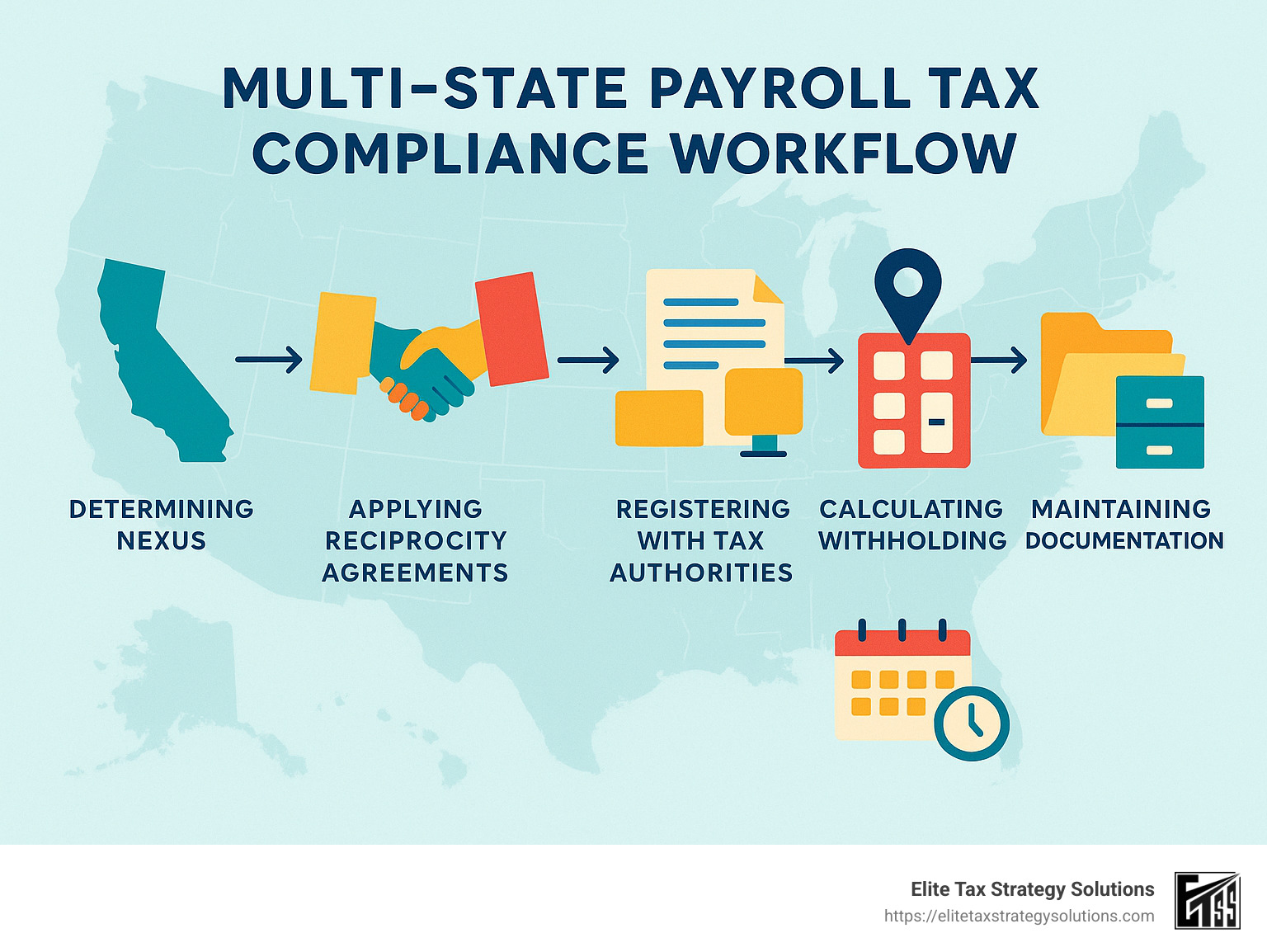
Multi State Payroll Tax Compliance Step-By-Step Process
Managing payroll across multiple states doesn’t have to feel like solving a Rubik’s cube blindfolded. With a systematic approach, you can steer the complexities of multi state payroll tax compliance and keep your business penalty-free. Let’s break down this process into manageable steps that will help you stay on track.
Step 1: Register with State Tax Authorities
Before you can withhold a single dollar, you need to establish your business’s legal identity with each state where you have employees. This registration process is your official “hello” to state tax authorities.
“Step 1 – Register: Enroll with each state’s tax authority where employees work and obtain withholding IDs,” advises Apryl Worden, a payroll compliance expert. “This is a critical first step that many employers overlook or delay, which can lead to significant penalties.”
The registration typically involves obtaining a state employer identification number (SEIN), signing up for income tax withholding, unemployment insurance, and any state-specific programs like disability or paid family leave. Think of it as getting your business’s passport for each state – without it, you can’t legally operate there.
Some states make this easy with online portals and unified registration systems, while others (bless their hearts) still require separate paper forms for different tax types. Either way, this foundation step cannot be skipped or postponed.
Step 2: Determine Withholding Requirements
Now comes the detective work – figuring out exactly which taxes apply to each employee. This isn’t just about knowing where your employees live, but understanding the complex web of rules that determine where taxes should be withheld.
You’ll need to identify each employee’s state of residence, where they physically perform their work, and then apply any relevant reciprocity agreements between states. Some employees might have withholding requirements in multiple states if they work across state lines regularly.
Remember those special thresholds we discussed earlier? This is where they come into play. An employee who spends just a few days working in New York might trigger withholding requirements there, while another state might have a more generous threshold.
Step 3: Calculate Withholding Amounts
With your withholding requirements mapped out, it’s time to calculate exactly how much to withhold. Each state has its own method for determining withholding amounts – some use wage bracket tables similar to federal withholding, others use percentage methods, and some (like Pennsylvania) simply apply a flat rate to all taxable wages.
You’ll need to obtain the current withholding tables or formulas for each applicable state. These change periodically, so make sure you’re working with up-to-date information. This is one area where good payroll software really earns its keep – trying to manually track all these different calculation methods across multiple states is a recipe for errors.
Step 4: Remit Taxes and File Returns
Now it’s time to actually send the money and file the required returns. Each state sets its own schedule for tax deposits and filings – these might be weekly, monthly, quarterly, or annually, often depending on your total tax liability.
Larger employers typically face more frequent filing requirements, while smaller businesses might qualify for quarterly or annual filing. Most states now require electronic filing and payment, though the thresholds and specific requirements vary.
“Payroll tax laws and regulations change frequently; however, a rapidly evolving regulatory environment is never a valid excuse for falling out of compliance.”
This quote highlights an important truth – staying on top of changing requirements is part of the job. Setting up calendar reminders for filing deadlines across all your states can help prevent costly missed deadlines.
Step 5: Maintain Comprehensive Records
Good recordkeeping isn’t just busywork – it’s your defense against audits and the foundation of accurate compliance. Most states require employers to retain payroll records for 3-6 years, including detailed information about employee residence and work locations, time and attendance records, wage payments, tax withholding documentation, and copies of all tax returns.
These records are your proof that you’ve done everything by the book. They’re also invaluable when responding to employee questions about their withholding or when preparing year-end tax documents.
Multi State Payroll Tax Compliance: Determining Where to Withhold
One of the trickiest aspects of multi state payroll tax compliance is figuring out exactly where to withhold taxes, especially for employees who work remotely or travel for business.
The Residence vs. Work Location Question
The general rule seems simple: withhold taxes for the state where the employee physically performs their work, not where they live. But like many “simple” rules in taxation, this one comes with a laundry list of exceptions:
Reciprocity agreements can flip this rule on its head, allowing withholding based on where employees live rather than where they work. For employees crossing state lines daily, these agreements can be a huge relief.
Some states aren’t content to let remote work reduce their tax base. New York, Connecticut, Delaware, Nebraska, and Pennsylvania apply “convenience of employer” rules. If an employee works remotely for their own convenience (rather than because the employer requires it), these states may still demand withholding as if the employee were physically working at the employer’s location.
For employees who work in multiple states without reciprocity agreements, you’ll need to split their wages based on time spent in each location. This requires meticulous tracking of where work is performed.
Example: Consider a salesperson based in Ohio who spends 60% of their time working in Ohio, 30% in Michigan, and 10% in Indiana. Since Ohio and Indiana have reciprocity, you wouldn’t need to withhold Indiana taxes. But you would need to withhold Michigan taxes on 30% of their wages, with the remaining 70% subject to Ohio withholding.
Tracking Employee Locations
Accurate location tracking is the backbone of proper withholding. Businesses use various approaches:
Employee self-reporting through time-tracking systems provides a straightforward method, though it relies on employees consistently recording their locations.
Advanced payroll systems now offer geocoding technology that can precisely map employees to their tax jurisdictions – particularly useful for businesses with many traveling employees.
Clear written policies requiring employees to notify payroll of any work location changes can prevent surprises at tax time.
“Ask remote employees to self-identify their work locations to determine withholding jurisdictions,” recommends the Federation of Tax Administrators. This simple step can prevent significant compliance issues down the road.
For businesses with employees working across state lines, we at Elite Tax Strategy Solutions can help determine the correct withholding jurisdictions and implement systems to track changing work locations. Learn more about our Accounting and Tax Compliance services.
Multi State Payroll Tax Compliance: Calculating, Remitting & Reporting
Once you’ve mapped out where to withhold taxes, you need to calculate the correct amounts, send the money to the right places, and document everything properly.
Calculating Withholding
Each state has developed its own unique approach to calculating income tax withholding:
Some states provide wage bracket tables that show exactly how much to withhold based on wages, pay period, and filing status – similar to the federal system most payroll professionals are familiar with.
Other states prefer percentage methods, providing formulas that calculate withholding as a percentage of wages, often with adjustments for personal exemptions and deductions.
A few states keep it simple with flat rates – Pennsylvania, for example, applies a straightforward 3.07% to all taxable wages.
You’ll need to obtain current withholding tables and formulas for each state where you have employees. These change periodically as states update their tax laws, so staying current is essential.
Remitting Taxes
Just as each state has its own calculation methods, they also set their own schedules for tax payments:
Income tax withholding typically follows a schedule similar to federal employment taxes, with payment frequencies based on your tax liability. High-volume employers might need to remit taxes weekly, while smaller businesses might qualify for monthly or quarterly schedules.
Unemployment insurance is usually paid quarterly, though some states require monthly payments from larger employers.
Disability and paid family leave programs each have their own payment schedules that vary by state.
Most states now require electronic payment through their own systems, similar to the federal EFTPS (Electronic Federal Tax Payment System). The days of mailing checks are largely behind us, which improves efficiency but means you need access to each state’s payment portal.
Reporting Requirements
Regular reporting keeps state tax authorities informed about your withholding activities:
Most states require quarterly reports detailing wages paid and taxes withheld for both income tax and unemployment insurance purposes.
Year-end reconciliation reports summarize the year’s withholding and payments, ensuring everything balances out.
W-2 forms must include state wages and withholding information for each applicable state.
Beyond tax reporting, employers must also report new hires to each state where they have employees, typically within 20 days of the hire date.
Managing Multi-State Complexity
The variation in requirements across states creates a complex compliance landscape. For example:
California calculates withholding on a progressive scale with multiple tax brackets that change based on income level.
New York has different withholding tables for New York City residents, adding another layer to consider.
Ohio employers must steer withholding for over 600 local tax jurisdictions – a monumental task without specialized systems.
For all but the smallest employers, managing these requirements manually is virtually impossible. Most businesses rely on specialized payroll software or outsourced services to handle the calculations, payments, and reporting accurately.
At Elite Tax Strategy Solutions, we help businesses remit the funds correctly and on time, while implementing systems to ensure ongoing compliance with all applicable state and local payroll tax laws. Our expertise can help prevent costly penalties and interest charges while giving you peace of mind that your multi state payroll tax compliance is handled professionally.
Technology, Tools & Best Practices for Staying Ahead
Managing multi state payroll tax compliance has become significantly easier thanks to modern technology. With cloud-based payroll solutions growing at an impressive 9.8% compound annual growth rate from 2021 to 2028, it’s clear that businesses are embracing digital solutions to tackle their compliance challenges.
Think about it—just a decade ago, most businesses were manually tracking tax rates across dozens of jurisdictions and hoping they didn’t miss anything. Today, sophisticated software can handle these complexities automatically.
Leveraging Technology for Compliance
The right technology can transform your multi state payroll tax compliance from a constant headache into a streamlined process. Modern systems offer remarkable capabilities that were once unimaginable.
Automated tax calculations have become the norm in quality payroll systems. These intelligent platforms apply the correct tax rates based on where your employees work, eliminating the tedious task of manually tracking changing tax rates across multiple states and localities.
Many advanced systems now incorporate geospatial tax determination—essentially using mapping technology to pinpoint exactly which tax jurisdictions apply to each employee. This is particularly valuable if you have staff in states like Ohio or Pennsylvania, where you might need to steer hundreds of local tax authorities.
Perhaps the most valuable feature of modern payroll systems is their built-in compliance updates. Leading providers continuously refresh their systems with the latest tax rates, thresholds, and forms. This means your payroll remains compliant without requiring constant manual updates from your team.
When it comes to reporting, comprehensive multi-state capabilities help you track compliance across all your jurisdictions and identify potential issues before they result in penalties. You can generate the reports you need for each state with just a few clicks, rather than building them manually.
Employee self-service portals have also transformed how we manage changing work locations. These secure platforms allow employees to update their address and work location information themselves, ensuring accurate withholding even as circumstances change.

Best Practices for Multi-State Compliance
While technology is essential, it’s not the complete solution. Implementing solid best practices will help ensure your multi state payroll tax compliance stays on track.
Regular internal audits are worth their weight in gold. By periodically reviewing your payroll processes and withholding calculations, you can identify and correct issues before they become problems during a government audit. I’ve seen countless clients save thousands in potential penalties by catching errors during their own internal reviews.
Maintaining a comprehensive compliance calendar has saved many of my clients from costly missed deadlines. This calendar should track filing and payment due dates for all jurisdictions where you have employees. When tax agencies receive payments late, they’re typically quick to assess penalties and interest.
Employee location tracking has become increasingly important in our remote work world. Implement formal processes for employees to report changes in their work location, especially for those who work remotely or travel frequently. A simple monthly attestation can prevent major compliance headaches.
Staying current on legislative changes is crucial in the changing tax landscape. Consider subscribing to updates from state tax agencies and professional organizations to stay informed about changing requirements. What’s compliant today might not be tomorrow.
Regular training for your payroll and HR staff is an investment that pays dividends. The regulatory landscape changes constantly, and keeping your team informed is essential for maintaining compliance.
Thorough documentation of your compliance processes provides a safety net during audits. Document how you determine work locations, calculate withholding, and make tax payments. This documentation becomes invaluable when tax authorities come knocking with questions.

Choosing Software vs Outsourcing vs PEO
When it comes to managing multi state payroll tax compliance, businesses typically choose between three options: in-house software, outsourced payroll services, or a Professional Employer Organization (PEO).
In-house payroll software gives you direct control over your processes and potentially lower long-term costs. It also integrates well with your existing systems. However, this approach requires internal expertise, ongoing maintenance, and regular software updates. If you have a knowledgeable payroll team and relatively stable operations, this might be your best choice.
Outsourced payroll services provide access to specialized expertise and reduce your internal workload. Many providers also assume some compliance responsibility, giving you added peace of mind. The downside? You’ll have less direct control, may face communication challenges, and service quality varies widely between providers. This option works well for growing businesses that want to focus on their core operations rather than payroll complexities.
A Professional Employer Organization (PEO) offers a comprehensive solution that includes compliance, benefits, and HR services, along with shared liability for payroll taxes. This “all-in-one” approach comes at a higher cost and offers less flexibility, but it can be perfect for businesses that want to completely offload their HR and payroll functions.
Your ideal choice depends on several factors: your company size and growth plans, how geographically dispersed your employees are, your internal expertise and resources, budget constraints, and the complexity of your payroll needs.
At Elite Tax Strategy Solutions, we help businesses evaluate these options and select the approach that best fits their specific needs and goals. Our expertise in multi state payroll tax compliance guides you toward efficient, cost-effective solutions that grow with your business. Learn more about our Tax Compliance Services.
Recordkeeping & Data Hygiene Essentials
Good recordkeeping isn’t just a best practice—it’s a legal requirement for payroll tax compliance. Most states require employers to maintain payroll records for 3-6 years, though some have even longer retention periods.
Your essential records should include comprehensive employee information such as legal names and addresses, Social Security numbers, work locations, states of residence, withholding certificates, and documentation of work location changes. This information forms the foundation of accurate payroll tax calculations.
Detailed payroll data is equally important, including time and attendance records, wage payment documentation, tax withholding calculations, and copies of pay statements. These records demonstrate how you arrived at your tax calculations and can be crucial during an audit.
Keep copies of all tax filings and payments, including your state registration documents, tax returns and reports, payment confirmations, and any correspondence with tax agencies. This documentation creates an audit trail that protects your business.
Don’t forget to document your policies related to payroll and taxes, remote work arrangements, travel that affects work location, and your compliance processes. These policy documents help demonstrate your good-faith efforts to remain compliant with complex regulations.
Given that payroll records contain sensitive personal information, security is essential. Implement secure storage for both physical and digital records, establish appropriate access controls, use encryption for digital files (especially when transmitting data), maintain secure backups, and develop proper destruction policies for records that have exceeded retention requirements.
By maintaining comprehensive, secure records, you not only meet legal requirements but also position your business to successfully steer audits and address any compliance questions that arise. At Elite Tax Strategy Solutions, we help clients develop robust recordkeeping systems that protect their businesses while simplifying compliance. More info about Tax Compliance Services
Common Mistakes, Penalties & How to Avoid Them
Let’s face it – even the most diligent business owners can stumble when it comes to multi state payroll tax compliance. As someone who’s helped hundreds of businesses steer these complex waters, I’ve seen how easy it is to make costly mistakes.
Think of payroll tax compliance as a dance with different rules in each state – miss a step, and you might just step on the tax authority’s toes!
Common Compliance Mistakes
The road to payroll tax troubles is often paved with good intentions. One of the most frequent missteps I see is failing to register in all applicable states. Many business owners don’t realize that having just one remote employee working from their home in another state can trigger registration requirements. This fundamental oversight can lead to a cascade of compliance problems down the road.
Another common pitfall involves reciprocity agreements. These arrangements between neighboring states sound straightforward, but they only apply to specific state pairings and only cover income tax withholding – not unemployment or other taxes. I recently worked with a client who mistakenly believed that because Pennsylvania and New Jersey have reciprocity, they didn’t need to worry about New Jersey unemployment taxes for their Pennsylvania employees working in New Jersey. That misunderstanding led to some uncomfortable conversations with state authorities.
Local taxes are another frequent blind spot. While focusing on state-level compliance, it’s easy to overlook city and county income taxes, especially in states like Ohio with over 600 local tax jurisdictions! These local taxes can add up quickly and create significant liability if ignored.
Without proper systems to track where employees actually perform their work, many employers withhold for the wrong jurisdiction. This becomes particularly problematic with remote or traveling employees who may work from multiple locations throughout the year.
Each state maintains its own schedule for tax payments and returns. Keeping track of these varying deadlines across multiple states challenges even the most organized businesses. One missed deadline can trigger a cascade of penalties that quickly add up.
State and local tax laws change with alarming frequency. Staying current with these changes requires vigilance and often specialized knowledge. What was compliant last year may not be this year.
And let’s not forget about unemployment insurance obligations. Some employers focus primarily on income tax withholding and neglect their SUTA responsibilities, leading to penalties and increased tax rates that can impact your bottom line for years to come.
The most serious compliance failures involve blatant criminal fraud. The Financial Crimes Enforcement Network (FinCEN) has noted a “concerning increase in federal and state payroll tax evasion” in recent years, which has prompted increased enforcement actions nationwide.
Penalties and Consequences
The price of non-compliance varies by state but is never pleasant. Monetary penalties often include late filing charges (typically a percentage of tax due), separate late payment penalties, failure-to-register penalties, and negligence penalties for repeated non-compliance. These can quickly add up to thousands of dollars even for small employers.
Beyond penalties, most states charge interest on unpaid taxes, often at rates significantly higher than commercial interest rates. This means your tax debt grows larger the longer it remains unpaid.
What many business owners don’t realize is that in many states, “responsible persons” – owners, officers, or other decision-makers – can be held personally liable for unpaid payroll taxes. This means your personal assets could be at risk, even if your business is structured as a corporation or LLC.
In cases of willful non-compliance or fraud, criminal charges are possible. These situations can result in hefty fines and even imprisonment in extreme cases.
The business consequences extend beyond direct penalties. Non-compliance can lead to costly audits that disrupt your operations, damage to your business reputation, difficulty obtaining business licenses or contracts, and employee dissatisfaction that may lead to legal claims.
Risk Mitigation Strategies
The good news is that with proper planning, you can minimize these risks. Start by creating a detailed compliance calendar that tracks all registration, filing, and payment deadlines across every jurisdiction where you have employees. Set up automated reminders well in advance of these deadlines to avoid last-minute scrambles.
Conduct regular nexus reviews to identify any new tax obligations as your business grows and changes. This is especially important as employees relocate or begin working remotely – a trend that accelerated dramatically during the pandemic and continues today.
Internal payroll audits should be performed at least annually. These reviews should verify that you’re correctly determining work locations, properly applying reciprocity agreements, accurately calculating withholdings, and making timely tax payments and filings.
Don’t go it alone – work with tax professionals who specialize in multi state payroll tax compliance. Their expertise can help identify and address compliance gaps before they result in penalties. At Elite Tax Strategy Solutions, we’ve helped numerous businesses avoid costly mistakes through proactive planning and review.
Make sure your employees understand the importance of reporting their work locations accurately. A simple change in where an employee works can trigger new tax obligations, so establish clear policies for employees to notify payroll of any location changes.
Documentation is your friend in case of an audit. Maintain thorough records of how you determine withholding jurisdictions, calculate tax amounts, and track changing requirements. Good documentation can be your best defense if your compliance is ever questioned.
Risk Mitigation Checklist
To protect your business from multi-state payroll tax problems, ask yourself these essential questions:
Have we registered for payroll taxes in all states where we have employees? Are we tracking employee work locations effectively? Are we correctly applying reciprocity agreements? Have we identified all applicable local tax jurisdictions? Do we have a process to stay current with changing tax laws?
Also consider: Are we conducting regular internal payroll audits? Do we maintain comprehensive documentation of our compliance processes? Have we consulted with tax professionals about our multi-state obligations? Is our compliance calendar complete with all relevant deadlines? Are our employees educated about reporting work location changes?
By addressing each of these areas, you’ll significantly reduce your risk of non-compliance and the associated penalties. Prevention is always less expensive than correction when it comes to tax issues.
At Elite Tax Strategy Solutions, we offer comprehensive Tax Compliance Audit services to help identify and address potential compliance issues before they result in penalties. Our proactive approach can save you significant costs and headaches in the long run.
After all, when it comes to multi state payroll tax compliance, an ounce of prevention is worth far more than a pound of cure – especially when that “cure” involves penalties, interest, and potentially contentious interactions with state tax authorities.
Frequently Asked Questions about Multi-State Payroll
When does a traveling employee create nexus in another state?
If you’ve ever sent employees across state lines for business, you’ve probably wondered exactly when you need to start worrying about payroll taxes in that other state. The answer isn’t as straightforward as we might hope!
Each state sets its own threshold for when a traveling employee creates multi state payroll tax compliance obligations, and these rules vary significantly. Some states use specific day counts, while others look at economic factors like how much money your employee earned while working there.
Take New York, for instance – their threshold is just 14 days present in the state within a calendar year. Once your employee crosses that line, you’re on the hook for withholding New York state income tax. But if you send that same employee to Arizona, you have a much more generous 60-day threshold before withholding requirements kick in.
Other states have their own magic numbers:
– Hawaii gives you 20 days
– Illinois allows 30 days
– Maine sets the bar at just 12 days
And to keep things interesting, some states have no minimum threshold whatsoever – they want their cut from day one!
For businesses with traveling employees, I recommend these practical steps: keep detailed records of all employee travel by state, learn each state’s specific thresholds, register for withholding once those thresholds are met, and maintain thorough documentation for when the inevitable audit comes knocking.
How do reciprocity agreements prevent double withholding?
Nobody wants to pay taxes twice on the same income, and that’s exactly what reciprocity agreements help prevent. These arrangements between neighboring states create a simpler tax situation for employees who live in one state but work in another.
Here’s how these agreements work in everyday terms:
First, your employee completes a nonresident withholding exemption form for their work state. This is essentially them saying, “Hey, I don’t live here, so please don’t take state income tax from my paycheck.” Next, you as the employer stop withholding income tax for the work state and instead withhold only for your employee’s home state.
Let’s make this concrete with an example: Imagine Sarah lives in Pennsylvania but commutes to her job in New Jersey. Without reciprocity, she’d have taxes withheld for New Jersey and would need to file tax returns in both states. But thanks to the reciprocity agreement between these states, Sarah can complete New Jersey Form NJ-165 (Employee’s Certificate of Nonresidence in New Jersey), and you’ll withhold only Pennsylvania income tax from her paychecks.
Reciprocity agreements only apply to state income tax withholding – not unemployment taxes or other payroll taxes. They also only exist between specific states (typically neighbors), and they don’t automatically apply. Your employee must formally request the exemption through the proper documentation.
Which taxes apply to hybrid employees splitting time between home and HQ?
The pandemic has transformed how we work, with hybrid arrangements becoming the new normal for many companies. But this flexibility creates some interesting multi state payroll tax compliance puzzles, especially when home and headquarters are in different states.
For state income tax withholding, the general rule is that taxes are based on where the work is physically performed. If Jamie works three days at home in Connecticut and two days at your New York office, you’d ideally allocate their wages between those states accordingly. But – and it’s a big but – some states complicate things with “convenience of employer” rules.
New York, Connecticut, Delaware, Nebraska, and Pennsylvania all have some version of these rules, which essentially say: “If the employee could work at the office but chooses to work remotely for their own convenience, we’re still taxing that income as if they were physically in our state.” This creates potential double taxation situations that can be quite thorny.
Unemployment insurance is a bit more straightforward – it’s typically assigned to just one state based on a four-factor test: where the services are localized, the employee’s base of operations, where direction and control come from, and the employee’s residence. Unlike income tax, you generally don’t split SUTA between states.
Local taxes add another layer of complexity. Cities like Philadelphia, New York City, and the many municipalities in Ohio may impose their own income taxes based on residence or work location. These local taxes often follow different rules than their state-level counterparts.
For disability insurance and paid family leave programs, these generally follow the same state determination as unemployment insurance and may require contributions from both you and your employee.

The key to managing hybrid employee taxes is accurate tracking. Many of our clients at Elite Tax Strategy Solutions use time-tracking systems that record not just hours worked but also work locations. This documentation proves invaluable both for calculating proper withholding and for defending your decisions if you’re ever audited.
Hybrid work arrangements create unique compliance challenges, but with proper systems and expert guidance, these challenges are entirely manageable. The peace of mind that comes from knowing you’re handling multi state payroll tax compliance correctly is well worth the effort.
Conclusion
As we’ve explored throughout this guide, multi state payroll tax compliance presents real challenges for today’s businesses. But here’s the good news: with a thoughtful approach and the right resources, you can master these complexities and turn potential headaches into a strategic advantage for your growing business.
The modern workplace has transformed dramatically. Remote work, once an exception, has become commonplace. Employees now collaborate across state lines without a second thought. While this flexibility brings tremendous benefits, it also creates a maze of tax obligations that demand careful navigation.
Getting multi state payroll tax compliance right matters on multiple levels. Beyond avoiding the obvious penalties and interest charges, proper compliance builds trust with both your employees and tax authorities. Your team members appreciate receiving correct tax withholding that prevents surprises at tax time. Meanwhile, tax agencies take notice when businesses consistently meet their obligations professionally.
At Elite Tax Strategy Solutions, we’ve guided countless businesses through these complexities. We’ve seen how proactive compliance planning creates a foundation for confident expansion across state lines. Our approach isn’t just about checking boxes—it’s about building sustainable systems that grow with your business.
When you partner with us for your multi state payroll tax compliance needs, you gain access to:
- Comprehensive nexus studies that identify your specific obligations
- Expert assistance with registrations across new tax jurisdictions
- Thorough compliance reviews that catch potential issues before they become problems
- Strategic planning that optimizes your approach to multi-state operations
- Ongoing advisory services that keep you informed as requirements evolve
The rise of distributed workforces has fundamentally changed the payroll landscape. But remember—within these challenges lie opportunities. The ability to hire talent regardless of location gives you access to a broader talent pool. Flexible work arrangements boost employee satisfaction and retention. And with the right compliance foundation, you can expand your business confidently across state lines.
Multi state payroll tax compliance isn’t just about avoiding penalties—it’s about creating the infrastructure that supports your business growth and evolution. With Elite Tax Strategy Solutions as your partner, you can transform potential compliance headaches into strategic advantages that position your business for sustainable success.
We’d love to show you how our personalized approach to tax planning and compliance can benefit your specific situation. Learn more about our tax support and compliance services and find why businesses trust us as their guide through the complexities of multi-state operations.