
Why Understanding IRS Publication 535 Matters for Your Business
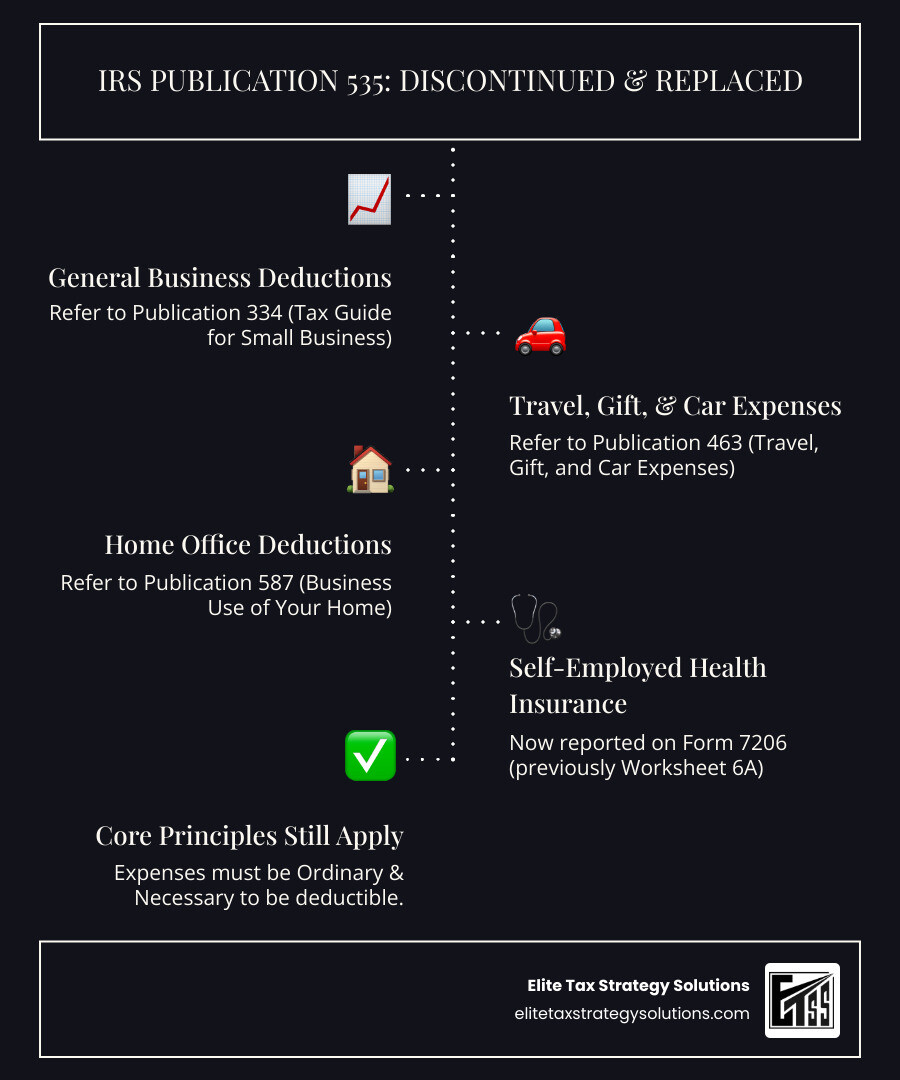
IRS Publication 535 was the IRS’s comprehensive guide to business expenses. However, as of tax year 2022, Publication 535 is no longer being updated. The IRS has replaced it with several targeted resources:
- For general business deductions: Use Publication 334 (Tax Guide for Small Business)
- For travel, gift, and car expenses: Use Publication 463
- For home office deductions: Use Publication 587
- Self-employed health insurance: Now use Form 7206 (previously Worksheet 6A)
The core principles from Publication 535 remain valid: business expenses must be both ordinary (common in your industry) and necessary (helpful for your business) to be deductible.
Though Publication 535 is discontinued, its core concepts are vital for maximizing legal tax deductions. Correctly categorizing expenses as deductible vs. capital, or choosing between cash and accrual accounting, can mean thousands in tax savings—or penalties if done wrong.
The stakes are high. Incorrectly deducting personal expenses can lead to disallowed deductions, accuracy-related penalties, interest, and even criminal charges for tax fraud. Proper documentation and understanding current IRS guidance is essential to avoid these risks.
I’m David Fritch. With 40 years of experience in my law firm and CPA practice, I’ve guided countless business owners through IRS Publication 535 and its successors to maximize deductions while ensuring compliance. At Elite Tax Strategy Solutions, I help high-income earners and small businesses implement advanced tax strategies that can save $40,000 or more annually.
Simple guide to irs publication 535:
What Happened to Publication 535 & Where to Find Guidance Now
The IRS officially stopped updating IRS Publication 535 after the 2022 tax year. The final 2022 Publication 535 is now a historical document. While it contains valuable foundational information, it doesn’t include tax law changes made after 2022.
The good news is the IRS replaced this single guide with several specialized publications, making it easier to find specific information. The most current resources are available on the IRS’s Guide to business expense resources page.
Notably, Worksheet 6A from the 2022 publication, used for the Self-Employed Health Insurance Deduction, is now a standalone document, Form 7206. This is one example of the IRS streamlining its guidance.
What Was the Purpose of IRS Publication 535?
For decades, IRS Publication 535 was the go-to guide for business expenses for sole proprietors, partnerships, and the self-employed. It was the rulebook explaining what could and couldn’t be deducted.
Its crucial role was to help business owners understand deduction rules to legally reduce taxable income while staying compliant. For our clients in Jasper, Indiana, and other suburban areas, it was an indispensable reference.
Key Replacement IRS Resources
The IRS has divided the old publication’s content into more focused, specialized guides. Each one digs deeper into specific topics, giving you more detailed information where you need it most.
Publication 334 (Tax Guide for Small Business) is the primary resource for general business tax information, especially for sole proprietors filing Schedule C. It covers filing requirements, payment options, and current rules for deductible expenses.
Publication 463 (Travel, Gift, and Car Expenses) provides detailed guidance on travel, meals, entertainment, gifts, and vehicle expenses. This is the guide for rules on mileage, client dinners, and documentation requirements, including the current standard mileage rate.
Publication 587 (Business Use of Your Home) is essential for the home office deduction. It explains the exclusive and regular use requirements, details the simplified and actual expense methods, and clarifies which home expenses are deductible.
Most sole proprietors report these expenses on Schedule C (Form 1040). Knowing which publication to consult saves research time and helps ensure you claim all legitimate deductions.
| Publication Title | Primary Focus | Who It’s For | Key Information Covered |
|---|---|---|---|
| Publication 334, Tax Guide for Small Business | General small business tax information | Sole proprietors, individuals using Schedule C | Filing requirements, payment options, current deductible expenses, general business operations. |
| Publication 463, Travel, Gift, and Car Expenses | Detailed guidance on specific expense categories | Businesses with travel, gift, or vehicle expenses | Rules for deducting travel, meals, entertainment, business gifts, and car expenses (including standard mileage rate). |
| Publication 587, Business Use of Your Home | Home office deductions | Individuals using part of their home for business | Requirements for exclusive and regular use, simplified vs. actual expense methods, specific deductible home expenses. |
The Golden Rules of Deductions: Core Principles
The two non-negotiable IRS requirements for any business deduction are that it must be both ordinary and necessary. These terms are the foundation of every legitimate deduction, originating from principles in IRS Publication 535. An expense must meet both criteria to be deductible.

Ordinary vs. Necessary Expenses Explained
An ordinary expense is one that is common and accepted in your specific industry. It doesn’t have to occur frequently, but it must be a standard expense for your type of business. For example, professional liability insurance is an ordinary expense for a consultant.
A necessary expense doesn’t have to be indispensable. The IRS defines it as something helpful and appropriate for your business that contributes to operations or helps generate income. For instance, advertising costs are considered necessary because they help grow your business.
I tell clients to ask two questions: Would a peer in your industry find this expense unusual? (Ordinary test). Does this expense help your business operate or make money? (Necessary test). The IRS provides helpful guidance on what they consider ordinary and necessary, which is worth reviewing if you’re unsure.
How Accounting Methods Affect Your Deductions
After an expense is deemed ordinary and necessary, you must determine when to deduct it. The timing depends on your accounting method—a critical part of your tax strategy. Most small businesses use either the cash or accrual method.
With the cash method, common for its simplicity, you deduct expenses in the tax year you pay them. For example, rent paid on December 30th is a deduction for that year; if paid on January 2nd, it’s deducted the following year.
The accrual method is more complex but offers strategic advantages. You deduct expenses when you incur the liability, not when you pay it, based on two specific tests. The all-events test requires that the liability is fixed and the amount is determinable. Economic performance must also occur, meaning the property or services have been provided.
For example, if you receive a $5,000 invoice in December but pay it in January, the cash method allows a deduction in January. With the accrual method, you could deduct it in December when the service was rendered and the liability was fixed. Choosing the right method is a key tax strategy decision affecting cash flow and tax liability.
A Deep Dive into Common Deductible Business Expenses
Knowing which specific expenses are deductible is where real tax savings occur. Let’s review common deductions once covered in IRS Publication 535 and now detailed in its successor publications.

Many ongoing business costs are deductible. Key examples include: employee pay (reasonable wages, salaries, bonuses); rent expense for your office or equipment; insurance premiums (general liability, property); business-related taxes (including your share of FICA); interest on business loans; advertising costs; and office supplies.
Startup Costs: Getting Your Business Off the Ground
Initial expenses for a new business are known as startup costs, and the IRS provides a specific way to deduct them. You can deduct up to $5,000 in startup costs in your first year of business. This deduction is reduced dollar-for-dollar if your total startup costs exceed $50,000. Any remaining costs must be amortized (deducted over time) over 15 years (180 months). The same rules apply to organizational costs for forming a corporation or partnership. Proper planning for these initial costs can significantly impact your first tax bill.
Home Office Deduction Requirements
The home office deduction is a valuable tax-saving tool, but the IRS has strict rules to prevent the deduction of personal expenses. To qualify, you must meet two main requirements:
First, you must use a specific area of your home exclusively and regularly for business. “Exclusive” means the space is only for business, while “regular” means you use it on an ongoing basis. Second, the home office must be your principal place of business, a place where you meet clients, or a separate structure used only for business.
You have two ways to claim this deduction. The Simplified Method allows a deduction of $5 per square foot (up to 300 sq. ft.), for a maximum of $1,500. The Actual Expense Method requires more detailed records but may yield a larger deduction by allowing you to deduct a percentage of actual home expenses like mortgage interest, utilities, and depreciation.
Business Meals and Entertainment After the TCJA
The Tax Cuts and Jobs Act (TCJA) of 2017 significantly changed the rules for deducting business meals and entertainment expenses.
Business Meals are generally 50% deductible, provided you or an employee is present and the meal has a clear business purpose. A temporary 100% deduction for restaurant meals in 2021-2022 has expired.
Entertainment Expenses for amusement or recreation are now generally disallowed. This means costs for taking clients to sporting events or concerts are typically no longer deductible. Meticulous records distinguishing meals from entertainment are essential.
Car Expenses and Business Bad Debts
If you use your personal vehicle for business, the IRS offers two methods for deducting expenses. The Standard Mileage Rate involves multiplying business miles by a set rate (for 2022, it was 58.5 cents/mile Jan-Jun and 62.5 cents/mile Jul-Dec). The Actual Expense Method involves tracking all car-related costs (gas, repairs, insurance, depreciation) and deducting the business-use percentage.
Regardless of the method, detailed mileage logs are crucial. You must record the date, destination, business purpose, and miles for each trip.
Business Bad Debts may be deductible if your business uses the accrual accounting method and a debt from a customer becomes completely worthless. This occurs when there is no reasonable hope of collection. Cash-basis taxpayers generally cannot take this deduction as they only record income when it’s received.
Capital Expenses vs. Deductible Expenses
Not all business spending is treated equally for tax purposes. A critical distinction is between immediately deductible expenses and capital expenses.
- Deductible Expenses: These are “ordinary and necessary” costs consumed within one tax year. They directly reduce your taxable income in the year they are incurred.
- Capital Expenses: These are investments that add value or extend the life of business assets, such as buildings or machinery. Instead of being deducted immediately, their cost is recovered over time through depreciation, amortization, or depletion.
The IRS provides a de minimis safe harbor election, allowing businesses to immediately expense small tangible property costs (up to $2,500 or $5,000 per invoice, depending on circumstances). Additionally, uniform capitalization rules (UNICAP) require certain costs to be capitalized into inventory.
Key Takeaways from the Final IRS Publication 535
Even though IRS Publication 535 is no longer revised, its final 2022 edition highlights rules that still apply. Two significant areas include:
- Research and Experimental Costs: Since 2022, these costs must be amortized over 5 years (domestic) or 15 years (foreign), not immediately deducted.
- Interest Expense Limitation: The deduction for business interest expense is generally limited to 30% of adjusted taxable income, a complex rule introduced by the TCJA.
The core principles of recovering operational and investment costs, once central to IRS Publication 535, remain foundational to tax planning.
Staying Compliant: Documentation, Penalties, and Best Practices
Knowing what to deduct is only half the battle; you must also prove it to the IRS. The IRS operates on a “prove it or lose it” basis, making meticulous record-keeping essential. Without solid proof, even valid deductions can be disallowed.
We stress the importance of comprehensive records to our clients. This includes keeping receipts, invoices, bank and credit card statements, and detailed mileage logs. Tools like appointment books can also substantiate the business purpose of meetings or travel. Without this digital or paper trail, you risk having legitimate deductions disallowed during an audit.
Consequences of Incorrectly Deducting Expenses
The IRS takes accurate reporting seriously. Incorrectly deducting expenses, whether by mistake or intentionally, can lead to severe consequences:
- Disallowed deductions: The IRS will remove any invalid or undocumented expense, increasing your taxable income.
- Accuracy-related penalties: A penalty, often 20% of the underpaid tax, can be applied for negligence or substantial understatement of income.
- Interest on underpayment: You will owe interest on any unpaid taxes from the original due date.
- Tax fraud and criminal charges: In severe cases of willful evasion, consequences can include substantial fines and imprisonment.
Documentation Needed to Support Your Deductions
To ensure your deductions withstand IRS scrutiny, your records must tell a complete story. Each document should establish key facts about the expense, creating an airtight case for its legitimacy.
You need proof of payment (receipt, canceled check, bank statement) showing the date and amount. Equally important is a clear explanation of the business purpose. For travel, document the destination, dates, and reason for the trip. For meals, list attendees and business topics discussed. The core principles of clear documentation, once found in IRS Publication 535, remain the bedrock of sound tax practice.
Conclusion
We’ve covered the transition from IRS Publication 535 to the new, specialized IRS guides. The key takeaway is that while Publication 535 is historical, its foundational principles—like ensuring an expense is both ordinary and necessary—remain the bedrock of smart tax planning.
Understanding your accounting method (cash vs. accrual) and the difference between a deductible expense and a capital expense is also crucial. Getting these distinctions right is key to maximizing every legitimate tax-saving opportunity.
Finally, never forget the importance of documentation. Proper records are your shield in an audit. Without clear proof of payment and business purpose, even legitimate expenses can be disallowed.
This is where proactive tax planning shines. At Elite Tax Strategy Solutions, we don’t just react to tax season; we help you plan all year. For our clients in Jasper, Indiana, and major suburban areas, we translate complex tax rules into clear, actionable strategies to ensure compliance and optimize your financial outcomes.
Ready to turn tax compliance from a headache into a powerful growth tool?
Learn more about tax planning for small businesses and find how our personalized approach can help you achieve significant annual savings—often $40,000 or more!