
Smart Ways to Keep More of Your Hard-Earned Money
Ever feel like Uncle Sam takes too big a slice of your paycheck? You’re not alone. As a taxpayer, learning how to reduce my income tax isn’t just smart financial planning—it’s essential for building wealth over time.
Most people only think about taxes during filing season, but the real magic happens with year-round planning. By the time you’re filling out your return, many of your best tax-saving opportunities have already passed.
The good news? There are plenty of legitimate, IRS-approved strategies to lighten your tax burden. Let me walk you through the most effective approaches that have saved my clients thousands.
Maxing out retirement accounts is perhaps the most powerful tool in your tax-reduction toolkit. Every dollar you contribute to traditional 401(k)s and IRAs is a dollar that won’t be taxed this year—potentially dropping you into a lower tax bracket altogether.
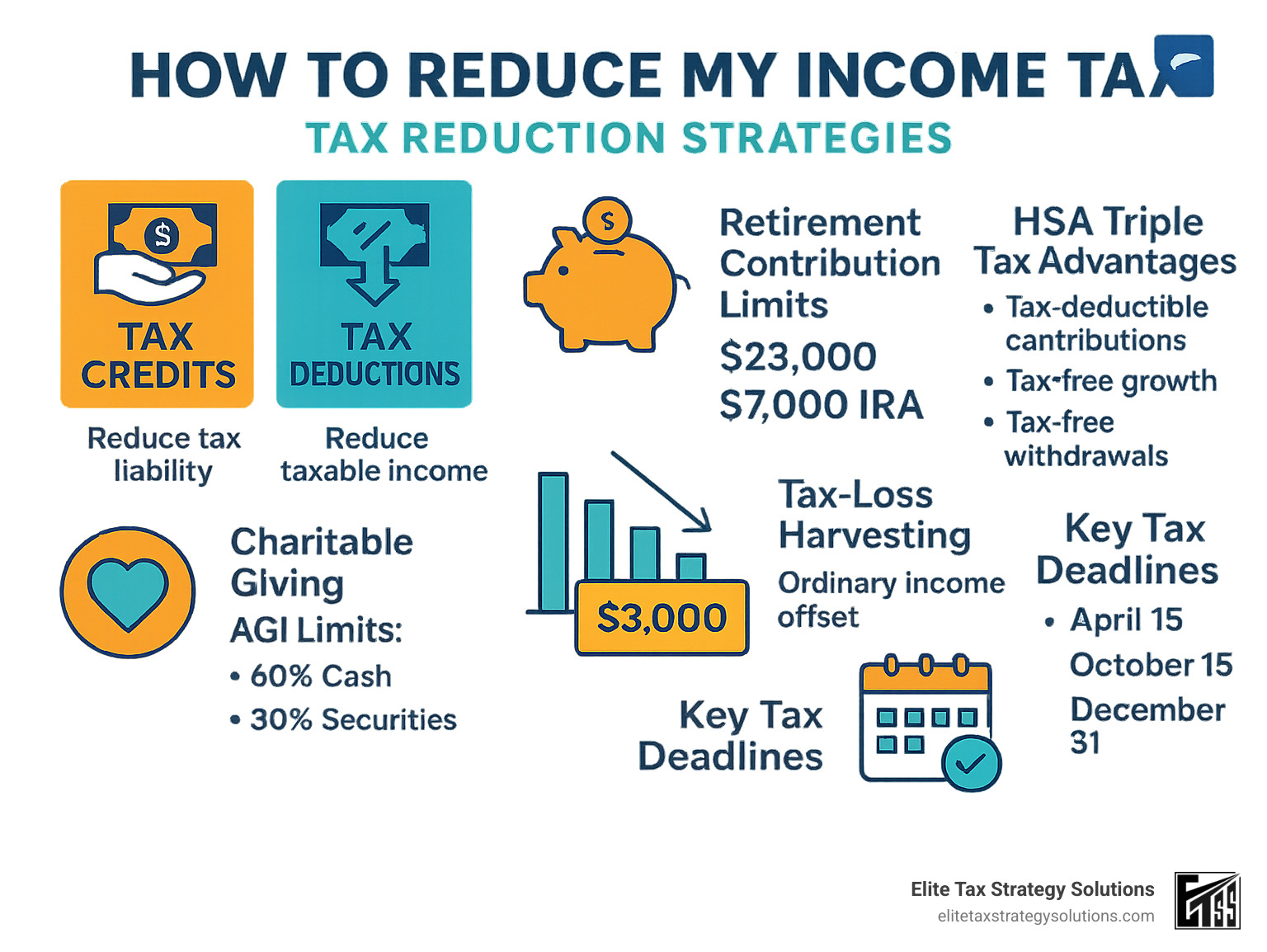
Health Savings Accounts (HSAs) offer what I call the “triple crown” of tax benefits: tax-deductible contributions, tax-free growth, and tax-free withdrawals for qualified medical expenses. It’s the only account type with this powerful combination.
While deductions reduce your taxable income, tax credits deliver even more bang for your buck with dollar-for-dollar reductions of your tax bill. Credits for children, education, energy improvements, and retirement savings can dramatically reduce what you owe.
Charitable giving isn’t just good for your community—it’s good for your tax situation too. Whether you donate cash, clothing, or appreciated stock, proper documentation can turn your generosity into tax savings.
Smart investors know that market downturns have a silver lining: tax-loss harvesting. By selling investments that have declined in value, you can offset capital gains and even reduce your ordinary income by up to $3,000.
For those with significant itemizable deductions, strategic bundling can be a game-changer. By concentrating deductions like medical expenses and charitable gifts into a single tax year, you can exceed the standard deduction threshold and maximize your write-offs.
Parents and grandparents should consider 529 education accounts, which allow tax-free growth for qualified education expenses. Some states even offer tax deductions for contributions.
If you’re self-employed or run a small business, tracking business expenses diligently can uncover substantial deductions. Home office, vehicle expenses, and professional development costs are frequently overlooked opportunities.
I’m David Fritch, and after 40+ years as a CPA, I’ve seen how strategic tax planning can transform financial futures. At Elite Tax Strategy Solutions, we specialize in helping clients earning between $200,000 and $2 million annually implement over 100 customized tax-saving techniques.
With tax laws constantly changing and the major TCJA provisions set to expire in 2026, there’s never been a more important time to get serious about how to reduce my income tax obligations. The difference between reactive tax preparation and proactive tax planning can mean thousands more in your pocket each year.
Know the Difference: Credits vs Deductions & Why It Matters
When I’m helping clients figure out how to reduce my income tax, the first thing we clarify is the difference between tax credits and deductions. This distinction isn’t just tax jargon—it can mean thousands of dollars in your pocket!
Tax credits are the superheroes of tax breaks. They reduce your tax bill dollar-for-dollar, directly lowering what you owe. If you qualify for a $1,000 tax credit, you’ll save exactly $1,000 in taxes—like getting a $1,000 gift card to the IRS store!
Deductions, while still valuable, work differently. They reduce your taxable income before calculating your tax. If you’re in the 24% tax bracket, a $1,000 deduction saves you $240 (24% of $1,000). Still helpful, but not as powerful as credits.
Some credits are even refundable, meaning if the credit exceeds your tax liability, you’ll get the difference as a refund. The Earned Income Tax Credit is a perfect example—it can put real money in your pocket even if you owe no tax at all.
| Feature | Tax Credits | Tax Deductions |
|---|---|---|
| How it works | Dollar-for-dollar reduction of taxes owed | Reduces taxable income |
| Value | Same for all income levels | Worth more in higher tax brackets |
| Examples | Child Tax Credit, Education credits | Mortgage interest, Charitable donations |
| Refundability | Some can generate refunds | Never generate refunds on their own |
When choosing between similar tax benefits, always go for the credit when possible! As one of my clients likes to say, “Credits are like cash, deductions are like coupons.”
More info about Tax Planning Strategies
Above-the-Line vs Below-the-Line Deductions
Not all deductions are created equal! When exploring how to reduce my income tax, understanding where deductions appear on your return can open up additional savings.
Above-the-line deductions (officially called “adjustments to income”) appear on Schedule 1 of your Form 1040. These are the VIP deductions because you can take them whether you itemize or claim the standard deduction. Plus, they reduce your Adjusted Gross Income (AGI), which can help you qualify for other tax benefits that phase out at higher income levels.
Some of my clients’ favorite above-the-line deductions include:
Traditional IRA contributions (up to $7,000 for 2024, or $8,000 if you’re 50+), student loan interest (up to $2,500), HSA contributions, half of self-employment tax, self-employed health insurance premiums, and educator expenses (up to $300 per educator).
Below-the-line deductions come after calculating your AGI. Here, you’ll need to choose between the standard deduction or itemizing. For 2024, the standard deduction is $14,600 for singles, $29,200 for married couples filing jointly, and $21,900 for heads of household.
I often tell my clients that choosing between standard and itemized deductions isn’t something to decide hastily. “These decisions can impact your entire financial picture,” as my colleague Vinay Navani at WilkinGuttenplan wisely notes.
The standard deduction is simpler, but itemizing might save more if you have significant mortgage interest, charitable contributions, medical expenses exceeding 7.5% of your AGI, or state and local taxes (though these are capped at $10,000).
The key is tracking potential deductions throughout the year so you can make an informed choice when tax season arrives. This proactive approach is essential to maximizing your tax savings.
More info about Optimizing Tax Deductions
Fund Pre-Tax & Tax-Free Accounts for Big Savings
One of the most effective ways to reduce your taxable income is by maximizing contributions to tax-advantaged accounts. These accounts not only help you save for the future but provide immediate tax benefits today.
For 2025, the IRS has raised the 401(k) contribution limit to $23,500, while the IRA contribution limit remains at $7,000. If you’re 50 or older, you can make additional “catch-up” contributions: $7,500 more to a 401(k) and $1,000 more to an IRA. Those between ages 60 and 63 can make even larger catch-up contributions of $11,250 to their 401(k) plans.
Mark Steber, a tax expert, emphasizes: “Every dollar you contribute not only helps you save for the future, but it can also help reduce the amount of income the IRS taxes.”
How to Reduce My Income Tax Through Retirement Contributions
Traditional 401(k) and IRA contributions are made with pre-tax dollars, directly reducing your taxable income for the year. For example, if you earn $80,000 and contribute $20,000 to your traditional 401(k), you’ll only be taxed on $60,000.
Here’s how to maximize this strategy:
- Contribute at least enough to get your full employer match – This is essentially free money and an immediate return on investment
- Max out your contributions if possible – Especially in high-income years
- Consider catch-up contributions if you’re eligible – These allow you to save more and reduce your taxable income further
- Time Roth conversions strategically – Consider converting traditional IRA funds to Roth when your account values are temporarily down or in years when your income is lower
As tax experts at Fidelity note, “If the value of the investments in your traditional IRA is temporarily down, it may be a good time to consider converting.” This allows you to pay taxes on a smaller amount while positioning yourself for tax-free growth in the future.
Leverage Health & Education Accounts
Health Savings Accounts (HSAs) offer what financial experts call a “triple tax advantage”:
- Contributions are tax-deductible (or pre-tax if made through payroll deduction)
- Growth within the account is tax-free
- Withdrawals for qualified medical expenses are tax-free
For 2025, HSA contribution limits are $4,300 for individuals and $8,550 for families, with an additional $1,000 catch-up contribution available for those over 55.
Unlike Flexible Spending Accounts (FSAs), HSAs don’t have a “use-it-or-lose-it” rule. Funds roll over year after year, making them valuable long-term tax planning tools.
For education expenses, 529 plans offer tax-free growth and withdrawals when used for qualified education expenses. While contributions aren’t federally tax-deductible, many states offer state income tax deductions or credits for 529 contributions.
A key update: 529 plans now cover up to $10,000 per student per year for K-12 tuition, in addition to college expenses. This expansion provides more flexibility for families looking to maximize tax advantages while funding education.
How to Reduce My Income Tax with Smart Itemizing & Charitable Giving
When it comes to lowering your tax bill, strategic charitable giving paired with smart itemizing can be a game-changer. The trick is knowing when to itemize and when the standard deduction makes more sense for your situation.
For 2024, the standard deduction amounts are quite substantial:
– $14,600 for single filers
– $29,200 for married couples filing jointly
– $21,900 for head of household
Itemizing only makes financial sense when your total itemizable deductions exceed these amounts. The most common itemized deductions include your state and local taxes (capped at $10,000), mortgage interest, charitable contributions, and medical expenses that go beyond 7.5% of your AGI.
One particularly powerful strategy for how to reduce my income tax is donating appreciated securities instead of cash. When you donate stocks or mutual funds that have grown in value and that you’ve owned for more than a year, you get a triple benefit:
You completely avoid paying capital gains tax on the appreciation, you receive a tax deduction for the full fair market value of what you donated, and the charity receives the same value they would have gotten from a cash gift.
As tax experts at Fidelity Charitable put it, “Donating long-term appreciated securities eliminates capital gains taxes and increases both deduction and effective gift by up to 23.8%.” That’s a win-win for both you and your favorite causes.
Bunch, Gift, and Harvest for Maximum Deduction
Since the Tax Cuts and Jobs Act nearly doubled the standard deduction, the “bunching” strategy has become incredibly popular among savvy taxpayers. Here’s the concept in a nutshell:
Rather than making consistent charitable donations every year, you concentrate or “bunch” multiple years’ worth of donations into a single tax year. This approach lets you itemize deductions in your “bunching” year and take the standard deduction in other years.
A donor-advised fund (DAF) pairs perfectly with this strategy. You can make one large contribution to your DAF, claim the full deduction immediately, and then distribute the funds to your favorite charities gradually over several years.
The AGI limits that apply to charitable deductions. Cash donations to public charities are deductible up to 60% of your AGI, while appreciated securities held long-term are deductible up to 30% of your AGI. Don’t worry if you can’t use the full deduction in one year—unused deductions can be carried forward for up to 5 years.
Qualified Charitable Distributions for Retirees
If you’re at least 70½ years old, Qualified Charitable Distributions (QCDs) offer a fantastic way to reduce taxes while supporting the causes you care about.
A QCD allows you to transfer up to $108,000 per year (or $216,000 for married couples filing jointly) directly from your IRA to qualified charities. The beauty of these distributions is that they count toward satisfying your Required Minimum Distributions (RMDs) but aren’t included in your taxable income.

The benefits of QCDs are truly impressive. They satisfy your RMD without increasing your taxable income, potentially keep your income below thresholds that would trigger higher Medicare premiums, allow you to support charities with pre-tax dollars, and—perhaps best of all—you don’t need to itemize deductions to receive the tax benefit.
As one tax expert succinctly notes, “Direct IRA-to-charity distributions avoid increasing AGI while satisfying RMD requirements, creating a double tax benefit.” It’s hard to beat that combination of financial efficiency and charitable impact.
Optimize Your Investment Portfolio Tax Footprint
When I talk to clients about how to reduce my income tax, smart investment management always comes up. The way you handle your investments can dramatically impact your tax bill—often saving thousands without sacrificing performance.
Tax-loss harvesting is probably the most powerful tool in your investment tax toolkit. This strategy involves selling investments that have declined in value to realize those losses for tax purposes. These losses can then offset capital gains from your winners. Even better, if your losses exceed your gains, you can use up to $3,000 of the excess to reduce your ordinary income each year. Any remaining losses? They roll forward to future tax years.
“You can apply up to $3,000 of investment losses ($1,500 if married filing separately) to offset your ordinary income for federal income tax purposes,” the IRS confirms.
Just be careful about the “wash-sale” rule. If you buy the same or a “substantially identical” investment within 30 days before or after selling at a loss, the IRS will disallow that loss. I’ve seen this trip up even sophisticated investors.
As tax expert Vinay Navani wisely cautions, “Selling assets solely for tax purposes could amount to ‘the tax tail wagging the investment dog.'” Make sure any tax move aligns with your broader investment goals.
Capital Losses vs Gains: Timing Moves
Understanding the difference between short-term and long-term capital gains is crucial for keeping your tax bill in check:
Short-term gains (assets held for one year or less) get taxed as ordinary income—potentially as high as 37%. Ouch! Long-term gains (assets held over a year) enjoy much lower rates of 0%, 15%, or 20%, depending on your income bracket.
Don’t forget about the 3.8% Medicare surtax that kicks in on investment income when your modified adjusted gross income exceeds $200,000 ($250,000 for married couples filing jointly).
Timing your investment moves can make a huge difference. Consider holding appreciated investments just a bit longer to reach that one-year mark for long-term treatment. If you’re having a particularly high-income year, that might be the perfect time to harvest some losses. And sometimes, spreading large gains across multiple tax years makes sense.
I always recommend reviewing your realized gains and losses in November—not December when everyone’s distracted by holidays. This gives you plenty of time to make strategic moves before year-end.
Asset Location & Rebalancing
One of my favorite strategies for how to reduce my income tax is proper asset location—putting different investments in the right type of accounts. This can significantly boost your after-tax returns without changing your overall investment mix.
Think of it this way: tax-inefficient investments (those spinning off ordinary income or frequent short-term gains) generally belong in tax-deferred accounts like your 401(k) or traditional IRA. This includes things like high-yield bonds, REITs, and actively managed funds with high turnover.
Meanwhile, tax-efficient investments (those generating qualified dividends, long-term capital gains, or tax-exempt income) often work better in taxable accounts. Your low-turnover index funds and municipal bonds fit here.
For investments with the highest growth potential? Consider your Roth accounts, where all that growth can eventually be withdrawn completely tax-free.
When it’s time to rebalance your portfolio, think about the tax consequences first. Often, you can rebalance within your tax-advantaged accounts to avoid triggering taxable events altogether. Another smart approach is using new contributions to adjust your allocation rather than selling existing positions.
These investment tax strategies require some planning, but they’re worth it. At Elite Tax Strategy Solutions, we’ve seen clients save tens of thousands through these approaches alone. The best part? These strategies work regardless of market conditions, giving you control over your tax situation even when markets are unpredictable.
Open up Self-Employment & Family-Based Breaks
If you’re self-employed or have a family (or both!), you’ve got some fantastic tax-saving opportunities at your fingertips. Let’s explore how these situations can help answer the question of how to reduce my income tax.
Self-employment comes with the valuable Qualified Business Income (QBI) deduction, allowing eligible business owners to deduct up to 20% of their qualified business income. This deduction alone can dramatically lower your taxable income if you qualify.
As a Schedule C filer (that’s sole proprietors and single-member LLCs), you can write off almost any expense that’s ordinary and necessary for your business. Think office rent, business travel, insurance premiums, and even that fancy accounting software you use to track everything.
“One of the biggest mistakes I see self-employed people make is not claiming all the deductions they’re entitled to,” says David Fritch, founder of Elite Tax Strategy Solutions. “They’re literally leaving money on the table.”
For families, the tax code offers several generous credits that can slash your tax bill significantly. The Child Tax Credit provides up to $2,000 per qualifying child under 17, while the Child and Dependent Care Credit covers 20-35% of childcare expenses (up to $3,000 for one dependent or $6,000 for two or more).
Education expenses can also generate substantial tax savings through credits like the American Opportunity Tax Credit (up to $2,500 per eligible student) and the Lifetime Learning Credit (up to $2,000 per tax return). Plus, you might be able to deduct up to $2,500 in student loan interest, depending on your income.
Recent scientific research on the Foreign earned income exclusion has shown additional opportunities for those working abroad, potentially excluding over $100,000 of foreign earnings from U.S. taxation.

How to Reduce My Income Tax If You’re Self-Employed
The self-employment world opens doors to retirement savings strategies that employees can only dream about. While a traditional 401(k) caps out for employees, self-employed folks can establish a Solo 401(k) and contribute as both employer and employee – potentially stashing away up to $69,000 for 2024 if you’re 50 or older.
“My clients are often shocked when they learn how much they can legally contribute to retirement plans as self-employed individuals,” shares a tax advisor at Elite Tax Strategy Solutions. “It’s one of the most powerful ways to reduce current-year taxes while building wealth.”
A SEP-IRA is another attractive option, allowing contributions of up to 25% of your net self-employment income (maximum $69,000 for 2024). Best of all, these contributions reduce your taxable income dollar-for-dollar.
Health insurance premiums are 100% deductible for self-employed individuals and their families – a significant benefit that employees don’t enjoy. And don’t forget about mileage deductions (65.5 cents per mile in 2024) for business travel and the home office deduction.
Speaking of home offices, you have two options: the regular method (based on actual expenses) or the simplified method ($5 per square foot, up to 300 square feet). Just remember that the space must be used regularly and exclusively for business. That spare bedroom that doubles as your office during the day and guest room at night? Unfortunately, that won’t qualify.
Tracking your business expenses carefully is crucial. A good mileage log and organized receipts can save you thousands in taxes and provide peace of mind if the IRS comes knocking.
For more comprehensive strategies, check out our guide to Tax Savings Strategies for High-Income Earners.
Dependent & Education Credits Every Family Should Know
As parents, we’re always looking for ways to stretch our dollars further. Thankfully, the tax code offers several family-friendly provisions that can help answer how to reduce my income tax while raising and educating children.
The Child Tax Credit remains one of the most valuable tax breaks for families, providing up to $2,000 per qualifying child under 17. What makes this credit especially powerful is that up to $1,600 of it can be refundable, meaning you might get money back even if you don’t owe any tax. This credit starts phasing out when your modified AGI exceeds $200,000 for single filers or $400,000 for married couples filing jointly.
Working parents struggling with childcare costs should definitely claim the Child and Dependent Care Credit (CDCC). This credit ranges from 20% to 35% of qualifying expenses, depending on your income. You can claim expenses up to $3,000 for one dependent or $6,000 for two or more, potentially saving you thousands on your tax bill.
“Many parents don’t realize they can claim education credits for their college students while simultaneously using 529 plan distributions,” explains a tax specialist at Elite Tax Strategy Solutions. “It’s all about coordinating these benefits properly.”
For higher education expenses, two key credits deserve your attention:
The American Opportunity Tax Credit (AOTC) is the more generous of the two, offering up to $2,500 per eligible student for the first four years of higher education. Even better, up to $1,000 of this credit is refundable, meaning it could generate a refund even if you don’t owe any tax.
The Lifetime Learning Credit (LLC) provides up to $2,000 per tax return for qualified education expenses, with no limit on the number of years it can be claimed. This makes it particularly valuable for graduate students or those taking courses to improve job skills.
Don’t forget about 529 plans for tax-free education savings. While contributions aren’t federally tax-deductible, the earnings grow tax-free and withdrawals for qualified education expenses are tax-free. Many states also offer state tax deductions or credits for 529 contributions, making them even more attractive.
When it comes to education expenses, proper documentation is essential. Keep those tuition statements (Form 1098-T) and receipts for course materials in a safe place to support your credits and deductions if questioned.
Plan Ahead: 2026 Sunset, Residency Rules & Audit-Proof Records
Looking ahead is a crucial part of answering how to reduce my income tax effectively. The Tax Cuts and Jobs Act (TCJA) has a looming expiration date after 2025, and this will bring several significant changes to your tax situation:
The tax landscape will shift dramatically with higher income tax rates returning to many brackets, smaller standard deductions, and the comeback of personal exemptions. The estate tax exemption will take a substantial dive from about $13.6 million down to approximately $6-7 million per person. Plus, that $10,000 SALT deduction cap that’s frustrated many homeowners in high-tax states? It’s scheduled to disappear.
This creates both a challenge and opportunity window. If you’re a high earner, 2024 and 2025 might be your last chance to take advantage of today’s relatively lower tax rates. Consider having a conversation with your tax professional about potentially accelerating income into these years if you expect to land in a higher bracket after 2026.
For those with significant estates, these next two years represent a critical planning period. The substantial drop in estate tax exemptions means you might want to consider strategic gifting now, while the exemption remains historically high.
Residency rules can also significantly impact your tax bill, especially in our increasingly remote work world. Most states use some variation of the 183-day rule to determine whether you’re a resident for tax purposes, but the specifics vary widely.
“If you’re splitting time between states, keep a detailed calendar of where you physically are each day,” advises David Fritch, CPA. “It’s not just about where you sleep – it’s about establishing your true domicile through documentation.”
For those working internationally, the Foreign Earned Income Exclusion can provide substantial tax relief, but requires meeting strict presence tests – including being abroad for at least 330 days in a 12-month period. This isn’t something you can establish retroactively, so planning is essential.
Keep Your Proof & Deadlines Straight
The best tax strategy in the world falls apart without proper documentation. Different deductions and credits require different types of proof, and knowing what to keep is half the battle in how to reduce my income tax.
For charitable donations, always get written acknowledgments for donations over $250. If you’re making non-cash donations valued over $500, you’ll need to complete Form 8283. Those receipts from Goodwill or The Salvation Army? Don’t toss them – they’re golden during tax season.
Business owners should maintain a careful system for receipts, invoices, and especially detailed logs for travel and entertainment expenses. The IRS scrutinizes these categories closely, so documentation is your best defense.
Medical expense deductions require saving medical bills, insurance statements, and receipts for supplies. For education expenses, hold onto your Form 1098-T from educational institutions along with receipts for qualified expenses like textbooks.
Understanding tax deadlines is equally crucial:
December 31st marks the cutoff for most strategies affecting the current tax year, including charitable donations and most expense payments. But April 15th (or the next business day if it falls on a weekend or holiday) gives you additional time for IRA and HSA contributions for the previous tax year – a valuable extension for last-minute tax planning.
For those making quarterly estimated tax payments, mark your calendar for April 15, June 15, September 15, and January 15. Missing these deadlines doesn’t just mean potential penalties – it could mean missing opportunities to adjust your tax strategy mid-year.
Consider Professional Guidance Before Big Moves
While tax software has made DIY filing more accessible than ever, complex tax situations often benefit tremendously from professional guidance. A qualified tax professional brings value well beyond just filling out forms.
They can spot tax-saving opportunities you might miss, help you steer increasingly complex tax rules, and provide strategies custom to your specific financial situation. If you face an audit, having professional representation can make a world of difference in both outcome and stress level.
At Elite Tax Strategy Solutions, we often see clients who come to us after making major financial decisions – when many tax-saving options are already off the table. That’s why we recommend mid-year tax check-ins to identify opportunities before year-end.
“Planning is the key to taxes,” emphasizes Carol W. Thompson, a respected tax expert. “It’s a far more sensible approach than going out and buying equipment [just for tax deductions].”
Professional guidance becomes particularly valuable before major life and financial decisions. Before buying or selling a home, starting or selling a business, retiring, changing jobs, receiving a large windfall, making significant charitable donations, or implementing estate planning strategies – a conversation with a tax professional could potentially save you thousands.
Think of tax planning as preventive medicine rather than emergency room care. A small investment in professional guidance often yields returns many times over in tax savings and financial peace of mind when it comes to how to reduce my income tax.
Frequently Asked Questions about how to reduce my income tax
Navigating tax reduction can feel overwhelming, but you’re not alone. Here are answers to some of the most common questions I hear from clients looking to keep more of their hard-earned money.
What documentation do I need to support deductions and credits?
Think of documentation as your shield in case the IRS comes knocking. Different deductions require different paperwork, but being thorough is always your best defense.
For charitable donations, keep those acknowledgment letters for anything over $250. For smaller gifts, your bank records or credit card statements will do the trick. Donating that old furniture? You’ll need Form 8283 if the value exceeds $500.
Medical expenses can add up quickly, and the IRS knows it. Hold onto those bills, insurance statements, and prescription receipts. And yes, that mileage driving to doctor appointments counts too—just keep a simple log.
Business owners, your record-keeping needs to be particularly sharp. Those receipts, invoices, and contracts aren’t just for accounting—they’re your proof that business expenses were legitimate. That coffee meeting? Note who you met and the business purpose right on the receipt.
For education expenses, Form 1098-T from your school is your golden ticket, but don’t forget to save receipts for textbooks and supplies too.
The general rule is to keep everything for at least three years after filing, since that’s the standard IRS audit window. But for certain situations like substantial underreported income, they can look back six years—or indefinitely in cases of fraud.
When should I itemize deductions instead of taking the standard deduction?
This question comes down to simple math, but the impact on how to reduce my income tax can be significant. Itemizing makes sense when your total eligible expenses exceed the standard deduction—which for 2024 is $14,600 for singles, $29,200 for married couples filing jointly, and $21,900 for heads of household.
The big-ticket items that might push you over the threshold include your mortgage interest, state and local taxes (though capped at $10,000), charitable gifts, and medical expenses exceeding 7.5% of your AGI.
I often recommend the “bunching” strategy for clients who are close to the threshold. Barbara, a client who donates regularly to her church, now makes two years’ worth of donations in January of odd years and December of even years—effectively “bunching” four years of donations into two tax years. This allows her to itemize in those years while taking the standard deduction in between.
“I never thought about timing my giving this way,” Barbara told me. “Now I get to support the causes I care about and save on taxes too.”
What deadlines apply for deductible contributions?
Missing a contribution deadline can mean missing out on valuable tax savings. Here’s what you need to know:
For your workplace 401(k) or similar plan, December 31 is your hard deadline. Those contributions come from your paycheck, so your last paycheck of the year is your last chance.
The good news about IRAs and HSAs is that you have until the tax filing deadline (typically April 15) to make contributions for the previous year. This gives you a few extra months to find the funds if your December budget was tight.
For charitable donations, December 31 is the cutoff for the current tax year. Pro tip: credit card donations count when charged, not when you pay the bill. So even if you don’t pay that credit card bill until January, a December 31 donation still counts for the previous year.
Parents saving in 529 plans need to complete contributions by December 31 for federal purposes, though some states allow contributions until their state tax filing deadline if you’re claiming a state tax benefit.
Self-employed folks, don’t forget those quarterly estimated tax payments: typically April 15, June 15, September 15, and January 15 of the following year. Missing these can result in penalties, even if you’re due a refund when you file.
As a client recently joked to me, “The only things certain in life are death, taxes, and tax deadlines.” While I can’t argue with that wisdom, I can tell you that understanding these deadlines is a crucial part of how to reduce my income tax.
Conclusion
Let’s face it – tax season can feel overwhelming. But armed with strategies on how to reduce my income tax, you’re now equipped to take control of your financial future instead of dreading April every year.
Throughout this guide, we’ve explored the critical difference between tax credits (those dollar-for-dollar reductions) and deductions (which lower your taxable income). We’ve uncovered how maximizing contributions to retirement accounts, HSAs, and education funds can dramatically cut your tax bill while building wealth. And we’ve seen how strategic timing of income, expenses, and charitable giving can keep thousands more dollars in your pocket.
But perhaps the most important takeaway is this: effective tax planning isn’t a once-a-year scramble. It’s an ongoing process that considers both your current financial picture and your long-term goals.
With major tax changes on the horizon – the TCJA provisions expiring after 2025 – the next two years present a unique window of opportunity. Tax rates will likely increase, standard deductions will decrease, and estate tax exemptions will drop significantly. The time to act is now.
At Elite Tax Strategy Solutions, we see this planning process as a partnership. Our clients aren’t just looking for someone to fill out forms – they want a trusted advisor who understands their unique situation and can identify opportunities others might miss.
Whether you’re a high-earning professional trying to manage your tax bracket, a business owner navigating complex deduction rules, or a family balancing college savings with retirement planning, a personalized approach makes all the difference.
Reducing your tax burden isn’t about taking shortcuts – it’s about making informed choices that align with tax law while supporting your financial goals. Every dollar saved in taxes is a dollar you can redirect toward building wealth, supporting causes you care about, or simply enjoying life more fully.
We encourage you to review your tax strategy regularly, especially before making major financial decisions. Consider how life changes – a new job, marriage, children, home purchase, or approaching retirement – might create new tax planning opportunities.
Ready to take your tax strategy to the next level? Our innovative tax planning approach can help you steer complex tax rules with confidence and clarity. Because at Elite Tax Strategy Solutions, we believe everyone deserves to keep more of what they earn through smart, proactive tax planning.
Tax reduction isn’t just about paying less – it’s about building the future you want, one strategic decision at a time.