Why HMRC Tax Compliance Matters More Than Ever
HMRC tax compliance is the process of ensuring your tax affairs meet all UK legal requirements and can withstand scrutiny from HM Revenue and Customs. For US-based individuals and businesses with UK interests, proactive management is essential.
Key Elements of HMRC Tax Compliance:
- Accurate record keeping – Maintain detailed financial records for all income and expenses.
- Timely filing – Submit all tax returns by their deadlines.
- Complete disclosure – Report all taxable income and claim only legitimate deductions.
- Proper documentation – Keep supporting evidence for all tax positions.
- Proactive engagement – Respond promptly to HMRC enquiries and requests.
What HMRC Can Check:
- Self Assessment tax returns
- Company Tax Returns
- PAYE records and returns
- VAT returns
- Any taxes paid by individuals or businesses
The stakes are high, as HMRC’s data analysis tools can spot discrepancies across multiple sources, from bank records to social media. Recent focus areas include R&D tax relief claims, where error and fraud reached £1.13 billion in 2020-2021, and international tax arrangements under new reporting standards.
Whether you’re a high-income earner or run a business with UK operations, understanding how HMRC operates can save you significant stress, time, and money. The key is being prepared before they come knocking.
I’m David Fritch, and over my 40 years as a CPA and tax professional, I’ve helped countless clients steer HMRC tax compliance challenges while working with international tax regulations. My experience shows that proactive compliance planning is always better than reactive damage control.
Hmrc tax compliance terminology:
Understanding HMRC Tax Compliance Checks
An HMRC compliance check is designed to ensure everyone pays the right amount of tax at the right time. The goal is to close the “tax gap”—the difference between what should be collected and what is. Without compliance work, at least 10% of taxes owed would go unpaid. Through various checks, HMRC typically reduces non-compliance to around 5% of total taxes due.
HMRC uses a strategic approach, with different types of enquiries based on the situation.
- Full Enquiry: This is the most intensive check. HMRC examines every aspect of your tax return, accounts, and financial records for a specific period, essentially reconstructing your entire financial picture. This usually happens when they suspect something significant is amiss.
- Aspect Enquiry: This is a targeted investigation into a specific area. For example, if your travel expenses seem high for your industry, they might focus only on that. However, a targeted enquiry can sometimes uncover other issues.
- Random Checks: These are genuinely random and help HMRC test its systems and gather intelligence on compliance levels. Being selected doesn’t mean you’re suspected of wrongdoing.
You may also face Pre-enquiry checks, which are often a letter or call asking for clarification on a specific point. How you handle these initial queries can determine if matters escalate to a formal investigation.

What Can HMRC Check?
HMRC’s reach extends across all UK tax obligations. They can scrutinize your Self Assessment tax return (covering income tax and capital gains), your Company Tax Return, your PAYE records if you employ people, and your VAT returns. Essentially, if it involves UK taxation, HMRC can review it, making comprehensive HMRC tax compliance essential.
For company directors, the Director information hub: HMRC tax compliance checks provides valuable insights into what HMRC expects. While these checks can seem daunting, they are a normal part of the tax system. Being prepared and understanding the process makes a significant difference.
The Anatomy of an HMRC Investigation
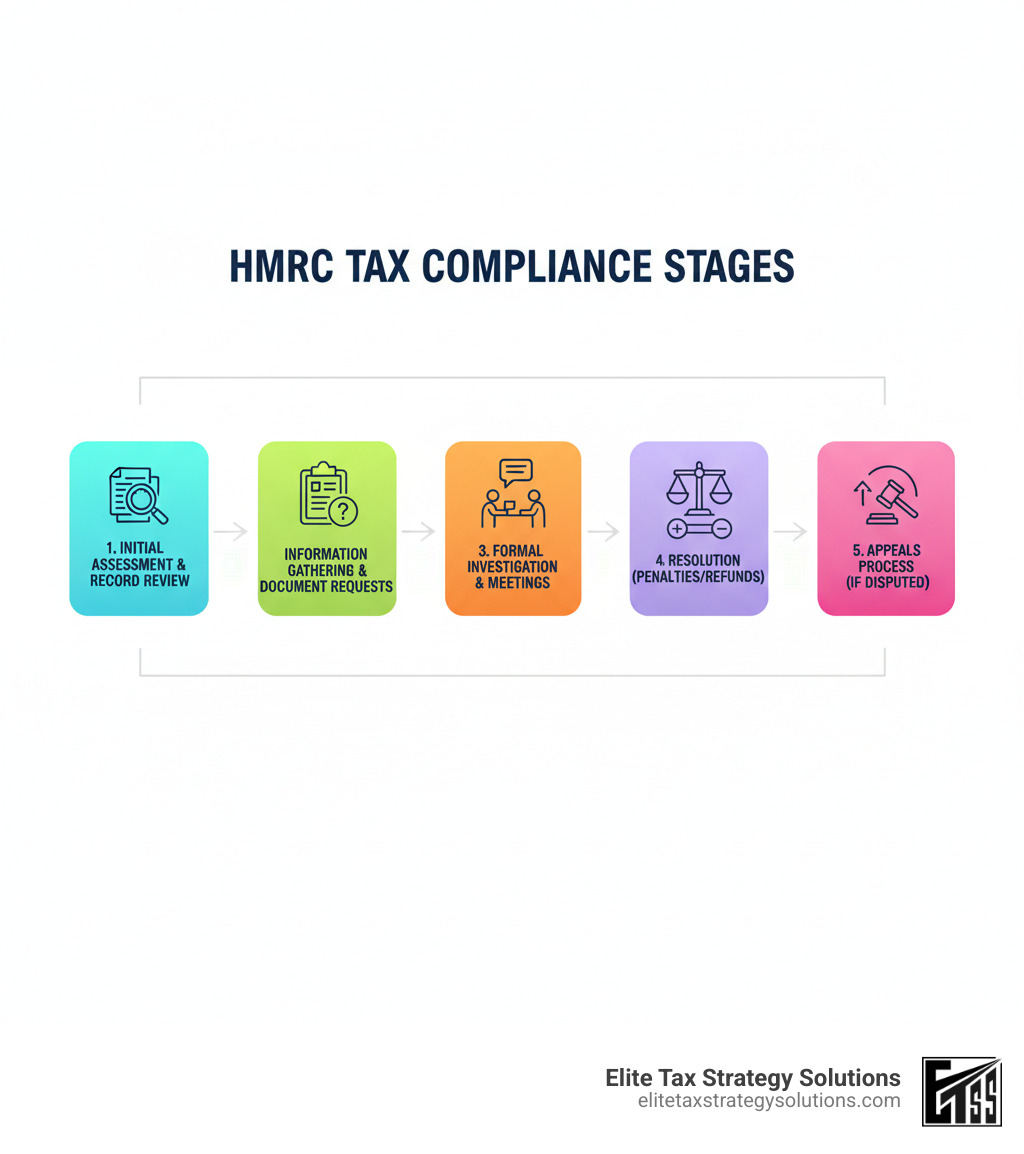
An HMRC tax compliance investigation is a staged process that often begins long before you are aware of it. Behind the scenes, HMRC’s sophisticated systems analyze data, looking for anomalies. When something catches their attention, the formal process begins.

What Triggers an HMRC Compliance Check?
Most checks are not random. They are often triggered by HMRC Connect, a powerful data-mining system that cross-references information from banks, employers, land registries, and even social media.
- Data discrepancies: Red flags are raised when your reported income doesn’t match bank interest records, or your VAT returns conflict with corporation tax figures.
- Filing history: A pattern of late or erroneous filings suggests a lack of diligence and can attract scrutiny.
- Unusual claims: Business expenses significantly higher than industry benchmarks or wild profit swings without clear explanation will likely lead to questions.
- Public information: A news article about your business success, a reported property purchase, or social media posts showing a lifestyle inconsistent with your declared income can all prompt a check.
- Public tip-offs: Allegations from former employees, business partners, or others can also initiate an investigation, though HMRC must verify such claims.
What Happens During a Check and What Are Your Rights?
The process usually starts with an initial contact letter explaining the type of check and the tax years involved. This is followed by information requests for specific documents and records, with a typical response deadline of 40 days. In some cases, HMRC may request meetings.
During this process, you have important rights. You have the right to an agent or adviser, which is strongly recommended due to the technical nature of investigations. You also have the right to appeal any HMRC decision. In return, you have an obligation to provide accurate information and cooperate fully. Hiding information will only worsen the situation.
The outcomes vary. An investigation may conclude with no further action or even a tax refund. More commonly, it results in additional tax due, plus penalties and interest, depending on the specifics and your level of cooperation.
For detailed guidance, HMRC provides resources like their General information about compliance checks.
Navigating this process successfully requires preparation, honesty, and professional guidance. With the right approach, most checks conclude with minimal disruption.
Navigating Complex Areas of HMRC Tax Compliance
For successful businesses or individuals with substantial income, HMRC tax compliance becomes more complex. Certain areas naturally attract more scrutiny from HMRC due to their inherent complexity and risk.

R&D Tax Relief: A Focus Area for HMRC
Research and Development (R&D) tax relief has become a major compliance headache for HMRC, with £1.13 billion in error and fraud identified for 2020-2021. The Small and Medium Enterprise (SME) scheme has been especially problematic, with non-compliance estimated at 24.4% of claims.
In response, HMRC has tightened the rules. For accounting periods from April 1, 2023, companies must notify HMRC in advance of their intent to claim R&D relief within a strict six-month window. From August 1, 2023, a detailed Additional Information Form must be submitted before the Corporation Tax return, breaking down project costs and technical details.
Given that more than 90% of R&D claimants use professional advisers, it’s clear that navigating these complex rules requires expertise. The days of casual R&D claims are over.
Guidelines for Compliance (GfC) and Large Business Strategy
HMRC also provides resources to help taxpayers. Their Guidelines for Compliance (GfC) offer practical insights into what good practice looks like in complex or confusing tax areas. These can be found in HMRC’s new Guidelines for Compliance (GfC) collection.
For larger businesses, HMRC’s Large Business Service (LBS) uses a more collaborative approach. A dedicated Customer Compliance Manager (CCM) is assigned to work with the business, encouraging proactive engagement to discuss risks before they become problems. This requires transparency but is often more efficient than a formal investigation.
International Tax and Significant Non-Compliance
International tax compliance has grown far more challenging. Agreements like FATCA (Foreign Account Tax Compliance Act) and the Common Reporting Standard (CRS) enable the automatic flow of financial information between countries, eliminating old avenues for secrecy.
HMRC treats “significant non-compliance” in international matters with extreme seriousness. This refers to patterns of behavior suggesting deliberate avoidance.
The consequences are severe, including higher penalties (100% to 200% of the tax due), public “naming and shaming” of deliberate defaulters, and, in the most serious cases, criminal investigation. For financial institutions, unresolved issues can lead to being classified as a “Non-Participating Financial Institution,” a status with crippling operational and reputational damage.
HMRC’s internal guidance, such as the manual on Significant Non-Compliance, confirms that the risks of getting international tax wrong have never been higher. Professional expertise and proactive planning are essential.
After the Check: Penalties, Appeals, and Prevention
The conclusion of an HMRC compliance check doesn’t always bring the relief you might expect. When an HMRC compliance check finds underpaid tax, you will likely face interest charges and penalties. Understanding how these work and your options is a key part of HMRC tax compliance.

How HMRC treats you depends heavily on your behaviour and cooperation. Being proactive and transparent can significantly improve the outcome.
Understanding Penalties and the Importance of Disclosure
Penalties are calculated as a percentage of the Potential Lost Revenue (PLR)—the underpaid tax. The percentage depends on your behaviour, which HMRC categorizes as careless, deliberate, or deliberate and concealed.
The penalty can be dramatically reduced by the quality of your disclosure, which HMRC assesses based on telling (disclosing the inaccuracy), helping (quantifying the error), and giving (providing access to records).
An unprompted disclosure, where you inform HMRC of an error before they begin an investigation, results in much lower penalties than a prompted disclosure. For example, penalties for careless errors range from 0-30%, but a high-quality unprompted disclosure can reduce this significantly. For deliberate and concealed behaviour, penalties can be as high as 100% of the tax due, but cooperation can still lead to a reduction.
How to Appeal an HMRC Decision and Prevent Future Checks
If you disagree with HMRC’s decision, you have the right to appeal, typically within 30 days. Your first option is an internal review by a different HMRC officer. This is often the quickest way to resolve a dispute.
If the review is unsuccessful, you can appeal to the First-tier Tribunal (Tax), an independent body. At any stage, you can also use Alternative Dispute Resolution (ADR), a form of mediation.
The best strategy is to prevent future checks through proactive compliance management.
- Meticulous record-keeping: Maintain accurate, organized digital records for all financial transactions.
- Use professional advisors: A firm like Elite Tax Strategy Solutions can ensure your returns are accurate and defensible, providing personalized tax planning that balances savings with robust compliance.
- Understand your obligations: Tax rules change frequently. Seek professional advice rather than guessing.
- Conduct regular reviews: Periodically review your tax position, especially after major business or life events, to identify potential issues early.
By taking a proactive and transparent approach, you are better prepared to handle any compliance check confidently.
Modern Tools and Trends in Tax Compliance
The landscape of HMRC tax compliance is constantly changing, driven by technology and shifting priorities. The COVID-19 pandemic, for example, caused HMRC to redeploy staff to manage support schemes like furlough and Bounce Back Loans. As a result, HMRC is now focusing its compliance efforts on potential fraud and error within those pandemic support schemes.
HMRC’s Digital Tools for Taxpayers
HMRC is making compliance easier with free digital resources. The Interactive Compliance Guidance tool is a prime example. This online Q&A tool demystifies the check process, explaining why information is requested, how to get support, and what to do if you disagree with a decision. It consolidates guidance from GOV.UK, which receives over 750 million views annually, into an easy-to-use format. You can learn more at HMRC launches new online interactive help for compliance checks.
The tool does not collect user data and, along with the Guidelines for Compliance (GfC), shows HMRC’s commitment to transparency.
The Evolving Landscape of hmrc tax compliance
Beyond the focus on pandemic schemes, the future of tax compliance is increasingly digital. The Making Tax Digital (MTD) initiative continues to expand, aiming to give HMRC real-time access to business data for more sophisticated risk assessment. This shift means robust digital records are no longer optional.
For our clients at Elite Tax Strategy Solutions, this data-driven evolution reinforces the value of professional guidance. The complexity of tax compliance is not decreasing; it is simply changing shape, requiring up-to-date expertise to steer successfully.
Conclusion
HMRC tax compliance can be managed effectively with a proactive approach. As we’ve seen, while HMRC’s tools are sophisticated, taxpayers who prioritize accurate records, timely filings, and honest disclosure have little to fear. An unexpected compliance check becomes a manageable process rather than a crisis.
HMRC’s focus may shift—from R&D tax relief to international transparency—but its goal remains consistent: to ensure everyone pays the correct tax. The penalty system itself is designed to reward cooperation, with unprompted disclosure being the best way to minimize financial consequences.
Remember your rights to professional representation and appeal, but also your responsibility to engage constructively. The digital shift, including tools like Making Tax Digital, is making transparency and good record-keeping more important than ever.
At Elite Tax Strategy Solutions, we help clients turn HMRC tax compliance from a source of stress into a well-managed part of their financial strategy. Our personalized approach focuses on optimizing your tax position while ensuring robust compliance, so you can avoid problems before they begin.
The tax landscape will continue to evolve, but the fundamentals of good practice remain. With the right guidance, you can steer any compliance challenge with confidence.