Why W2 Earners Face the Highest Tax Burden
Contrary to popular belief, W2 employees often face the highest effective tax rates. It can feel unfair to see a large part of your hard-earned paycheck disappear. However, you’re not stuck. Smart, legal tax planning isn’t about finding loopholes; it’s about using the powerful strategies available to you to reduce your tax bill.
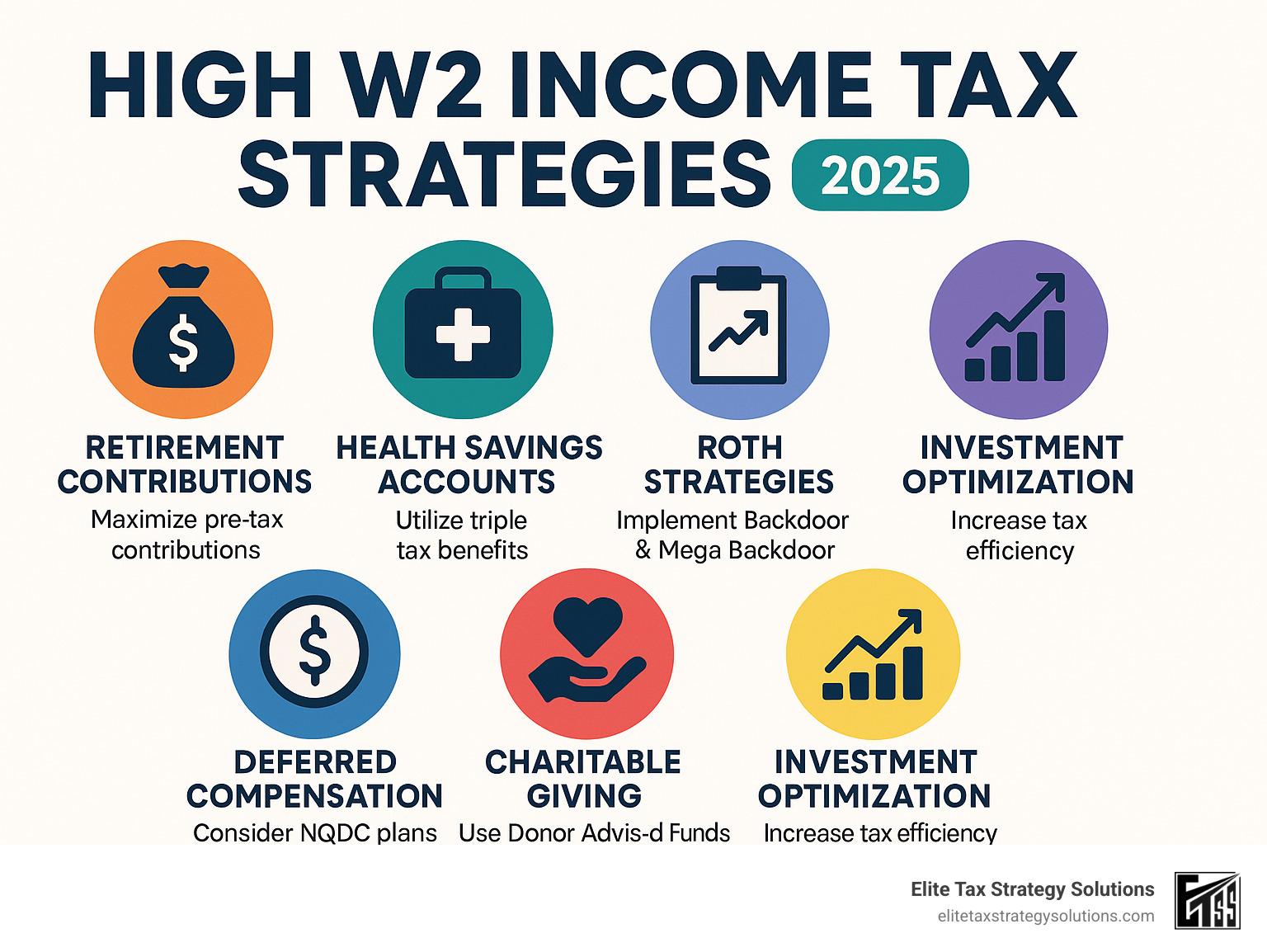
Here are some effective ways high W2 income earners can reduce their taxes:
- Maximize pre-tax retirement contributions (like 401(k), 403(b), and 457(b)).
- Use Health Savings Accounts (HSAs) for triple tax benefits.
- Implement Backdoor Roth and Mega Backdoor Roth strategies.
- Consider Nonqualified Deferred Compensation (NQDC) plans.
- Strategically use Donor Advised Funds (DAFs) for charitable giving.
- Optimize investment portfolios for tax efficiency.
- Explore real estate tax advantages, even for W2 earners.
This guide will show you how these powerful strategies work.
I’m David Fritch. With 40 years of experience as a lawyer, CPA, and investment advisor, I specialize in helping high-income earners implement effective high w2 income tax strategies. My goal is to maximize your tax savings and achieve financial optimization.
Quick look at high w2 income tax strategies:
- tax planning for high salaried employees
- high income individual tax planning
- extra medicare tax for high earners
Foundational Strategies: Maximizing Your “Above-the-Line” Deductions
The primary goal of tax planning is to reduce your current taxable income. The most effective way to start is by maximizing “above-the-line” deductions, which directly lower your Adjusted Gross Income (AGI). While most taxpayers take the standard deduction, using these specific deductions provides a powerful foundation for any high w2 income tax strategies.

For even more foundational insights, dive into our guide on Tax Strategies for High Income W2 Earners.
Boost Your Retirement Savings
This is the most straightforward first step. Maximizing contributions to employer-sponsored plans like 401(k)s and 403(b)s immediately reduces your taxable income. For 2025, you can contribute up to $23,500, plus a $7,500 catch-up contribution if you’re 50 or older. These pre-tax contributions defer taxes until retirement.
When choosing between a Traditional and a Roth 401(k), consider your expected future tax bracket. A Traditional plan offers immediate savings, while a Roth provides tax-free withdrawals in retirement. For those exceeding income limits for direct Roth IRA contributions, the “Backdoor Roth IRA” is a popular strategy. It involves making non-deductible contributions to a Traditional IRA and then converting them to a Roth IRA. Warning: The “pro-rata rule” can make this complex if you have existing pre-tax IRA funds. Professional guidance is crucial here!
You can find more details directly from the source on Tax-advantaged retirement plans, and then dig even deeper into our specific insights on Retirement Tax Strategies for High Income Earners.
Leverage a Health Savings Account (HSA)
If you have a high-deductible health plan (HDHP), a Health Savings Account (HSA) is one of the best tax-advantaged accounts available. It offers a unique “triple tax benefit”:
- Tax-deductible contributions: For 2025, you can contribute up to $4,300 for individuals or $8,600 for families.
- Tax-deferred growth: Investments inside the HSA grow tax-free.
- Tax-free withdrawals: Funds used for qualified medical expenses are withdrawn tax-free.
Many high earners use their HSA as a long-term investment vehicle, paying for current medical costs out-of-pocket to let the HSA funds grow tax-free for retirement.
For the most up-to-date contribution limits, always check the HSA contribution limits. To find more about how Elite Tax Strategy Solutions helps you maximize these savings, visit Maximize Tax Savings.
Use Other Key Deductions
While the 2017 tax law eliminated many itemized deductions, some valuable above-the-line deductions remain.
529 Plans offer tax-deferred growth and tax-free withdrawals for qualified education expenses. Some states also offer a tax deduction for contributions, and they can be a powerful estate planning tool. For more detailed information, consult the official 529 College Savings Plan guide.
Another key deduction is for Student Loan Interest. You can deduct up to $2,500 in interest paid each year, though this deduction phases out at higher income levels.
Advanced High W2 Income Tax Strategies for Significant Savings
After maximizing foundational deductions, it’s time to explore advanced high w2 income tax strategies for more significant tax reductions. These sophisticated methods can uncover hidden advantages and help you keep more of your hard-earned money.
For a comprehensive look at these complex approaches, check out our insights on Advanced Tax Planning.
Deferring Income with Nonqualified Deferred Compensation (NQDC)
If offered by your employer, a Nonqualified Deferred Compensation (NQDC) plan is a powerful tool. It allows you to defer a portion of your salary or bonus until a future date, typically retirement. This deferred income is not taxed in the year it’s earned, directly reducing your current tax liability. The funds grow tax-deferred, and you only pay taxes upon withdrawal, ideally in a lower-income year. This can also help you qualify for other tax benefits that have income limits. Ask your HR department if an NQDC plan is available. Learn more from the IRS on Deferred compensation plans and how we can assist with Salary Tax Planning.
Strategic Charitable Giving to Maximize Deductions
For the charitably inclined, strategic giving can significantly reduce your tax bill, especially if your contributions allow you to itemize your deductions. A key strategy is bunching contributions: consolidating several years’ worth of donations into a single high-income year to exceed the standard deduction. A Donor-Advised Fund (DAF) is an excellent tool for this; you get an immediate tax deduction and can distribute the funds to charities over time. Also, consider donating appreciated securities held for over a year. You can deduct their full market value and avoid paying capital gains tax. For those 70.5 or older, Qualified Charitable Distributions (QCDs) allow you to donate up to $100,000 annually directly from your IRA, satisfying your RMD without the income being taxed. Understand your options for Charitable Contribution Deductions and explore how we can help with Deduction Optimization.
Opening up Real Estate Tax Benefits
W2 earners can leverage real estate for significant tax benefits. Rental properties allow you to take depreciation deductions, creating a “paper” loss that can offset rental income. A cost segregation study can accelerate these deductions. Two key strategies for W2 earners are:
- The short-term rental loophole: If you materially participate in a short-term rental (average stay of 7 days or less), you may be able to use depreciation losses to offset your active W2 income. This requires meeting specific participation tests.
- Real Estate Professional Status (REPS) for a spouse: If a non-working or part-time spouse qualifies as a Real Estate Professional (spending >750 hours and >50% of their working time on real estate), they can deduct unlimited rental losses against any household income, including your W2 salary.
These strategies are complex and require meticulous documentation, but the tax savings can be substantial.
Optimizing Your Investment Portfolio for Tax Efficiency
Optimizing your investment portfolio can minimize the tax drag on your returns. Tax-loss harvesting involves selling losing investments to offset capital gains and up to $3,000 of ordinary income annually. Asset location is another key strategy: place tax-inefficient assets (like actively managed funds or REITs) in tax-deferred accounts (401k, IRA) and high-growth assets in tax-free accounts (Roth IRA, HSA). Taxable accounts are best for tax-efficient investments like municipal bonds (which offer tax-free interest income) and broad-market ETFs, which tend to be more tax-efficient than mutual funds. Understanding Capital gains and losses is fundamental to these strategies. We can help you implement Tax Efficient Investments to maximize your after-tax returns.
Navigating Special Situations and Recent Law Changes
The tax world is always changing. For high-income W2 earners, staying current on these shifts and leveraging unique situations like a side business is key to keeping your high w2 income tax strategies effective. Proactive planning is essential.
Being proactive like this is a big part of smart Personal Tax Planning.

Managing a Side Business for Additional Deductions
A side business can open up significant tax deductions unavailable to most W2 employees. By forming an LLC and treating your side hustle as a legitimate business, you can deduct ordinary and necessary expenses. This includes a potential Home Office Deduction, Business Travel & Meals (often 50% deductible), and Health Insurance Premiums if you’re self-employed. A side business also opens up powerful retirement savings vehicles like a SEP IRA or Solo 401(k), which allow for much larger pre-tax contributions than a traditional IRA, further reducing your current taxable income. Just be sure to follow the Home Office Deduction rules carefully!
The Impact of SECURE Act 2.0 on High Earners
The SECURE Act 2.0 introduced important changes for retirement planning. Key updates for high earners include:
- Later RMD Age: The age for Required Minimum Distributions (RMDs) was pushed to 73 and will eventually go to 75, allowing funds more time for tax-deferred growth.
- Increased Catch-Up Contributions: Starting in 2025, those aged 60-63 can make even larger catch-up contributions to employer-sponsored plans.
- 529 to Roth IRA Rollovers: You can now roll over up to $35,000 (lifetime limit) from a 529 plan to a Roth IRA, tax and penalty-free, subject to certain rules.
These changes open up new doors for saving money efficiently. You can dive deeper into the specifics of The SECURE Act and learn how it shapes your Tax Efficient Retirement Planning.
Advanced high w2 income tax strategies: When to Execute a Roth Conversion
A Roth conversion involves moving pre-tax funds from a Traditional IRA or 401(k) to a Roth IRA. You pay income tax on the converted amount now, but qualified withdrawals in retirement are tax-free. The best time for a conversion is often during a Low-Income Year (e.g., sabbatical, early retirement) to pay tax at a lower rate. It’s a strategic bet that your tax rate will be higher in the future. A conversion helps create a source of Tax-Free Retirement Income and avoids future RMDs on those funds. Be aware of the 5-year rule for withdrawing converted amounts penalty-free. Learn more about How High Income Earners Can Retire Without Giving Uncle Sam a Fortune.
Frequently Asked Questions about High W2 Income Tax Strategies
Here are answers to some of the most common questions about high W2 income tax strategies.
What is the single most effective tax strategy for a high-income W2 employee?
While there’s no single magic bullet, the most effective starting point is to maximize contributions to tax-advantaged accounts. This provides a dollar-for-dollar reduction of your current taxable income. Key accounts include:
- 401(k)/403(b): Your first and most powerful line of defense.
- Health Savings Account (HSA): Offers a powerful triple-tax advantage if you have a high-deductible health plan.
- Nonqualified Deferred Compensation (NQDC): If available, this allows you to defer large portions of your income, significantly lowering your current tax bill.
These strategies are foundational because they directly reduce the income the IRS sees, leading to immediate tax savings.
Can a W2 employee really benefit from real estate tax deductions?
Absolutely. While it requires strategic planning, W2 earners can gain significant tax benefits from real estate. The two primary strategies are:
- The “Short-Term Rental Loophole”: If you materially participate in managing a short-term rental (like an Airbnb or VRBO), you may be able to use depreciation losses to offset your W2 income.
- Real Estate Professional Status (REPS) for a non-working spouse: If a spouse qualifies as a real estate professional, their rental property losses can be used to offset any household income, including your high W2 salary.
Both of these strategies require careful attention to IRS rules and meticulous record-keeping, but the potential for substantial tax benefits makes them well worth exploring.
Why is professional tax guidance crucial for high W2 earners?
Professional guidance is crucial because these strategies are complex, and mistakes can be costly. An expert helps you:
- Steer Complexity: Avoid pitfalls like the Backdoor Roth “pro-rata rule” or misinterpreting material participation for real estate.
- Avoid Costly Errors: Prevent mistakes that could lead to overpaying taxes, penalties, or an IRS audit.
- Stay Compliant: Ensure your strategies are legal and properly documented as tax laws evolve.
- Create a Personalized Plan: Integrate multiple strategies into a cohesive plan custom to your unique financial goals and situation for maximum tax savings.
A tax professional acts as your financial navigator, steering you through the complex waters of the tax code to ensure you keep more of your hard-earned money and achieve true financial optimization.
Conclusion: Taking Control of Your W2 Tax Bill
As a high-income W2 employee, you don’t have to accept a high tax bill. By being proactive, you can use legitimate and powerful high w2 income tax strategies to keep more of your hard-earned money and accelerate your financial goals. The key is to leverage the tax code to your advantage. By maximizing retirement accounts, using HSAs and NQDC plans, giving charitably, exploring real estate, and optimizing investments, you can take control of your tax situation. You’re not just earning; you’re optimizing.

At Elite Tax Strategy Solutions, we specialize in helping high earners steer this complex landscape. Our proactive approach to tax optimization and compliance means we craft a personalized strategy designed for you, aimed at maximizing savings and securing your financial future.
Ready to take control of your tax bill and open up your full financial potential? We’re here to help. Find our innovative tax planning services and let’s build your custom plan together.