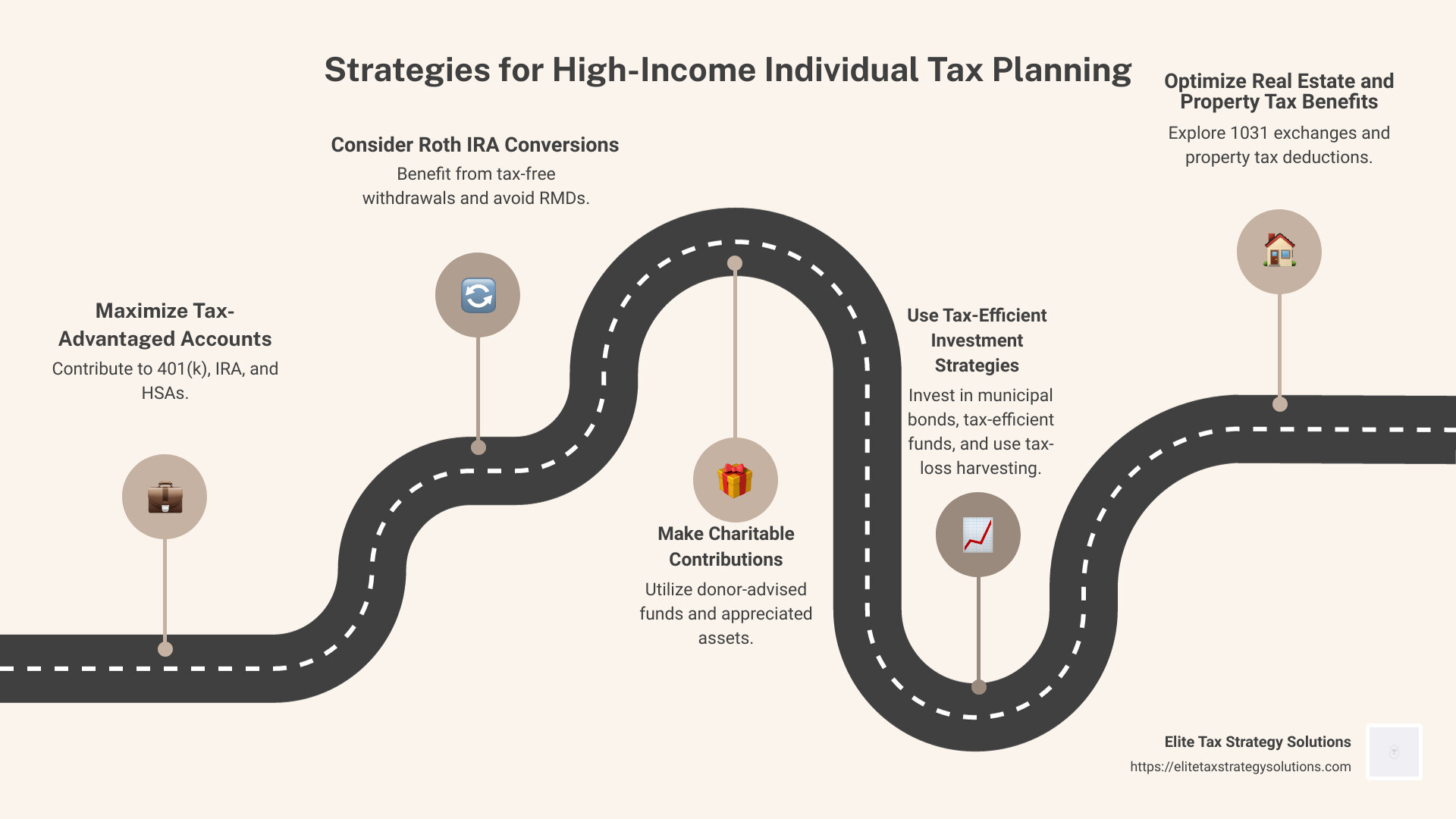
High income individual tax planning is crucial for those earning substantial incomes. It helps manage and reduce your tax burden, ensuring you don’t pay more than necessary. Here are some essential strategies for reducing your tax burden:
- Maximize tax-advantaged account contributions (401(k), IRA, HSA)
- Consider Roth IRA conversions
- Make charitable contributions
- Use tax-efficient investment strategies
- Optimize real estate and property tax benefits
- Use Health Savings Accounts (HSAs)
- Plan your tax residency wisely
Tax planning is vital for high-income earners to preserve wealth and meet long-term financial goals. As your income increases, so does tax complexity. It’s easy to feel overwhelmed but remember, thoughtful planning can substantially reduce your taxable income.
My name is David Fritch, and with over 40 years of experience in tax planning and financial advisory, I’ve guided numerous clients through the maze of high income individual tax planning. My aim is to help you optimize tax savings while ensuring financial stability.
High income individual tax planning terms to know:
– extra medicare tax for high earners
– financial planning for high income earners
– high net worth tax strategies
Understanding High Income Tax Brackets
When it comes to high income individual tax planning, understanding tax brackets is crucial. Knowing how your income is taxed can help you make informed decisions to minimize your tax burden. Let’s break it down:
Federal Tax Brackets
The federal tax system in the U.S. is progressive, meaning that higher income is taxed at higher rates. For 2023, the highest tax bracket is 37%. This applies to:
- Single filers with taxable income over $578,125
- Married couples filing jointly with taxable income over $693,750
Your taxable income is your adjusted gross income (AGI) minus deductions. For instance, if your AGI is $800,000 and you have $100,000 in deductions, your taxable income would be $700,000. This puts you in the 37% bracket for the amount over $693,750.
State Tax Brackets
State taxes add another layer of complexity. Each state has its own tax rates and brackets. For example, California has a top marginal tax rate of 13.3%, while Florida has no state income tax at all. Understanding your state’s tax system can help you plan better.
IRS Definition of High-Income Earners
The IRS defines high-income earners as those with Total Positive Income (TPI) of $200,000 or more. TPI includes all positive income amounts reported on your tax return, such as wages, interest, and dividends.
Taxable Income
Taxable income is the portion of your income subject to tax after deductions. It’s different from your AGI, which is your total income minus certain “above-the-line” deductions like contributions to retirement accounts.
Here’s a quick example:
- Total Income: $600,000
- Above-the-Line Deductions: $50,000 (e.g., 401(k) contributions, HSA contributions)
- Adjusted Gross Income (AGI): $550,000
- Standard Deduction: $27,700 (for married couples filing jointly in 2023)
- Taxable Income: $522,300
Knowing your taxable income helps you understand which federal and state tax brackets you fall into, allowing for better planning and potential tax savings.
Key Takeaways
- Federal tax brackets are progressive; higher income means higher tax rates.
- State tax brackets vary widely; some states have no income tax.
- The IRS considers $200,000+ in TPI as high income.
- Taxable income is your AGI minus deductions.
Understanding these elements can help you steer the complexities of high-income tax planning and find opportunities to reduce your tax burden. Next, we’ll explore strategies to maximize tax-advantaged accounts and further lower your taxable income.
Maximize Tax-Advantaged Accounts
One of the most effective ways to reduce your tax burden as a high-income earner is to maximize contributions to tax-advantaged accounts. These accounts offer significant tax benefits, allowing you to save more for the future while lowering your taxable income today. Let’s dive into the key types of accounts you should consider:
401(k) Contributions
A 401(k) plan is a powerful tool for tax-deferred savings. In 2024, you can contribute up to $23,000 to your 401(k). If you are 50 or older, you can make an additional catch-up contribution of $7,500, bringing your total potential contribution to $30,500.
Example: If you earn $200,000 and contribute the maximum $23,000 to your 401(k), your taxable income is reduced to $177,000, potentially moving you into a lower tax bracket.
IRA Contributions
Individual Retirement Accounts (IRAs) offer another avenue for tax-advantaged savings. For 2024, you can contribute up to $7,000 to a traditional IRA, or $8,000 if you are 50 or older. Contributions to a traditional IRA may be tax-deductible, depending on your income and whether you have a retirement plan at work.
Tip: Even if you have a 401(k) at work, you might still benefit from contributing to an IRA. Check the IRS rules to see if you qualify for deductions based on your income.
Health Savings Accounts (HSAs)
HSAs are not just for medical expenses—they are also a tax-saving powerhouse. To contribute to an HSA, you must have a high-deductible health plan. For 2024, the contribution limits are $4,150 for individuals and $8,300 for families. If you are 55 or older, you can contribute an extra $1,000.
Fact: Contributions to an HSA are tax-deductible, the account grows tax-free, and withdrawals for qualified medical expenses are also tax-free. This triple tax advantage makes HSAs an excellent option for high-income earners.
Catch-Up Contributions
If you are 50 or older, you can take advantage of catch-up contributions to boost your retirement savings. This is especially beneficial if you started saving later in life or want to maximize your tax-advantaged savings as you approach retirement.
Summary:
– 401(k): Up to $30,500 (with catch-up)
– IRA: Up to $8,000 (with catch-up)
– HSA: Up to $9,300 (with catch-up)
Maximizing contributions to these accounts can significantly reduce your taxable income and help you build a substantial nest egg for retirement. Next, we’ll explore Roth IRA conversions and how they can offer tax-free growth and withdrawals.
Roth IRA Conversions
Roth IRA conversions are a powerful tool for high-income earners looking to minimize future tax burdens. Let’s break down the key benefits and strategies.
Roth IRA Benefits
Roth IRAs offer several advantages, making them an attractive option for tax planning:
- Tax-Free Growth: Once you contribute to a Roth IRA, your investments grow tax-free. This means you don’t pay taxes on dividends, interest, or capital gains within the account.
- Tax-Free Withdrawals: In retirement, you can withdraw your contributions and earnings tax-free, provided you meet the conditions. This can be a huge benefit in managing your tax liability in retirement.
- No Required Minimum Distributions (RMDs): Unlike traditional IRAs, Roth IRAs do not require you to take distributions at age 73. This allows your investments to continue growing tax-free for as long as you like.
Conversion Strategy
A Roth IRA conversion involves transferring funds from a traditional IRA or a 401(k) into a Roth IRA. Here’s how to do it effectively:
- Choose the Right Time: Convert during a low-income year. This helps minimize the tax impact since the amount converted is added to your taxable income for that year.
- Partial Conversions: Instead of converting all at once, consider spreading the conversion over several years. This can help manage your tax bracket and avoid a large tax bill in any single year.
- Monitor Tax Brackets: Keep an eye on your marginal tax rate. If you’re close to moving into a higher bracket, you might want to convert just enough to stay within your current bracket.
Tax-Free Withdrawals
One of the most compelling reasons to convert to a Roth IRA is the ability to make tax-free withdrawals in retirement. To qualify:
- Five-Year Rule: You must have held the Roth IRA for at least five years.
- Age 59½ Rule: Withdrawals must be made after you turn 59½ to avoid penalties and taxes on earnings.
Example: If you convert $50,000 from a traditional IRA to a Roth IRA at age 50, you can start making tax-free withdrawals at age 59½, assuming the five-year rule is met.
RMD Avoidance
Traditional IRAs require you to start taking RMDs at age 73, which can significantly increase your taxable income. Roth IRAs, however, do not have RMDs, offering more flexibility in managing your retirement income.
Fact: By converting to a Roth IRA, you can avoid forced withdrawals, allowing your investments to grow tax-free for as long as you like.
Tip: Consider converting smaller amounts each year to manage your tax bracket and avoid large, unexpected tax bills.

By strategically converting to a Roth IRA, you can enjoy tax-free growth and withdrawals, avoid RMDs, and better manage your tax liability in retirement. Next, we’ll explore how charitable contributions can further reduce your tax burden.
Charitable Contributions
Charitable contributions can significantly reduce your tax burden while supporting causes you care about. Let’s explore key strategies: donor-advised funds, appreciated assets, and qualified charitable distributions.
Donor-Advised Funds
A donor-advised fund (DAF) is a charitable investment account that offers immediate tax benefits and allows you to recommend grants over time.
How it works:
1. Contribute Assets: You can donate cash, stocks, or other assets to a DAF.
2. Immediate Deduction: You receive an immediate tax deduction for the fair market value of the assets.
3. Grant Over Time: You can recommend grants to your favorite charities at any time.
Example: By contributing $50,000 in appreciated stocks to a DAF, you avoid capital gains tax on the appreciation and get a tax deduction for the full $50,000.
Appreciated Assets
Donating appreciated assets like stocks or real estate instead of cash can be a tax-efficient way to give.
Benefits:
– Avoid Capital Gains Tax: You don’t pay capital gains tax on the appreciation.
– Fair Market Value Deduction: You can deduct the fair market value of the asset.
Case Study: Jane owns stock worth $100,000, which she bought for $40,000. By donating the stock to charity, she avoids paying capital gains tax on the $60,000 appreciation and gets a deduction for the full $100,000.
Qualified Charitable Distributions (QCDs)
A QCD allows individuals aged 70.5 or older to donate up to $100,000 directly from their IRA to a charity, avoiding taxable income.
Advantages:
– Avoid Higher Tax Bracket: The distribution doesn’t count as taxable income.
– Satisfy RMDs: QCDs count towards your required minimum distributions (RMDs).
Fact: In 2022, QCDs can reduce your taxable income by up to $100,000 per individual.
Tax Deductions
To maximize your charitable deductions, consider these strategies:
- Bunching Donations: Consolidate multiple years’ worth of donations into one year to exceed the standard deduction threshold.
- Timing: Make donations in high-income years to maximize your tax savings.
Example: If you typically donate $10,000 per year, bunching three years’ worth of donations into one year ($30,000) could help you exceed the standard deduction and itemize your deductions.
By using these charitable giving strategies, you can reduce your tax burden while making a positive impact. Next, let’s dive into investment strategies for tax efficiency.
Investment Strategies for Tax Efficiency
High-income earners can significantly reduce their tax burden by adopting smart investment strategies. Here are some key approaches:
Municipal Bonds
Municipal bonds, or “munis,” are debt securities issued by local governments. They offer a unique tax advantage: the interest income is generally exempt from federal income tax, and often state and local taxes if you live in the issuing locality.
Why Consider Munis:
– Tax-Free Interest: Munis provide tax-free interest payments, making them attractive for high-income earners.
– Lower Default Risk: Historically, municipal bonds have lower default rates compared to corporate bonds. From 1970 to 2022, the default rate for munis was just 0.08%, compared to 6.9% for global corporate issuers.
Example: If you’re in a high tax bracket, the tax-equivalent yield of a municipal bond can be more appealing than taxable bonds, even if the interest rate is lower.
Tax-Efficient Funds
Investing in tax-efficient funds like index funds and exchange-traded funds (ETFs) can help minimize your tax liability. These funds are designed to be more tax-advantaged than actively managed funds.
Benefits:
– Lower Turnover: Index funds and ETFs typically have lower turnover rates, resulting in fewer taxable events.
– Capital Gains Efficiency: These funds often distribute fewer capital gains, reducing your tax bill.
Fact: Tax-efficient funds can help you keep more of your investment returns by minimizing taxes on capital gains and dividends.
Tax-Loss Harvesting
Tax-loss harvesting involves selling investments that have declined in value to offset capital gains from other investments. This strategy can reduce your overall tax liability.
How It Works:
1. Sell Losing Investments: Sell investments that are currently at a loss.
2. Offset Gains: Use the losses to offset any capital gains you have realized.
3. Carry Forward Losses: If your losses exceed your gains, you can use up to $3,000 of the excess to offset other income and carry forward any remaining losses to future tax years.
Example: If you have $10,000 in capital gains and $7,000 in capital losses, you can offset the gains with the losses, reducing your taxable capital gains to $3,000.
Beware of Wash-Sale Rules: These rules prevent you from repurchasing the same or a substantially identical security within 30 days of selling it for a loss.
Qualified Opportunity Zones
The Tax Cuts and Jobs Act of 2017 introduced Qualified Opportunity Zones (QOZs) to encourage investment in distressed communities. By investing in a Qualified Opportunity Fund (QOF), you can defer or reduce capital gains taxes.
Advantages:
– Tax Deferral: You can defer capital gains taxes on the initial investment until the earlier of the date you sell the QOF investment or December 31, 2026.
– Tax Reduction: If you hold the investment for at least 10 years, you can potentially eliminate capital gains taxes on the appreciation of the QOF investment.
Case Study: If you reinvest $100,000 of capital gains into a QOF and hold it for 10 years, any appreciation on the QOF investment could be tax-free.
By incorporating these investment strategies into your financial plan, you can optimize your tax efficiency and grow your wealth more effectively. Next, let’s explore real estate and property tax strategies.
Real Estate and Property Tax Strategies
Real estate can be a powerful tool for high-income earners to reduce their tax burden. Here are some effective strategies to consider:
Inherited Real Estate
When you inherit real estate, the IRS allows a “step-up” in basis. This means the property’s tax basis is adjusted to its fair market value at the time of inheritance, rather than the original purchase price.
Benefits:
– Reduced Capital Gains Tax: When you sell the inherited property, your capital gains tax is based on the stepped-up basis, potentially lowering your tax liability.
– Tax Deferral: If you choose to hold onto the property, you can defer taxes until you sell it.
Example: If your parents bought a house for $100,000 and it’s worth $500,000 when you inherit it, your new basis is $500,000. If you sell it for $600,000, you only pay capital gains tax on the $100,000 increase, not the $500,000.
Property Tax Deductions
Property taxes can take a significant bite out of your income, but there are ways to mitigate this through deductions.
Key Points:
– SALT Deduction: You can deduct up to $10,000 in state and local taxes (SALT) from your federal taxable income. This includes property taxes.
– Itemizing Deductions: To take advantage of the SALT deduction, you must itemize your deductions rather than taking the standard deduction.
Tip: Pay property taxes early if you haven’t reached the $10,000 SALT cap. Some states and counties offer discounts for early payments, providing additional savings.
1031 Exchanges
A 1031 exchange allows you to defer capital gains taxes when you sell an investment property and reinvest the proceeds in a similar property.
How It Works:
1. Sell Property: Sell your investment property and identify a replacement property within 45 days.
2. Reinvest Proceeds: Reinvest the proceeds into the replacement property within 180 days.
3. Tax Deferral: Deferred taxes on the capital gains until you sell the replacement property.
Benefits:
– Tax Deferral: Defer capital gains taxes, allowing more capital to be reinvested.
– Wealth Accumulation: Keep more money working for you, potentially increasing your wealth over time.
Case Study: Suppose you sell a rental property for $1 million with a $500,000 gain. By using a 1031 exchange to buy a new property for $1.2 million, you defer the $500,000 capital gains tax, allowing you to invest the full amount into the new property.
By leveraging these real estate and property tax strategies, you can significantly reduce your tax burden and maximize your investment returns. Next, let’s look into Health Savings Accounts (HSAs).
Health Savings Accounts (HSAs)
Health Savings Accounts (HSAs) offer a triple tax advantage for high-income earners: tax-deductible contributions, tax-free growth, and tax-free withdrawals for qualified medical expenses. Here’s how you can use HSAs for effective high income individual tax planning:
HSA Contributions
To contribute to an HSA, you must be enrolled in a high-deductible health plan (HDHP). For 2024, the contribution limits are:
- $4,150 for individuals
- $8,300 for families
If you’re 55 or older, you can contribute an additional $1,000 as a catch-up contribution. These contributions are tax-deductible, reducing your taxable income for the year.
Tax-Free Growth
One of the most compelling aspects of HSAs is that the money you contribute grows tax-free. You can invest your HSA funds in a variety of options, including stocks, bonds, and mutual funds, allowing your savings to grow over time without the drag of taxes.
Example: If you contribute $8,000 annually to your HSA and earn a 6% return, your balance could grow to over $100,000 in 10 years, all tax-free.
Qualified Medical Expenses
Withdrawals from an HSA are tax-free if used for qualified medical expenses. This includes a wide range of expenses such as:
- Doctor visits
- Prescription medications
- Dental and vision care
- Over-the-counter medications and first aid supplies
If you withdraw money for non-qualified expenses before age 65, you’ll face a 20% penalty plus ordinary income tax. After age 65, you can withdraw funds for any purpose without the penalty, though you’ll pay ordinary income tax on non-medical withdrawals.
Long-Term Strategy
HSAs are not “use-it-or-lose-it” accounts like Flexible Spending Accounts (FSAs). The funds in your HSA roll over year after year, allowing you to build a substantial nest egg for future medical expenses or even to supplement your retirement savings.
Tip: Consider investing your HSA contributions for the long term instead of spending them on current medical expenses. This allows your money to grow tax-free and be available for future healthcare costs.
By leveraging the benefits of HSAs, high-income earners can enjoy significant tax savings while preparing for future medical expenses. Next, let’s explore the advantages of tax residency planning.
Tax Residency Planning
Tax residency planning can be a powerful tool for high-income earners looking to reduce their tax burden. By strategically choosing your primary residence, you can take advantage of lower state income taxes and other tax benefits.
State Income Tax
State income tax rates vary widely. Some states have high rates, while others have no state income tax at all. For example, states like California and New York have high state income tax rates, whereas states like Florida, Texas, and Nevada have no state income tax.
States with No State Income Tax:
– Alaska
– Florida
– Nevada
– New Hampshire
– South Dakota
– Tennessee
– Texas
– Washington
– Wyoming
By establishing residency in a state with no income tax, you can potentially save thousands of dollars annually.
Residency Requirements
Establishing residency in a new state isn’t just about spending more time there. States have specific requirements to determine residency, such as:
- Physical Presence: You need to spend a significant amount of time in the state, often over six months per year.
- Home Ownership or Rental: Owning or renting a home in the state can help establish residency.
- Driver’s License and Voter Registration: Changing your driver’s license and voter registration to the new state.
- Bank Accounts and Professional Services: Using local banks, doctors, and other services.
Tax Benefits
The benefits of tax residency planning go beyond just state income tax savings. Some states offer additional tax advantages, such as:
- No Estate or Inheritance Tax: States like Florida and Texas do not impose estate or inheritance taxes.
- Lower Property Taxes: Some states have lower property taxes, which can add up to significant savings over time.
- Tax Incentives: Certain states offer tax credits or incentives for specific activities, such as investing in renewable energy or contributing to a state-sponsored college savings plan.
Example Scenario
Case Study: A high-income earner lives in California and pays a state income tax rate of 13.3%. By moving to Texas, which has no state income tax, this individual can save a significant amount on their state tax bill. If they earn $500,000 annually, this move could save them approximately $66,500 each year.
By carefully planning your tax residency, you can optimize your tax situation and potentially save a substantial amount of money. Next, let’s address some frequently asked questions about high income individual tax planning.
Frequently Asked Questions about High Income Individual Tax Planning
How to reduce taxes as a high-income earner?
Reducing taxes as a high-income earner involves several smart strategies:
1. Maximize Retirement Contributions:
Contributing the maximum allowed to tax-advantaged retirement accounts like 401(k)s and IRAs can significantly reduce your taxable income. For 2024, the 401(k) contribution limit is $22,500, with an additional $7,500 catch-up contribution allowed for those aged 50 and older.
2. Make Charitable Donations:
Charitable contributions are a great way to lower your tax bill. Donating appreciated assets, such as stocks, can provide a double benefit: you avoid paying capital gains taxes and receive a deduction for the full market value of the asset.
3. Time Your Income:
If possible, defer income to years when you expect to be in a lower tax bracket. For example, by deferring bonuses or delaying the exercise of stock options, you can manage your taxable income more effectively.
What is considered a high-income taxpayer?
The IRS defines a high-income taxpayer as someone who reports $200,000 or more in Total Positive Income (TPI) on their tax return. For married couples filing jointly, this threshold is $400,000.
Income Thresholds for 2023:
– Single Filers: $182,101 and above
– Married Filing Jointly: $364,201 and above
Being classified as a high-income taxpayer can subject you to higher tax rates and additional taxes, such as the Net Investment Income Tax (NIIT).
How to avoid the 32% tax bracket?
Avoiding the 32% tax bracket requires strategic planning:
1. Max Out Retirement Plans:
Maximizing contributions to your 401(k) and IRA can lower your taxable income. For instance, contributing the full $22,500 to a 401(k) can significantly reduce your taxable income.
2. Use Deductible Expenses:
Take advantage of all possible deductions. This includes mortgage interest, medical expenses exceeding 7.5% of your AGI, and state and local taxes (up to $10,000).
3. Consider Roth Conversions:
While a Roth conversion is a taxable event, it can be strategically timed to avoid higher tax brackets in the future. Roth IRAs allow for tax-free withdrawals in retirement, which can help manage your tax bracket later on.
4. Charitable Contributions:
Donating to charity not only supports causes you care about but also provides a tax deduction. Consider using a donor-advised fund to manage your charitable giving and maximize tax benefits.
5. Manage Investment Income:
Invest in tax-efficient funds and consider tax-loss harvesting to offset gains. Municipal bonds are also a good option as their interest is often exempt from federal and sometimes state taxes.
By implementing these strategies, high-income earners can effectively reduce their taxable income and avoid higher tax brackets.
Next, we’ll explore the importance of proactive planning and how Elite Tax Strategy Solutions can help you steer the complexities of high-income individual tax planning.
Conclusion
In summary, high income individual tax planning is essential for reducing your tax burden and enhancing your financial well-being. By understanding tax brackets, maximizing tax-advantaged accounts, and employing smart strategies like Roth IRA conversions and charitable contributions, you can significantly lower your taxable income.
Proactive planning is crucial. The tax landscape is constantly evolving, and what works today might not be effective tomorrow. Regularly reviewing your tax situation and adjusting your strategies is key to staying ahead.
At Elite Tax Strategy Solutions, we specialize in providing personalized tax planning services for high earners and closely held businesses. Our proactive approach ensures that you maximize your tax savings while maintaining compliance with ever-changing tax regulations.
By integrating tax planning with your overall financial goals, we help you achieve financial stability and long-term success.
Visit our Innovative Tax Planning page to learn more about how we can assist you in navigating the complexities of high-income individual tax planning.
Don’t let taxes get the best of you—commit to proactive planning and let us help you keep more of what you’ve earned.