Why Double Taxation Doesn’t Have to Drain Your Profits
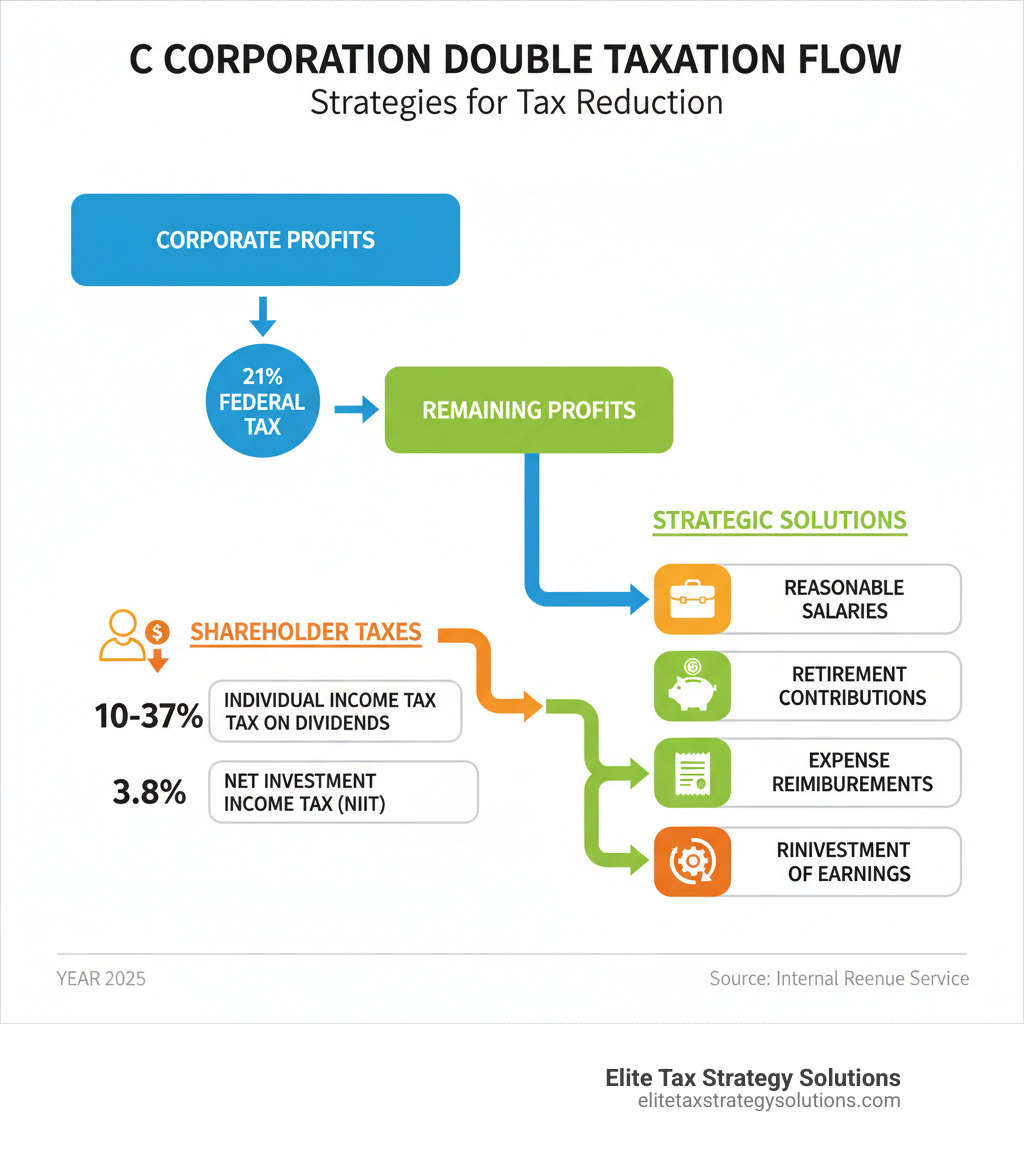
Corporate tax reduction strategies are essential for C corporation owners. Unlike pass-through entities, C corporations face double taxation: profits are taxed at the corporate level (21% federal rate) and again when distributed to shareholders as dividends.
Quick Corporate Tax Reduction Strategies:
- Optimize compensation mix – Pay reasonable salaries instead of dividends to reduce double taxation
- Time income and expenses – Defer revenue and accelerate deductions strategically
- Maximize depreciation – Use Section 179 expensing and bonus depreciation for equipment
- Claim all available tax credits – R&D credits, energy credits, and hiring incentives
- Leverage retirement contributions – Tax-deductible contributions for owners and employees
- Manage international operations – Use transfer pricing and foreign tax credits efficiently
The good news is that smart C corp owners can dramatically reduce their tax burden. Research shows businesses using proactive tax planning can achieve significant savings, with some case studies showing savings of $48 million on large asset sales through proper structuring.
Effective tax planning isn’t just about minimizing liabilities; it’s about strategically positioning your business for long-term success. C corporations have numerous tools at their disposal, from managing income timing to maximizing deductions and credits.
I’m David Fritch. With 40 years of experience as a law firm and CPA practice owner, I’ve helped countless businesses implement corporate tax reduction strategies. My expertise with high-income earners shows that the right approach turns tax planning into a competitive advantage.
Corporate tax reduction strategies vocab explained:
Understanding the C Corp Tax Landscape
Think of a C corporation as its own person in the eyes of the tax law. This separate legal entity status protects your personal assets and helps attract investors, but it also creates a unique tax situation.
At the federal level, your C corp pays a flat 21% corporate tax rate on its profits. This rate, a result of the Tax Cuts and Jobs Act (TCJA) of 2017, is a significant reduction from previous rates as high as 35%.
However, the federal bill is just the start. Most states also impose their own corporate income taxes, with 44 states levying rates from 2.25% to 11.5%. Some states add gross receipts taxes as well.
This layered tax environment makes smart corporate tax reduction strategies crucial. Understanding how these taxes interact can save your business substantial money. For fundamentals, the IRS offers guidance on the basics of C corp taxation.
What is ‘Double Taxation’ and How Does it Work?
Double taxation is why C corporations can be expensive without proper planning. Understanding it is the first step to managing it.
The process has two phases. First, your corporation pays tax on its profits at the 21% federal rate (plus state taxes). This is the corporate level tax.
Next, when you distribute after-tax profits to shareholders as dividends, the IRS taxes this as income to the recipients. These dividend distributions are taxed at individual rates from 10% to 37%, and high earners may face an additional 3.8% Net Investment Income Tax.
For example, a C corp with $100,000 in profit pays $21,000 in corporate tax. If the remaining $79,000 is distributed as dividends to a shareholder in the 24% tax bracket, they owe another $18,960. The total tax is nearly $40,000 on the original $100,000 profit.
A key silver lining is retained earnings. When your corporation keeps profits for reinvestment instead of distributing them, you only pay the first layer of tax. This is a powerful strategy for growing companies needing capital for expansion or equipment.
C Corp vs. S Corp: A Quick Tax Comparison
The choice between a C corp and an S corp depends on your specific goals.
S corporations are pass-through entities, so they don’t pay corporate income tax. Profits and losses flow directly to the owners’ personal tax returns, eliminating double taxation. S corp owners might also qualify for the Qualified Business Income (QBI) deduction, reducing their taxable income by up to 20%.
C corporations face double taxation but offer more flexibility. They have no limits on the number or type of shareholders, while S corps are restricted to 100 U.S. citizen or resident shareholders.
Regarding profit distribution, C corp owners receive dividends, which are taxed as described above. S corp owners receive distributions that are generally tax-free, provided they have sufficient basis in their stock.
However, C corps excel in reinvestment benefits. If your strategy is to keep profits in the company for growth, the 21% corporate tax rate can be more attractive than the higher individual rates S corp owners face on all profits, whether distributed or not.
If you plan to take money out of the business regularly, an S corp often makes more sense. If you’re building for the future and reinvesting profits, a C corp can be the better long-term choice.
Core Corporate Tax Reduction Strategies
Think of tax planning like building a house; you need a solid foundation. The corporate tax reduction strategies in this section are that foundation, helping you keep more profits in your business.

Mitigating Double Taxation Through Smart Compensation
Many C corp owners focus too much on dividends. A better approach involves smart compensation planning.
Reasonable salaries are your first defense against double taxation. Paying yourself and other shareholder-employees a salary creates a deductible business expense for the corporation, reducing its taxable income. The IRS requires these salaries to be “reasonable,” reflecting fair market value for the job.
Health insurance premiums are another powerful tool. When your C corp pays for health coverage, it gets a tax deduction, and you receive a non-taxable benefit—a rare win-win.
Retirement plan contributions (e.g., SEP-IRA, 401(k)) create immediate tax savings while building your future. The corporation deducts its contributions, and you build tax-deferred wealth. Small businesses may even get a tax credit for starting a plan.
Don’t forget expense reimbursements. When the corporation reimburses you for legitimate business expenses paid out-of-pocket, it gets a deduction without creating taxable income for you. Just keep detailed records.
Strategically Managing Income and Expenses
Timing is everything in tax planning. Smart corporate tax reduction strategies often involve controlling when income is recognized and when expenses are deducted.
Income deferral is effective if you expect lower profits or tax rates next year. For cash-basis businesses, this could mean delaying an invoice until January. Accrual-basis companies can use installment sales to spread gains over several years.
Conversely, expense acceleration is useful in a profitable year. Prepaying expenses like insurance, stocking up on supplies, or buying equipment before year-end creates immediate deductions.
Your accounting method (cash vs. accrual) dictates your flexibility. Cash-basis businesses have more control over timing. To change your accounting method, you typically need IRS approval.
Year-end planning should start in the fourth quarter, allowing you to make strategic moves like accelerating purchases or timing bonus payments.
Maximizing Business Deductions and Write-Offs
Every missed business expense is money left on the table. C corporations can claim numerous deductions to reduce their tax burden.
Net Operating Losses (NOLs) offer relief in a tough year. While you can’t carry back losses from 2021 forward, you can carry them forward indefinitely to offset up to 80% of taxable income in a future year.
Charitable contributions let you support causes while saving on taxes. C corporations can generally deduct cash contributions up to 10% of their taxable income.
Bad debts are deductible for accrual-basis taxpayers when accounts receivable become worthless.
Standard business deductions include office rent, utilities, supplies, insurance, professional fees, advertising, and employee expenses. Business travel and meals (with limitations) also qualify. The key is maintaining excellent records. For a good overview, see this list of common business deductions.
Every deduction should be legitimate and well-documented. The goal is to pay your fair share—no more, no less.
Advanced Tax Savings: Depreciation, Credits, and International Planning
As your business grows, so do your opportunities for advanced corporate tax reduction strategies. This is the master class of tax planning, covering depreciation, tax credits, and international taxation.

Leveraging Depreciation for Major Asset Purchases
Smart depreciation strategies can turn major equipment purchases into immediate tax savings.
Accelerated depreciation allows you to front-load deductions instead of spreading them evenly over an asset’s life, reducing your current tax bill.
Bonus depreciation, a key feature of the Tax Cuts and Jobs Act, allowed a 100% immediate deduction for qualified equipment. This benefit is phasing out (60% in 2024, expiring by 2026), so acting soon is key to maximizing these savings.
Section 179 expensing is another powerful tool. In 2025, you can immediately deduct up to $1.25 million in qualifying equipment and software, including computers, furniture, and some building improvements. For details, see Section 179 expensing.
The timing of equipment purchases is critical. An asset bought and placed in service on December 30th can generate tax savings for the entire year.
Vehicle depreciation rules offer unique opportunities. Vehicles over 6,000 pounds, like many SUVs and trucks, often qualify for much higher Section 179 deductions than smaller cars.
Open uping Value with Business Tax Credits
Tax credits are pure gold because they reduce your tax bill dollar-for-dollar, unlike deductions, which only reduce taxable income.
The R&D tax credit isn’t just for labs. If you’re developing new products, improving processes, or creating software, you might qualify. This credit rewards innovation and can even be used against payroll taxes for some small businesses.
The Work Opportunity Tax Credit (WOTC) provides savings for hiring from specific groups facing employment barriers, offering thousands per qualifying employee.
Clean energy credits, expanded by the Inflation Reduction Act, can offset costs for installing solar panels, upgrading equipment, or buying electric business vehicles.
Many of these fall under the General Business Credit, which lets you combine credits and carry unused portions to other tax years. This flexibility is especially valuable for companies with under $50 million in revenue. Learn more about the General Business Credit.
Key Considerations for International Tax Planning
For C corporations operating globally, international tax planning is complex but rewarding.
Transfer pricing is critical when you have related entities in different countries. The IRS requires transactions to follow the arm’s length principle, pricing them as if the companies were unrelated. Proper transfer pricing can optimize your global tax position, but documentation is extensive.
Foreign tax credits prevent double taxation on income taxed by a foreign country and the U.S. by offsetting your U.S. liability.
Tax treaties between the U.S. and other nations can offer benefits like reduced withholding taxes or income exemptions. Each treaty is different, so understanding the specific provisions is crucial.
International tax rules change constantly. Staying compliant while optimizing your tax position requires expert guidance. For current information, refer to Navigating international tax rules.
Year-End Planning and Staying Compliant
The final months of the year are your last chance to lock in tax savings. Corporate tax reduction strategies require careful attention to timing and solid compliance practices.

Proactive Year-End Corporate Tax Reduction Strategies
November and December are prime time for tax planning. Review your numbers and make moves that can save you thousands.
Timing your asset purchases is key. Buy and place equipment into service before December 31st to claim Section 179 or bonus depreciation for the current tax year.
Capital loss harvesting can offset capital gains. Sell underwater investments before year-end to create capital losses. You can use up to $3,000 of net capital losses to reduce ordinary income.
Retirement contributions offer a powerful year-end move. Maximizing contributions for yourself and employees reduces your current tax bill. You often have until the tax filing deadline to make these contributions.
Income and expense timing requires a strategic review. If profits are high, consider delaying some billing until January. Conversely, prepaying expenses like insurance or supplies can accelerate deductions into the current year.
Bonus payments for accrual-basis C corporations can be deducted in the current year if accrued in December and paid within 2.5 months after year-end.
Best Practices for C Corp Tax Compliance
A brilliant tax strategy is worthless without proper compliance. The IRS demands documentation.
Record-keeping is the foundation. Document every transaction and business decision affecting your taxes. Modern accounting software helps, but discipline is essential.
Filing deadlines for C corporations center around IRS Form 1120, due by the 15th day of the fourth month after your tax year ends (usually April 15th).
Extensions (Form 7004) give you an extra six months to file, but not to pay. You must still estimate and pay taxes owed by the original deadline to avoid penalties.
Estimated tax payments are required quarterly for most C corporations to avoid underpayment penalties. Pay at least 90% of your current year’s liability or 100% of last year’s (110% for large corporations).
Audit preparation is empowering. With immaculate records and well-documented strategies, an audit is less intimidating. Regular internal reviews help ensure your strategies are both aggressive and defensible.
Frequently Asked Questions about C Corp Tax Reduction
Over my four decades in tax planning, I’ve seen the same questions from C corp owners repeatedly. Here are some key insights.
What is the biggest tax mistake C-corps make?
The most costly mistake is failing to proactively manage compensation versus dividends. Too many owners simply distribute profits as dividends, triggering double taxation unnecessarily.
Smart owners do the opposite:
- They pay themselves reasonable salaries, creating a corporate tax deduction.
- They reimburse legitimate business expenses.
- They maximize deductible benefits like health insurance and retirement plans.
- They retain earnings strategically for reinvestment, deferring the second layer of tax.
Without these proactive corporate tax reduction strategies, you are leaving substantial money on the table.
Is an S-corp always better for taxes than a C-corp?
No. It’s like asking if a hammer is always better than a screwdriver—it depends on the job.
S-corps are ideal when owners want regular profit distributions. Since income passes through to personal returns, you avoid corporate-level tax. This works well for service businesses where owners take out most profits annually.
C-corps are superior for growth-focused businesses that reinvest heavily. The flat 21% federal corporate rate allows you to accumulate and reinvest capital much faster than if profits were taxed at higher individual rates.
If you’re building for the future and keeping profits in the business, a C-corp is often your best bet. If you’re extracting profits regularly, an S-corp may serve you better.
How often should a business review its tax strategy?
I recommend annual tax strategy reviews at a minimum, preferably in the fourth quarter to impact the current tax year.
However, you should also reassess your strategy whenever significant changes occur:
- Business changes: Major equipment purchases, new markets, or ownership shifts.
- Legislative changes: Tax laws evolve constantly, creating new opportunities and risks.
- Economic conditions: Interest rates, inflation, and market volatility can alter the value of certain strategies.
Think of tax planning as steering a ship. You set your course annually but adjust constantly for changing conditions. The businesses that save the most treat tax strategy as an ongoing conversation.
Conclusion: Build Your Proactive Tax Strategy for Long-Term Savings
You’ve just explored a range of corporate tax reduction strategies that can transform your C corporation’s tax outcome. From smart compensation to depreciation and tax credits, these are proven tools to save your business significant money.
Effective tax planning does more than reduce your tax burden; it creates more capital for growth. Every dollar saved on taxes can fuel innovation, expand operations, or strengthen your competitive position. Tax planning is a growth tool, allowing you to play offense for your business’s future.
However, navigating C corp taxation is not a DIY project. The tax code is complex and constantly changing. One missed opportunity or compliance error can cost far more than professional fees, making the value of expert guidance undeniable.
At Elite Tax Strategy Solutions, we believe proactive tax planning is essential for success. We partner with you year-round—not just at tax time—to identify opportunities, anticipate challenges, and adapt your strategy as your business evolves.
We understand the unique challenges high earners and closely held businesses face. You deal with substantial revenues and complex transactions, and our expertise is custom to this environment. We don’t use one-size-fits-all solutions because your business isn’t one-size-fits-all.
Your C corporation’s tax strategy should work as hard as you do. Don’t let double taxation drain your profits. The question isn’t whether you can afford professional tax planning—it’s whether you can afford to go without it.