Why Corporate Tax Planning Is Critical for Business Success
Corporate tax planning is the strategic process of analyzing your company’s financial situation year-round to legally minimize tax liability while ensuring compliance with federal, state, and international regulations. Unlike basic tax compliance that focuses on filing returns, effective tax planning helps businesses keep more profits, improve cash flow, and build long-term financial stability.
Key Benefits of Corporate Tax Planning:
– Maximize deductions and credits – R&D credits, energy incentives, Section 179 depreciation
– Optimize timing – Defer income or accelerate expenses to manage tax brackets
– Choose the right entity structure – C-corp vs S-corp vs LLC for your situation
– Improve cash flow – Strategic planning reduces unexpected tax bills
– Stay compliant – Avoid penalties and audit risks through proactive management
With the federal corporate tax rate at 21% and various state taxes adding to the burden, businesses that don’t plan strategically often pay thousands more than necessary. The Tax Cuts and Jobs Act (TCJA) created new opportunities, but many provisions expire after 2025.
Smart businesses don’t wait until tax season to think about taxes. They build year-round strategies that align with their growth plans and changing regulations.
I’m David Fritch, and I’ve spent 40 years helping business owners steer corporate tax planning complexities through my CPA practice and tax strategy firm.
Corporate tax planning basics:
– Business tax regulations
– Tax risk management
– Comprehensive tax planning
Corporate Tax Planning 101: Objectives, Benefits & Compliance
Think of corporate tax planning like planning a cross-country road trip. You wouldn’t just fill up the tank and hope for the best – you’d map out the most efficient route, find the best gas stations, and plan your stops strategically. That’s exactly what separates smart tax planning from basic compliance.
Tax compliance is like following traffic laws – it keeps you out of trouble, but it doesn’t get you where you want to go faster or cheaper. Corporate tax planning, on the other hand, is your GPS system for navigating the complex world of business taxes while keeping more money in your pocket.
| Tax Compliance | Strategic Tax Planning |
|---|---|
| Reactive – responds to what happened | Proactive – shapes what will happen |
| Annual focus during filing season | Year-round strategic approach |
| Minimizes penalties and interest | Maximizes profits and cash flow |
| Backward-looking documentation | Forward-thinking optimization |
| Basic deduction claiming | Advanced credit and incentive strategies |
Businesses that accept proactive corporate tax planning typically save 15-30% more on their tax liability compared to those who only focus on compliance. The difference often comes down to understanding advanced concepts like ASC 740 reporting requirements and knowing how to minimize audit risk while maximizing legitimate deductions and credits.
More info about Tax Compliance for Companies
What is Corporate Tax Planning?
Corporate tax planning is like being the architect of your business’s financial future instead of just the janitor cleaning up last year’s mess. It’s a comprehensive strategy that looks at your business through a tax lens – not just once a year, but continuously as your company grows and changes.
At its core, it involves forecasting your income and expenses so you can spot opportunities before they pass you by. The timing strategy aspect is particularly powerful. Sometimes it makes sense to accelerate expenses into the current year, other times you’ll want to defer income to the next year.
Then there’s structure optimization – choosing whether your business should be a C-corp, S-corp, or LLC isn’t just a legal decision, it’s a tax strategy that can save or cost you tens of thousands annually.
Why It Matters for Every Business Size
Corporate tax planning isn’t just for the big players. Smaller businesses often see the biggest percentage impact because they have more flexibility to implement changes quickly.
Cash flow improvement is usually the first thing business owners notice. Instead of getting blindsided by tax bills, you’ll know exactly what’s coming and when. The competitive edge is real too. When your competitors are paying full freight on their taxes, you’re keeping 20-30% more working capital available for marketing, inventory, and expansion.
Most importantly, proper corporate tax planning creates long-term sustainability through multi-year strategies like bonus depreciation schedules, NOL carryforwards, and entity structure optimizations that keep delivering value year after year.
Core Corporate Tax Planning Strategies
When it comes to corporate tax planning, think of it like building a house – you need a solid foundation made up of four key pillars. These are maximizing your deductions and credits, timing your income and expenses just right, making the most of depreciation benefits, and picking the best entity structure for your business.

Maximizing Deductions & Credits
Most businesses only scratch the surface when it comes to deductions and credits. They claim the obvious stuff like rent and utilities, but miss out on thousands of dollars in savings.
Operating expenses go way beyond the basics. That home office where you handle business calls? Deductible. The software subscriptions that keep your business running? Deductible. Even business dinners where you discussed marketing campaigns can qualify with proper documentation.
The Research and Development credit is probably the most underused tax break out there. Most business owners think R&D is just for tech companies. But if you’re developing new products, improving your processes, or creating better ways to serve customers, you might qualify.
Energy incentives got a major boost with recent legislation. Installing solar panels, upgrading to energy-efficient equipment, or adding electric vehicle charging stations can generate substantial credits while cutting operating costs.
For businesses that own their buildings, cost segregation studies can be game-changers. Instead of depreciating your entire building over 39 years, you can accelerate depreciation on specific components. A properly done cost segregation study on a $1 million building often generates $200,000 to $300,000 in additional first-year deductions.
More info about Business Tax Planning Strategies
Timing Income and Expenses (Corporate Tax Planning Focus)
This is where corporate tax planning gets really interesting. It’s all about being smart with your calendar and understanding how timing affects your tax bill.
Income deferral might mean holding off on that big invoice until January 2nd instead of December 30th. Or structuring a large sale as an installment agreement. Expense acceleration means December becomes your friend. Prepay next year’s insurance premiums, rent, or software subscriptions. Buy that equipment you’ve been thinking about.
The key is knowing your business’s income patterns. If you’re expecting a banner year next year, deferring income and accelerating expenses makes perfect sense.
Leveraging Depreciation & Section 179
If you’re buying equipment, vehicles, or other business assets, depreciation strategies are your best friend.
Bonus depreciation is still available but it’s disappearing fast. In 2024, you can immediately deduct 60% of qualifying equipment costs. That drops to 40% in 2025, then phases out completely.
Section 179 lets you immediately expense up to $1,080,000 in qualifying equipment purchases for 2024. Instead of depreciating that new machinery over seven years, you can deduct the entire cost right now.
Heavy vehicles over 6,000 pounds often qualify for improved depreciation benefits. If you legitimately need a vehicle for business and it meets the weight requirements, the tax benefits can be substantial.
Qualified Business Income deduction
Choosing the Right Entity Structure
Your entity choice affects everything else in your tax planning strategy. Yet many business owners pick their structure when they start and never think about it again.
C Corporations get that flat 21% federal tax rate, which can be attractive for profitable businesses. They also offer better fringe benefit deductions and potential for Section 1202 treatment, which could exclude up to $10 million in gain from federal taxes.
S Corporations avoid the double taxation issue while potentially saving on payroll taxes. The key is getting the salary vs. distribution mix right.
LLCs offer the ultimate flexibility. You can choose how you want to be taxed – as a partnership, S-corp, or even elect C-corp treatment.
Pass-through entities might qualify for the 20% qualified business income deduction under Section 199A. However, the rules are complex and the benefit phases out at higher income levels.
The right choice depends on your current situation, growth plans, and long-term goals. We regularly review entity elections with clients because what made sense five years ago might not be optimal today.
Advanced & International Considerations
When your business starts crossing state lines or international borders, corporate tax planning transforms from challenging to genuinely complex. But complexity also brings opportunity. Companies that master these advanced strategies often find significant tax savings that their competitors miss entirely.

The landscape has shifted dramatically since the Tax Cuts and Jobs Act (TCJA), and many provisions are set to expire after 2025. Meanwhile, global initiatives like the OECD’s Base Erosion and Profit Shifting (BEPS) project are reshaping how multinational businesses approach tax planning.
Managing Multistate and SALT Exposure
The 2018 Wayfair Supreme Court decision opened the floodgates for economic nexus rules, meaning you might owe taxes in states you’ve never even visited.
California sets its threshold at $500,000 in sales with no transaction count, while Georgia triggers at just $100,000 in sales OR 200 transactions. Texas splits the difference at $500,000. It’s like playing a game where every state has different rules.
But sales tax is just the beginning. Income tax nexus can be triggered by seemingly innocent activities. That remote employee who moved to Florida during the pandemic? You might now have filing requirements there. Store inventory in an Amazon warehouse in Nevada? That could create nexus too.
The key to managing this complexity lies in strategic apportionment planning. Multi-state businesses must allocate income among different states using various formulas, but smart planning can optimize this allocation.
International Operations & Transfer Pricing (Corporate Tax Planning Deep Dive)
International corporate tax planning feels like navigating a maze blindfolded. The foundation rests on the arm’s-length principle, which sounds simple but gets complicated fast.
When your U.S. company does business with related foreign entities, those transactions must be priced as if they occurred between strangers. This affects everything from intercompany service fees to licensing of intellectual property.
Transfer pricing documentation has become increasingly demanding. If your international related-party transactions exceed certain thresholds, you’ll need detailed documentation including master files and local files detailing specific transactions.
The good news? Tax treaty benefits can provide significant relief when properly planned. Treaties can reduce withholding taxes on cross-border payments and help avoid double taxation through foreign tax credits.
Planning for M&A, Reorgs & Exit
Whether you’re buying, selling, or restructuring, major corporate transactions can trigger massive tax consequences if not handled properly.
Section 382 NOL limitations represent one of the biggest traps in merger and acquisition planning. Companies with valuable net operating losses must carefully manage ownership changes because an ownership change exceeding 50% can severely limit NOL utilization.
For business founders and early investors, Section 1202 qualified small business stock planning can be a game-changer. This provision allows you to exclude up to 100% of gain on the sale of qualified stock, but requires careful planning from the company’s very beginning.
Tax-free reorganizations offer another powerful tool when properly structured. Mergers and acquisitions can often be accomplished on a tax-deferred basis, preserving cash for operations rather than immediately paying taxes.
The TCJA sunset provisions add urgency to exit planning. Many favorable provisions expire after 2025, creating a potential window for optimizing transaction timing and structure.
More info about Corporate Tax Strategies
Technology, Automation & Best Practices
Running a successful business today means embracing technology, and corporate tax planning is no exception. Smart business owners are leveraging automation and AI-powered tools to stay ahead of tax obligations while freeing up time to focus on growing their companies.
Modern tax software has revolutionized how we approach corporate tax planning. These systems integrate directly with your accounting software, pulling data in real-time to calculate tax liabilities and identify planning opportunities as they happen.
Artificial intelligence is changing the game by automatically scanning your financial records to spot deductions you might have missed. The software learns your business patterns and flags unusual transactions that could trigger audit risk.
One of our clients, a manufacturing company in Indiana, reduced their tax prep time by 60% after implementing automated ASC 740 tax provision calculations.
More info about Tax Management Services
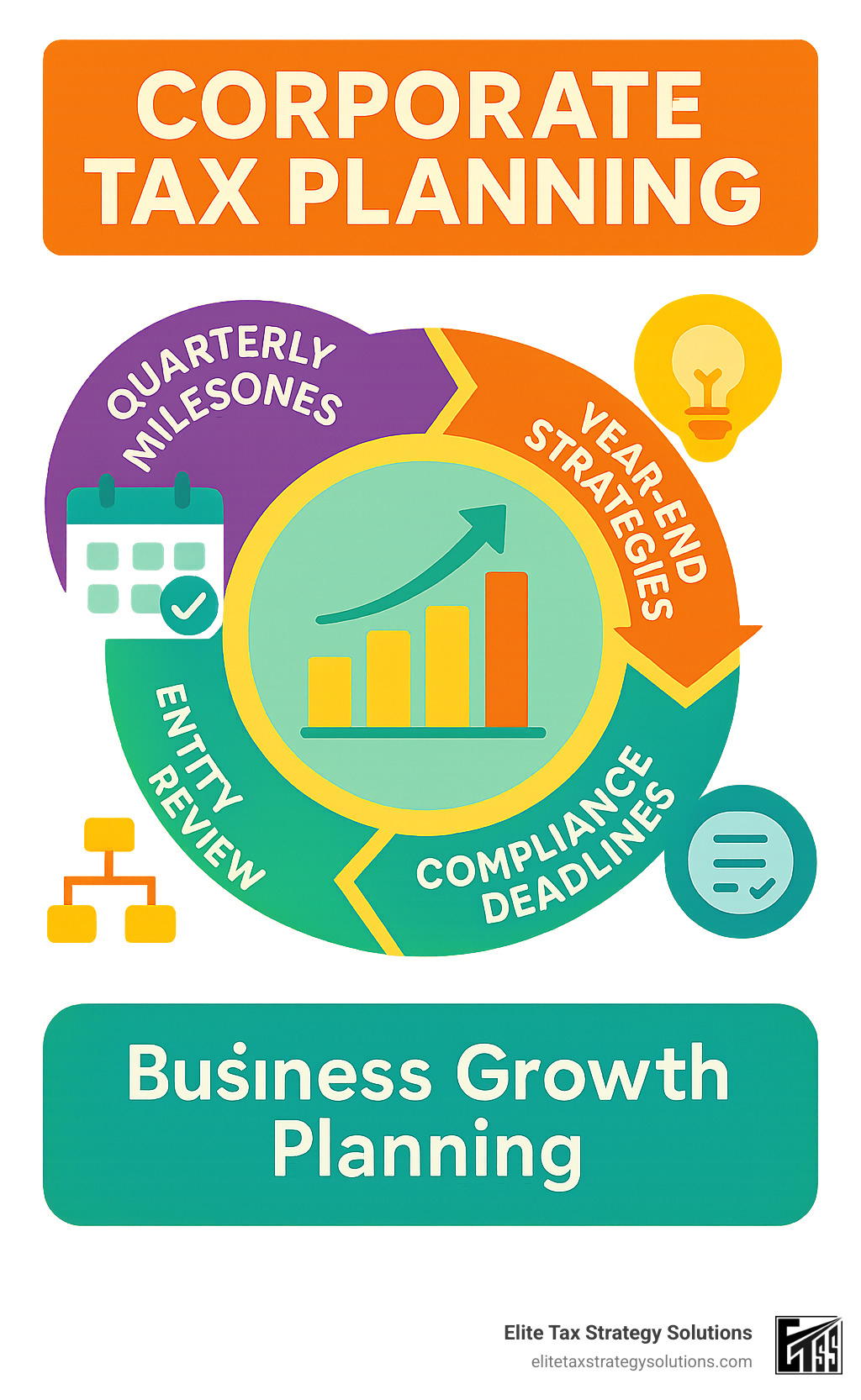
Building a Year-Round Tax Calendar
The biggest mistake I see business owners make is treating taxes like a once-a-year chore. Effective corporate tax planning happens throughout the year, with specific milestones and checkpoints that keep you on track.
In the first quarter, we review how the previous year turned out and update projections for the current year. By mid-year, we’re conducting thorough reviews of estimated tax payments and making adjustments to avoid surprises.
The third quarter is crucial for preliminary year-end planning. This is when we start modeling different scenarios and preparing strategies for the final months of the year.
Key filing deadlines remain non-negotiable. C corporations must file Form 1120 by the 15th day of the fourth month after year-end, while S corporations and partnerships face earlier deadlines on the 15th day of the third month.
Form 4466 allows corporations to request quick refunds of estimated tax overpayments, providing faster access to cash flow when you’ve overpaid during the year.
Avoiding Common Pitfalls
After four decades in this business, I’ve seen the same mistakes repeated countless times. Most of these pitfalls are completely avoidable with proper planning and awareness.
Audit triggers are often unintentional. Businesses that show dramatic income swings from year to year naturally attract attention, especially if the changes seem inconsistent with industry trends.
The key is maintaining consistent documentation and reasonable explanations for any unusual items. We help clients prepare audit-ready files that clearly support every deduction and credit claimed.
Expired tax provisions catch many businesses off guard. The TCJA’s bonus depreciation phases down each year through 2026. The Section 199A qualified business income deduction expires entirely after 2025 unless Congress extends it.
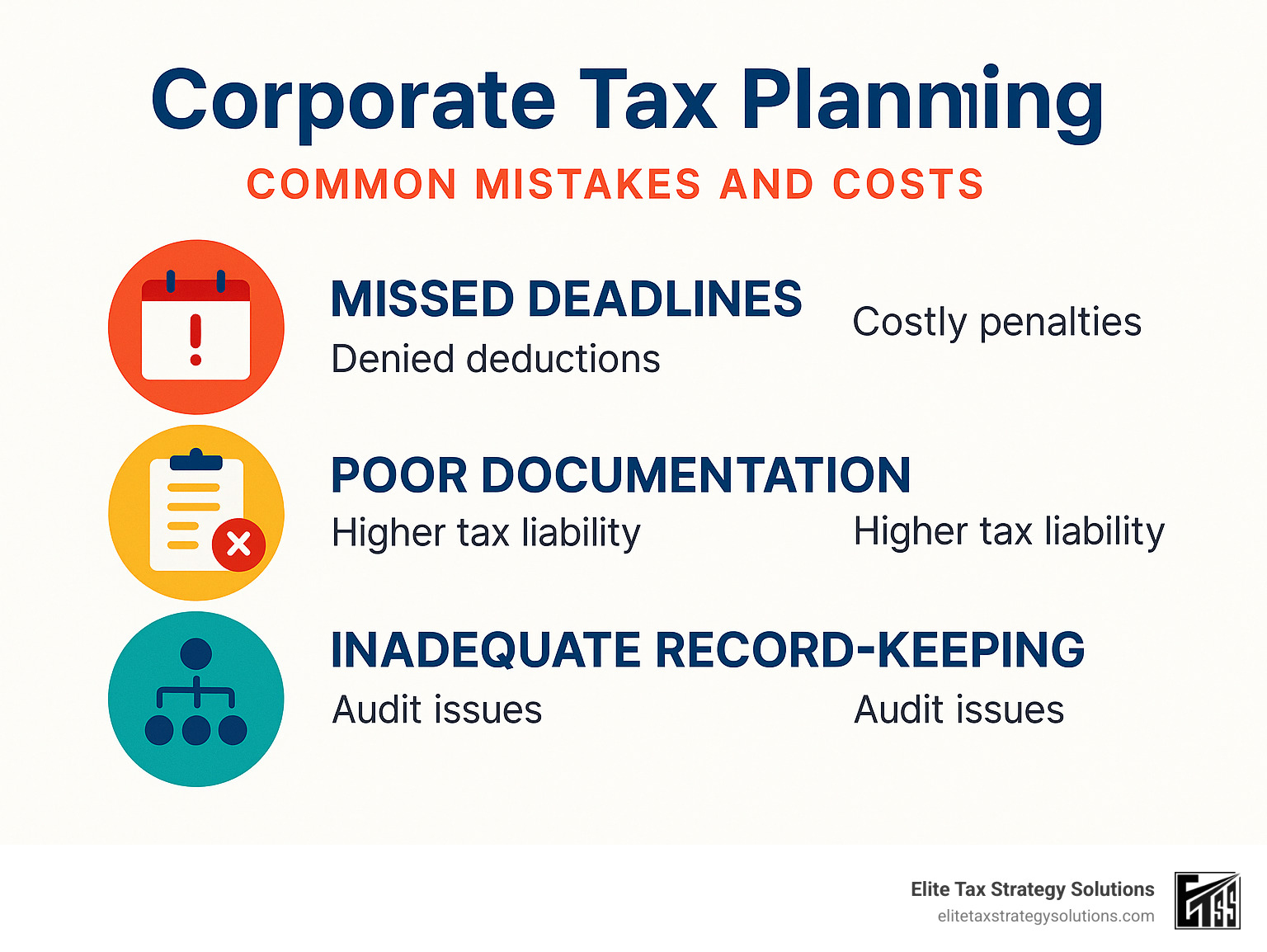
Poor record-keeping remains the number one cause of problems during audits. The IRS expects businesses to maintain detailed records supporting every deduction claimed.
The most successful businesses we work with have learned that corporate tax planning is an investment, not an expense. They understand that proactive planning and professional guidance typically save far more than they cost, while reducing stress and audit risk at the same time.
Frequently Asked Questions about Corporate Tax Planning
After working with hundreds of business owners over four decades, I’ve noticed the same questions come up again and again. Let me share the answers to the three most important ones that can make or break your tax strategy.
How does corporate tax planning differ from basic compliance?
Think of the difference between corporate tax planning and basic compliance like the difference between a GPS navigation system and a rearview mirror. Compliance looks backward at what already happened, while planning looks forward to where you want to go.
Basic compliance is reactive. You gather last year’s receipts, fill out forms, and hope you don’t owe too much. Corporate tax planning is proactive. It’s about making smart decisions throughout the year that legally reduce your tax bill.
The financial difference is significant. Our clients who accept strategic planning typically save 15-30% more on their tax liability compared to those who only focus on compliance.
Here’s what this looks like in practice: A compliance-focused business might claim $50,000 in equipment depreciation over five years. A planning-focused business might use bonus depreciation to claim $30,000 immediately, improving cash flow when they need it most for growth.
Which depreciation method provides the greatest current-year benefit?
For most businesses right now, bonus depreciation delivers the biggest immediate tax benefit. In 2024, you can deduct 60% of qualifying equipment costs right away, which means a $100,000 machinery purchase could generate a $60,000 deduction this year.
But bonus depreciation is phasing out. It drops to 40% in 2025, then 20% in 2026, and disappears completely after that.
Section 179 is another powerful option, especially for smaller businesses. You can immediately expense up to $1,080,000 in qualifying equipment purchases for 2024.
The best choice depends on your specific situation. If you expect your business to be more profitable in future years, taking the big deduction now through bonus depreciation makes sense.
What should multinationals do now for expiring TCJA provisions?
Many of the Tax Cuts and Jobs Act’s best provisions expire after 2025, and waiting until then to act could cost you hundreds of thousands in lost opportunities.
The clock is ticking on bonus depreciation. If your business has been considering major equipment purchases, 2024 and 2025 are your last years to capture significant immediate deductions.
Entity structure reviews become urgent. The 20% qualified business income deduction for pass-through entities expires after 2025. Some businesses might benefit from converting to C-corporation status before then.
My recommendation is simple: don’t wait for Congress to act. We’re helping clients model different scenarios and implement strategies now while the current rules are still in effect.
Conclusion
Corporate tax planning isn’t just about cutting your tax bill – though that’s certainly a nice benefit. It’s really about giving your business the breathing room it needs to grow and thrive. When you keep more of your hard-earned profits instead of sending them to the IRS, you suddenly have options you didn’t have before.
I’ve watched businesses transform when they shift from scrambling at tax time to planning strategically all year long. One client saved $47,000 in their first year just by timing their equipment purchases and optimizing their entity structure. But the real win? They used that money to hire two new employees and expand into a neighboring market.
The tax world never sits still. Bonus depreciation is phasing out, international rules keep evolving, and who knows what Congress will do with the TCJA provisions after 2025. Businesses that plan ahead don’t just adapt to these changes – they profit from them.
Whether you’re running a growing company here in Jasper, Indiana, or managing operations across multiple states, the fundamentals stay the same. Start planning early, think strategically, and don’t try to go it alone.
Here’s what I’ve learned after 40 years in this business: every month you wait to implement strategic tax planning is money left on the table. The entity structure optimization we discussed, those depreciation strategies, the multistate planning techniques – they all work better when you have time to implement them properly.
Your business deserves every legal advantage available. The strategies we’ve covered aren’t just theoretical – they’re proven approaches that help businesses like yours keep more profits where they belong: working for your growth and success.
More info about Corporate Tax Strategy
Ready to stop overpaying taxes and start building real wealth in your business? Let’s talk about how strategic corporate tax planning can change your financial future.