Why Tax Compliance is Crucial for Your Consulting Business
Consultant tax compliance means meeting every federal, state, and local rule that applies to you as an independent contractor. Miss even one requirement and penalties can erase weeks of billable hours.
Core requirements at a glance:
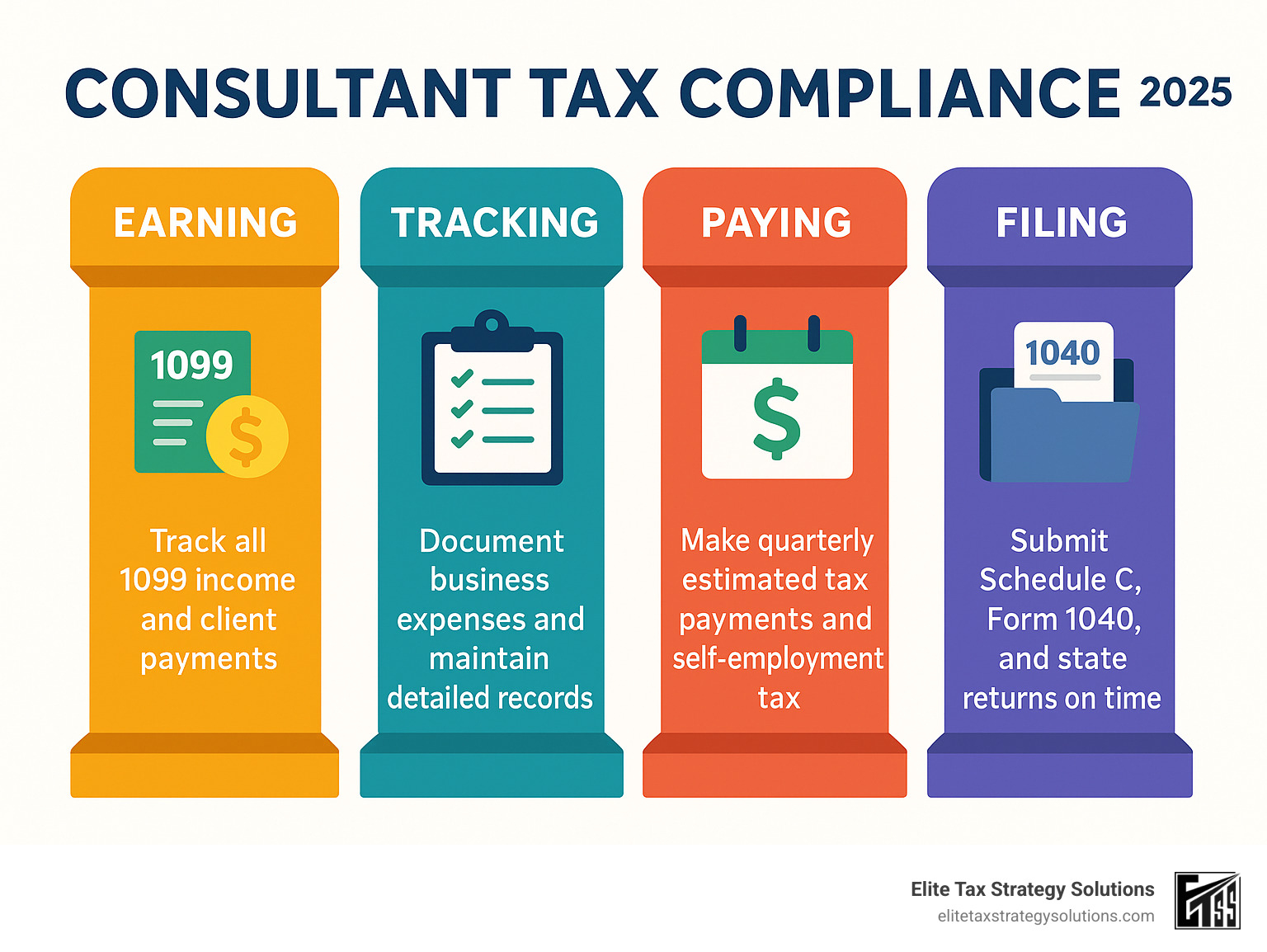
- Self-Employment Tax – 15.3 % on net earnings (Social Security + Medicare)
- Estimated Tax Payments – due Jan 15, Apr 15, Jun 15, Sep 15
- Business Expense Tracking – keep receipts for home-office, travel, software, and more
- Form 1099-NEC – track all client payments over $600
- Schedule C – report income and expenses with your Form 1040
Why is this challenging?
- No automatic withholding – you must set aside 25-30 % of every payment
- Quarterly estimates – forecasting income months in advance is hard
- Documentation – the IRS wants proof, not promises
- Multi-state rules – even a single day of work can trigger filings
- Ever-changing law – new legislation drops every year
A proactive system turns these hazards into routine business processes. I’m David Fritch, CPA and founder of Elite Tax Strategy Solutions, and after 40 years of helping consultants, I can confirm that solid compliance is the first step toward real tax planning.
Helpful reading from Elite Tax Strategy Solutions:
The Core Pillars of Tax Compliance for Consultants

Your business structure is the foundation of consultant tax compliance. Choose wisely and the rest of your tax life becomes easier.
Common options
- Sole proprietorship – simplest; report everything on Schedule C, but 100 % of profit is subject to self-employment tax.
- Single-member LLC – liability shield with the same tax treatment, plus the option to elect S-Corp status later.
- S-Corporation – usually pays off once profit tops about $60k because you can split income between payroll (subject to payroll tax) and distributions (not).
- C-Corporation – rarely useful for solo consultants because of double taxation, but can work for firms that retain earnings.
Our Tax Planning for Consultants service models each scenario so you keep more of what you earn.
Your Key Federal Obligations
- Self-Employment Tax – 12.4 % Social Security (on the first $160,200 for 2023) + 2.9 % Medicare, plus 0.9 % extra Medicare on earnings above $200k.
- Estimated taxes – pay at least 90 % of current-year liability or 100 % (110 % when prior-year AGI > $150k) of last year’s tax by the four quarterly due dates.
- Forms – Schedule C, Schedule SE, and Form 1040, plus any state equivalents.
Our 1099 Tax Compliance program calculates those estimates and sends reminders so deadlines never sneak up.
Deductions: Documentation Wins Audits
Home office, travel, software, professional development, health insurance, and vehicle expenses can all be deductible. The catch? You need contemporaneous records. Cloud bookkeeping paired with receipt-capture apps makes this nearly effortless.
See the systems we set up in our Small Business Tax Planning Strategies service.
State & Local Tax (SALT) Surprises
States now assert “economic nexus,” so even remote work for out-of-state clients can create filing duties. Some jurisdictions also tax certain consulting services or require local business licenses. Track where you work and seek guidance before crossing a new border.
Advanced Strategies for Modern Consultant Tax Compliance

Tax rules evolve constantly. The 2018 Tax Cuts and Jobs Act (TCJA) introduced the 20 % Section 199A deduction, changed meal/entertainment rules, and expanded §179 expensing to $1.08 million. Yesterday’s strategy may already be obsolete.
Our Proactive Tax Planning service reviews new legislation every year and adjusts your plan long before April 15.
New Federal Reporting: BOIR
Under the Corporate Transparency Act most LLCs and corporations must file a Beneficial Ownership Information Report (BOIR) with FinCEN. Entities formed before 1-1-2024 have until 1-1-2025; newer entities file within 90 days of formation. Penalties: up to $500 per day. We include BOIR guidance in every compliance engagement.
Going Global
Foreign clients or bank accounts trigger extra forms:
- Foreign tax credit (Form 1116)
- FATCA (Form 8938)
- FBAR (FinCEN 114) when aggregate foreign accounts exceed $10k
- Possible PFIC reporting (Form 8621) on foreign mutual funds
Penalties can dwarf the income involved, so don’t guess—ask an expert. Explore our International Tax Compliance service.
Retirement & Wealth-Building
Tax-advantaged accounts cut current tax and build future wealth:
- SEP-IRA – contribute up to 25 % of net profit (max $66k for 2023)
- Solo 401(k) – employee deferral plus employer match for higher caps
- Defined benefit plan – for consistently high earners
- HSA – triple tax benefit if you have a high-deductible health plan
We incorporate these options into our Tax Planning for Freelancers engagements.
The Role of Professional Services and Technology in Compliance

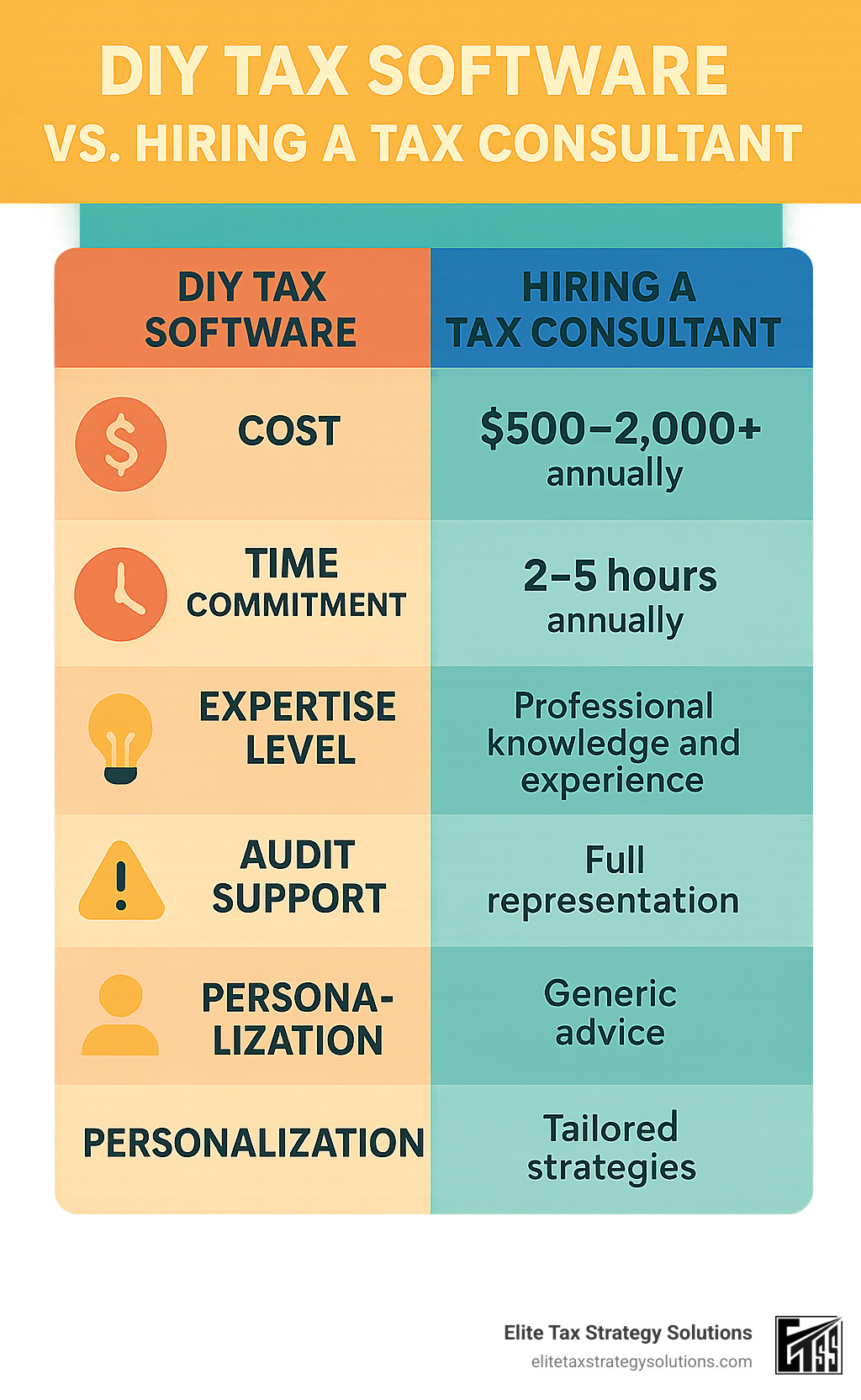
DIY compliance can consume 40+ hours a year—time you could spend billing clients. Fees for professional help often pay for themselves in saved taxes and avoided penalties.
Why Hire a Tax Professional
- Expertise on demand – regulations change; we keep up so you don’t have to.
- Strategy, not just forms – entity selection, timing of income, retirement plans.
- Audit representation – peace of mind if the IRS calls.
- Time savings – focus on your core business.
Our Tax Compliance Services combine year-round advice with filing accuracy. Clients also receive unlimited email support through our IRS Tax Compliance program.
Technology That Makes It Easier
Cloud bookkeeping (QuickBooks, Xero, FreshBooks), receipt-capture apps, and secure client portals automate the grunt work. AI assists with categorization and deadline reminders, but software is a tool—professional judgment remains essential.
How to Choose the Right Tax Compliance Partner

Your tax professional will know more about your finances than most friends or family, so take the interview seriously.
Credentials to Require
- CPA – licensed accountants with broad tax authority
- Enrolled Agent (EA) – federally licensed tax specialists
- Proven experience with consultants in your industry
Verify CPA licenses through your state board and EA status on the IRS site. Both the AICPA and NAEA maintain directories.
Proactive vs. Reactive
Great advisors stay in touch year-round, model scenarios before you act, and explain how new laws affect you. That’s the standard for our Proactive Tax Planning service.
Questions to Ask
- How many consulting clients do you serve?
- What’s your communication turnaround?
- What software do you use and can I access it?
- Do you provide audit support?
- How are your fees structured?
A partner who answers these clearly—and asks you thoughtful questions in return—is worth their weight in deductions.
Frequently Asked Questions about Consultant Tax Compliance
What is the difference between tax planning and tax compliance?
Think of tax compliance as playing defense—you’re meeting your legal obligations to stay out of trouble with the IRS. This means filing your returns on time, paying the correct amount of taxes, and keeping detailed records of your business activities. It’s all about looking backward at what you’ve already done and making sure you’ve reported everything correctly.
Tax planning, on the other hand, is playing offense. You’re looking ahead and making strategic decisions to legally minimize your future tax burden. This might involve choosing the right business structure, timing when you receive payments, or deciding which equipment to purchase before year-end.
Here’s a simple way to remember the difference: compliance asks “Did I do everything right?” while planning asks “What can I do better next time?”
Both are absolutely essential for successful consultant tax compliance. You can’t ignore your current obligations, but you also shouldn’t miss opportunities to reduce your tax burden through smart planning.
The real magic happens when these two work together. Good record-keeping for compliance purposes gives you the data you need for effective planning. And smart planning makes compliance easier by organizing your financial life in tax-efficient ways.
Our Business Tax Compliance service handles both sides of this equation, ensuring you meet all your current obligations while positioning you for future tax savings.
I received a 1099-NEC. Does that mean I don’t have to pay taxes until next year?
Absolutely not—and this misconception can cost you thousands in penalties and interest. That 1099-NEC is just a piece of paper telling you (and the IRS) that a client paid you $600 or more during the year. It doesn’t change when you owe taxes or how much you owe.
Here’s what many consultants don’t realize: independent contractor income hits you with a double tax burden. You’ll pay regular income tax just like everyone else, plus an additional 15.3% in self-employment tax to cover Social Security and Medicare. This isn’t optional—it’s the price of being your own boss.
The IRS expects you to pay taxes as you earn money, not when you file your return the following year. This is where quarterly estimated tax payments come in. If you expect to owe $1,000 or more in taxes, you need to make payments by January 15, April 15, June 15, and September 15.
Miss these deadlines, and you’ll face penalties even if you pay everything you owe by the filing deadline. The IRS doesn’t care that you set the money aside—they want it when it’s due.
Think of it this way: employees have taxes taken out of every paycheck automatically. As a consultant, you need to do this yourself by making estimated payments. It’s like being your own payroll department.
How can I prepare for a potential IRS audit?
The best audit defense is meticulous record-keeping that starts from day one of your consulting business. The IRS wants to see contemporaneous records—meaning you documented things when they happened, not when you got audited three years later.
Every business expense needs a paper trail that shows what you bought, when you bought it, how much you paid, and why it was necessary for your business. A receipt from Office Depot isn’t enough—you need to note what the supplies were for and how they related to your consulting work.
Separate your business and personal finances completely. Use dedicated business bank accounts and credit cards for all business expenses. This separation makes it crystal clear to the IRS that you’re running a legitimate business, not just trying to deduct personal expenses.
Mixing business and personal expenses is like waving a red flag at the IRS. It makes you look disorganized at best and dishonest at worst. Neither impression will help you in an audit.
Understanding common audit triggers can help you avoid unnecessary scrutiny. The IRS pays attention to consultants who claim unusually high deductions relative to their income, report 100% business use of vehicles or equipment, or have inconsistent reporting patterns from year to year.
This doesn’t mean you shouldn’t claim legitimate deductions—just make sure you can back them up with solid documentation and reasonable explanations.
Working with a professional gives you someone who can represent you before the IRS if needed. Having qualified representation can significantly improve audit outcomes and reduce the stress of dealing with IRS examinations. You don’t want to face an IRS agent alone, especially when thousands of dollars might be at stake.
Our Tax Audit Preparation service includes comprehensive record-keeping system setup and ongoing support to ensure you’re prepared for any IRS inquiry. We’d rather help you avoid an audit than deal with one after it starts.
Conclusion: Take Control of Your Tax Strategy
Consultant tax compliance doesn’t have to keep you awake at night. Yes, the requirements are complex, but here’s the truth—once you understand the core principles and set up proper systems, compliance transforms from a constant worry into a strategic advantage for your business.
Think about it this way: every successful consultant faces the same fundamental challenge. You need to meet all legal obligations before you can even think about optimization. There’s no shortcut around this reality, but there’s definitely a smarter way to approach it.
The consultants who sleep well at night are those who accept proactive planning throughout the year rather than that familiar April scramble. They understand that tax planning isn’t something you do once—it’s woven into every business decision they make.
Professional guidance isn’t just about avoiding mistakes (though that’s important). It’s about finding opportunities you didn’t know existed. The right tax advisor often saves you more money than their fees cost, while giving you back hours of your life to focus on what you do best.
Technology can streamline your compliance process beautifully, but don’t fall into the trap of thinking an app can replace expertise. The best approach combines smart tools with professional knowledge—letting technology handle the routine tasks while humans tackle the strategic thinking.
Here’s something that might surprise you: record-keeping and documentation are actually your secret weapons. Not just for staying compliant, but for maximizing every legitimate deduction available to you. Good records don’t just protect you from audits—they help you keep more of what you earn.
The path forward starts with getting your fundamentals rock-solid. Proper business structure, accurate record-keeping, and timely estimated payments create the foundation. From there, you can build strategic planning that minimizes your long-term tax liability while supporting your growth goals.
Tax compliance isn’t a destination you reach and forget about. Tax laws change, your business evolves, and new opportunities emerge constantly. The consultants who thrive long-term are those who view consultant tax compliance as an integral part of their business strategy, not an annual chore to endure.
At Elite Tax Strategy Solutions, we specialize in helping high-earning consultants and closely held businesses steer these complexities with confidence. Our personalized approach focuses on maximizing tax savings while ensuring complete compliance, giving you the financial stability and peace of mind to focus on serving your clients and growing your practice.
Whether you’re just launching your consulting career or looking to optimize an established practice, the best time to take control of your tax strategy is right now. Don’t let compliance concerns hold you back from achieving your business and financial goals.
Take the next step in your tax journey with our expert support and compliance services. Let us help you transform tax compliance from a source of stress into a competitive advantage that supports your long-term success.