Why Compliance Tax Credits Are Your Key to Open uping Hidden Tax Savings
Compliance tax credits represent government incentives designed to reward businesses for meeting specific regulatory requirements while achieving policy goals like environmental sustainability, research and development, or workforce training. These credits can provide substantial financial benefits – ranging from 15% to 60% of eligible expenses – but they come with complex rules and documentation requirements that many businesses struggle to steer.
Key Types of Compliance Tax Credits:
- Clean Economy Credits: 15-60% refundable credits for clean technology investments
- R&D Tax Credits: Relief for research and experimental development expenses
- Clean Vehicle Credits: Incentives for electric and hybrid vehicle purchases
- Energy Efficiency Credits: Benefits for qualifying home and commercial energy improvements
- Manufacturing Credits: Support for clean technology production facilities
The challenge? Accessing the full value of these incentives is not as easy as it may seem. Common pitfalls include misclassified capital costs, partnership restrictions, missed wage requirements, and oversimplified financial modeling. Many businesses leave money on the table simply because they don’t understand the intricate compliance requirements.
For high-income earners and small business owners, these credits offer a powerful way to reduce tax burdens while supporting business growth and sustainability goals. However, the complexity of regulations across different jurisdictions requires expert guidance to maximize benefits.
I’m David Fritch, and with 40 years of experience managing tax compliance and strategy for small business owners, I’ve helped countless clients steer the complexities of compliance tax credits to achieve substantial tax savings. Through my work at Elite Tax Strategy Solutions, I’ve seen how proper planning and documentation can transform these credits from bureaucratic headaches into powerful financial tools.
Compliance tax credits terms explained:
Understanding Compliance Tax Credits
Think of compliance tax credits as the government’s way of saying “thank you” with real money for doing the right thing. These aren’t just feel-good incentives – they’re serious financial tools that can transform your business’s bottom line while helping you meet important regulatory goals.
The beauty of these credits lies in their timing. As governments worldwide push harder for clean technology adoption and sustainable business practices, they’re backing up their policy goals with substantial financial rewards. This creates a unique window where doing what’s environmentally and socially responsible also happens to be incredibly profitable.
What Are Compliance Tax Credits?
Compliance tax credits work differently than the tax deductions you might be familiar with. Instead of simply reducing your taxable income, these credits provide dollar-for-dollar reductions in what you actually owe. It’s like getting a direct discount on your tax bill – and in many cases, you can even get cash back.
Here’s where it gets interesting: these credits come in two flavors that can dramatically affect your cash flow.
Refundable credits are the gold standard. Even if you don’t owe any taxes, the government will cut you a check for the full credit amount. Canada’s clean economy tax credits work this way, which means even startup companies or businesses going through tough times can still collect the full benefit.
Non-refundable credits can only offset taxes you actually owe, but they’re still valuable. Most can be carried forward to future years, giving you flexibility in your tax planning.
The government’s motivation is simple: they want to encourage private businesses to invest in areas that benefit everyone – clean technology, research and development, workforce training. By offering credits worth 15% to 60% of your eligible expenses, they’re essentially becoming your investment partner.
After four decades in tax strategy, I’ve seen how understanding this distinction between refundable and non-refundable credits can completely change a business’s financial planning. More info about Tax Compliance Services
Global Momentum Behind Compliance Tax Credits
Right now, we’re living through what I call the “great credit rush.” Governments everywhere are rolling out compliance tax credits at an unprecedented pace, and the amounts are staggering.
Canada is leading the charge with five major refundable investment tax credits. The Clean Hydrogen Investment Tax Credit offers 15-40% of eligible expenses, while the Clean Technology Investment Tax Credit provides a flat 30%. The Carbon Capture, Utilization and Storage credit goes even higher at 37.5-60%. Add in the Clean Electricity Investment Tax Credit at 15% and the Clean Technology Manufacturing Investment Tax Credit at 30%, and you’re looking at billions in potential benefits.
The United States responded with the Inflation Reduction Act, dramatically expanding clean energy incentives. They’ve improved production tax credits, boosted investment tax credits for solar and wind, and created entirely new credits for energy storage and clean vehicle manufacturing.
Europe isn’t sitting still either. The EU has implemented comprehensive sustainability reporting requirements that open up tax incentives for businesses that can prove their environmental compliance.
But here’s the catch – many of these credits include sunset provisions. They’ll decrease in value or disappear entirely within the next decade. This creates both urgency and opportunity. For businesses in energy, utilities, mining, forestry, chemicals, cement, and steel, compliance tax credits aren’t just nice-to-have incentives anymore. They’re essential financial tools for funding the transition to sustainable operations while staying competitive.
Eligibility & Regulatory Framework
Getting your hands on compliance tax credits isn’t just about wanting them – you need to meet specific eligibility requirements and follow complex regulatory frameworks. The rules are detailed, vary by location, and missing even small requirements can cost you big.
The good news? Once you understand the framework, these credits become much more manageable. The challenging part is that requirements differ significantly between Canada and the United States, creating a maze of rules for businesses operating in both countries.
Key eligibility factors include prevailing wage requirements, apprenticeship rules, entity structure limitations, partnership restrictions, and capital-cost criteria. Each of these areas has specific documentation needs that must be maintained throughout your project lifecycle.
For businesses serious about maximizing these benefits, proper record-keeping isn’t optional – it’s essential. We’ve seen too many companies lose substantial credits simply because they didn’t maintain the right paperwork from day one.
You can explore available programs through the Government benefits finder for Canadian programs or check IRS clean energy credits for U.S. opportunities.
Jurisdictional Snapshot: CRA vs IRS Compliance Tax Credits
The Canadian Revenue Agency (CRA) and the Internal Revenue Service (IRS) have taken different approaches to compliance tax credits, creating unique opportunities and challenges for businesses.
Canada’s approach centers around the Income Tax Act and focuses heavily on refundable credits. This means even if your company doesn’t owe taxes, you can still receive cash payments from these credits.
The United States, through the Inflation Reduction Act, has expanded their credit system dramatically but with different rules. While most U.S. credits aren’t refundable, they’ve introduced “elective pay” provisions that can provide similar benefits for certain taxpayers.
| Aspect | Canada (CRA) | United States (IRS) |
|---|---|---|
| Refundability | Most clean economy credits are refundable | Limited refundability, but elective pay available |
| Labor Requirements | Prevailing wage and apprenticeship rules | Prevailing wage and apprenticeship requirements |
| Credit Rates | 15-60% depending on credit type | Varies by technology and compliance level |
| Partnership Restrictions | Complex at-risk rules for limited partners | Different partnership allocation rules |
| Documentation | Attestation forms and detailed records | Similar documentation with IRS-specific forms |
| Audit Approach | Comprehensive review of all aspects | Focus on technical compliance and wage requirements |
Audit triggers are another crucial difference. The CRA tends to take a comprehensive approach, reviewing all aspects of your claim. The IRS focuses more intensively on technical compliance and wage requirements, but their audits can be equally thorough.
Both systems require businesses to meet prevailing wage and apprenticeship standards to qualify for improved credit rates. Miss these requirements, and your credit rates can drop significantly – sometimes by more than half.
Mandatory Documentation to Secure Compliance Tax Credits
Documentation is where many businesses stumble with compliance tax credits. It’s not enough to do the right things – you need to prove you did them with the right paperwork, maintained properly, and available when auditors come calling.
Attestation forms are your formal promise to the government that you’ve met all requirements. These aren’t just checkboxes – they’re legal documents that must be supported by detailed records.
Wage records require comprehensive documentation of every dollar paid to employees and contractors on eligible projects. This includes payroll records showing actual wages, prevailing wage rate determinations for each location, contractor agreements, and apprenticeship participation records.
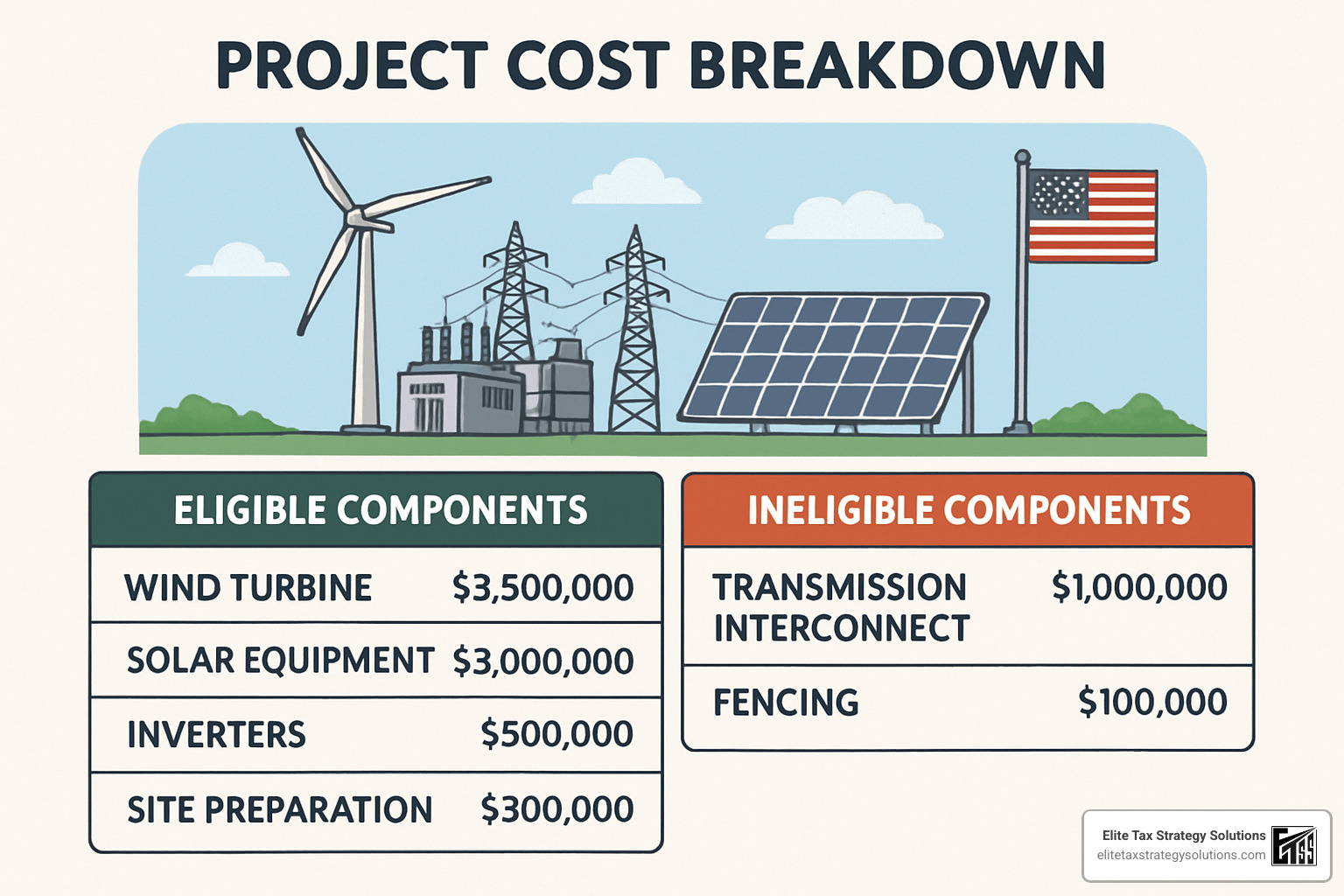
Engineering reports provide the technical proof that your investments qualify for specific credit categories. For example, if you’re installing a biomass-fueled power plant, you’ll need engineering analysis showing which components qualify (like the boiler) and which don’t (like storage conveyors).
Capital-cost allocation documentation breaks down project costs into eligible versus ineligible components. This is where proper planning pays off – seemingly related equipment might be excluded from credit calculations, and you need clear documentation to support your classifications.
The documentation burden is substantial, but the financial benefits justify the investment. We’ve worked with clients who received full credit value because they maintained proper documentation, while others lost substantial amounts simply because they couldn’t prove compliance.
More info about Tax Compliance Outsourcing can help you manage these complex requirements without overwhelming your internal resources.
Maximizing Value & Avoiding Pitfalls
Here’s the reality about compliance tax credits: the difference between getting maximum value and leaving thousands (or millions) on the table often comes down to the details. After helping countless clients steer these waters, I’ve learned that success requires both strategic thinking and meticulous attention to the fine print.
Common Pitfalls That Erode Compliance Tax Credits
I’ve seen too many businesses make costly mistakes with compliance tax credits simply because they didn’t know what to watch for. Let me share the most common pitfalls so you can steer clear of them.
Misclassified capital assets cause more headaches than almost anything else. Here’s a real example: a client was building a biomass-fueled power plant and assumed everything qualified for clean technology credits. Wrong! The boiler qualified, but the storage conveyors and handling equipment didn’t. This kind of misclassification can inflate your projected credit values by 20-30%.
The lesson? Every piece of equipment needs individual evaluation. Don’t assume that because it’s part of a “clean” project, it automatically qualifies.
Partnership structure restrictions can be brutal if you’re not prepared. The at-risk contribution rules mean that limited partners might get way less credit than their ownership percentage suggests. I’ve worked on cases where smart partnership restructuring added over $1 million in available credits.
Missed wage thresholds are particularly painful because they’re often preventable. To get the best credit rates, you need to meet prevailing wage requirements – and this applies to both your employees and contractors. Miss these standards, and you could lose 5-10 percentage points on your credit rate. On a $10 million project, that’s potentially $500,000 to $1 million walking out the door.
Oversimplified financial models cause problems because these credits don’t exist in isolation. They interact with other tax benefits, have timing restrictions, and include carryforward limitations. A basic spreadsheet won’t cut it – you need sophisticated modeling that accounts for all these moving parts.
The key is getting ahead of these issues through early planning and bringing together the right team – tax specialists, engineers, and project managers who understand both the technical and compliance sides. More info about Tax Compliance Audit
Strategic Stacking & Monetization of Compliance Tax Credits
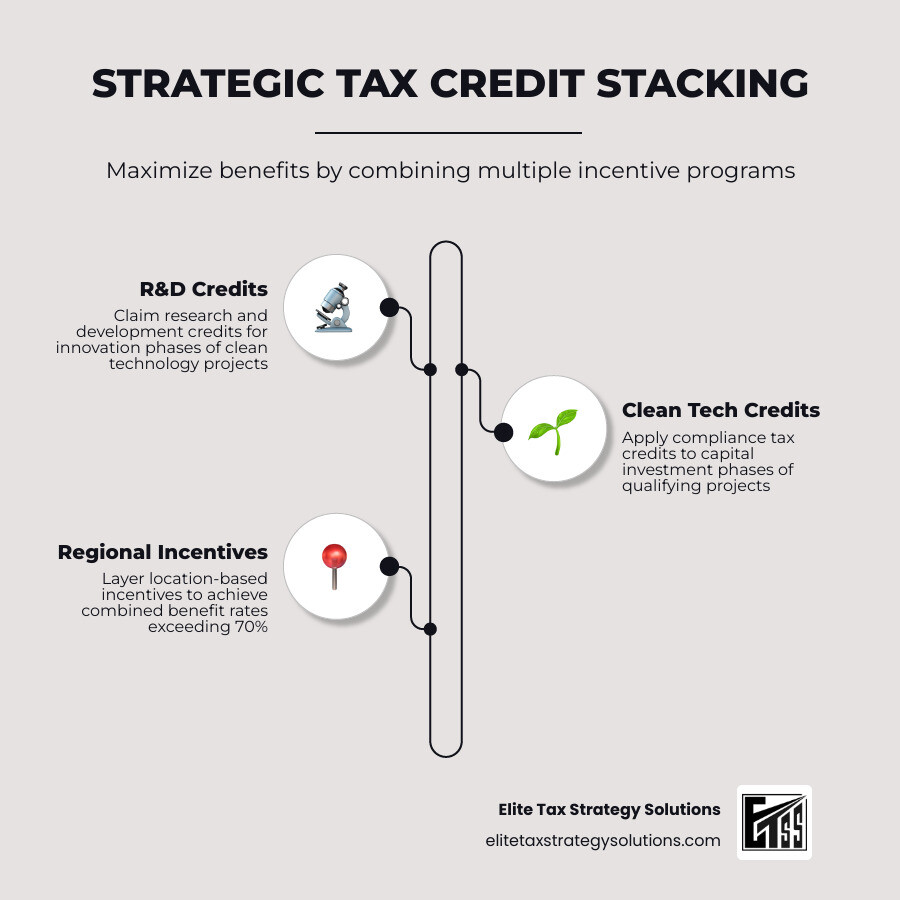
Here’s where compliance tax credits get really exciting: when you combine them strategically with other tax incentives, the results can be spectacular. This approach, called “stacking,” is where the real money is made.
R&D credit combinations offer incredible opportunities for companies developing new technologies. Let’s say you’re creating innovative hydrogen production technology. You might claim R&D credits for the development work and clean technology credits for the capital investment. With proper timing and documentation, you’re double-dipping legally and effectively.
Regional development incentives can push your total benefits through the roof. Many areas offer additional incentives for projects in specific regions or economic zones. Stack these with federal compliance tax credits, and I’ve seen clients achieve combined benefit rates exceeding 70% of eligible costs.
Accelerated depreciation creates interesting strategic choices. Sometimes electing accelerated depreciation might reduce your current-year credit benefits, but it could provide better overall tax outcomes when you look at the bigger picture.
Elective pay and transferability have changed the game, especially in the U.S. You can now elect direct payment of credits instead of using them to offset tax liability. This means you can monetize credits even when your tax liability is limited – a game-changer for many businesses.
The secret sauce is comprehensive modeling that accounts for all these interactions. It’s not just about knowing the rules – it’s about understanding how they work together to create maximum value. More info about Tax Support and Compliance
Implementation Roadmap & Best Practices
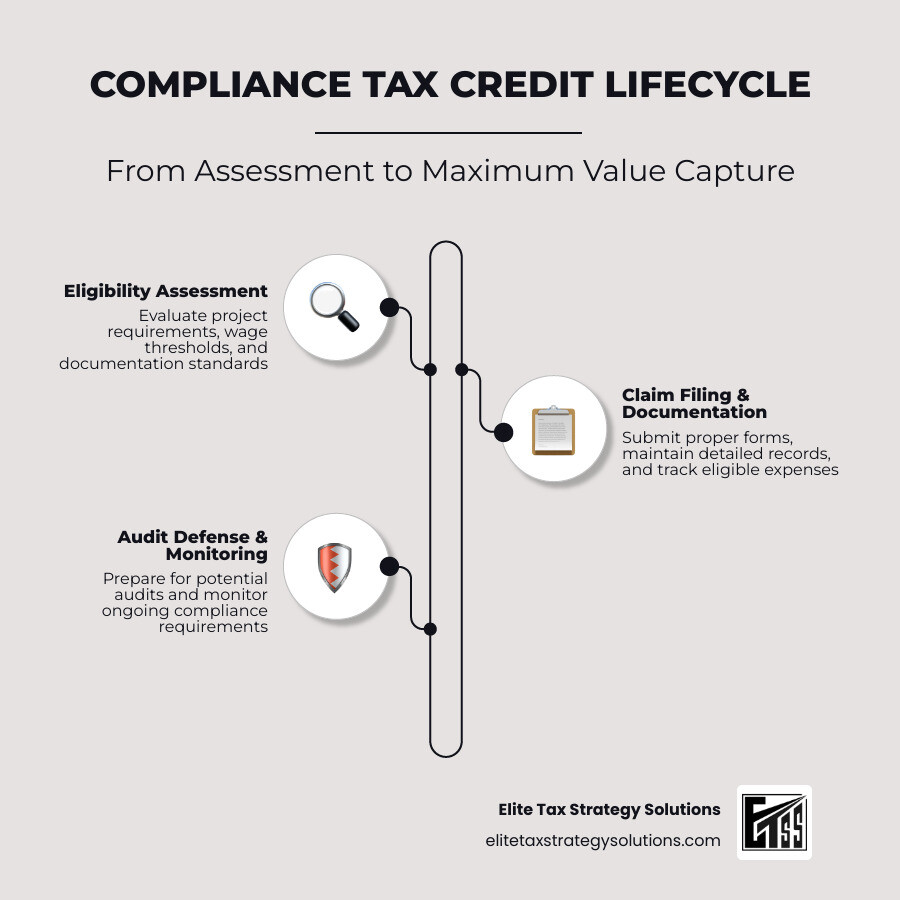
Successfully capturing the full value of compliance tax credits requires a systematic approach that begins with project planning and continues through audit defense. Based on our experience helping clients steer these complex requirements, we’ve developed a proven implementation roadmap.
Step-by-Step Claim Process for Compliance Tax Credits
Step 1: Project Scoping and Eligibility Assessment
The foundation of any successful compliance tax credits strategy begins with comprehensive project scoping. This involves:
- Detailed analysis of all project components to identify eligible activities
- Review of applicable credit programs and their specific requirements
- Assessment of entity structure and partnership implications
- Preliminary financial modeling to estimate credit values
Step 2: Eligibility Testing and Documentation Planning
Once potential credits are identified, rigorous eligibility testing ensures compliance:
- Technical review of equipment and activities to confirm qualification
- Analysis of prevailing wage requirements for project locations
- Development of documentation and record-keeping procedures
- Establishment of data collection systems for ongoing compliance
Step 3: Cost Tracking and Allocation Systems
Accurate cost tracking is essential for maximizing credit values:
- Implementation of project accounting systems that segregate eligible costs
- Development of allocation methodologies for mixed-use assets
- Establishment of contractor and subcontractor reporting requirements
- Regular monitoring of cost accumulation against credit thresholds
Step 4: Filing and Claim Preparation
The filing process requires careful attention to detail and timing:
- Preparation of all required forms and attestations
- Compilation of supporting documentation
- Review of calculations and cross-references
- Coordination with other tax attributes and planning strategies
Step 5: Audit Defense and Ongoing Compliance
Even after filing, ongoing compliance and audit preparation remain critical:
- Maintenance of comprehensive audit files
- Regular review of compliance with ongoing requirements
- Preparation for potential government inquiries
- Updates to procedures based on changing regulations
This five-step process has helped our clients at Elite Tax Strategy Solutions achieve consistently successful outcomes with compliance tax credits. More info about Accounting and Tax Compliance
Building a Future-Proof Compliance Tax Credits Program
Creating a sustainable compliance tax credits program requires looking beyond individual projects to build organizational capabilities that can adapt to changing regulations and opportunities.
Automation and Technology Solutions: Modern compliance programs rely heavily on technology to manage the volume and complexity of required documentation. Key technology components include automated wage tracking, document management systems with audit trail capabilities, and compliance monitoring dashboards.
Key Performance Indicators (KPIs): Successful programs establish clear metrics including credit capture rate (actual credits claimed vs. theoretical maximum), documentation completeness scores, audit defense success rates, and return on investment for compliance activities.
Continuous Improvement Processes: The regulatory landscape for compliance tax credits continues evolving, requiring programs that can adapt quickly through regular review of new regulations, benchmarking against industry best practices, and integration of lessons learned.
The investment in building robust compliance capabilities pays dividends through improved credit capture rates, reduced audit risk, and improved ability to identify new opportunities as they emerge. More info about GST Return Compliance
Frequently Asked Questions about Compliance Tax Credits
How much can I save through compliance tax credits?
The potential savings from compliance tax credits can be truly impressive – we’re talking about real money that can transform your business’s financial outlook. The exact amount depends on your specific situation, but let me share what we typically see.
Canadian businesses can access some of the most generous programs globally. The clean economy credits range from 15% to 60% of eligible expenses, with most falling in that sweet spot of 30-40%. Picture this: if you’re investing $10 million in clean technology, you could receive $3-4 million back in refundable credits.
U.S. businesses have excellent opportunities too, especially after the Inflation Reduction Act expanded clean energy incentives. Credits typically range from 30-50% of eligible costs, but you need to meet those prevailing wage and apprenticeship requirements to get the higher rates.
R&D activities offer another layer of savings, typically providing 15-25% relief on qualifying research expenses. Some jurisdictions sweeten the deal with improved rates for small businesses or specific types of research.
But here’s where it gets really exciting – the magic happens when you combine multiple programs. I’ve personally helped clients achieve combined benefit rates exceeding 70% of eligible costs through strategic stacking of federal, state or provincial, and local incentives.
What documentation will auditors request?
Government auditors are thorough when it comes to compliance tax credits. They want to see everything, and they know exactly what to look for. After defending countless audits, I can tell you exactly what they’ll ask for.
Wage and labor records are their top priority. They’ll want complete payroll records, prevailing wage determinations for each location, every contractor agreement, apprenticeship participation records, and those signed attestations proving you met all requirements.
Technical documentation comes next. Engineering reports, equipment specifications, detailed project plans, and cost breakdowns showing exactly which components qualify and which don’t.
Financial records need to tell the complete story. General ledger details, invoices, contracts, and clear allocation methodologies showing how you calculated credit amounts. Auditors are trained to spot inconsistencies, so everything needs to line up perfectly.
Governance documentation rounds out their requests. Board resolutions, partnership agreements, entity structure charts, and evidence of your decision-making processes.
The secret to audit success? Start collecting comprehensive records from day one of your project. Don’t wait until the audit notice arrives – by then, it’s often too late to gather everything you need.
Can compliance tax credits be combined with other incentives?
This is where compliance tax credits get really interesting. Yes, you can absolutely combine them with other incentives, but it requires careful planning to avoid conflicts and maximize your benefits.
Most combinations work beautifully when done right. You can typically stack credits from different levels of government – federal plus state or provincial plus local programs. You can also combine different types of activities, like R&D credits with clean technology credits.
Watch out for potential conflicts though. Some programs have specific exclusions or force you to choose between alternatives. For example, certain accelerated depreciation elections might reduce your available credit amounts.
The optimization strategy that works best involves comprehensive modeling of all available incentives and their interactions. This often reveals opportunities to restructure projects or adjust timing to maximize total benefits. I’ve seen cases where a simple timing change increased total benefits by over $500,000.
The key insight I’ve learned over 40 years in this business? Engage experienced tax professionals early in your planning process. The earlier we get involved, the more opportunities we can identify and the more costly mistakes we can help you avoid.
Conclusion
Compliance tax credits offer some of the most powerful tax-saving opportunities available to businesses today. With benefits ranging from 15% to 60% of eligible expenses, these credits can transform your tax burden while supporting important business investments in clean technology, research and development, and workforce training.
But here’s the thing – these opportunities won’t last forever. Many of the most generous credits come with sunset provisions that will reduce or eliminate benefits within the next decade. The businesses that understand this urgency and act now will gain significant advantages in financing their growth and staying competitive.
Through my 40 years of experience helping small business owners and high earners optimize their tax strategies, I’ve seen how compliance tax credits can make the difference between struggling with tax burdens and thriving with strategic advantages. At Elite Tax Strategy Solutions, we’ve guided countless clients through the complex requirements to capture millions in tax savings.
The key insight? Success with these credits isn’t just about knowing they exist – it’s about implementing them correctly. The documentation requirements are substantial, the compliance rules are intricate, and the audit risks are real. But when done right, these credits provide both immediate cash flow benefits and long-term strategic value.
For businesses in Jasper, Indiana, and surrounding areas, our personalized approach ensures you don’t just file the paperwork – you build a comprehensive compliance program that maximizes benefits while protecting against costly mistakes.
Whether you’re investing in clean technology, expanding research activities, or planning major equipment purchases, compliance tax credits should be part of your conversation from day one. The complexity might seem daunting, but that’s exactly why professional guidance pays for itself many times over.
Don’t let these substantial tax savings slip away while you wait for “someday.” The regulatory landscape is becoming more demanding, not less, and the most generous incentives are already beginning their phase-out periods. Your future self will thank you for taking action today.