
Why Charitable Giving Tax Strategies Matter for Your Bottom Line
Charitable giving tax strategies can help you support causes you care about while significantly reducing your tax burden. Here are some of the most effective approaches:
Top Charitable Giving Tax Strategies:
- Donate appreciated assets (stocks, real estate) instead of cash to avoid capital gains tax
- Bunch contributions into one year to exceed the standard deduction threshold
- Use Donor-Advised Funds (DAFs) for immediate tax deductions with flexible grant timing
- Make Qualified Charitable Distributions (QCDs) from IRAs if you’re 70½+ to satisfy RMDs tax-free
- Give long-term appreciated securities to deduct fair market value and skip capital gains tax
While Americans are generous, many high-income earners miss valuable tax opportunities. For 2025, only those who itemize deductions can claim charitable gifts. However, starting in 2026, new rules under the “One Big Beautiful Bill” will allow non-itemizers to deduct up to $1,000 ($2,000 for married couples) for cash donations.
Giving the right assets at the right time through the right vehicle can turn your charitable contributions into powerful tax savings. Instead of just writing checks, you can donate appreciated stock to avoid capital gains tax or “bunch” gifts into one year to maximize deductions. Unfortunately, many taxpayers miss these strategies, resulting in smaller deductions and higher tax bills.
With proper planning, your charitable giving can create a “double win”—supporting your causes while optimizing your tax position. Whether you’re managing a business sale, facing RMDs, or simply want to give more effectively, the right strategies can save you thousands.
I’m David Fritch, and for over 40 years, I’ve helped high-income earners and business owners with tax planning. My firm, Elite Tax Strategy Solutions, specializes in custom charitable giving tax strategies that transform philanthropic impact and financial outcomes by aligning your giving with your wealth management goals.
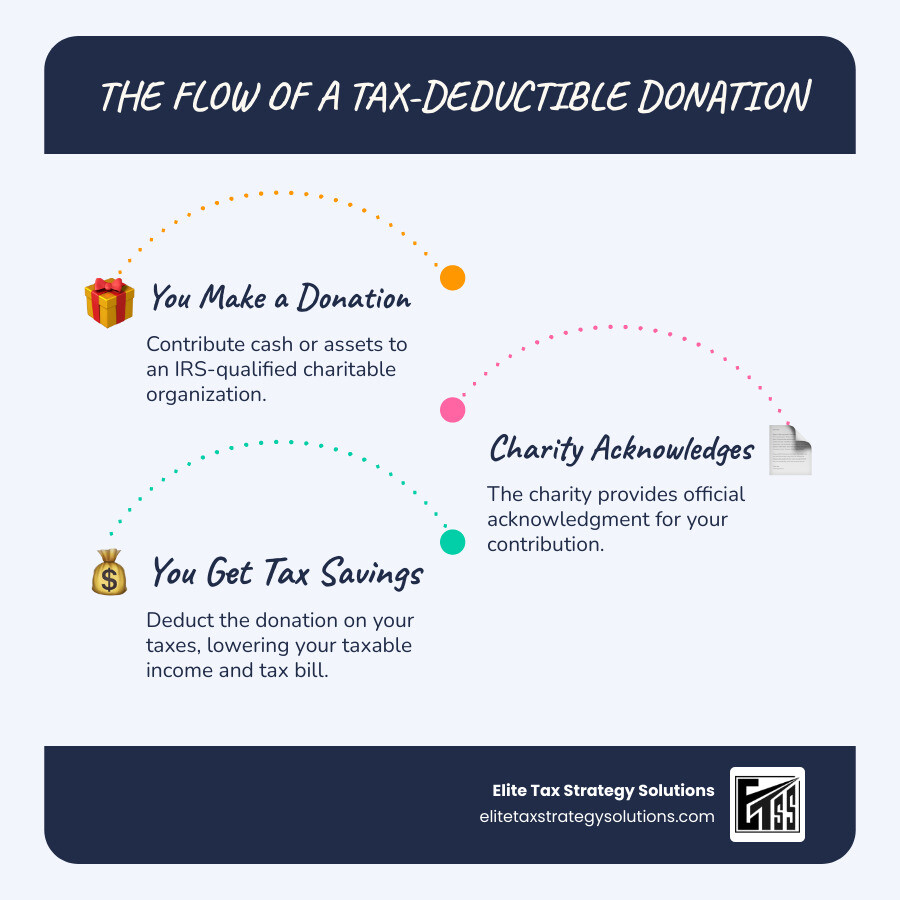
This infographic illustrates how a tax-deductible donation flows from the donor to a qualified charity, reducing the donor’s taxable income on their tax return, resulting in lower taxes owed or a larger refund.
Simple guide to charitable giving tax strategies terms:
- tax planning for high income earners
- advanced tax planning strategies
- wealth management tax planning
Foundational Strategies: Maximizing Your Cash Donations
While most charitable giving starts with cash, even these simple donations can pack a bigger tax punch with a few key strategies.

For 2025, you can deduct cash donations up to 60% of your adjusted gross income (AGI). The real challenge for many, however, is the standard deduction ($31,500 for married couples, $15,750 for singles in 2025). If your total itemized deductions (charitable gifts, mortgage interest, state/local taxes) don’t exceed this amount, you won’t get a tax benefit from your donations. This is where smart timing and strategic charitable giving tax strategies become crucial.
How ‘Bunching’ Can Overcome the Standard Deduction
Bunching means consolidating several years of donations into a single year. Instead of donating $10,000 annually, you might give $30,000 in one year and skip the next two. This pushes your itemized deductions over the standard deduction threshold in the giving year, creating significant tax savings.
For example, a married couple with $10,000 in state/local taxes and a $12,000 annual donation would have $22,000 in itemized deductions—far below the $31,500 standard deduction. They get no tax benefit for their gift. By bunching three years of donations ($36,000) into one year, their itemized deductions jump to $46,000. This surpasses the standard deduction by $14,500, generating real tax savings. In the other two years, they simply take the standard deduction.
This strategy is especially effective in high-income years. To ensure your favorite charities receive steady support, you can bunch contributions into a Donor-Advised Fund (DAF). You get the full tax deduction upfront and can then recommend grants from the DAF to charities over several years.
Substantiating Your Donations for the IRS
Losing deductions due to poor record-keeping is a common mistake. The IRS has specific documentation rules you must follow:
- Under $250: A bank record, canceled check, or credit card statement is sufficient.
- $250 or more: You need a contemporaneous written acknowledgment from the charity stating the donation amount and whether you received any goods or services in return. You must have this before you file your tax return.
- Noncash donations over $500: You must file Form 8283.
- Noncash donations over $5,000: A qualified appraisal is typically required, and the charity must sign part of Form 8283.
My advice: get written acknowledgments for every donation and save them with your tax records. The Official IRS guidance on charitable contributions has full details. At Elite Tax Strategy Solutions, we ensure our clients’ documentation is flawless as a core part of any solid charitable giving tax strategy.
Cash donations are powerful, but as we’ll see, donating appreciated assets can deliver even greater tax benefits.
Asset-Based Giving: Opening More Value Than Cash
Donating appreciated assets is one of the most powerful charitable giving tax strategies, especially for those with investment portfolios. When you donate assets like stock or real estate that you’ve owned for more than a year, you can typically deduct the full fair market value (FMV) and completely avoid paying capital gains tax on the appreciation.

If you sell the asset first and then donate the cash, you must pay capital gains tax, reducing the amount available for charity and your overall tax benefit. Donating the asset directly skips the tax bill. The deduction for these non-cash assets is generally limited to 30% of your AGI.
Donating Appreciated Assets: A Smarter Way to Give
Donating long-term appreciated assets provides a double benefit: you avoid capital gains tax and can deduct the asset’s full fair market value. This almost always results in a larger tax saving than selling first and donating the after-tax proceeds.
Consider this example: You bought stock for $10,000 that’s now worth $20,000. You’re in a 30% income tax bracket and face a 15% capital gains tax.
| Scenario | Sell Stock, Donate Cash | Donate Stock Directly |
|---|---|---|
| Asset Value | $20,000 | $20,000 |
| Original Cost | $10,000 | $10,000 |
| Capital Gain | $10,000 | $10,000 |
| Capital Gains Tax Due | $1,500 (15% of $10,000) | $0 (tax avoided) |
| Net Donation Amount | $18,500 ($20,000 – $1,500) | $20,000 |
| Income Tax Deduction Value (30%) | $5,550 (30% of $18,500) | $6,000 (30% of $20,000) |
| Total Tax Benefit | $4,050 ($5,550 – $1,500) | $7,500 ($6,000 + $1,500) |
| Impact on Charity | Receives $18,500 | Receives $20,000 |
By donating the stock directly, you save an additional $3,450 in taxes, and the charity receives $1,500 more. This is why asset-based giving is a cornerstone of effective tax planning.
Combining Tax-Loss Harvesting with Charitable Giving
You can also turn underperforming investments into a tax opportunity. Tax-loss harvesting involves selling assets at a loss to offset capital gains. You can deduct up to $3,000 in net capital losses against ordinary income annually.
The strategy is to sell depreciated assets to capture the tax loss, then donate the cash proceeds to charity. This gives you a double benefit: a capital loss to reduce your taxable income and a charitable deduction for your cash donation.
Advanced Asset Donations: Private Business Interests & Stock Options
For business owners and executives, charitable giving tax strategies can involve high-value assets with large embedded gains.
- Private Business Interests: Donating appreciated interests in a C-Corp, S-Corp, or LLC held for over a year works like donating public stock. You can avoid capital gains tax and deduct the fair market value. This requires careful valuation and timing, often before a sale or merger.
- Stock Options & Restricted Stock: For executives, donating vested restricted stock shares can help avoid capital gains tax on appreciation while claiming a deduction for their current value. Timing and understanding your company’s equity plan are critical.
These complex strategies require experienced guidance. At Elite Tax Strategy Solutions, we help business owners and executives steer these donations to maximize their tax savings and philanthropic impact.
Strategic Giving Vehicles and Advanced Charitable Giving Tax Strategies
Choosing the right vehicle for your contributions is a key part of advanced charitable giving tax strategies. The structure you use can amplify your tax savings and your philanthropic impact, especially for high-income earners.

Using Donor-Advised Funds (DAFs) for Simplicity and Power
Donor-Advised Funds (DAFs) are one of the most popular and flexible giving tools. A DAF functions like a charitable savings account: you contribute cash or appreciated assets, receive an immediate tax deduction, and then recommend grants to your favorite charities over time.
This flexibility makes DAFs perfect for “bunching” contributions. You can make a large donation in a high-income year to maximize your deduction, then maintain your regular giving schedule to charities in subsequent years. Assets in a DAF can also grow tax-free, potentially increasing the amount you can give. The sponsoring organization handles all record-keeping, simplifying the process. For more details, A comprehensive guide to charitable planning offers excellent insights.
A Powerful Tool for Seniors: Qualified Charitable Distributions (QCDs)
For those age 70½ or older with a traditional IRA, the Qualified Charitable Distribution (QCD) is an outstanding strategy. You can direct up to $108,000 (for 2025) from your IRA directly to a charity. This transfer counts toward your Required Minimum Distribution (RMD) but is excluded from your taxable income.
By keeping the distribution out of your adjusted gross income (AGI), a QCD can help you avoid higher tax brackets, increased Medicare premiums, and taxes on Social Security benefits. You don’t need to itemize to benefit from a QCD, making it valuable for retirees taking the standard deduction. The key is ensuring the funds go directly from your IRA to the charity.
Sophisticated Charitable Giving Tax Strategies with Trusts and Insurance
For individuals with significant wealth, charitable trusts and life insurance offer advanced estate planning opportunities.
-
Charitable Remainder Trusts (CRTs): You transfer appreciated assets to a trust, receive an income stream for life or a set term, and get an immediate partial tax deduction. The trust can sell the assets without paying capital gains tax. When the trust terminates, the remaining assets go to your chosen charity.
-
Charitable Lead Trusts (CLTs): These work in reverse, providing an income stream to a charity for a set period. Afterward, the remaining assets return to you or your heirs, often with reduced gift and estate tax costs.
-
Life Insurance: Naming a charity as the beneficiary of a life insurance policy can create a large future gift at a relatively low cost. While there’s no income tax deduction for premiums, the death benefit passes to the charity outside of your taxable estate.
These sophisticated strategies require careful coordination with your overall financial plan. At Elite Tax Strategy Solutions, we help clients in Jasper, Indiana and beyond structure these vehicles for maximum benefit.
Key Tax Rules, Compliance, and Special Considerations
Your charitable giving tax strategies interact with other parts of the tax code. Understanding these rules and upcoming legislative changes is key to avoiding mistakes and maximizing your impact.

Navigating the Alternative Minimum Tax (AMT) and New Legislation
The Alternative Minimum Tax (AMT) is a parallel tax system that ensures high-income earners pay a minimum amount of tax. While charitable deductions are still allowed under AMT, they may provide less benefit, and large gifts of appreciated property can sometimes trigger AMT concerns. Modeling these scenarios is crucial to understanding the true after-tax cost of your gift.
Looking ahead, the “One Big Beautiful Bill” (OBBB) will significantly shift charitable giving tax strategies starting in 2026:
- Non-Itemizer Deduction: A new deduction for non-itemizers will be available for up to $1,000 (individual) or $2,000 (married) for cash donations to operating charities (DAFs excluded).
- Itemizer Floor: Itemizers will only be able to deduct charitable donations that exceed 0.5% of their AGI.
- Benefit Cap: The tax benefit for charitable gifts will be capped at 35%, reducing the value of the deduction for those in higher tax brackets.
These changes make 2025 a critical planning year. Accelerating or bunching gifts into 2025 may be a wise strategy before the new rules take effect.
A Note on Canadian Charitable Giving Tax Rules
While our firm focuses on US tax law for clients in Jasper, Indiana, and across the country, it’s useful to know that Canadian rules are different. Canada uses a system of non-refundable tax credits instead of deductions. Like the US, Canada offers significant tax advantages for donating appreciated public securities, but the mechanics and provincial variations differ. Cross-border giving requires specialized guidance, as tax systems vary dramatically between countries.
Frequently Asked Questions about Charitable Giving Tax Strategies
Here are answers to some of the most common questions I receive about making giving both impactful and tax-efficient.
What are the primary tax benefits of charitable giving?
The main tax advantages include:
- An itemized deduction that reduces your taxable income.
- Avoiding capital gains tax when you donate appreciated assets like stock or real estate.
- Reducing your AGI, which can help you qualify for other tax credits and lower Medicare premiums.
- Lowering potential estate taxes through strategic gifts in your estate plan.
These benefits are central to smart charitable giving tax strategies.
Is it better to donate appreciated stock or cash?
For investors, donating appreciated stock (held for more than a year) is almost always better than donating cash. You get a double tax benefit: a deduction for the stock’s full fair market value and complete avoidance of the capital gains tax you would have paid if you sold it. As the table in our section on asset-based giving shows, this strategy results in a larger donation to charity and greater tax savings for you.
Can I get a tax deduction if I don’t itemize?
For the 2025 tax year, the answer is generally no. You must itemize deductions on Schedule A to get a tax benefit from charitable gifts. However, starting in 2026, the “One Big Beautiful Bill” (OBBB) introduces a new deduction for non-itemizers. You’ll be able to deduct up to $1,000 (individual) or $2,000 (married) for cash donations made to operating charities. This new benefit will not apply to contributions made to Donor-Advised Funds. Proactive planning with a firm like Elite Tax Strategy Solutions can help you steer these upcoming changes.
Conclusion
Strategic charitable giving is about creating a thoughtful plan that honors your values while maximizing your financial efficiency. We’ve covered how charitable giving tax strategies—from bunching contributions and donating appreciated assets to using DAFs and QCDs—can transform your philanthropy into a powerful financial tool.
Knowing these strategies is the first step; implementing them correctly in coordination with your overall financial picture is where the real value lies. That’s where personalized guidance makes all the difference.
At Elite Tax Strategy Solutions, we help clients in Jasper, Indiana, and beyond turn charitable intentions into tax-efficient reality. Our proactive approach means we work with you year-round to identify opportunities, steer complexities like business sales or RMDs, and make informed decisions before deadlines pass. We provide custom solutions because cookie-cutter advice isn’t enough to maximize your charitable impact and tax savings.
With legislative changes on the horizon, the best time to start planning is now. Proactive planning can save you thousands and amplify your philanthropic legacy. Let us show you how strategic giving can align with your financial goals, creating a win-win for your wallet and the causes you care about.
Explore our innovative tax planning services and find how we can help you make the most of your generosity.