Business tax savings strategies are vital for small business owners and high-income earners seeking to improve their financial stability. By adopting proactive steps, entrepreneurs can significantly reduce their tax liabilities and maximize their financial well-being. Here’s a quick list to get you started:
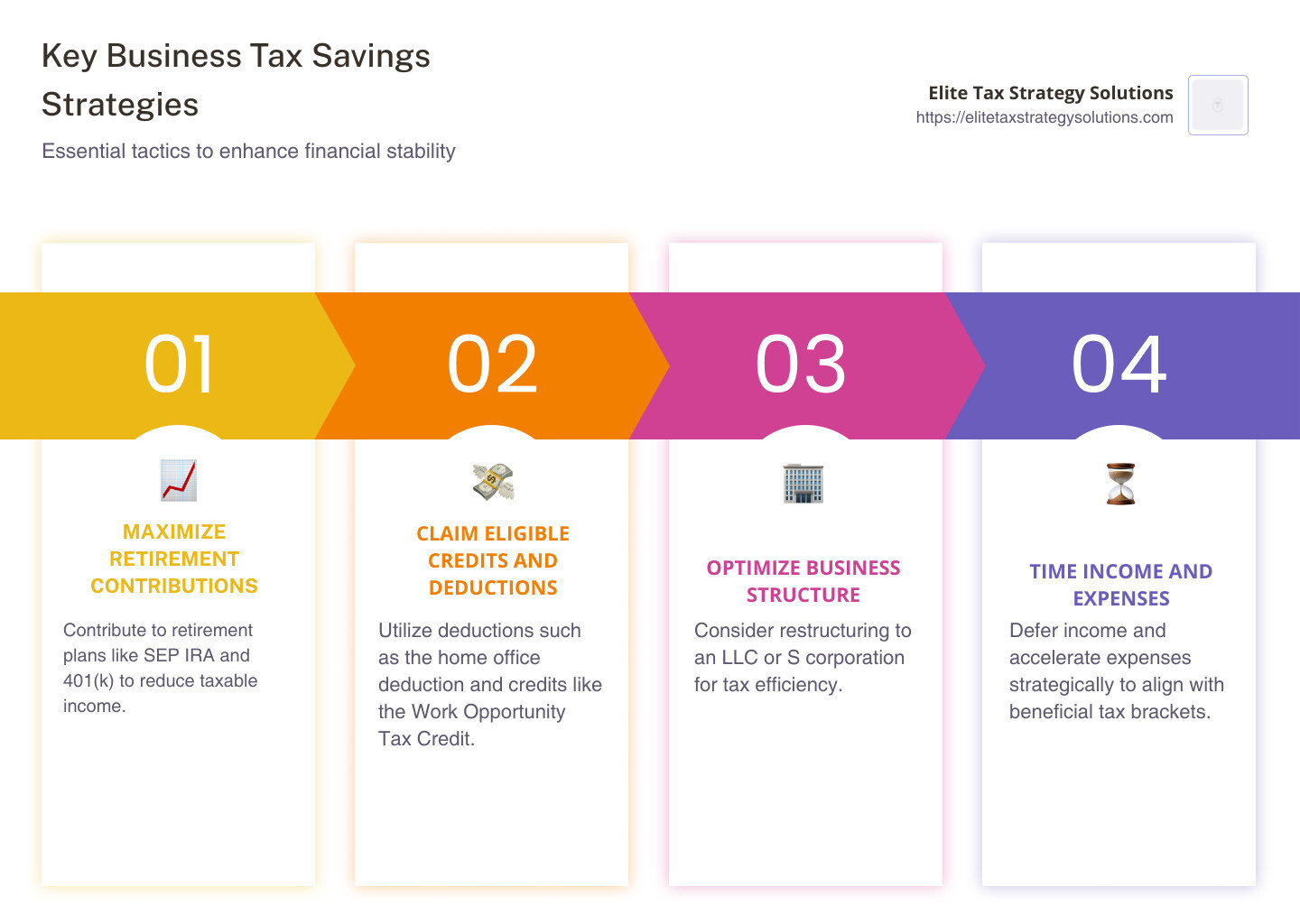
- Maximize retirement contributions to lower taxable income.
- Claim eligible tax credits and deductions, like the home office deduction.
- Optimize your business structure for tax efficiency.
- Time income and expenses to take advantage of tax brackets.
By implementing these powerful tactics, entrepreneurs can steer the complexities of tax regulations, reduce stress, and achieve long-term financial goals.
As an expert in business tax savings strategies, I’m David Fritch. With 40 years of experience, including running my own law and CPA practice and serving as an investment advisor, I’ve dedicated my career to helping small business owners and high-income earners manage and lower their tax burdens. Let’s explore the nuances of these strategies in the following sections.
Understanding Business Tax Savings Strategies
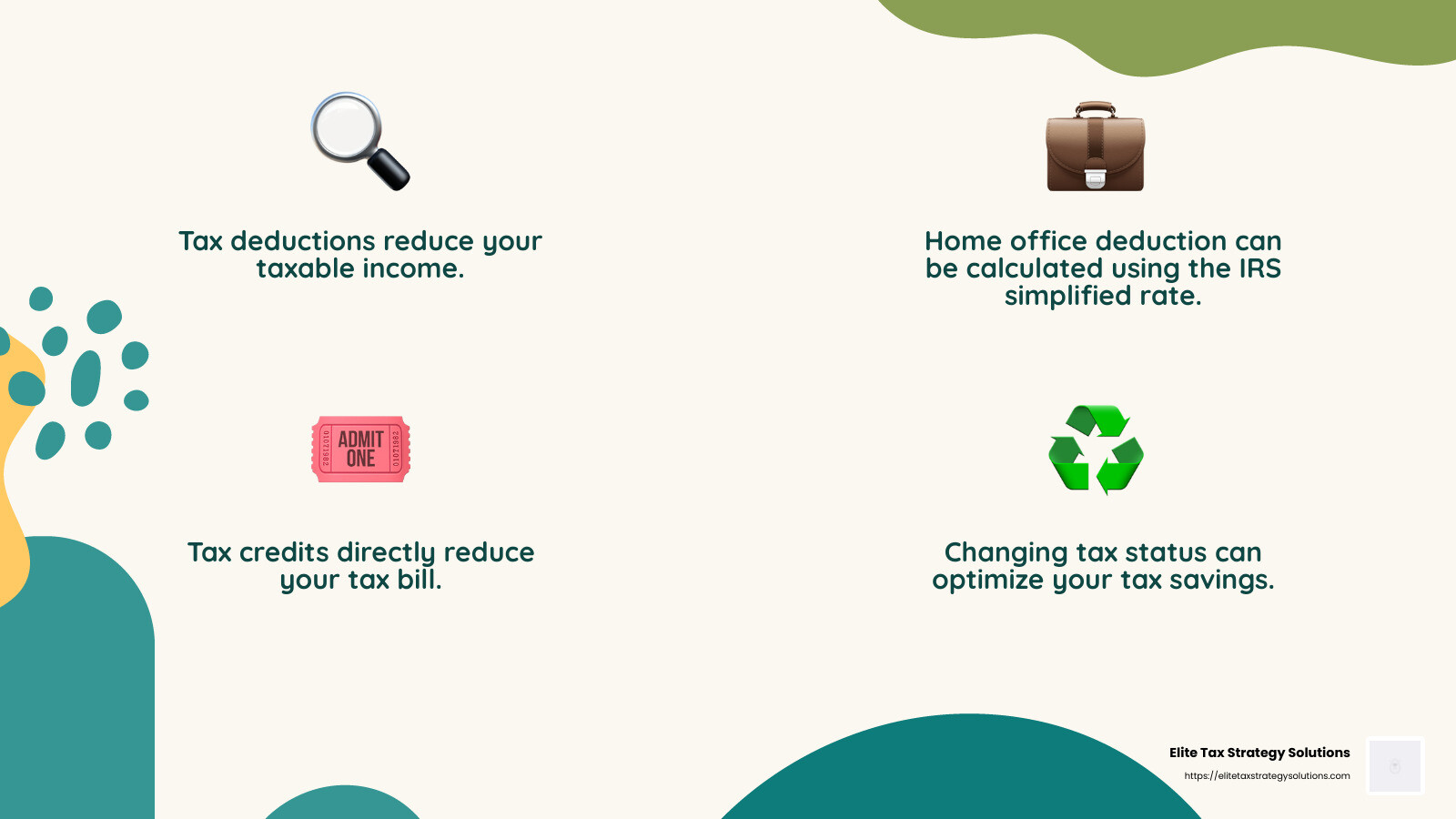
Navigating business taxes can feel like a maze, but understanding the basics of business tax savings strategies can light your way. Let’s break down some essential components: tax deductions, tax credits, and tax status changes.
Tax Deductions
Think of tax deductions as your best friend when it comes to lowering your taxable income. They help reduce the amount of income you need to pay taxes on. For instance, if you’re running a business from home, you might qualify for a home office deduction. This can be calculated based on actual expenses or using the IRS simplified rate of $5 per square foot, up to 300 square feet. Keeping a detailed record of these expenses throughout the year can save you from last-minute scrambles during tax season.
Another powerful deduction is the Qualified Business Income (QBI) deduction, which might allow you to deduct up to 20% of your business income. This is particularly beneficial for pass-through entities like sole proprietorships and partnerships.
Tax Credits
Unlike deductions, tax credits directly reduce the amount of tax you owe. They’re like a golden ticket in the tax world. For example, the Work Opportunity Tax Credit rewards businesses for hiring individuals from certain groups who face significant barriers to employment. This can directly lower your tax bill and support inclusive hiring practices.
Additionally, the Disabled Access Credit can help businesses that make their facilities accessible to individuals with disabilities. These credits not only reduce your tax burden but also encourage positive social contributions.
Tax Status Change
Changing your business’s tax status can lead to substantial savings. If you’ve outgrown your current structure, it might be time to consider a change. For example, an LLC can elect to be taxed as a C corporation by filing Form 8832 with the IRS. This switch can be beneficial because, under the Tax Cuts and Jobs Act of 2017, the corporate tax rate was reduced to 21%, which might be lower than your current individual tax rate.
However, this decision isn’t just about tax savings. It’s crucial to consider the overall impact on your business operations and consult with a tax professional who can help you evaluate the pros and cons.
By grasping these fundamental strategies, you can better manage your tax responsibilities and keep more of your hard-earned money. Up next, we’ll dive into how maximizing retirement contributions can further improve your tax savings.
Maximize Retirement Contributions
Maximizing retirement contributions is a smart move for entrepreneurs looking to save on taxes while preparing for the future. By taking advantage of retirement plans like SEP IRAs and 401(k)s, you can reduce your taxable income and secure your financial future.
SEP IRA
A Simplified Employee Pension (SEP) IRA is a popular choice for small business owners. It’s easy to set up and manage. With a SEP IRA, you can contribute up to 25% of your compensation, with a cap of $66,000 for 2023. These contributions are tax-deductible, which means they can significantly lower your taxable income.
SEP IRAs are especially beneficial for businesses with few or no employees, as only the employer contributes. If you’re self-employed, this can be a great way to maximize your retirement savings and reduce your tax bill.
401(k)
The 401(k) plan is another powerful tool for business tax savings. It allows both employer and employee contributions, offering flexibility and higher contribution limits. For 2023, you can contribute up to $22,500, or $30,000 if you’re 50 or older. Employers can also contribute, bringing the total limit to $66,000.
Setting up a 401(k) can make your business more attractive to potential employees, as it shows you’re invested in their future. Plus, employer contributions to a 401(k) are tax-deductible, providing another opportunity to reduce your taxable income.
Tax Benefits of Retirement Plans
Both SEP IRAs and 401(k)s offer significant tax advantages. Contributions are made with pre-tax dollars, which means they reduce your taxable income for the year. This can lower your overall tax liability and help you keep more of your money.
Moreover, the Setting Every Community Up for Retirement Improvement (SECURE) Act provides tax incentives for small businesses that establish retirement plans. You may qualify for a tax credit of up to $5,000 to cover the startup costs of setting up a new plan, making it even more appealing to take this step.
By strategically using retirement plans, you can boost your savings and enjoy substantial tax benefits. Up next, we’ll explore how leveraging tax deductions and credits can further improve your business tax savings strategies.
Leverage Tax Deductions and Credits
Tax deductions and credits are powerful tools that can significantly reduce your tax burden. Understanding how to use them effectively is key to optimizing your business tax savings strategies. Let’s explore some of the most impactful options.
Home Office Deduction
If you run your business from home, you might qualify for the home office deduction. This allows you to deduct expenses related to the part of your home used exclusively for business.
There are two ways to calculate this deduction:
-
Simplified Method: Deduct $5 per square foot of your home used for business, up to 300 square feet. This is straightforward and easy to calculate.
-
Actual Expenses Method: Calculate the percentage of your home used for business and apply that to your actual expenses, such as mortgage interest, utilities, and repairs.
Using the home office deduction can save you money, but remember to keep detailed records and ensure your home office meets the IRS’s requirements for regular and exclusive business use.
QBI Deduction
The Qualified Business Income (QBI) deduction is a valuable benefit for pass-through business owners. It allows you to deduct up to 20% of your qualified business income, potentially lowering your taxable income significantly. However, there are rules and limitations to consider.
-
Specified Service Trades or Businesses (SSTBs): For SSTBs, the QBI deduction phases out once your taxable income exceeds $191,950 (single) or $383,900 (married filing jointly) for 2024. If your income is above $241,950 (single) or $483,900 (married filing jointly), you lose the deduction entirely.
-
Non-SSTBs: If your business isn’t an SSTB and your income is above the threshold, you can still claim the deduction, but it’s limited to 50% of your share of W-2 wages or 25% of those wages plus 2.5% of your share of qualified property.
The QBI deduction can be complex, so it’s wise to consult a tax professional to ensure you’re maximizing your benefits.
Work Opportunity Tax Credit (WOTC)
The Work Opportunity Tax Credit (WOTC) encourages businesses to hire individuals from certain target groups who face barriers to employment, such as veterans or those receiving public assistance.
-
Credit Value: The credit is worth up to $2,400 per eligible new hire.
-
Eligibility: To qualify, you must submit Form 8850 to your local state agency within 28 days of the employee’s start date. Once confirmed, you can claim the credit on your next tax return.
The WOTC not only helps reduce your tax liability but also supports efforts to create a more inclusive workforce.
By leveraging these deductions and credits, you can significantly reduce your tax burden and keep more money in your pocket. Next, we’ll explore how optimizing your business structure can further improve tax efficiency.
Optimize Business Structure for Tax Efficiency
Choosing the right business structure is crucial for tax efficiency. It can make a big difference in how much tax you pay and how your business grows. Let’s explore three common structures: LLC, S corporation, and C corporation.
Limited Liability Company (LLC)
An LLC is a flexible structure that combines the benefits of a corporation with those of a partnership or sole proprietorship.
-
Pass-Through Taxation: LLCs benefit from pass-through taxation, meaning the business’s income is reported on the owners’ personal tax returns, avoiding corporate taxes. This can be a big win for small businesses looking to save on taxes.
-
Flexibility: Owners can choose how the LLC is taxed—either as a sole proprietorship, partnership, or corporation—by filing the appropriate forms with the IRS.
-
Liability Protection: LLCs protect personal assets from business debts, making them a popular choice for entrepreneurs.
S Corporation
An S corporation offers another way to achieve pass-through taxation, similar to an LLC, but with some additional benefits and requirements.
-
Avoid Double Taxation: Like LLCs, S corporations avoid the double taxation that C corporations face. Income is passed directly to shareholders, who report it on their personal tax returns.
-
Salary and Distribution: Owners can receive both a salary and distributions. This allows them to potentially lower their tax burden by taking advantage of lower tax rates on distributions.
-
Limitations: S corporations have restrictions, such as a limit of 100 shareholders and only one class of stock. All shareholders must be U.S. citizens or residents.
C Corporation
A C corporation is a traditional corporation with its own set of advantages and challenges.
-
Separate Tax Entity: C corporations are taxed separately from their owners. This means they pay corporate taxes on profits, and shareholders pay taxes on dividends, leading to double taxation.
-
Unlimited Growth Potential: C corporations can have unlimited shareholders and multiple classes of stock, making it easier to raise capital from investors.
-
Flat Tax Rate: C corporations benefit from a flat 21% tax rate, which can be advantageous for businesses with high profits.
Choosing the Right Structure
Deciding on the best structure depends on your business goals, income level, and growth plans.
- Consult a Professional: It’s wise to work with a tax advisor to evaluate your options and run a cost-benefit analysis. This ensures you choose a structure that aligns with your financial objectives and minimizes your tax liability.
By optimizing your business structure, you can create a foundation that supports tax efficiency and long-term success. Next, we’ll look at how timing your income and expenses can further improve your tax savings.
Timing Income and Expenses
Timing is everything, especially when it comes to business tax savings strategies. By carefully managing when you recognize income and expenses, you can significantly reduce your tax liability. Let’s explore some effective strategies: defer income, accelerate expenses, and the cash method accounting.
Defer Income
Deferring income means pushing it into the next tax year. This can be beneficial if you expect to be in the same or a lower tax bracket next year. Here are some tips:
-
Delay Invoicing: If you’re using cash method accounting, consider delaying invoices until the end of the year. This way, payment comes in the following year, shifting income to the next tax year.
-
Installment Sales: If you’re selling property, use the installment method. This allows you to receive payments over time, reporting income only as you receive payments.
-
Interest and Dividends: Consider buying short-term bonds or certificates of deposit that mature in the next year to defer interest income.
Accelerate Expenses
Accelerating expenses means making deductible purchases before the end of the year. This helps reduce taxable income in the current year. Here’s how:
-
Prepay Expenses: Pay for next year’s expenses now, like office rent or insurance premiums. Just ensure the benefit doesn’t exceed IRS limitations.
-
Use Credit Cards: Charge recurring expenses to your credit card. You can deduct them this year, even if you pay the bill next year.
-
Bunch Expenses: Group expenses together at the end of the year to maximize deductions. This works well with medical or business expenses.
Cash Method Accounting
The cash method of accounting is a simple way to manage income and expenses. Here’s why it can be advantageous:
-
Flexibility: You recognize income when you receive it and deduct expenses when you pay them. This gives you control over when to record income and expenses.
-
Automatic Change: Certain businesses can automatically switch to the cash method if they meet IRS criteria, like having average annual gross receipts of $27 million or less.
-
Benefit for Small Businesses: Especially useful for small businesses, the cash method can help smooth out income and expenses, aligning them with actual cash flow.
By strategically timing your income and expenses, you can optimize your tax position and improve your business’s financial stability. This proactive approach is key to effective tax planning and achieving long-term success. Next, we’ll address some frequently asked questions about business tax savings strategies.
Frequently Asked Questions about Business Tax Savings Strategies
How can small businesses reduce their tax liability?
Small businesses can reduce their tax liability by taking advantage of various tax deductions and tax credits. Here are some effective strategies:
-
Evaluate Tax Credits: Tax credits like the Small Business Health Care Tax Credit or the Work Opportunity Tax Credit can directly reduce the amount you owe. For example, hiring individuals from certain targeted groups can qualify you for the Work Opportunity Tax Credit.
-
Track Business Expenses: Deductions for expenses like travel, rent, and utilities can lower your taxable income. Every bit helps, so keep detailed records of all business-related expenses.
-
Consider Hiring Family Members: Hiring family members, such as your spouse or children, can provide tax advantages. For instance, wages paid to children under 18 in a sole proprietorship are exempt from Social Security and Medicare taxes.
What are the benefits of changing business structure for tax purposes?
Changing your business structure can have significant tax benefits. Here’s how:
-
S Corporation vs. C Corporation: As a C corporation, your business faces double taxation—once at the corporate level and again on dividends. Switching to an S corporation can avoid this, as income is passed through to owners and taxed at individual rates.
-
Limited Liability Company (LLC): An LLC offers flexibility in taxation. It can be taxed as a sole proprietorship, partnership, or corporation, depending on your needs. This flexibility can help optimize your tax position.
-
Protection and Simplicity: While a C corporation might offer asset protection, an S corporation or LLC can provide similar benefits with potentially lower tax liability.
How do retirement plans impact tax savings?
Retirement plans are a powerful tool for tax savings. Here’s why:
-
Tax-Deferred Growth: Contributions to plans like a 401(k) or SEP IRA are tax-deferred. This means you don’t pay taxes on contributions until you withdraw funds, typically in retirement when you may be in a lower tax bracket.
-
Contribution Limits: Maximize your contributions to take full advantage of tax benefits. For example, in 2023, the SEP IRA contribution limit is up to 25% of compensation or $66,000, whichever is less.
-
Employer Contributions: As a business owner, you can benefit from both employee and employer contributions, increasing your retirement savings while reducing taxable income.
By understanding these strategies, small businesses can effectively manage their tax liability, ensuring they keep more of their hard-earned money. Next, we’ll dig into more advanced tax planning techniques to further improve your business’s financial health.
Conclusion
At Elite Tax Strategy Solutions, we believe that proactive tax planning is key to achieving financial stability and maximizing tax savings. Our personalized services are designed to help high earners and closely held businesses steer the complexities of the tax landscape with ease.
Why Choose Us?
Our approach is simple yet effective. We work closely with our clients to understand their unique financial situations and tailor strategies that align with their long-term goals. Whether it’s structuring your business for tax efficiency, leveraging deductions and credits, or maximizing retirement contributions, we ensure that every decision is informed and strategic.
Proactive Planning
Tax laws are constantly evolving, and staying ahead means being proactive. We keep our clients informed about the latest changes and how they impact their tax obligations. By integrating tax planning with your broader financial strategy, we help you not only save on taxes but also grow your wealth.
Personalized Services
We understand that no two businesses are the same. That’s why our services are personalized to meet your specific needs. From identifying the right business structure to optimizing cash flow through smart timing of income and expenses, we offer solutions that are as unique as your business.
When tax regulations can be daunting, let us be your guide. With our expertise, you can confidently steer the tax landscape and focus on what you do best—running your business.
For more on how we can help you with innovative tax planning, visit our Innovative Tax Planning page.
By choosing Elite Tax Strategy Solutions, you’re not just opting for a service; you’re investing in a partnership dedicated to your financial success.