Why Proactive Tax Planning is Your Secret Weapon
Business tax savings strategies can save your company thousands of dollars each year, but only if you implement them correctly and consistently.
Quick Answer: Top Business Tax Savings Strategies
- Maximize deductions – Home office, business expenses, equipment purchases
- Use Section 179 – Deduct up to $1,250,000 in equipment costs immediately (2025)
- Choose the right structure – S-Corp election can save on self-employment taxes
- Strategic timing – Defer income, accelerate expenses
- Leverage tax credits – R&D, hiring incentives, health care credits
- Employ family – Income splitting and payroll tax savings
- Retirement planning – SEP-IRA, Solo 401(k) for tax-deferred growth
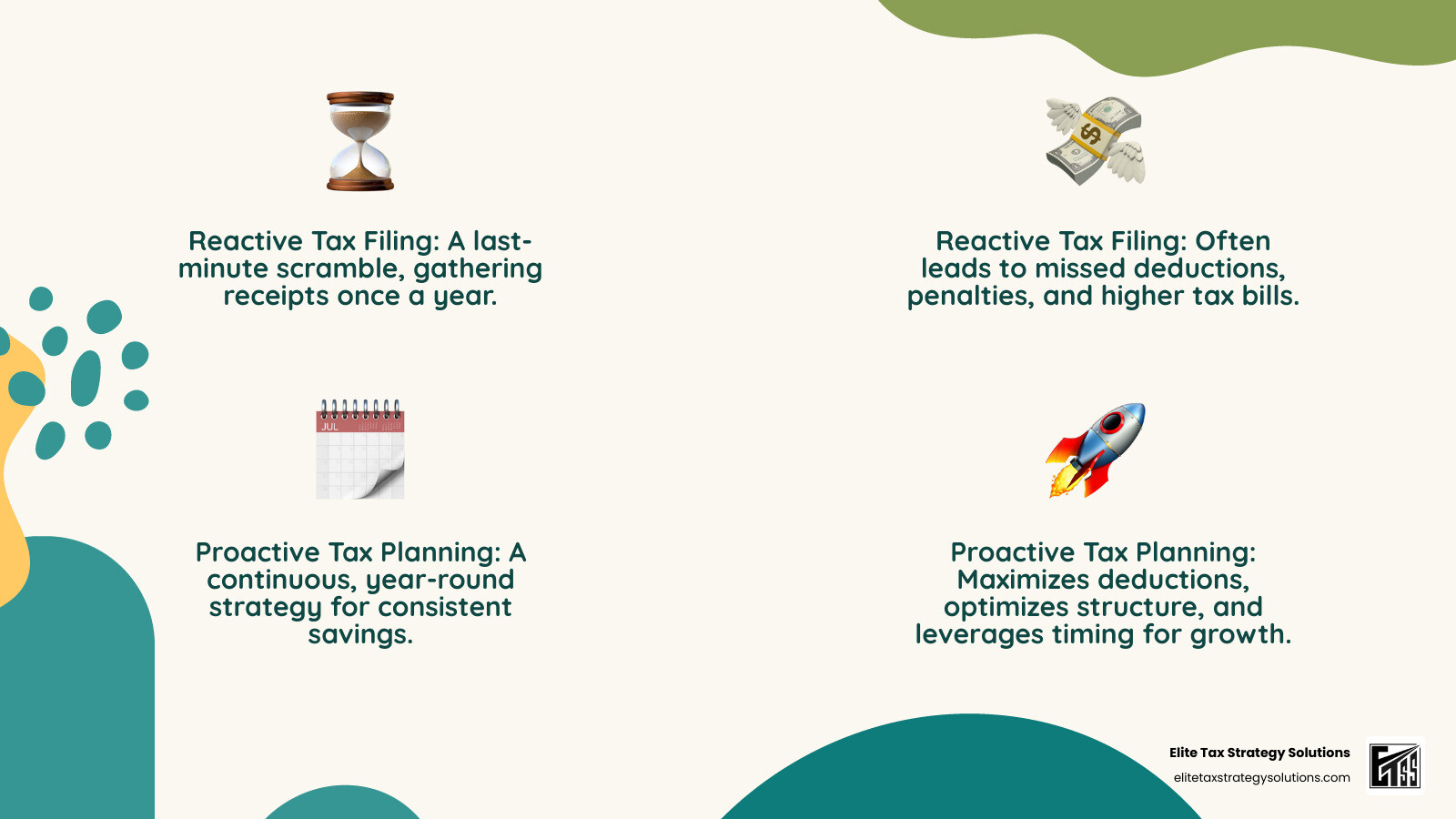
Most business owners treat taxes as a once-a-year chore, gathering receipts in March and hoping for the best. This reactive approach costs them money.
Smart owners understand that proactive tax planning isn’t about finding loopholes. It’s about using legitimate strategies throughout the year to legally minimize their tax burden while staying compliant.
The difference is significant. A sole proprietorship earning $100,000 annually could save nearly $7,000 in self-employment taxes by electing S-Corp status. A business purchasing new equipment can use Section 179 to immediately deduct the full cost instead of depreciating it over years.
These aren’t complex schemes; they’re straightforward strategies that work when applied correctly. I’m David Fritch, and I’ve spent 40 years helping business owners implement these effective business tax savings strategies through my CPA practice and law firm.
Business tax savings strategies word guide:
Foundational Strategies: Deductions and Record-Keeping
Think of business tax savings strategies like building a house: you must start with a solid foundation. For your tax strategy, that foundation is maximizing deductions and maintaining meticulous records. Many business owners miss out on thousands in basic deductions right under their noses.
Every legitimate business expense you deduct reduces your taxable income dollar for dollar. Combined with meticulous record-keeping, this creates an audit-proof system that provides confidence and peace of mind. Let’s explore our insights on Optimizing Tax Deductions to build this crucial foundation.
Maximizing Common (and Overlooked) Business Deductions
It’s often the everyday expenses that business owners forget to track. The rule is simple: if an expense is ordinary and necessary for your business, it’s likely deductible. Key deductions include:
- Office rent and utilities, for both commercial spaces and qualifying home offices.
- Business insurance premiums for general liability, professional indemnity, and property.
- Professional fees paid to your accountant, lawyer, or tax advisor.
- Advertising costs, from social media campaigns to promotional materials.
- Employee expenses beyond salaries, such as training, bonuses, and benefits.
- Interest on business debt from loans, credit cards, or lines of credit.
- Education and training costs for courses or conferences that improve skills for your current business.
The key is to keep every receipt and document the business purpose. The IRS needs to see that these expenses genuinely helped your business operate and grow. For a comprehensive overview, see this guide to deductible expenses.
The Home Office Deduction: Your Commute-Free Tax Break

The home office deduction can save you thousands, but the IRS is strict. Your office must pass the exclusive and regular use test, meaning it’s a specific area used only for business. It must also be your principal place of business.
Once you qualify, choose a calculation method:
- Simplified method: $5 per square foot (up to 300 sq. ft.) for a maximum $1,500 deduction. It’s easy and requires minimal records.
- Actual expense method: Deduct a percentage of your mortgage interest, rent, utilities, insurance, and repairs based on the office’s share of your home’s total square footage. This often yields a larger deduction but requires more work.
Bonus: If your home office is your principal place of business, travel to client meetings becomes deductible business mileage, not non-deductible commuting. The IRS rules for the home office deduction have all the details.
The Critical Importance of Meticulous Record-Keeping
Meticulous record-keeping separates successful business tax savings strategies from expensive mistakes. Your records are your business’s financial story and your best defense in an audit.
- Audit-Proof Your Business: Detailed documentation is your shield. Legitimate deductions can be disallowed without adequate proof.
- Substantiate Claims: Keep original receipts, invoices, and bank statements. Credit card statements alone are often not enough.
- Identify Deductions: Good accounting software helps categorize expenses, revealing tax-saving opportunities.
- Separate Finances: Use dedicated business bank accounts and credit cards. This is crucial for protecting your liability and simplifying bookkeeping.
Modern software like QuickBooks or Xero can automate much of this. The IRS generally requires you to keep records for at least three years, but keeping them for six is safer. For help setting up robust systems, consider our Business Tax Advisory services.
Advanced Business Tax Savings Strategies
Once you’ve mastered the basics, it’s time for more sophisticated business tax savings strategies. These power moves involve smart asset management, leveraging tax credits, and strategic timing of income and expenses. They require a deeper understanding of the tax system but can build long-term financial strength. That’s where our Tax Optimization Strategies help you see the bigger picture.
Leveraging Depreciation and Section 179 for Major Purchases
When your business buys new equipment, machinery, or vehicles, you create a tax opportunity. Instead of deducting costs over many years through depreciation, you can often claim them immediately.

Section 179 lets you deduct the full purchase price of qualifying equipment in the year you start using it. For 2025, you can deduct up to $1,250,000. The deduction phases out once total equipment purchases exceed $3,130,000.
Bonus depreciation adds another layer of savings. In 2025, it’s set at 40%, allowing you to deduct a large portion of the cost right away, even if you exceed Section 179 limits.
The heavy vehicle deduction is particularly powerful. Vehicles with a Gross Vehicle Weight Rating over 6,000 pounds (like a Ford F-150 or Chevy Suburban) get special treatment. For 2025, heavy SUVs can qualify for a significant Section 179 deduction of up to $31,300, plus 40% bonus depreciation.
The equipment must be in service by December 31st and used more than 50% for business. This strategy improves cash flow for reinvestment and growth. Check The Official Website of Section 179 for the latest details and see how it fits your Tax Savings for Businesses plan.
Open uping Powerful Tax Credits for Your Business
While deductions reduce your taxable income, credits reduce your tax bill dollar for dollar. They are a direct discount on your final tax amount.
- Research & Development (R&D) Credit: For businesses that develop new products, improve processes, or create software. It’s not just for tech companies.
- Work Opportunity Tax Credit (WOTC): Provides a credit for hiring individuals from certain groups facing employment barriers, such as qualified veterans.
- Small Business Health Care Tax Credit: For businesses with fewer than 25 employees that pay at least half of their health insurance premiums.
- Employer-Provided Child Care Credit: A valuable credit for businesses that help employees with child care expenses.
Eligibility requirements can be complex, so it’s wise to work with a professional to ensure you claim all available credits.
Strategic Timing: A Key Business Tax Savings Strategy
Timing is everything in tax planning. By controlling when you recognize income and expenses, you can shift your tax burden to more favorable periods.
Your accounting method (cash or accrual) sets the rules. Cash-basis accounting offers more flexibility.
- Defer Income: Delay sending invoices for work completed in December until January, especially if you expect to be in a lower tax bracket next year.
- Accelerate Expenses: Prepay next year’s rent, insurance, or supplies in December to deduct them this year. Complete necessary repairs before year-end.
For accrual-basis companies, you can deduct bonuses in the current year if you pay them within 2.5 months after year-end. Successful timing requires planning ahead, which is why our Business Tax Planning Strategies approach involves year-round collaboration.
Structural and People-Powered Tax Strategies
Your business structure and the people you employ can open up some of the most powerful business tax savings strategies. These strategic moves can save you thousands annually while building a stronger foundation. For guidance on these decisions, explore our Corporate Tax Planning services.
Choosing the Right Business Structure for Tax Optimization
Your business structure is the foundation of your tax strategy. The best choice depends on your income, expenses, and growth plans.
| Structure | Tax Treatment (Federal) | Key Tax Implications |
|---|---|---|
| Sole Proprietorship | Pass-through (owner reports income/expenses on personal tax return) | No separate business tax. Owner pays self-employment tax (Social Security and Medicare) on net earnings. Unlimited personal liability. |
| Partnership | Pass-through (partners report their share on personal returns) | Similar to sole proprietorship but with multiple owners. Partners pay self-employment tax on their share of earnings. |
| LLC | Pass-through by default (can elect corporate taxation) | Offers liability protection with pass-through taxation flexibility. By default, owners still pay self-employment tax on all profits. |
| S-Corp | Pass-through with payroll requirements | Income splits between salary (subject to payroll taxes) and distributions (not subject to self-employment taxes). Significant potential savings but more administrative burden. |
| C-Corp | Separate entity taxation | Double taxation on distributed profits, but lower corporate rates on retained earnings. Best for businesses planning major growth or investment. |
For profitable service businesses, the S-Corp election is a powerful tool. A business owner earning $100,000 could take a reasonable salary of $50,000 (subject to payroll taxes) and receive $50,000 as a distribution (not subject to self-employment tax), potentially saving nearly $7,000 annually.
However, the IRS requires “reasonable compensation” for S-Corp owners. The salary must reflect fair market value for the work performed. The S-Corp election also brings additional administrative tasks like payroll. For details, see the IRS information on S Corporations or our Tax Planning for S Corps services.
Tax-Smart Retirement Planning for You and Your Team
Retirement plans are a potent tax-saving tool. Contributions are typically tax-deductible, reducing your current tax bill while you build long-term, tax-deferred wealth.
- SEP IRA: Ideal for solo entrepreneurs. You can contribute up to 25% of compensation (up to $69,000 for 2024). It’s simple to set up and administer.
- SIMPLE IRA: Good for businesses with up to 100 employees. It involves employee contributions and a required employer match or contribution, all of which are deductible.
- Solo 401(k): A great option for the self-employed (and their spouse). You can contribute as both “employee” and “employer,” potentially allowing contributions up to $69,000 in 2024 ($76,500 if 50 or older).
- Defined Benefit Plans: Best for high earners near retirement, allowing for very large, tax-deductible contributions.
Offering retirement plans also helps attract and retain quality employees. For more, see the IRS guide to self-employed retirement plans.
The Tax Advantages of Employing Family Members: An Overlooked Business Tax Savings Strategy
When done correctly, employing family members is a legitimate and powerful business tax savings strategy. It works by splitting income, shifting it from your high tax bracket to a family member’s lower one.
Employing your children is particularly advantageous. You can pay them a reasonable wage for legitimate work, which your business deducts. Thanks to the standard deduction ($14,600 for a single person in 2024), your child may owe little or no federal income tax. If your business is a sole proprietorship and your child is under 18, their wages are generally exempt from Social Security and Medicare taxes.
Employing your spouse can also open doors to tax-free fringe benefits, like health insurance premiums, which are deductible for the business and tax-free to the employee-spouse.
To make this strategy work, you must follow these non-negotiable rules:
- Legitimate Work: The work must be necessary for the business, and the family member must actually perform it.
- Reasonable Compensation: Pay them what you would pay a non-family member for the same job.
- Thorough Records: Keep job descriptions, time sheets, and pay stubs, just as you would for any other employee.
The IRS scrutinizes these arrangements, so legitimacy and documentation are everything.
Frequently Asked Questions about Business Tax Savings Strategies
Here are answers to the most common questions we hear from business owners looking to make the most of their How to Minimize Taxes opportunities.
Can I deduct the full cost of a new business vehicle in one year?
Yes, this is often possible and is one of the most powerful business tax savings strategies. While regular cars have strict depreciation limits, heavy vehicles receive much better tax treatment.
If your SUV, pickup, or van has a Gross Vehicle Weight Rating (GVWR) over 6,000 pounds, it qualifies for accelerated depreciation. Think of vehicles like a Ford F-150 or a Chevy Tahoe.
Using Section 179 and bonus depreciation, you can often deduct a substantial portion, if not all, of the vehicle’s cost in the year you buy it. For 2025, this includes a Section 179 deduction up to $31,300 for heavy SUVs, plus 40% bonus depreciation.
The key requirement is that the vehicle must be used more than 50% for business purposes. You must keep detailed mileage logs to prove your business use percentage. This strategy can generate thousands in immediate tax savings. For technical details, see the Details on the 2025 Section 179 Deduction.
How does the Qualified Business Income (QBI) deduction work?
The QBI deduction is like a 20% discount on your business income for qualifying pass-through entities (sole proprietorships, partnerships, S-Corps, LLCs). This deduction reduces your personal taxable income.
For 2024, if your taxable income is under $195,300 (single) or $390,700 (married filing jointly), you generally get the full 20% deduction.
It gets more complex if your income is higher, especially if you’re in a Specified Service Trade or Business (SSTB)—like a doctor, lawyer, or consultant. For higher earners, the deduction may be limited or eliminated based on factors like W-2 wages paid or the cost of business property. The calculation can be complex, but the savings are significant. Learn more about Maximizing Your Qualified Business Income (QBI) Deduction Before It Expires.
When is it time to hire a tax professional?
Knowing when to get professional help is one of the smartest business moves you can make. Consider hiring a tax professional if you are:
- Experiencing business growth that complicates your tax situation.
- Considering major changes like incorporating or electing S-Corp status.
- Handling complex transactions like mergers, acquisitions, or raising capital.
- Facing an IRS audit and need expert representation.
- Wanting proactive, year-round planning to continuously optimize your tax position.
The tax code is constantly changing. A professional’s job is to stay current so you can focus on yours. The tax savings we generate for clients often far exceed our fees, making professional help a smart investment. At Elite Tax Strategy Solutions, we provide a thorough, proactive approach to maximize savings while ensuring compliance.
Conclusion: Building a Proactive and Strategic Tax Future

We’ve covered a wide range of business tax savings strategies, from foundational deductions and record-keeping to advanced tactics like leveraging Section 179 and choosing the right business structure. We’ve also explored how to use retirement plans and family employment to your advantage.
But the single most important takeaway is this: these strategies only work when you’re thinking ahead.
Tax planning is not a last-minute scramble in March. It’s an ongoing, year-round process. Every major purchase, new hire, and structural change has tax implications that are best addressed before you act, not after.
For business owners in places like Jasper, Indiana, and the surrounding areas we serve, every dollar saved on taxes is a dollar that can be reinvested into your company, your employees, or your own financial security. The tax code is always changing, which is why having a knowledgeable advisor is essential.
At Elite Tax Strategy Solutions, we don’t just file returns. We believe in a thorough, proactive approach to build a comprehensive strategy that supports your long-term goals. You started your business to pursue your passion, not to become a tax expert. Let us handle the strategy so you can focus on what you do best.
Ready to stop leaving money on the table and start building a real tax strategy? Develop a proactive strategy with our tax planning for small businesses services.