
Why 1099 Tax Deductions Matter for Your Financial Success
Even though you will claim most of the 1099 tax deductions list 2024 when you file your 2024 tax return in early 2025, understanding these write-offs right now lets you make smarter spending and record-keeping decisions throughout both 2024 and 2025. Many of the rules remain the same from year to year, and wherever the IRS has already announced 2025 updates—such as the higher standard mileage rate—we note them below so you stay a step ahead.
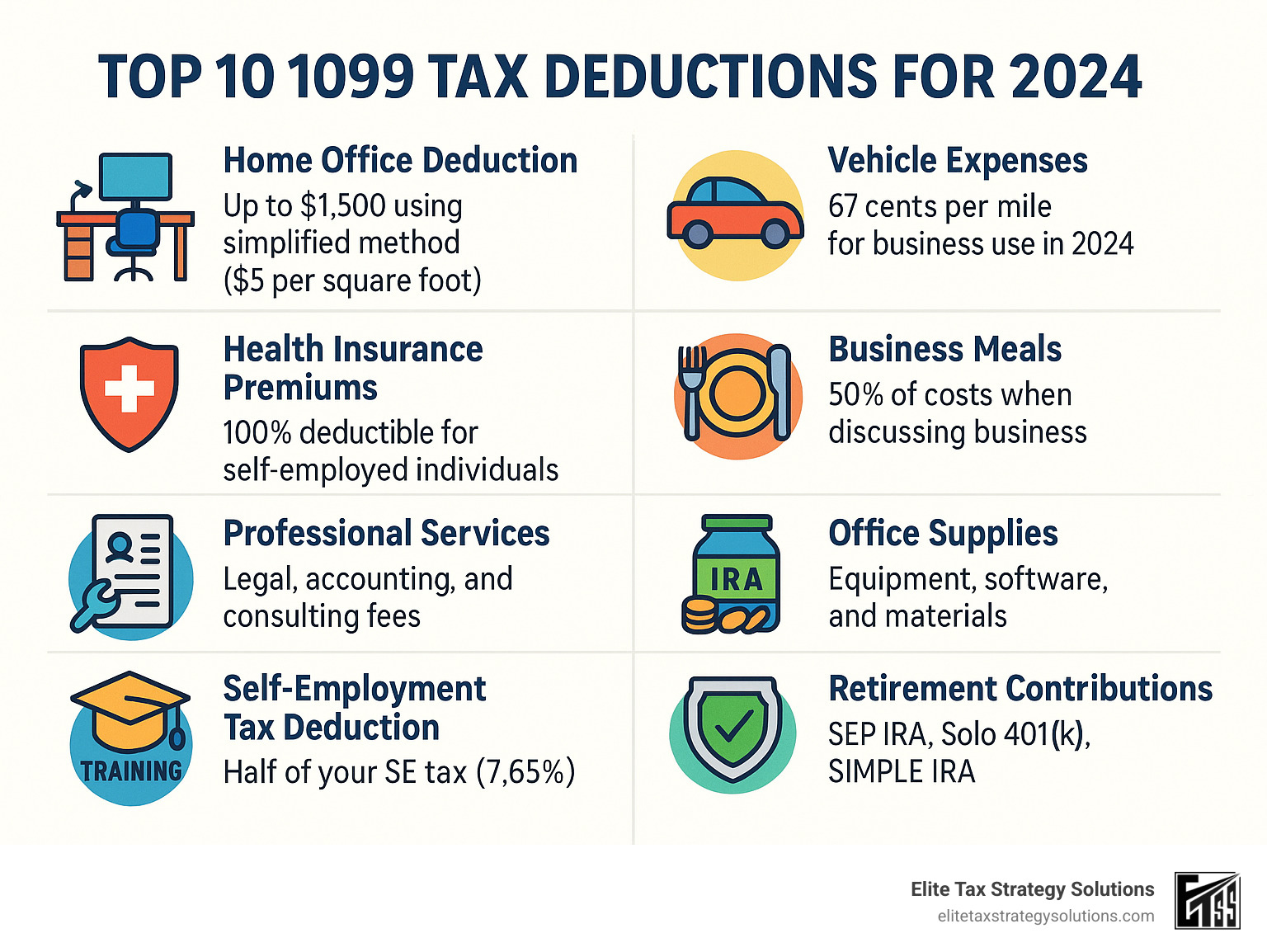
Top 1099 Tax Deductions for 2024 (and what’s changing for 2025):
- Home Office Deduction – Up to $1,500 using simplified method ($5 per square foot)
- Vehicle Expenses – 67 cents per mile for business use in 2024 (increases to 70 cents in 2025)
- Health Insurance Premiums – 100% deductible for self-employed individuals
- Business Meals – 50% of costs when discussing business
- Professional Services – Legal, accounting, and consulting fees
- Office Supplies – Equipment, software, and materials
- Self-Employment Tax Deduction – Half of your SE tax (7.65%)
- Retirement Contributions – SEP IRA, Solo 401(k), SIMPLE IRA (2025 limits are higher—details in Section 1)
- Education Expenses – Professional development and training
- Business Insurance – Liability, property, and professional coverage
While tax regulations can be complex, independent contractors can access numerous deductions to lower their tax burden. The self-employment tax rate is 15.3%, covering Social Security (12.4%) and Medicare (2.9%). Unlike W-2 employees, 1099 workers pay the full amount. However, you can deduct half of this tax and may also claim the Qualified Business Income (QBI) deduction of up to 20% of your business income.
With 40 years of experience as a CPA and attorney, I’ve helped countless high-income earners and small business owners steer the 1099 tax deductions list 2024—and prepare for 2025 changes—to maximize savings while ensuring full IRS compliance.
Simple 1099 tax deductions list 2024 glossary:
- business expense categories
- small business tax reduction strategies
- tax strategies for small business owners
The Ultimate 1099 Tax Deductions List 2024
As an independent contractor, you control your taxes. The upside is claiming business expenses to reduce your taxable income. Understanding the 1099 tax deductions list 2024 is key to keeping more of your money.
These business expenses are reported on Schedule C (Form 1040), which determines your net business profit or loss. This figure flows to your personal tax return, reducing your Adjusted Gross Income (AGI). A lower AGI means a lower tax bill, which is a powerful way to maximize your savings. Let’s explore the most valuable deductible expense categories.
Office and Operational Expenses
Many day-to-day costs of running your business are fully deductible and can significantly lower your tax bill.
Home Office Deduction
To qualify for the home office deduction, you must use a part of your home exclusively and regularly for your business, and it must be your principal place of business.
You have two ways to calculate this deduction:
- Simplified Method: For 2024, you can deduct $5 per square foot of your home office, up to a maximum of 300 square feet (a $1,500 deduction). This method is straightforward and requires minimal record-keeping.
- Regular Method: This method allows you to deduct a percentage of your actual home expenses (like rent, mortgage interest, utilities, and insurance) based on your office’s square footage relative to your home’s total size. It requires more detailed records and filing Form 8829 but can result in a larger deduction.
Here’s a quick comparison:
| Feature | Simplified Method | Regular Method |
|---|---|---|
| Calculation | $5 per square foot | Percentage of actual home expenses |
| Maximum Deduction | $1,500 (300 sq ft) | No fixed maximum, depends on actual expenses |
| Record-Keeping | Minimal | Detailed records of all home expenses |
| IRS Form | Schedule C | Schedule C and Form 8829 |
| Depreciation | Not applicable | Can include depreciation of your home |
| Complexity | Lower | Higher |
Office Supplies
Deductible office supplies include items like pens, paper, printer ink, and cleaning supplies for your workspace. Tools for your trade, such as a hammer or saw, are also deductible.
Business Software
Software essential for your business is deductible, including design programs, accounting software, and subscriptions like Microsoft 365 or Zoom. For software with mixed personal and business use, deduct the business-use percentage.
Phone and Internet Bills
You can deduct the business-use percentage of your personal cell phone and home internet bills. A dedicated business line or internet service is 100% deductible. A second home landline used for business is also deductible, but the first is considered personal.
Business Insurance Premiums
Premiums for business insurance are deductible. This includes general liability, professional liability (errors and omissions), commercial property, and business income insurance.
Professional Services Fees
Fees for professional services that help your business are deductible, including legal, accounting, and consulting fees.
Vehicle, Travel, and Meal Expenses
Expenses from business-related transportation and travel offer significant deductions.
Business Use of Vehicle
If you use your personal vehicle for business, you can deduct the costs using one of two methods:
-
Standard Mileage Rate: This is the simplest method. For 2024, the rate is $0.67 cents per mile for business use. This rate covers gas, maintenance, and depreciation. For 2025, the rate increases to $0.70 cents per mile. Simply track your business miles and multiply by the rate.
-
Actual Expense Method: This method lets you deduct the actual costs of operating your vehicle for business, including gas and oil, repairs, tires, insurance, and depreciation. You must track your business-use percentage if the vehicle is also used for personal trips.
Important Note: If you choose the standard mileage rate the first year you use a vehicle for business, you generally must stick with that method for that vehicle. If you start with the actual expense method, you can switch to the standard rate in later years.

Business Travel
When traveling for business away from your tax home, you can deduct expenses like airfare, lodging, local transportation, tips, and laundry. The trip’s primary purpose must be business.
Business Meals
For 2024, you can generally deduct 50% of the cost of business-related meals with clients or partners, or while traveling for business. The expense must be “ordinary and necessary” and not lavish. Keep records of the date, location, amount, business purpose, and attendees. Learn more about the 50% meal deduction rule from the IRS.
Health, Retirement, and Education Deductions
Independent contractors can deduct expenses related to their personal well-being and future.
Self-Employed Health Insurance Deduction
A key benefit in the 1099 tax deductions list 2024 is the self-employed health insurance deduction. If ineligible for an employer-sponsored plan, you can deduct 100% of the premiums you pay for health, dental insurance, and qualified long-term care premiums. This is an adjustment to income that reduces your AGI and applies to premiums for yourself, your spouse, dependents, and children under age 27.
Retirement Plan Contributions
Saving for retirement offers a great tax advantage. Contributions to self-employed retirement plans reduce your taxable income. Popular options include:
- SEP IRA (Simplified Employee Pension IRA): Easy to set up with flexible contribution amounts.
- Solo 401(k): Allows contributions as both an “employee” and “employer,” enabling higher contribution limits. For 2025, the employee contribution limit is $23,500 (plus a $7,500 catch-up if age 50+), with a total combined limit of $70,000 (excluding catch-up).
- SIMPLE IRA (Savings Incentive Match Plan for Employees IRA): Good for small businesses with a few employees. The 2025 contribution limit is $16,500.
These are “above-the-line” deductions that reduce your AGI. We can help you explore these options with our innovative tax planning services.
Professional Development and Education Deductions
Expenses for education that maintains or improves skills for your current business are deductible. This includes webinars, seminars, industry publications, certifications, and conferences. However, you cannot deduct education that qualifies you for a new trade or business.
Key Tax Concepts for Independent Contractors
Understanding a few key tax concepts will give you more confidence in reducing your tax liability. It’s not just about finding deductions but knowing how the pieces fit together.
What is the difference between a tax deduction and a tax credit?
Understanding the difference between tax deductions and credits is crucial. A tax deduction lowers your total taxable income, so the amount you save depends on your tax bracket. A tax credit is more valuable, providing a dollar-for-dollar reduction of your final tax bill. For example, a $1,000 tax credit cuts your tax bill by exactly $1,000.

How the Self-Employment Tax Deduction Works
As an independent contractor, you pay both the employee and employer portions of Social Security and Medicare taxes, which is a 15.3% self-employment (SE) tax rate for 2024 (12.4% for Social Security up to $168,600 and 2.9% for Medicare on all earnings).
The good news is the IRS allows you to deduct one-half of your self-employment tax. This is an “above-the-line” deduction claimed on Schedule SE (Form 1040) that directly reduces your Adjusted Gross Income (AGI), lowering your overall income tax liability. It’s a key part of the 1099 tax deductions list 2024.
Understanding the Qualified Business Income (QBI) Deduction
The Qualified Business Income (QBI) deduction, also known as Section 199A, is a major tax break allowing many self-employed individuals to deduct up to 20% of their qualified business income. QBI is essentially the net income from your business.
This deduction is available whether you itemize or take the standard deduction. For 2024, income limitations apply. You can take the full 20% QBI deduction if your total taxable income is at or below $191,950 (single filers) or $383,900 (joint filers). Above these thresholds, the deduction may be limited, especially if your business is a “specified service trade or business” (SSTB) like health, law, or consulting. This deduction is calculated on Form 8995 and is set to expire after 2025 unless renewed. Find more details from the IRS on the Qualified Business Income (QBI) deduction.
Best Practices for Maximizing Your 1099 Deductions
Claiming all entitled deductions is crucial for maximizing tax savings. However, doing it correctly is equally important to avoid IRS issues. Here are best practices to keep you compliant and financially savvy.
Essential Record-Keeping for Your 1099 Tax Deductions List 2024
Meticulous record-keeping is the bedrock of a smart tax strategy. The IRS requires proof for every deduction; without it, deductions can be disallowed during an audit, leading to additional taxes and penalties. Keep the following records:
- Mileage Logs: For business vehicle use, log dates, destinations, purpose, and odometer readings. Many apps can automate this.
- Expense Receipts: Keep receipts, invoices, and credit card statements for all business expenses. Digital copies are usually sufficient.
- Bank Statements: Reconcile bank statements regularly to account for every business transaction.
- Invoices: Keep copies of all invoices you send to clients.
- Canceled Checks: Retain records of checks written for business expenses.
Using accounting software or a spreadsheet to track income and expenses simplifies tax time. As a rule, keep all tax records for at least six years from your filing date to substantiate your expenses.
Common Mistakes to Avoid
Even experienced contractors can make tax mistakes. Here are common pitfalls to avoid:
- Forgetting Small Expenses: Don’t overlook small costs like office supplies, software subscriptions, or parking fees. While minor individually, they add up and can significantly reduce your tax bill.
- Misclassifying Expenses: Do not deduct personal expenses. A business expense must be “ordinary and necessary” for your trade. For example, the home office deduction requires a space used exclusively and regularly for business, not a multi-purpose area.
- Not Separating Personal vs. Business Use: For dual-use items like a cell phone or vehicle, you must track and deduct only the business-use percentage. Overestimating this percentage can raise IRS red flags.
- Missing Estimated Tax Payments: As a 1099 worker, you must pay income and self-employment taxes via quarterly estimated payments to avoid penalties. We can help manage these payments to prevent tax-time surprises.
- Ignoring State Tax Laws: State tax laws differ from federal rules; a federal deduction may not apply at the state level. Our personalized tax planning services consider all relevant state and local tax implications, including for those in Jasper, Indiana, or suburban areas.
We provide comprehensive tax support and compliance services to help you steer these complexities and avoid costly errors.
Frequently Asked Questions about 1099 Deductions
It’s normal to have questions when navigating the 1099 tax deductions list 2024. Here are answers to some of the most common queries we receive.
What is the most overlooked tax deduction for 1099 workers?
The most overlooked deductions often include the home office deduction, which many don’t realize they qualify for, and the self-employment tax deduction (deducting half of your SE taxes). Others frequently missed are the business-use portion of personal assets (like a cell phone or internet bill) and professional development costs for courses or industry publications to improve your skills. Every small deduction adds up.
Can I take the standard deduction and still write off my business expenses?
Yes, you can absolutely take the standard deduction and write off your business expenses. This is a common point of confusion. Business expenses are reported on Schedule C (Form 1040) to calculate your net business profit or loss. This calculation reduces your gross income to determine your Adjusted Gross Income (AGI). This happens before you decide whether to take the standard deduction or itemize your personal deductions on Form 1040. This allows you to benefit from both your business write-offs and the standard deduction.
What tax forms do I need to claim my 1099 deductions?
To claim deductions from the 1099 tax deductions list 2024, you’ll use several key IRS forms:
- Schedule C (Form 1040), Profit or Loss from Business: This is the main form for listing your business income and most expenses.
- Schedule SE (Form 1040), Self-Employment Tax: This form is used to calculate your self-employment tax and claim the deduction for one-half of that tax.
- Form 8829, Expenses for Business Use of Your Home: You’ll need this if you use the regular method to claim the home office deduction.
- Form 4562, Depreciation and Amortization: Use this form to deduct the cost of larger assets like equipment or vehicles over time.
You will also receive income forms like Form 1099-NEC or Form 1099-MISC from clients, which report the income you must account for on your Schedule C.
Partner with a Professional to Optimize Your Tax Strategy
You’ve explored the 1099 tax deductions list 2024, a powerful tool for independent contractors. However, navigating the rules can be complex, especially for high earners or growing businesses.
This is where Elite Tax Strategy Solutions comes in. We help independent contractors and small business owners open up their full tax-saving potential. Our goal is to maximize your savings and ensure your financial footing is solid.
We act as your year-round tax co-pilot. Our proactive approach helps you strategically find and use every deduction you qualify for, keeping more of your hard-earned money in your pocket. Trying to handle complex tax laws alone can lead to missed savings or IRS issues.
With our team, you’ll gain clarity and confidence. We help you understand the tax code, implement smart strategies, and keep your records perfectly organized.
Ready to feel in control of your financial future? Let’s chat about how our expertise can make a real difference for your bottom line.
Click here to Schedule an Appointment with us today. Or, explore our tax planning for small businesses to see the full scope of how we can help.