1099 tax compliance is a crucial aspect of managing a successful business. Ensuring compliance involves correctly reporting non-employment income such as payments to independent contractors. If you’re short on time, here are the essentials:
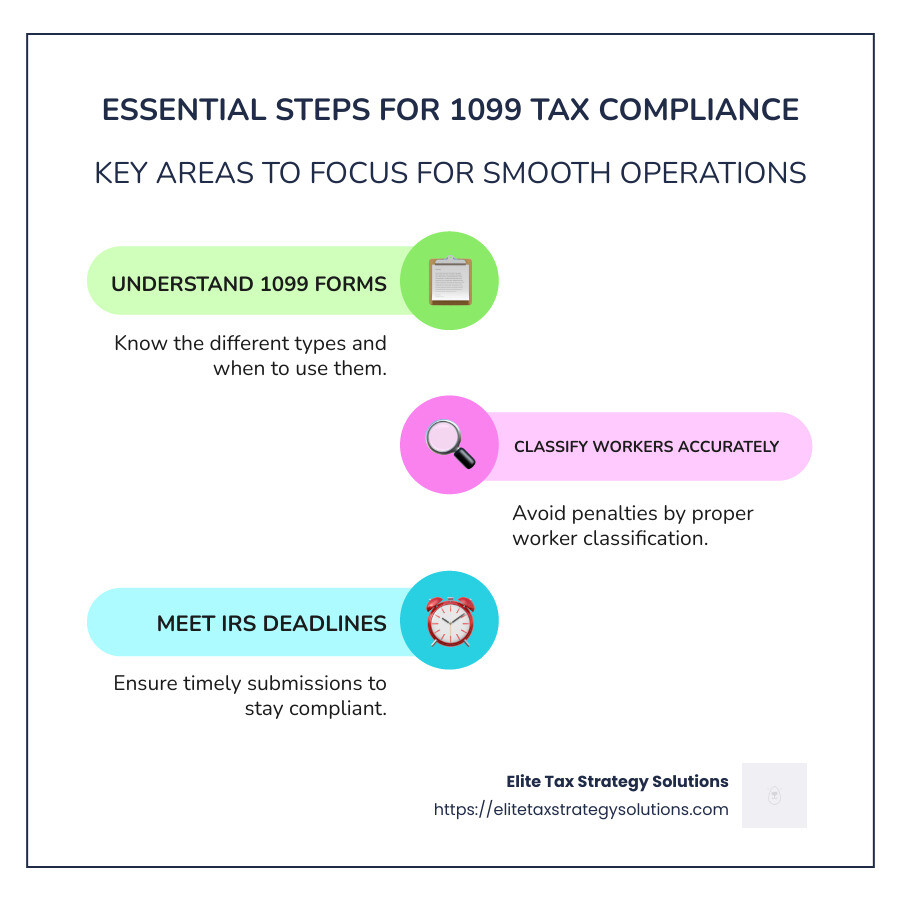
- Understand the different types of 1099 forms and when they apply.
- Classify your workers accurately to avoid costly penalties.
- Meet IRS deadlines to ensure your business stays compliant.
The importance of 1099 tax compliance cannot be overstated. Proper compliance protects businesses from penalties and facilitates smooth operations. The IRS requires accurate submission of 1099 forms to report a variety of income streams. Failure to comply may result in increased scrutiny, fines, or both.
As someone who has dedicated years to helping businesses steer complex tax regulations, I, David Fritch, bring 40 years of expertise in law and accounting. My experience ensures that your business’s approach to 1099 tax compliance is both effective and efficient. Transitioning from these foundations, let’s dig deeper into understanding the intricacies of 1099 forms.
1099 tax compliance terms explained:
– tax compliance for companies
– tax compliance services
– foreign tax compliance
Understanding 1099 Forms
When it comes to 1099 tax compliance, understanding the different types of 1099 forms is essential. These forms are used to report various kinds of non-employment income to the IRS, ensuring that taxes are accurately assessed and paid. Let’s explore the main types of 1099 forms you need to know.
Form 1099-NEC
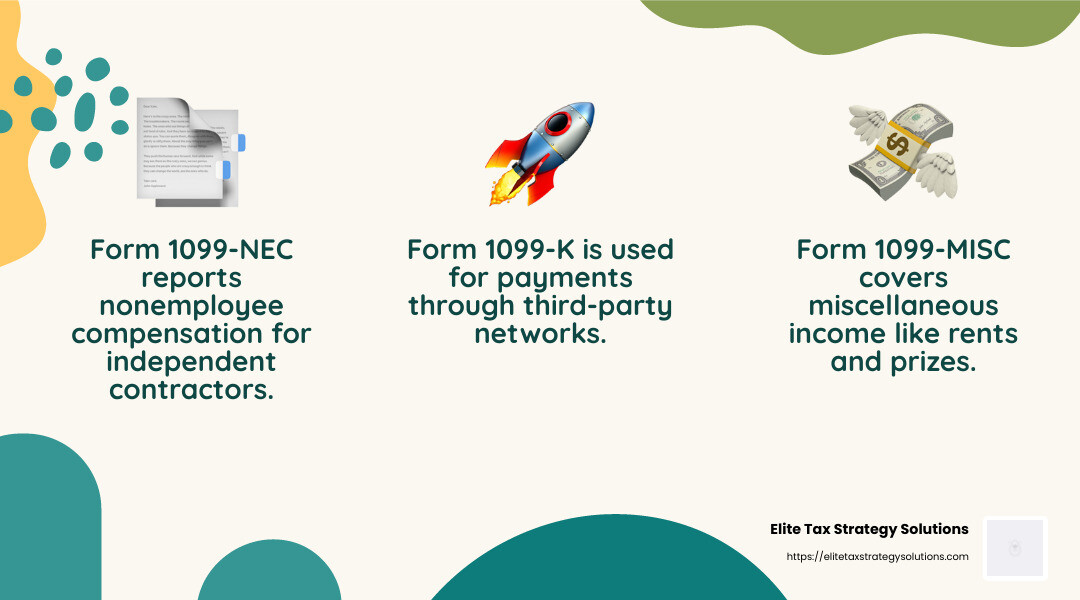
Form 1099-NEC is used to report nonemployee compensation. This form is crucial for businesses that hire independent contractors. If you pay a contractor $600 or more in a year, you must issue a 1099-NEC. This form was reinstated in 2021 to specifically address payments for services rendered by non-employees, separating it from other miscellaneous income.
Key points about Form 1099-NEC:
- Independent Contractors: This form applies to payments made to individuals who are not employees.
- $600 Threshold: Any payments totaling $600 or more in a calendar year must be reported.
- Timely Filing: The deadline to send this form to contractors and the IRS is January 31.
Form 1099-MISC
Form 1099-MISC is used for reporting miscellaneous income. While it used to include nonemployee compensation, it now covers other types of payments. This form is still widely used for various income types, such as rents, prizes, and medical payments.
Here’s what you need to know about Form 1099-MISC:
- Miscellaneous Payments: Includes rents, prizes, awards, and medical payments.
- $600 and $10 Thresholds: Report payments of $600 or more for most categories, and $10 or more for royalties.
- Direct Sales Reporting: If your business makes direct sales of at least $5,000 to a buyer for resale, it must be reported.
Other 1099 Forms
Besides 1099-NEC and 1099-MISC, there are other forms for specific types of income:
- 1099-K: Used for reporting payments made through third-party networks, such as credit card transactions. The threshold for reporting these payments is $5,000 for tax year 2024.
- 1099-INT: Issued for interest income, typically by banks or financial institutions. You’ll receive this form if you earn more than $10 in interest.
- 1099-DIV: Sent to taxpayers who receive dividend income from investments. This form reports dividends and distributions received from investments like stocks.
Understanding these forms is a vital step in ensuring 1099 tax compliance. Each form has its own rules and thresholds, and knowing which one applies to your situation can save you from potential penalties.
In the next section, we’ll dive into the compliance requirements associated with these forms, including reporting thresholds and penalties for non-compliance.
1099 Tax Compliance Requirements
When it comes to 1099 tax compliance, businesses must be aware of several key requirements to avoid penalties and ensure proper reporting. Let’s break down the essential components: reporting thresholds, backup withholding, and penalties for non-compliance.
Reporting Thresholds
For most 1099 forms, the IRS sets specific reporting thresholds:
-
$600 Payments: If you pay an independent contractor or service provider $600 or more in a calendar year, you must issue a 1099 form. This applies to both nonemployee compensation (Form 1099-NEC) and miscellaneous income (Form 1099-MISC).
-
$10 Royalties: For royalty payments, the threshold is much lower. If you pay $10 or more in royalties, you need to report it using Form 1099-MISC.
-
$5,000 Direct Sales: If your business makes direct sales of at least $5,000 of consumer products to a buyer for resale anywhere other than a permanent retail establishment, this must be reported on Form 1099-MISC.
Backup Withholding
Backup withholding is an important aspect of 1099 tax compliance. It comes into play when a payee fails to provide a valid Taxpayer Identification Number (TIN).
-
TIN Requirements: Businesses must collect a valid TIN from each contractor or payee. If a TIN is not provided, backup withholding is required.
-
28% Withholding: The IRS mandates a 28% withholding on payments subject to backup withholding. This means if a contractor hasn’t provided their TIN, 28% of their payment must be withheld and sent to the IRS.
-
IRS Remittance: It’s crucial to remit withheld amounts to the IRS promptly. Failure to do so can result in penalties.
Penalties for Non-Compliance
Failure to comply with 1099 reporting requirements can result in significant penalties. Here are the types of penalties businesses might face:
-
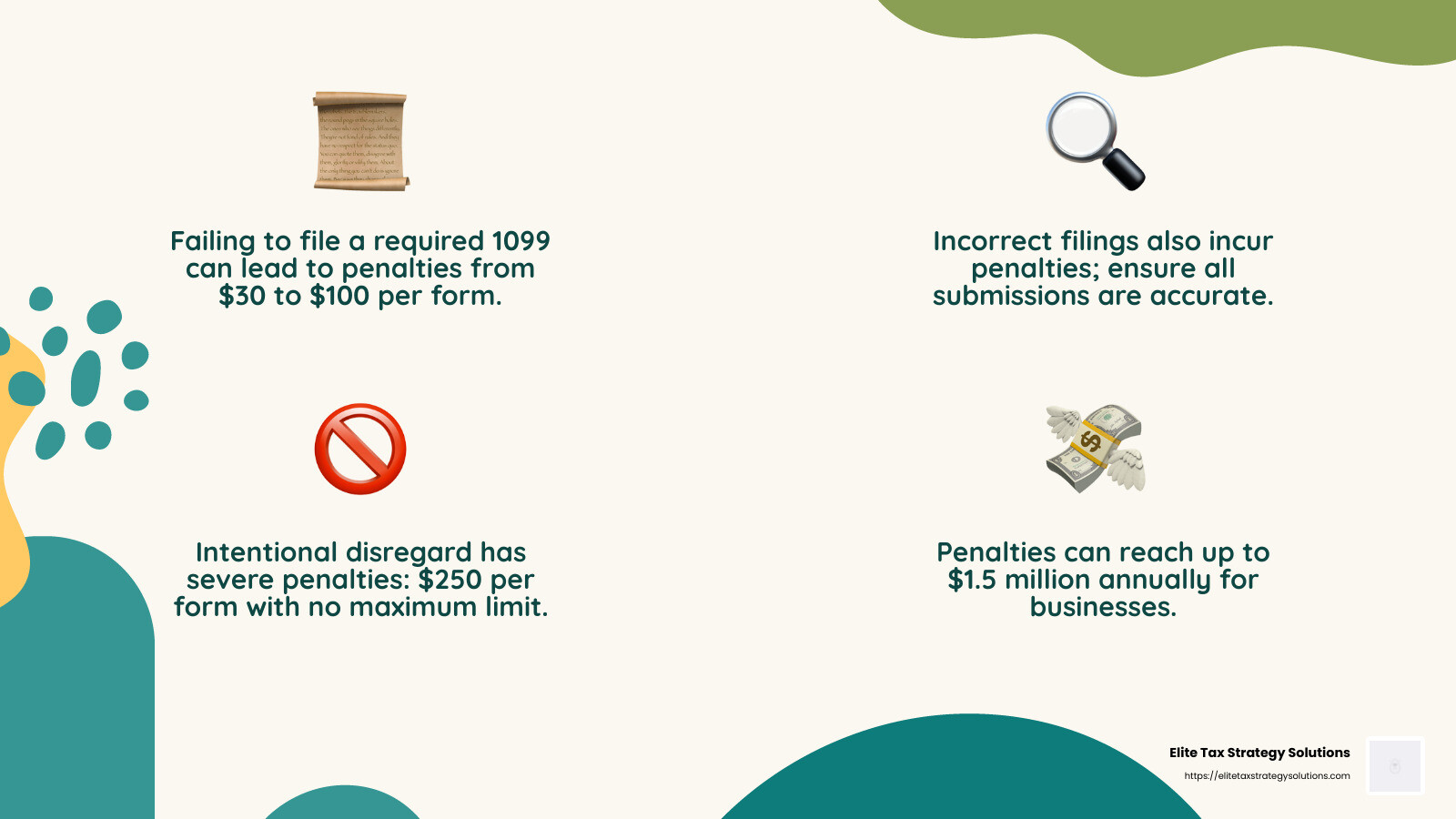
Failure to File: If you don’t file a required 1099 form, penalties range from $30 to $100 per form, depending on how late the filing is. The maximum penalty can reach $1.5 million per year.
-
Incorrect Filing: Filing forms with incorrect information can also lead to penalties. The IRS expects accurate and timely submissions.
-
Intentional Disregard: If a business intentionally disregards the requirement to file a 1099, the penalty is $250 per form, with no maximum limit.
Understanding these requirements is crucial for businesses to maintain compliance and avoid costly penalties. In the next section, we will explore the best practices for ensuring smooth 1099 reporting and compliance.
Best Practices for 1099 Tax Compliance
Navigating 1099 tax compliance can be tricky, but following best practices can make the process smoother and help avoid penalties. Let’s explore key areas: worker classification, obtaining W-9 forms, and maintaining documentation.
Worker Classification
Correctly classifying workers is the first step in 1099 tax compliance. Misclassification can lead to hefty fines.
-
Independent Contractors vs. Employees: Independent contractors usually control how they work and are paid on a per-job basis. Employees, on the other hand, have set hours and tasks and are more closely managed.
-
Federal and State Tests: Use these tests to determine the right classification. They consider factors like behavior control, financial control, and the relationship between the parties. Always keep records of your classification decisions as they can protect you if audited.
Obtaining W-9 Forms
Before you pay a vendor or contractor, ensure you have their W-9 form. This form is crucial for collecting accurate information.
-
Vendor Engagement: Engage vendors early and explain why you need a W-9. This will make them more likely to comply.
-
Payment Prerequisites: Make it a rule to receive a completed W-9 before issuing any payment. This ensures you have the necessary details like the Taxpayer Identification Number (TIN) to complete 1099 forms accurately.
-
Accurate Information: Double-check the information on the W-9 to avoid errors on the 1099 forms. Incorrect info can lead to IRS penalties.
Maintaining Documentation
Proper documentation is your safety net during audits and ensures compliance with IRS guidelines.
-
Audit Protection: Keep detailed records of all payments and related documents. This includes contracts, invoices, and correspondence related to worker classification and payments.
-
Compliance Records: Maintain organized records for each vendor and contractor. These should include their W-9 forms and any communications about payments and classifications.
-
IRS Guidelines: Familiarize yourself with IRS documentation requirements. This will help you know what to keep and for how long, ensuring you’re always prepared if the IRS comes knocking.
By focusing on these best practices, businesses can streamline their 1099 processes and minimize risks. In the next section, we’ll discuss the importance of e-filing and deadlines to further improve compliance.
E-Filing and Deadlines
As we move forward in understanding 1099 tax compliance, it’s crucial to grasp the importance of e-filing and adhering to deadlines. These steps help businesses stay compliant and avoid penalties.
E-Filing Requirements
Starting in 2024, the IRS has lowered the threshold for mandatory electronic filing from 250 to just 10 or more information returns. This change means more businesses need to e-file their 1099s using the IRS’s Information Return Intake System (IRIS).
-
Transmitter Control Code (TCC): To e-file, you’ll need a TCC. Apply for one well in advance, as processing can take up to 45 days.
-
IRIS System: The IRIS system is the platform for submitting your electronic 1099 forms. It streamlines the filing process and helps ensure accuracy.
Filing Deadlines
Meeting deadlines is a key aspect of 1099 tax compliance. Missing them can lead to penalties, so mark these dates on your calendar:
-
January 31: This is the deadline for sending 1099 forms to recipients, such as independent contractors.
-
February 28: If you’re filing paper forms with the IRS, they must be submitted by this date. However, e-filers have until April 1.
-
April 1: This is the final deadline for submitting electronic 1099 forms to the IRS.
Penalties for Late Filing
Failing to file on time can be costly. The IRS imposes penalties based on how late the forms are filed:
-
$60 per form: This penalty applies if you file within 30 days after the deadline.
-
$120 per form: If you file more than 30 days late but by August 1, this penalty kicks in.
-
$290 per form: Filing after August 1 or not filing at all incurs the highest penalty.
Staying on top of e-filing requirements and deadlines not only helps avoid these penalties but also ensures smooth business operations. Next, we’ll address common questions about 1099 tax compliance to further clarify this process.
Frequently Asked Questions about 1099 Tax Compliance
What are the tax considerations for 1099?
When dealing with 1099 tax compliance, understanding tax considerations is key. Income reported on a 1099 is generally subject to self-employment tax, which covers Social Security and Medicare contributions. Unlike W-2 employees who have these taxes withheld from their paychecks, independent contractors must calculate and pay these taxes themselves.
For instance, if you earn $1,000 from freelance work, you’ll need to set aside a portion for self-employment tax. This is in addition to personal income tax, which you’ll also need to pay based on your total annual earnings. It’s wise to consult a tax professional to ensure you’re setting aside the right amounts and making any necessary estimated tax payments throughout the year.
What is 1099 compliance?
1099 compliance involves correctly reporting taxable income from non-employment sources, such as payments made to contractors and vendors. The IRS requires businesses to issue 1099 forms to anyone they’ve paid $600 or more in non-employment income during the tax year. This includes payments for services provided by independent contractors, freelancers, and other non-employees.
Ensuring 1099 compliance means accurately classifying workers, gathering necessary information like Taxpayer Identification Numbers (TINs), and meeting all IRS reporting requirements. Proper compliance helps businesses avoid penalties and maintain good standing with the IRS.
What are the rules for 1099 taxes?
The rules for 1099 taxes involve several key points:
-
$600 Payments: Businesses must issue a 1099 form for any non-employment income payments of $600 or more. This includes payments for services, rents, and more.
-
Royalty Payments: If you’ve made royalty payments of $10 or more, you must report these on a 1099 form.
-
Backup Withholding: If a payee fails to provide a correct TIN, you’re required to withhold 28% of the payment as backup withholding and remit it to the IRS. This ensures that taxes are still collected even if the recipient hasn’t provided the necessary tax information.
Understanding these rules and adhering to them is essential for businesses to remain compliant and avoid costly penalties. We’ll explore more about [1099 tax compliance](https://www.investopedia.com/financial-edge/0110/10-things-you-should-know-about-1099s.aspx#:~:text=Service%20(IRS) to ensure your business is on the right track.
Conclusion
Navigating 1099 tax compliance can seem daunting, but it’s crucial for businesses to get it right. By understanding the types of 1099 forms, the reporting thresholds, and the penalties for non-compliance, businesses can avoid unnecessary fines and maintain good standing with the IRS.
At Elite Tax Strategy Solutions, we specialize in helping high earners and closely held businesses optimize their tax strategies while ensuring compliance. Our proactive approach means we don’t just react to tax issues; we anticipate them and develop strategies to handle them efficiently. This ensures that our clients can focus on their core business activities without the worry of unexpected tax complications.
Proactive compliance is about more than just avoiding penalties. It’s about optimizing your tax position to maximize savings and support your financial stability. Our team is dedicated to providing personalized tax planning services that align with your unique business goals.
If you want to learn more about how we can help with your 1099 tax compliance, visit our Tax Support and Compliance page. Let’s work together to ensure your business is not just compliant, but thriving.